

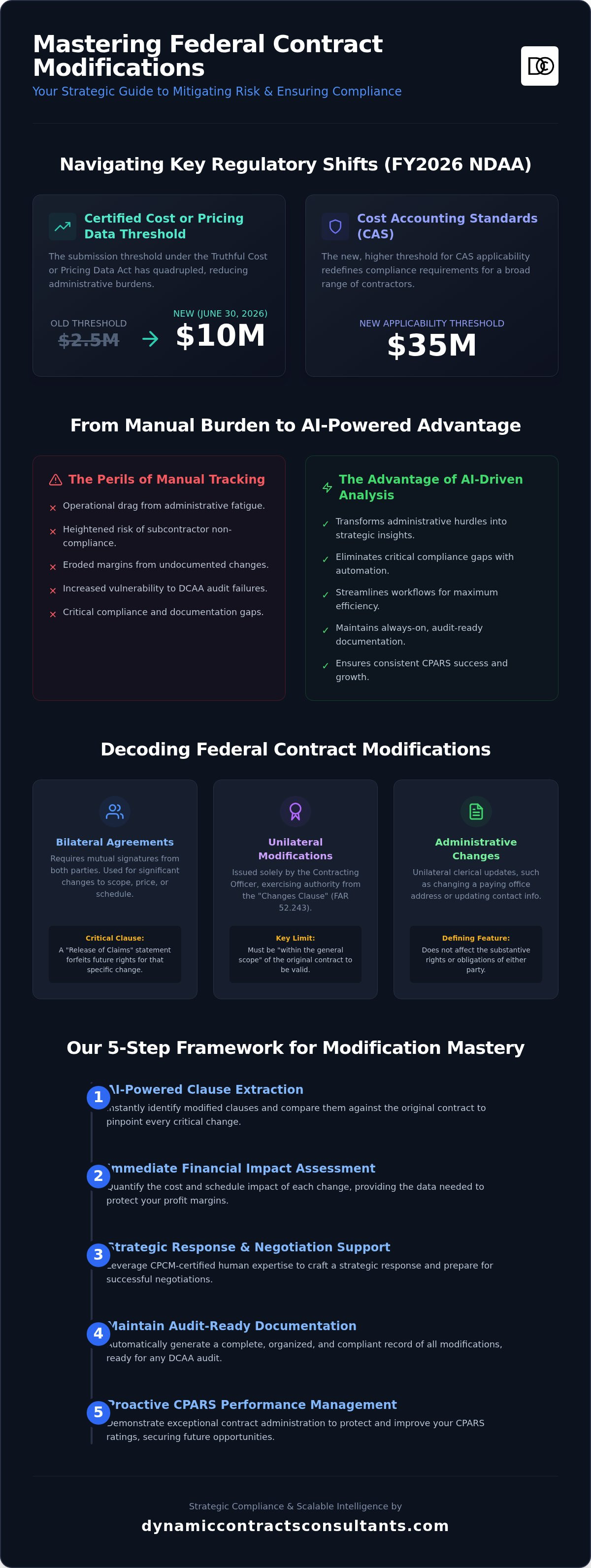
Did you know that as of June 30, 2026, the threshold for certified cost or pricing data under the Truthful Cost or Pricing Data Act has surged from $2.5 million to $10 million? While these legislative shifts in the FY2026 NDAA aim to reduce regulatory burdens, they also introduce new complexities for firms managing federal contract modifications in an increasingly volatile market. We recognize that the administrative fatigue resulting from manual clause extraction and the fear of unilateral changes impacting your margins are significant burdens on your operational efficiency.
We agree that maintaining a competitive edge shouldn't require sacrificing your peace of mind to the risk of subcontractor non-compliance or DCAA audit failures. You deserve a system that transforms these administrative hurdles into strategic advantages. Our guide promises to help you master the intricacies of FAR Part 43 to mitigate performance risk and ensure your documentation is always audit-ready. We'll examine a streamlined workflow for modification analysis, discuss the impact of the new $35 million Cost Accounting Standards threshold, and provide the tools necessary for consistent CPARS success.
Key Takeaways
- Understand the fundamental regulatory framework of FAR Part 43 and how the "Changes Clause" governs the government’s authority to modify your contract terms.
- Distinguish between bilateral supplemental agreements and unilateral modifications to effectively protect your profit margins and negotiate scope changes.
- Learn how we optimize the process of managing federal contract modifications by replacing manual tracking with AI-driven analysis to eliminate critical compliance gaps.
- Implement a structured 5-step framework for immediate clause extraction and financial impact assessment to maintain audit-ready documentation for CPARS success.
- Discover how blending CPCM-certified human expertise with revolutionary technology ensures your post-award administration remains compliant with the latest 2026 regulatory thresholds.
The Regulatory Landscape of Federal Contract Modifications
In the complex environment of government procurement, a contract modification is defined as any written change to the terms, scope, or price of an existing agreement. For prime contractors, effectively managing federal contract modifications is a strategic necessity rather than a simple clerical task. The cornerstone of this process is the 'Changes Clause' (FAR 52.243), which provides the government with the unique authority to direct changes within the general scope of the contract. Understanding the Regulatory Landscape of Federal Contract Modifications is vital because, under the legal doctrine of privity, you remain solely liable to the government for all performance obligations. This liability persists even when modifications impact your subcontractors' ability to deliver. We've found that proactive management is essential for maintaining a positive CPARS rating, as it demonstrates your ability to navigate shifting requirements while protecting the government's interests.
The Doctrine of Scope and Authority
A critical challenge in contract administration involves distinguishing between 'within-scope' modifications and 'cardinal changes.' A within-scope change is one that potential bidders could've reasonably anticipated during the original competition. Conversely, a cardinal change is so significant that it fundamentally alters the contract's nature, often requiring a completely new procurement process. You must also verify who possesses the actual authority to bind the government. While a Contracting Officer's Representative (COR) often provides technical guidance, only a warranted Contracting Officer (CO) holds the legal power to authorize modifications. The 'Changes Clause' serves as the mechanism that allows the government to issue unilateral directives for work within the contract's general scope.
FAR Part 43 vs. FAR Part 12 Requirements
The rules governing modifications shift significantly depending on whether your contract follows standard acquisition procedures or commercial item acquisitions. Under FAR Part 43, the government retains broad power to issue unilateral changes for specific requirements like shipping or packaging. In contrast, FAR Part 12, which governs commercial items, operates more like traditional B2B agreements and generally requires a bilateral agreement for any changes to terms and conditions. We integrate these critical distinctions into our post-award contract administration frameworks to ensure you don't inadvertently accept a change that exceeds your commercial risk profile. By aligning your internal workflows with these specific FAR requirements, we help you maintain operational efficiency while securing your long-term success.
Categorizing Modifications: Bilateral, Unilateral, and Administrative
Effective oversight begins with Categorizing Modifications: Bilateral, Unilateral, and Administrative correctly. Administrative changes are issued unilaterally by the Contracting Officer to update clerical details, such as a paying office address, without affecting the substantive rights of either party. We've observed that the most significant risks often stem from "constructive changes." These occur when informal directives from government personnel lead to increased costs without a formal modification document. If you don't document these interactions precisely, you're essentially performing unfunded work. Managing federal contract modifications effectively means identifying these shifts in real time to protect your revenue.
Bilateral Supplemental Agreements
Bilateral modifications, or supplemental agreements, require mutual signatures from both you and the Contracting Officer. These are typically used to negotiate price adjustments, schedule shifts, or changes to the statement of work. When we assist clients in these negotiations, we emphasize the "Release of Claims" statement. This clause is a legal waiver. Once you sign it, you generally forfeit the right to seek further compensation for that specific change. It's vital to ensure all technical and financial impacts are captured in a single, audit-ready document before finalizing the agreement.
Managing Unilateral Change Orders
Unilateral modifications are issued solely by the government. They are often used for administrative updates or to exercise contract options. Under the "Changes Clause," the government can also issue a change order that directs you to start new work before a price is settled. You have a mandatory duty to proceed with the work once directed. However, you must assert your right to a claim for equitable adjustment (REA) within a 30-day window. We utilize DCAA compliance consulting to perform rigorous cost-impact analyses during this period. This ensures that every dollar of increased performance cost is accounted for and defensible. If the complexity of these classifications feels overwhelming, you can consult with our strategic partners to safeguard your contract's profitability.
The Compliance Gap: Manual Tracking vs. AI-Powered Analysis
Traditional contract administration often relies on manual spreadsheets and human memory. This approach creates a dangerous compliance gap. In 2026, the sheer volume of regulatory shifts makes manual oversight a liability rather than a standard practice. Managing federal contract modifications requires a transition from clerical checklists to scalable intelligence. We've seen how administrative fatigue leads to inconsistent clause extraction, where critical nuances in a 100-page modification are simply overlooked. Our approach replaces these outdated methods with AI-driven automation, ensuring that every change is captured without the errors inherent in manual review.
The High Cost of Administrative Error
Missed deadlines are just the beginning of the risks associated with manual tracking. When you fail to extract a new clause or a revised flow-down requirement, the ripples affect your entire supply chain. Subcontractor non-compliance often stems directly from the prime contractor's failure to communicate updated terms. This oversight inevitably leads to negative DCAA audit findings and jeopardizes your reputation. Beyond compliance, slow modification processing stalls project cash flow and creates friction with government stakeholders. We provide specialized compliance support to bridge this gap, protecting your operational efficiency and your bottom line.
Leveraging FARIFY for Real-Time Clause Extraction
Our proprietary platform, FARIFY, represents a paradigm shift in how we navigate The Regulatory Landscape of Federal Contract Modifications. Instead of your team spending days manually reviewing a complex document, our AI analyzes it in minutes. It identifies new FAR/DFARS triggers and generates precise compliance matrices that track changes across the entire procurement lifecycle. This isn't just about speed; it's about the precision required for strategic compliance. We maintain a 'Human-in-the-Loop' assurance model where our CFCM-certified experts verify AI outputs to ensure absolute accuracy.
This hybrid model allows us to deliver audit-ready documentation that simplifies the contract closeout process. By utilizing scalable intelligence, you can manage a higher volume of modifications with fewer administrative resources. The result is a more resilient project framework where every change is documented, every cost impact is analyzed, and every regulatory requirement is met. You don't have to choose between speed and accuracy when you have the right technology and expertise on your side.
A 5-Step Framework for Managing Contract Modifications
Success in the post-award environment depends on a disciplined, repeatable process. We recommend a 5-step framework for managing federal contract modifications to ensure your operational efficiency remains intact while regulatory risks are minimized. This structured approach moves beyond simple reaction to proactive strategy:
- Step 1: Immediate Clause Extraction and Impact Assessment using AI-driven tools like FARIFY.
- Step 2: Rigorous Technical and Financial Analysis of the proposed change in scope.
- Step 3: Strategic Negotiation and Execution of the formal modification document.
- Step 4: Comprehensive Flow-Down Implementation to all affected subcontractors and vendors.
- Step 5: Continuous Post-Award Monitoring and Audit-Ready Record Retention for CPARS success.
Phase 1: Impact Analysis and Negotiation
When a modification is proposed, you must evaluate its alignment with your original capture plan. It's not just about the immediate task; it's about how the change affects your long-term resource allocation and past performance record. For modifications exceeding the $10 million threshold for contracts entered after June 30, 2026, you'll need to provide certified cost or pricing data under the Truthful Cost or Pricing Data Act. Before signing, we advise using a checklist to verify the Contracting Officer's actual authority. Don't rely on a COR's verbal request; it isn't a binding modification and can lead to unrecoverable costs.
Phase 2: Subcontractor Flow-Down Management
The moment you execute a prime modification, your procurement team must update every affected subcontract agreement. This isn't a suggestion. Failing to flow down modifications can result in the prime assuming 100% of the risk for subcontractor non-performance or non-compliance. This is particularly critical for cybersecurity updates and revised delivery schedules. We've designed our post-award compliance services to manage these complex vendor tiers, ensuring your entire supply chain remains synchronized with the prime contract's requirements. We help you avoid the common pitfall of assuming subcontractor compliance without formal, written flow-down documentation.
Strategic compliance requires a partner who understands both the regulatory burden and the technology needed to solve it. Contact our expert consultants today to implement this 5-step framework and protect your contract margins.
Securing Your Performance with Dynamic Contracts Consultants LLC
We believe that managing federal contract modifications shouldn't be a source of operational friction or financial risk. Our methodology at Dynamic Contracts Consultants LLC blends CPCM-certified expertise with revolutionary AI technology to transform compliance from a burden into a competitive asset. We've successfully managed high-stakes modifications for major agencies, including the DoD, State Department, and EPA. This track record ensures that every change order we process strengthens your federal portfolio rather than weakening your margins. By de-risking your contract actions, we help you improve long-term win-rates and maintain the high CPARS ratings necessary for sustained growth in a volatile market.
Expert Oversight for Complex Federal Regulations
Our team at Dynamic Contracts Consultants LLC holds the industry's most respected credentials, including CFCM and CCCM-NCMA certifications. These qualifications allow us to provide simple solutions to complex problems within the federal acquisition system. We navigate the labyrinth of FAR and DFARS requirements so your internal teams can focus on mission delivery. As a minority-owned small business, Dynamic Contracts Consultants LLC also offers a strategic advantage for prime contractors seeking to meet diversity participation goals. We position ourselves as your strategic partner, ensuring that every administrative step is backed by disciplined analysis and professional authority.
The Future of Audit-Ready Administration
The 2026 regulatory environment demands more than just clerical accuracy when managing federal contract modifications; it requires scalable intelligence. Our AI-driven approach ensures precision in every contract action, from real-time clause extraction to the generation of audit-ready documentation. By establishing a strategic partnership with Dynamic Contracts Consultants LLC, you gain a dedicated team that manages the full procurement lifecycle. This comprehensive support allows you to scale your operations without the typical overhead associated with high-volume contract administration. We've designed our services to be both technical and accessible, focusing on the practical outcomes that drive your business success.
We invite you to experience a customized compliance assessment for your existing contract portfolio. This assessment will identify potential gaps in your modification tracking and provide a roadmap for digital transformation. You can contact us today to schedule a demonstration of the FARIFY platform. Let us show you how our human-in-the-loop assurance model can secure your performance and protect your revenue for years to come.
Future-Proofing Your Post-Award Strategy
The 2026 regulatory environment leaves no room for administrative error, especially as agencies face increased pressure to reduce federal spending. We've explored how transitioning from manual tracking to AI-driven automation is no longer optional for firms seeking to protect their margins. By adopting a structured 5-step framework, you ensure that every scope change is analyzed, documented, and flowed down to your subcontractors with total precision. Mastering the complexities of FAR Part 43 is the definitive way to maintain your competitive edge and secure a superior CPARS rating.
Our team at Dynamic Contracts Consultants LLC brings prime contractor experience with the DoD and NOAA, providing you with the human-in-the-loop assurance necessary for high-stakes environments. We combine this field-tested knowledge with our FARIFY platform for rapid, AI-powered FAR/DFARS compliance extraction. When you partner with our CPCM-certified contract administration specialists, you're not just managing federal contract modifications; you're building a resilient, audit-ready procurement lifecycle.
Streamline your modification management; contact our experts today. We're ready to help you navigate these complexities and turn regulatory hurdles into strategic growth opportunities. Your long-term success in the federal marketplace starts with a commitment to operational excellence and strategic compliance.
Frequently Asked Questions
What is the difference between a change order and a supplemental agreement?
A change order is a unilateral modification issued by the Contracting Officer under the "Changes" clause, whereas a supplemental agreement is a bilateral modification signed by both parties. Change orders are typically used for administrative or technical adjustments within the contract scope. Supplemental agreements are used to negotiate changes to price, schedule, or work requirements. We recommend documenting all verbal directives to prevent constructive change disputes later.
Can the government unilaterally change the price of my contract?
The government cannot unilaterally change the contract price unless specific clauses allow for price adjustments following a change order. While a Contracting Officer can direct work changes, they must eventually negotiate a fair price adjustment with you. If an agreement isn't reached, you must file a Request for Equitable Adjustment (REA). Managing federal contract modifications requires tracking these costs immediately to ensure full recovery during negotiations.
What happens if I refuse to perform work under a unilateral modification?
Refusing to perform work directed by a valid unilateral modification can lead to a termination for default. Under the standard "Disputes" clause, you're required to proceed with performance while any claim or dispute is being resolved. Failure to comply can severely damage your CPARS rating and jeopardize future awards. We help you document the impact while maintaining performance to protect your legal standing and project revenue.
How does the 'Christian Doctrine' apply to contract modifications?
The Christian Doctrine holds that certain mandatory FAR clauses are considered part of a federal contract even if they're physically absent. In the context of modifications, this means a court may read a required clause into your contract as if it were there from day one. This underscores why you must verify all flow-down requirements during the modification process. Our AI tools identify these missing regulatory triggers to ensure your documentation remains audit-ready.
Are prime contractors required to flow down all modifications to subcontractors?
You must flow down any modification that affects a subcontractor's scope of work, schedule, or compliance obligations. Failure to do so means you're assuming 100% of the risk for their non-performance or regulatory violations. This is especially critical for cybersecurity requirements like NIST SP 800-171. Managing federal contract modifications effectively involves updating every subcontract agreement simultaneously to ensure your entire supply chain remains synchronized and compliant with the prime contract.
What is an Equitable Adjustment (REA) and when should I file one?
A Request for Equitable Adjustment (REA) is a formal proposal seeking more time or money due to government-directed changes. You should file an REA when a unilateral change order or a constructive change increases your performance costs. Typically, you have a 30-day window to assert your right to an adjustment after receiving a change order. Our experts provide the financial analysis needed to make these requests defensible and successful.
How does DCAA verify modification compliance during an audit?
DCAA auditors examine your accounting system to ensure costs related to modifications are segregated and properly allocated. They verify that any certified cost or pricing data provided for mods exceeding the $10 million threshold is accurate and complete. Auditors also look for evidence that flow-down clauses were properly managed. We provide DCAA compliance consulting to ensure your records are structured correctly for a seamless and successful audit experience.
What is the best way to track modifications across a multi-year federal contract?
The most efficient method involves using an AI-powered platform like FARIFY to automate clause extraction and milestone tracking. Manual spreadsheets are prone to human error and missed deadlines over long performance periods. Our system generates compliance matrices that evolve with every modification, providing a real-time view of your obligations. This ensures your documentation is always organized, making the final contract closeout process significantly faster and less stressful for your team.


