

The 2026 federal procurement landscape is no longer accessible to firms relying on legacy bidding strategies or manual compliance checks. As the Revolutionary FAR Overhaul streamlines acquisition, knowing how to win a government contract requires a sophisticated integration of strategic capture management and automated precision. We recognize that the escalating costs of proposal development and the rigorous demands of DFARS compliance create significant barriers for even the most capable organizations. The risk of post-award audit failure remains a constant concern for leadership teams seeking to scale within the federal sector.
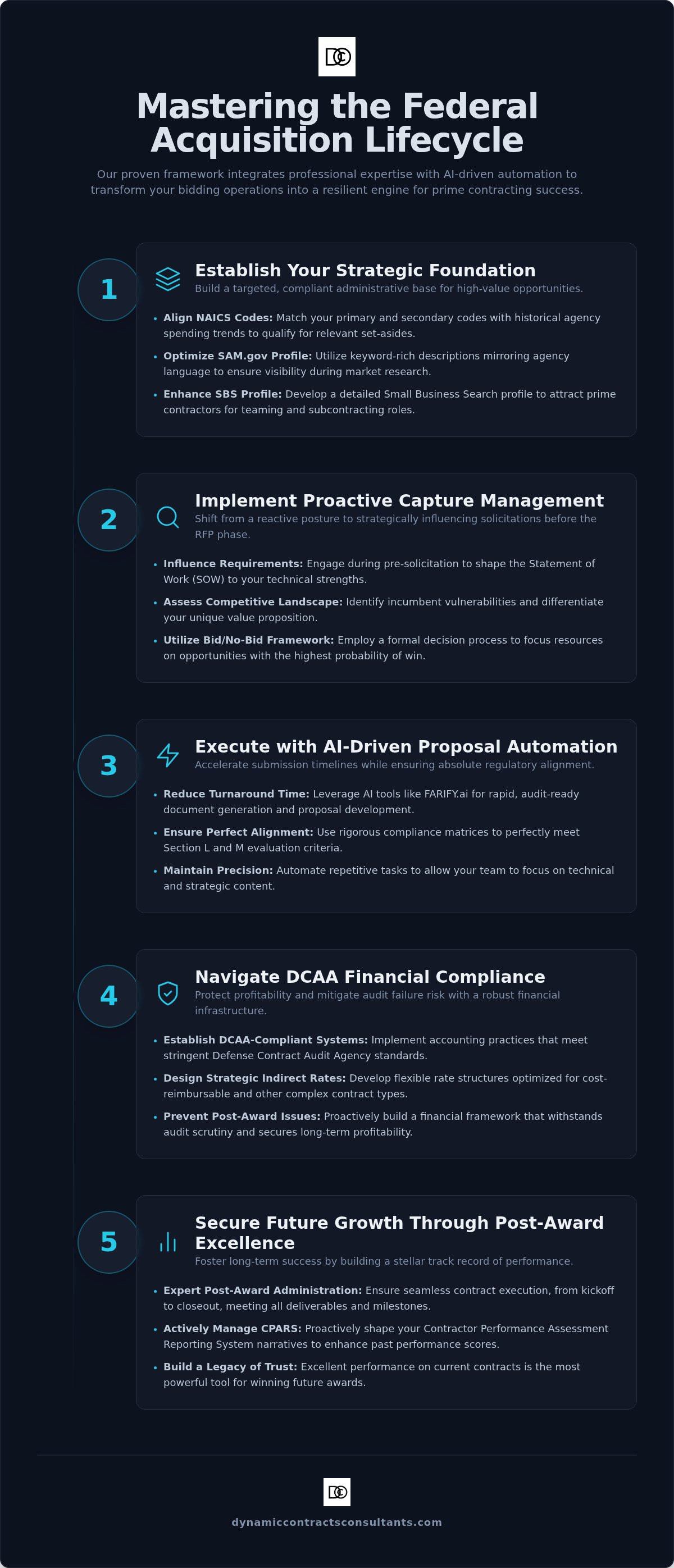
In this strategic guide, we'll demonstrate how to master the federal acquisition lifecycle through our proven framework of professional expertise and AI-driven automation. You'll learn to implement a repeatable capture process that reduces turnaround time while maintaining absolute regulatory alignment. We'll explore the deployment of FARIFY.ai for rapid, audit-ready document generation and illustrate how to build a DCAA-compliant financial infrastructure. By applying our simple solutions to complex problems, you'll possess the tactical roadmap necessary to transform your bidding operations into a resilient engine for long-term prime contracting success.
Key Takeaways
- Align your NAICS codes with agency spending to build a targeted administrative foundation for high-value federal opportunities.
- Master how to win a government contract by adopting our proactive capture management model to influence solicitations well before the RFP phase.
- Accelerate your submission timelines using AI-driven automation and rigorous compliance matrices that align perfectly with Section L and M requirements.
- Protect your profitability by establishing DCAA-compliant accounting systems and strategic indirect rate structures designed for cost-reimbursable contracts.
- Foster long-term growth through expert post-award administration and the active management of CPARS narratives to enhance your past performance.
Establishing Your Strategic Foundation for Federal Acquisitions
Success in the federal market isn't accidental; it's the result of rigorous administrative alignment. Before you can execute a bid, your organization must be visible and compliant within the U.S. government procurement process. This begins with identifying your primary and secondary North American Industry Classification System (NAICS) codes. These codes don't just categorize your business; they determine which set-aside opportunities you qualify for and which agencies will view you as a viable partner. We recommend a deep analysis of historical agency spending to ensure your codes align with current procurement trends, especially following the 2026 SBA overhaul of size standards which significantly increased revenue caps for many industries.
Beyond NAICS, your Unique Entity Identifier (UEI) and Commercial and Government Entity (CAGE) code are the essential keys to the System for Award Management (SAM.gov). However, a simple registration isn't enough to understand how to win a government contract in a competitive environment. You must also develop a robust Small Business Search (SBS) profile. This secondary profile acts as your digital capability statement, allowing prime contractors to find you for vital subcontracting roles. We've seen that firms with detailed, capability-focused SBS profiles attract significantly more teaming inquiries than those with generic registrations.
Navigating the System for Award Management (SAM)
Your SAM profile shouldn't be a static document. We emphasize the use of keyword-rich descriptions that mirror the technical language used in agency requirements. If your profile lacks specific industry terminology, you'll remain invisible during the initial market research phases. Maintaining an active status is non-negotiable; even a minor lapse can lead to procurement delays or disqualification from an active solicitation. We often link this foundational data to our acquisition planning services to ensure your digital presence supports your long-term growth objectives and scalable intelligence goals.
Identifying High-Value Prime and Subcontracting Opportunities
Strategic growth often requires a phased approach. While prime contracts offer higher visibility, teaming agreements allow you to build essential past performance credit without the full administrative burden of lead management. We analyze expiring contracts to help you anticipate upcoming solicitations months before they hit the public portal. This is especially critical for acquisitions under the $350,000 Simplified Acquisition Threshold (SAT), where speed is a primary factor. Leveraging minority-owned and small business set-asides provides a distinct competitive advantage. These designations aren't just labels; they're strategic entry points that limit competition and increase your probability of win. Our focus remains on showing you how to win a government contract by building a foundation that agency buyers can trust.
Advanced Capture Management and the Bid/No-Bid Framework
Transitioning from a reactive to a proactive posture is the defining characteristic of elite federal contractors. Most firms wait for the Request for Proposal (RFP) to appear on SAM.gov, but by then, the competitive advantage has often vanished. Realizing how to win a government contract involves engaging in capture planning months before a solicitation is public. We work with you to influence the Statement of Work (SOW) during the pre-solicitation and synopsis phases. This allows your specific technical strengths to be reflected in the requirement's language, effectively narrowing the field of viable competitors. The SBA guide to winning contracts outlines the importance of market research, but we take this further by assessing the specific technical pain points of agency decision-makers.
You must determine your unique value proposition relative to the incumbent and other likely bidders. This requires a deep assessment of the competitive landscape to identify where their past performance might be vulnerable or where their pricing structures lack flexibility.
The Strategic Capture Planning Process
A formal capture plan serves as your tactical blueprint for the procurement lifecycle. We identify the key influencers and technical stakeholders who shape the agency's acquisition strategy. Our process includes a rigorous gap analysis to determine where your internal capabilities might fall short of the technical requirements. To address these gaps, we help you establish teaming agreements that enhance your technical volume and past performance score. Learn more about our strategic capture management services to see how we transform raw data into actionable win strategies.
Implementing a Data-Driven Bid/No-Bid Decision Model
Resources are finite, and pursuing the wrong opportunity is a costly drain on your operational efficiency. We implement a rigorous bid/no-bid analysis to protect your ROI and focus your efforts on high-probability wins. This model evaluates opportunities based on technical fit, past performance relevance, and financial feasibility. By using AI-generated acquisition planning, we rapidly assess risk factors that manual reviews might overlook. You can explore our detailed methodology in The Bid/No-Bid Analysis Decision Framework. Our goal is to ensure that every proposal you submit is backed by a data-driven justification. If the risk profile doesn't align with your growth strategy, we provide the clarity needed to walk away and wait for a superior fit. If you're ready to refine your selection process, consult with our capture specialists today.
Executing a High-Impact Proposal Development Lifecycle
Once the capture phase has identified a high-probability opportunity, the focus shifts to the rigorous execution of the proposal development lifecycle. This stage is where your strategic vision is translated into a technical and cost volume that leaves no room for ambiguity. We've found that the most successful contractors don't just write; they architect their responses around the specific requirements of Section L and Section M. Understanding how to win a government contract means recognizing that compliance is the baseline for entry. If your proposal fails to address a single sub-factor in the evaluation criteria, it's likely to be deemed non-responsive regardless of your technical merit.
Our process begins with the extraction of all RFP requirements to create a robust compliance matrix. This document serves as the backbone of the entire response, mapping every agency demand to a specific paragraph in your proposal. We utilize this matrix to guide our drafting, ensuring that the technical volume speaks directly to the agency's pain points while adhering to the strict formatting and submission guidelines provided in the solicitation.
AI-Driven Automation in Proposal Writing
The speed of modern procurement demands a shift toward scalable intelligence. We leverage FARIFY.ai to generate compliant solicitation responses in minutes; this allows your technical experts to focus on high-level strategy rather than administrative drafting. By using customized proposal templates, we maintain brand consistency and technical rigor across all volumes. It's not about replacing human insight; it's about augmenting it with AI-driven automation to ensure operational efficiency. Explore our professional proposal writing services to see how we combine cutting-edge technology with seasoned expertise.
Ensuring Compliance Matrix Accuracy
Precision is maintained through a structured "Color Team" review process. Red Team reviews focus on the overall win theme and technical accuracy, while Gold Team reviews ensure the final document is polished and ready for submission. We also incorporate human-in-the-loop quality control to verify adherence to all flow-down clauses and procurement integrity standards. During the cost volume development, it's vital to reference official DCAA audit checklists to ensure your financial projections are audit-ready. This rigorous approach mitigates the risk of post-award disputes and establishes your firm as a reliable partner capable of long-term growth.
Navigating Financial Compliance and DCAA Audit Scrutiny
Financial rigor is the bedrock of federal prime contracting. While technical excellence is required, your ability to manage public funds determines your long-term eligibility. You must establish a DCAA-compliant accounting system before you even consider pursuing cost-reimbursable contracts. This is a critical step in understanding how to win a government contract that offers scalable growth. Many firms fail because their internal systems cannot withstand the scrutiny of a pre-award survey, such as the SF 1408. We provide the strategic compliance frameworks necessary to ensure your records are tamper-proof and fully integrated across payroll and ERP systems. We focus on the financial mechanics of how to win a government contract through rigorous cost accounting that aligns with the latest FAR/DFARS reporting requirements.
Preparation for DCAA Audit Scrutiny
The Defense Contract Audit Agency (DCAA) has modernized its approach in 2026. It now utilizes a three-tier system for classifying findings, ranging from material weaknesses to less-than-material noncompliance. We help you implement rigorous internal controls for labor charging and indirect cost allocation to mitigate these risks. Our team conducts pre-audit gap analyses to identify financial vulnerabilities before they become liabilities during a formal review. You can find more details in our guide on DCAA Compliance Consulting: A Strategic Framework for 2026. Precise record-keeping isn't just about compliance; it's about protecting your reputation. DCAA audits in 2026 place greater emphasis on Total Time Accounting, requiring complete digital audit trails for every labor hour tracked on a project.
Strategic Indirect Rate Consulting
Your pricing must be competitive yet profitable to ensure long-term operational efficiency. We analyze your fringe, overhead, and general and administrative (G&A) rates to optimize your cost proposal for Section L and M requirements. Utilizing AI-generated financial analysis allows us to forecast project profitability with high-impact precision, ensuring that your bid remains sustainable over the entire procurement lifecycle. This level of scalable intelligence ensures you aren't underbidding at the expense of your company's growth. Maintaining audit-ready records throughout the contract lifecycle is a continuous obligation. If you're seeking to fortify your financial infrastructure and ensure your business systems are fully integrated, contact our DCAA compliance specialists to secure your audit-ready status today.
Securing Future Awards through Post-Award Compliance Excellence
The award notification is a strategic milestone, not the finish line. We've seen many contractors focus so heavily on the bid that they neglect the administrative rigor required during execution. If you want to understand how to win a government contract consistently, you must prioritize your past performance record. The Contractor Performance Assessment Reporting System (CPARS) is the primary mechanism agencies use to evaluate your reliability for future solicitations. Your performance on the current contract is the most persuasive evidence you can provide in your next technical volume.
Managing operational risk during the period of performance requires strict adherence to the Procurement Integrity Act, especially during contract modifications. We ensure that every change order is documented and compliant with FAR regulations to prevent scope creep or unauthorized commitments. A standardized contract closeout process further reinforces agency trust; it ensures all deliverables are met and final payments are processed without administrative friction. This disciplined approach protects your margins and strengthens your standing with the contracting officer.
CPARS Narrative Support and Risk Management
Your CPARS rating is your most valuable asset in the federal marketplace. We help you document performance milestones proactively, providing the government's Contracting Officer Representative (COR) with the data they need to draft positive appraisals. Don't wait for a negative report to react. We address performance discrepancies immediately through formal communication, protecting your future win rate from the impact of a sub-par narrative. Professional post-award compliance and administration ensures your team remains focused on delivery while we handle the regulatory burden of performance tracking.
Comprehensive Contract Administration
Operational efficiency post-award depends on tracking deliverables and milestones with absolute precision. We utilize automated compliance tracking to ensure no deadline is missed and no clause is overlooked. This includes managing flow-down clauses for your subcontractors, which is a vital part of maintaining your small business participation goals and ensuring your entire supply chain meets federal standards. Failure to monitor your subs can lead to significant compliance gaps, financial penalties, and damage to your reputation. Our Guide to Post-Award Contract Administration provides a deeper dive into these technical requirements. By executing with excellence, you're not just finishing a project; you're actively demonstrating how to win a government contract for years to come through a legacy of reliability and strategic compliance.
Achieving Scalable Growth in the 2026 Federal Market
Success in the modern federal sector demands a transition from reactive bidding to a model of scalable intelligence. We've established that how to win a government contract in 2026 requires a rigorous focus on the entire procurement lifecycle; from proactive capture management to post-award administrative excellence. By integrating our proven prime contractor track record with AI-powered speed via FARIFY, your organization can submit technically superior bids that withstand the most intense regulatory scrutiny. Our DCAA audit-ready assurance ensures that your financial infrastructure remains a competitive asset rather than a liability.
We're committed to your long-term success as a strategic partner. You possess the roadmap to navigate complex FAR/DFARS requirements and influence agency decision-making through data-driven precision. It's time to transform your procurement operations into a repeatable engine for growth. Leverage our expert insights for your business growth; contact Dynamic Contracts Consultants LLC today to secure your position as a leader in federal contracting. We look forward to building your legacy of compliance and performance.
Frequently Asked Questions
What is the first step to winning a government contract?
The foundational first step in how to win a government contract is completing your registration in the System for Award Management (SAM.gov) and identifying your primary NAICS codes. You must also secure your Unique Entity Identifier (UEI) and CAGE code to establish federal eligibility. We recommend performing deep market research to align your codes with agency spending patterns. This administrative alignment ensures your organization is visible to contracting officers during the initial market research phase.
How long does it typically take to win a federal contract?
The timeline for securing a federal award typically ranges from six to eighteen months, depending on your industry and the procurement method used. Simplified acquisitions move faster than large-scale competitive solicitations, which involve complex evaluation cycles. We emphasize that winning is a lifecycle process, not a single event. Consistent capture management and building a past performance record are essential for reducing the time between your initial registration and your first prime contract award.
Do I need a DCAA-compliant accounting system for all contracts?
You don't need a DCAA-compliant accounting system for firm-fixed-price contracts, but it's mandatory for cost-reimbursable awards. We advise establishing these systems early if you intend to pursue complex Department of Defense or Department of State opportunities. Having a compliant system in place serves as a significant differentiator during the pre-award survey phase. It demonstrates your organization's financial rigor and readiness to manage public funds according to strict federal cost accounting standards.
How does FARIFY.ai accelerate the proposal writing process?
FARIFY.ai utilizes AI-driven automation to generate audit-ready solicitation responses, PWS, and SOW documents in minutes rather than days. It extracts RFP requirements with precision to build robust compliance matrices, allowing your technical experts to focus on win themes. We combine this technology with human-in-the-loop assurance to maintain the highest regulatory standards. This scalable intelligence significantly reduces proposal development costs while ensuring your submissions align perfectly with Section L and Section M criteria.
Can a small business compete with large incumbents for prime contracts?
Small businesses successfully compete for prime contracts by leveraging socioeconomic set-aside programs and strategic teaming agreements. Agencies have an annual goal to award 23% of prime contract dollars to small businesses, creating a shielded competitive environment. We help you identify these set-asides to limit the field of competitors. By acting as a prime contractor on smaller efforts, you build the past performance record necessary to eventually challenge larger incumbents on high-value requirements.
What is a compliance matrix and why is it essential?
A compliance matrix is a technical document that maps every RFP requirement to a specific paragraph in your proposal. It's essential because it ensures your response is 100% compliant and responsive to the government's needs. We use this matrix to guide our "Color Team" reviews and verify that no technical or administrative sub-factor is overlooked. This rigorous mapping process minimizes the risk of being deemed non-responsive during the initial evaluation phase.
How do I improve my CPARS rating after winning a contract?
Improving your CPARS rating requires proactive documentation of performance milestones and frequent communication with your Contracting Officer Representative (COR). You should provide the government with data-driven narratives that highlight your operational efficiency and technical excellence throughout the contract lifecycle. We assist you in addressing any performance discrepancies immediately to prevent negative appraisals. Maintaining a stellar past performance record is the most effective strategy for securing future awards in the federal marketplace.
What are the most common reasons for losing a government bid?
Most contractors lose bids due to administrative non-compliance, insufficient past performance relevance, or a failure to demonstrate cost realism. If your technical volume doesn't speak directly to the Section M evaluation criteria, you won't survive the initial cut. We help you implement a rigorous bid/no-bid analysis to avoid pursuing opportunities where your risk profile is too high. Mastering how to win a government contract involves recognizing that even minor formatting errors can lead to immediate disqualification.


