

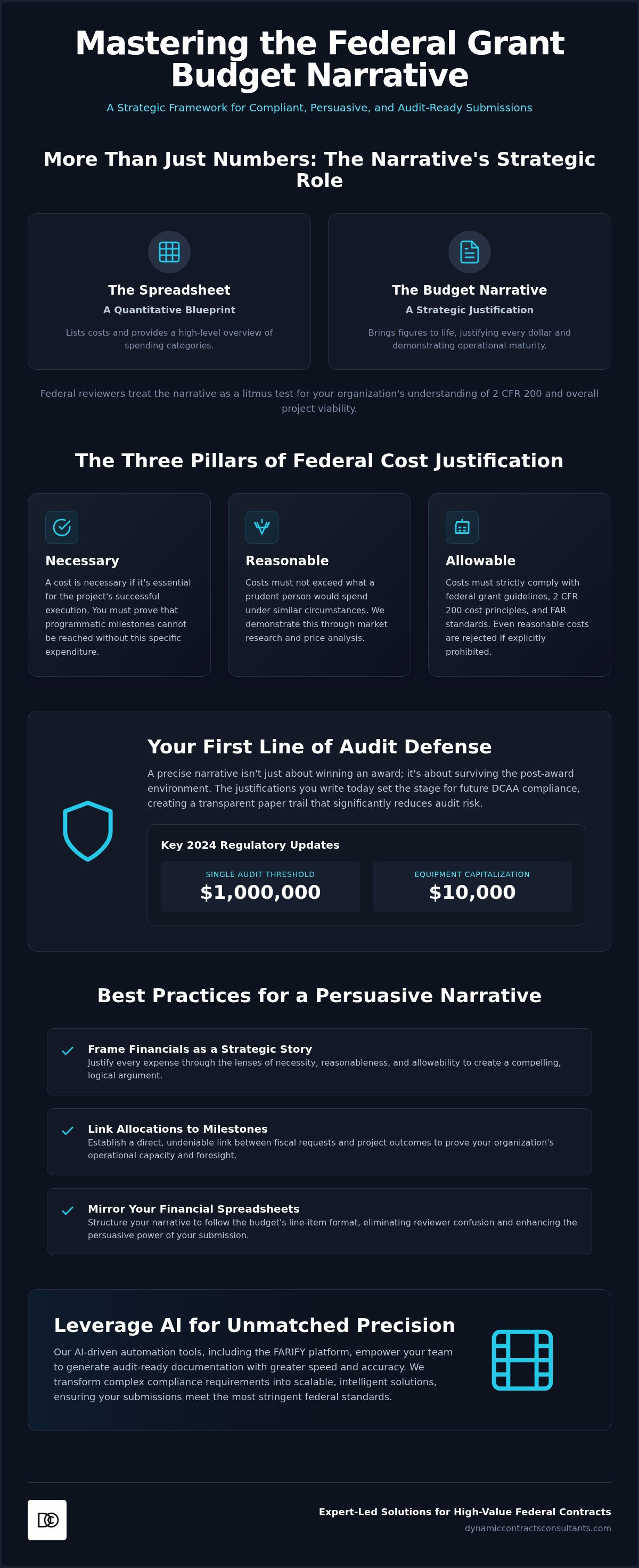
A federal grant budget narrative is not merely a financial disclosure; it is the primary instrument for preemptive audit defense and the most critical component of your project's strategic justification. While many organizations view the budget as a secondary attachment, federal reviewers treat it as a litmus test for your operational maturity and understanding of 2 CFR 200. We recognize the significant pressure you face when justifying costs, especially with the 2024 updates that increased the single audit threshold to $1,000,000 and the equipment capitalization threshold to $10,000. Balancing these technical requirements with compelling storytelling is often the difference between a successful award and a costly rejection.
We've developed this expert framework to help you master the nuances of financial justification, ensuring your narratives are both compliant and persuasive. You'll gain a clear roadmap for drafting documents that satisfy DCAA standards while directly linking every dollar to your programmatic goals. This guide provides a detailed analysis of the current regulatory environment, offering the strategic intelligence necessary to increase your win-rates for high-value federal contracts. We'll examine the essential steps to transform your financial data into a robust, audit-ready narrative that inspires confidence in federal agencies.
Key Takeaways
- Learn to frame your financial data as a strategic story that justifies every expense through the lenses of necessity, reasonableness, and allowability.
- Establish a direct link between fiscal allocations and project milestones to produce a federal grant budget narrative that proves your organization's operational capacity.
- Navigate the complexities of FAR and DCAA standards to ensure your cost accounting practices meet the most stringent federal compliance requirements.
- Leverage AI-driven automation and our FARIFY platform to generate audit-ready documentation with greater precision and speed.
- Adopt drafting best practices that mirror your financial spreadsheets to eliminate reviewer confusion and enhance the persuasive power of your submission.
Defining the Federal Grant Budget Narrative: Strategic Context
The budget spreadsheet is a quantitative blueprint, but the federal grant budget narrative serves as the strategic script that brings those figures to life. While the spreadsheet lists costs, the narrative provides the qualitative justification required to convince federal reviewers that your proposed spending is a sound investment. To understand the broader context of these financial vehicles, one might ask, What is a Grant? At its core, it's a non-repayable fund disbursed by one party to a recipient, often a government department or foundation, for a specific purpose. In the federal arena, your narrative is where you demonstrate that purpose is being met with maximum fiscal efficiency.
Reviewers prioritize the narrative during the scoring process because it reveals your organization's operational maturity. A budget summary provides a high-level overview of categories, but the detailed narrative drills down into the who, what, when, where, and why of every dollar. If your narrative fails to provide a logical bridge between your programmatic activities and your financial requests, your proposal's overall credibility suffers. We see many applicants fail because they treat the narrative as an afterthought rather than the cornerstone of their technical approach.
The Three Pillars of Federal Budgeting: Necessary, Reasonable, and Allowable
We focus on three fundamental criteria that dictate whether a cost is acceptable under federal standards. First, a cost is Necessary if it's essential for the project's successful execution. You must prove that the project cannot reach its milestones without this specific expenditure. Second, Reasonable costs are those that don't exceed what a prudent person would spend under similar circumstances. We demonstrate this through market research or price analysis, often referencing current thresholds like the $15,000 micro-purchase limit to justify pricing strategies. Finally, Allowable costs must comply with specific federal grant guidelines and FAR standards. Even a reasonable cost is rejected if it's explicitly prohibited by the funding agency's regulations or 2 CFR 200 cost principles.
Why the Narrative is Your First Line of Audit Defense
Drafting a precise narrative isn't just about winning the award; it's about surviving the post-award environment. The justifications you write today set the stage for future DCAA compliance. When auditors review your books, they look back at the federal grant budget narrative to understand the original intent behind the spending. Clear, detailed documentation at the proposal stage significantly reduces audit risk by providing a transparent paper trail. We specialize in strategic compliance, ensuring that your narrative is built on a foundation of regulatory precision from day one. This proactive approach protects your organization from the severe penalties associated with non-compliant financial reporting and ensures you're ready for the scrutiny of a federal audit.
Aligning Financial Justification with Programmatic Impact
A successful proposal requires more than just accurate arithmetic. It demands a sophisticated alignment between your financial request and the technical milestones you've promised to achieve. Federal evaluators scrutinize your submission for Cost Realism, a metric that determines if your proposed budget is sufficient to perform the work, neither overinflated nor dangerously low. We believe your federal grant budget narrative should serve as the connective tissue between your vision and your execution strategy. By using a disciplined approach to capture management, we help you identify the agency’s specific pain points and funding priorities long before you enter the drafting phase. This ensures your budget isn't just a list of costs, but a targeted response to the agency's mission.
Reviewers look for a seamless flow between the narrative and the numbers. If your project plan mentions specialized software but your budget doesn't account for licensing fees, your credibility evaporates. You're not just selling a service; you're selling the reliability of your management team. We focus on building budgets that support the proposed timeline, demonstrating that your organization has the fiscal stamina to see the project through to completion without unexpected shortfalls.
Linking Line Items to Technical Volumes
The most common reason for proposal rejection is the budget-program disconnect. This occurs when the technical volume describes a complex methodology requiring senior-level subject matter experts, but the financial volume only budgets for entry-level staff. You must ensure that every personnel request and equipment purchase aligns perfectly with the technical expertise and infrastructure described in your narrative. When you're completing standard federal grant application forms, your narrative must explain exactly how each line item enables a specific project deliverable. This level of detail removes ambiguity and proves that your methodology is grounded in financial reality.
Demonstrating Scalable Growth and Efficiency
We help you use the narrative to signal institutional commitment and operational efficiency. Highlighting cost-sharing or matching funds, even when not strictly required, demonstrates that your organization is a stakeholder in the project's success. It shows you're managing resources effectively to achieve scalable growth. Our grant writing services focus on optimizing this alignment, ensuring that your federal grant budget narrative reflects a sophisticated understanding of resource management. If you're ready to refine your financial strategy for an upcoming opportunity, contact our team for a strategic consultation.
Navigating Federal Compliance: FAR and DCAA Standards
While strategic alignment secures the award, strict adherence to the Federal Acquisition Regulation (FAR) ensures you keep it. In the federal procurement lifecycle, the federal grant budget narrative acts as a legal declaration of your organization's intent to follow these complex cost principles. We've seen many contractors struggle because they treat grants as less regulated than contracts, yet the Defense Contract Audit Agency (DCAA) applies similarly rigorous standards to ensure costs are allowable and allocable. Our DCAA compliance consulting provides the necessary framework to help you navigate these requirements without compromising your operational efficiency.
A critical but often overlooked element is the inclusion of flow-down clauses within your subcontracting budgets. If you're working with partners, your narrative must explicitly state how federal requirements will be passed to lower-tier entities. Failure to document these obligations can leave your organization liable during a post-award audit. You're responsible for ensuring your entire supply chain meets the same high standards of financial transparency that the government expects from you.
Understanding Indirect Costs and Negotiated Rates
Justifying indirect costs requires a high degree of precision. If your organization has a Negotiated Indirect Cost Rate Agreement (NICRA), your narrative should reference this document to provide an immediate baseline for reviewers. However, for organizations that haven't yet established a negotiated rate, the 2024 revisions to 2 CFR 200 now allow for a 15% de minimis indirect cost rate of Modified Total Direct Costs (MTDC). We help you articulate these costs within the Official Federal Grant Budget Forms (SF-424), ensuring that your overhead, fringe benefits, and G&A expenses are clearly defined and defensible under current federal guidelines.
Procurement System Reviews and Audit Preparedness
Your narrative is a foundational document for future scrutiny, including a potential Procurement System Review (CPSR). It provides the initial evidence that your internal controls and purchasing systems are capable of managing federal funds with integrity. To be truly audit-ready, you must document the specific market research and price analysis used to justify every significant line item. DCAA compliance represents the definitive benchmark for federal financial integrity in 2026, ensuring that every dollar requested is backed by transparent, verifiable data.
Best Practices for Drafting a Persuasive Budget Narrative
To achieve maximum clarity, your federal grant budget narrative must mirror the structure of your financial spreadsheet exactly. Reviewers should be able to toggle between the two documents without friction. We focus on high-impact language that justifies high-cost items through detailed price analysis, preemptively answering the evaluator's primary concern: "Why does this project cost so much?" Precision is your greatest asset here. Avoid vague descriptions or "fluff" that obscures the practical necessity of your expenses. Instead, use intelligence-driven justifications that prove you've calculated every figure with surgical accuracy.
Every significant expenditure requires a clear basis of estimate. We recommend quantifying justifications using recognized standards, such as current GSA per diem rates or verified vendor quotes. This transparency doesn't just satisfy compliance requirements; it builds a visionary image of your organization as a disciplined and trustworthy partner. When you provide a robust price analysis for high-value items, you eliminate the guesswork for the reviewer and significantly improve your proposal's scoring potential.
Personnel and Fringe: The Core of Your Narrative
Personnel costs often represent the largest portion of a federal budget. You must detail specific roles, responsibilities, and time commitments expressed as Full-Time Equivalents (FTEs). Don't simply state a salary; justify the rate using industry benchmarks, such as Bureau of Labor Statistics data, or historical payroll records. Transparency in your fringe benefit calculations is equally vital. We help you explain these rates by breaking down components like health insurance, retirement contributions, and FICA, ensuring the reviewer understands the full cost of your human capital. This level of detail proves your organization's operational efficiency and commitment to fair labor standards.
Travel, Equipment, and Supplies: Justifying the Tools
Travel and equipment requests are frequently scrutinized for reasonableness. For travel, break down every trip by purpose, destination, and the number of staff involved. We use the FY 2027 GSA standard rate of $181 per day for continental U.S. travel as a benchmark to ensure your estimates remain defensible. When requesting equipment, you must justify the purchase over leasing through a clear cost-benefit lens. Demonstrate how owning the asset provides long-term value or is necessary for specialized technical tasks. Finally, link all supplies directly to specific project activities, showing that no resource is requested without a direct programmatic purpose. If you're struggling to articulate these complex justifications, contact our team for a strategic consultation on your next submission.
Leveraging AI and Expert Consulting for Audit-Ready Submissions
The evolution of federal procurement in 2026 demands a shift from traditional manual drafting to a model built on scalable intelligence. As the volume of available foundation and foundation-led grants remains high, with over 7,500 active opportunities reported in late 2026, the competition for federal funds has intensified. To maintain a competitive edge, your federal grant budget narrative must be both technically perfect and strategically superior. We've pioneered the integration of AI for grant writing to ensure our clients don't just meet the minimum requirements but set the standard for financial transparency.
Our proprietary platform, FARIFY.ai, transforms the financial justification process by automating the most labor-intensive aspects of document generation. By combining this cutting-edge technology with our deep subject matter expertise, we position your organization as a low-risk, high-impact partner for federal agencies. We don't just provide a document; we provide a strategic asset designed for long-term success throughout the entire procurement lifecycle.
The FARIFY Advantage: Speed Meets Precision
FARIFY.ai accelerates the drafting process by generating compliant documentation in minutes rather than days. This efficiency is critical when navigating the 2026 regulatory landscape, where staying current with thresholds like the $1,000,000 single audit limit is non-negotiable. The platform ensures that every federal grant budget narrative is aligned with the latest FAR and DFARS requirements, significantly reducing the administrative burden on your internal teams. This speed allows your leadership to focus on high-level strategy and programmatic innovation while we handle the technical rigors of financial compliance.
Why Professional Oversight is Essential
While AI provides the foundation of speed, our "human-in-the-loop" approach ensures that every submission meets the highest regulatory standards. We perform rigorous gap analysis and generate detailed compliance matrices to verify that your budget perfectly mirrors your technical volume. This expert oversight is what makes a submission truly "audit-ready," providing the quality control necessary to survive DCAA scrutiny. Our role doesn't end at the submission phase; we serve as your strategic partner for post-award contract administration, ensuring your organization remains compliant as you scale.
We invite you to leverage our unique blend of AI-driven automation and veteran consulting expertise for your next high-value bid. By partnering with Dynamic Contracts Consultants LLC, you're securing a roadmap for operational efficiency and audit-proof financial reporting. Let us help you transform your financial justifications into a powerful tool for growth and federal success.
Securing Your Federal Funding Future with Strategic Precision
Mastering the federal grant budget narrative requires a sophisticated blend of financial transparency and programmatic vision. As we've explored, your narrative must serve as a direct bridge between your technical milestones and the rigorous requirements of 2 CFR 200. By prioritizing cost realism and aligning every line item with the agency's mission, you transform a required disclosure into a powerful instrument of persuasion. Compliance with FAR and DCAA standards isn't simply an administrative hurdle; it's the definitive benchmark of your organization's operational integrity in a competitive landscape.
We stand ready to guide you through this complex regulatory environment. Our team brings proven prime contractor experience with the DoD and EPA, ensuring your submissions are built on a foundation of real-world success. We combine AI-powered FAR/DFARS document generation through FARIFY with deep DCAA-compliant consulting expertise to deliver audit-ready results with unmatched efficiency. Optimize your next federal proposal with our expert grant writing and AI-driven compliance services. By partnering with Dynamic Contracts Consultants LLC, you're choosing a strategic ally dedicated to your long-term growth and federal success. We look forward to helping you navigate the procurement lifecycle with confidence.
Frequently Asked Questions
What is the difference between a budget justification and a budget narrative?
While the terms are frequently used interchangeably, a budget justification focuses specifically on the necessity and reasonableness of each cost, whereas a federal grant budget narrative provides the broader strategic story. We treat the narrative as the qualitative script that links your financial requests directly to project milestones. This document ensures reviewers understand the programmatic impact of every dollar, providing the essential context that a simple spreadsheet or justification list lacks.
Are indirect costs always allowable in federal grant budget narratives?
Indirect costs are allowable provided they are necessary, reasonable, and compliant with 2 CFR 200 and FAR standards. Organizations with a Negotiated Indirect Cost Rate Agreement (NICRA) should use their established rates. For those without one, the 2024 revisions increased the de minimis rate to 15% of Modified Total Direct Costs. You must explicitly describe these costs in your narrative to ensure they aren't flagged as unallowable during a federal audit or procurement review.
How much detail is required for personnel costs in a 2026 federal grant?
Federal agencies in 2026 require granular detail for personnel costs, including specific roles, responsibilities, and time commitments expressed as Full-Time Equivalents (FTEs). We recommend justifying salary rates through industry benchmarks or historical payroll data to prove cost realism. Your narrative should also break down fringe benefits with high transparency, explaining the calculation methods for health insurance and retirement. Providing this level of precision demonstrates operational maturity and reduces the risk of scoring deductions.
Can I use AI to write my federal grant budget narrative?
You can leverage AI to accelerate the drafting process, provided you maintain human oversight for regulatory accuracy. Our FARIFY.ai platform is specifically designed to generate audit-ready contracting documents in minutes by utilizing models trained on acquisition regulations. However, we emphasize a "human-in-the-loop" approach where our experts review the AI-generated outputs. This ensures your federal grant budget narrative remains fully compliant with the latest FAR/DFARS standards while benefiting from modern technological speed.
What happens if my budget narrative doesn't match my technical proposal?
A mismatch between your budget and technical proposal is the primary reason for application rejection. If your technical volume describes complex subject matter expertise that isn't reflected in your personnel budget, reviewers will question your project's feasibility. We perform rigorous gap analysis to ensure that every technical deliverable is backed by the necessary financial resources. This alignment is critical for passing the Cost Realism evaluation and proving your organization can execute the proposed work.
How do I justify equipment purchases in a federal grant application?
Justifying equipment requires a detailed cost-benefit analysis that compares purchasing against leasing options. Under the 2024 Uniform Guidance updates, the equipment capitalization threshold increased to $10,000, meaning items below this amount are typically categorized as supplies. In your narrative, we suggest linking each purchase to a specific project activity. You must demonstrate that the equipment is essential for the project's success and that the acquisition cost represents a reasonable market rate.
What are the common pitfalls that lead to budget narrative rejection?
The most common pitfalls include using vague justifications like "miscellaneous costs," failing to link expenses to milestones, and neglecting FAR compliance. Many organizations also overlook flow-down clauses when budgeting for subcontractors, which creates significant post-award liability. We've observed that narratives lacking a clear basis of estimate, such as GSA per diem rates, are frequently rejected. Avoiding these errors requires a disciplined approach to documentation and a deep understanding of federal cost principles.
How does DCAA compliance affect the drafting of a grant budget?
DCAA compliance sets the benchmark for financial integrity, requiring that your grant budget is structured for future audit scrutiny. It forces a higher standard of documentation, where every line item must be supported by verifiable data and price analysis. We integrate these standards into the initial drafting phase to ensure your records are audit-ready from day one. This proactive compliance strategy protects your organization from the severe penalties associated with non-compliant federal financial reporting.


