

Failing your first DCAA pre-award survey doesn't just delay a single project. It effectively blacklists your firm from the most lucrative cost-reimbursable contracts in the federal marketplace for 2026. We recognize that the pressure of mastering the dcaa pre-award survey checklist feels overwhelming. It's especially daunting when the difference between an "acceptable" rating and a referral to the SBA rests on 18 specific DFARS criteria. You likely feel buried by the complexity of FAR 31.2 cost principles and the administrative weight of manual compliance tracking.
Our team has designed this guide to help you master the SF 1408 requirements and secure your position as a trusted government partner. We'll show you how to transform your accounting system from a regulatory hurdle into a scalable engine for growth. You'll gain a clear roadmap for implementing the updated May 2026 requirements of DFARS 252.242-7006. We'll explore the ROI of cost-reimbursable contracting and explain how AI-driven automation ensures your system remains audit-ready without the traditional overhead. This is your path to operational maturity and long-term federal success.
Key Takeaways
- Understand how the SF 1408 survey serves as a critical gateway to high-value cost-reimbursable federal contracts and determines contractor responsibility.
- Navigate the dcaa pre-award survey checklist to establish rigorous cost segregation and CLIN-level accumulation protocols that meet 2026 standards.
- Position your firm for SBIR Phase III and complex R&D projects by transforming strategic compliance into a powerful market differentiator.
- Conduct a data-driven gap analysis to ensure your written policies reflect the operational efficiency and internal controls required by the DCAA.
- Learn how we leverage AI-driven automation and FARIFY to generate audit-ready documentation with scalable intelligence and precision.
What is the DCAA Pre-Award Survey and Why Does it Matter?
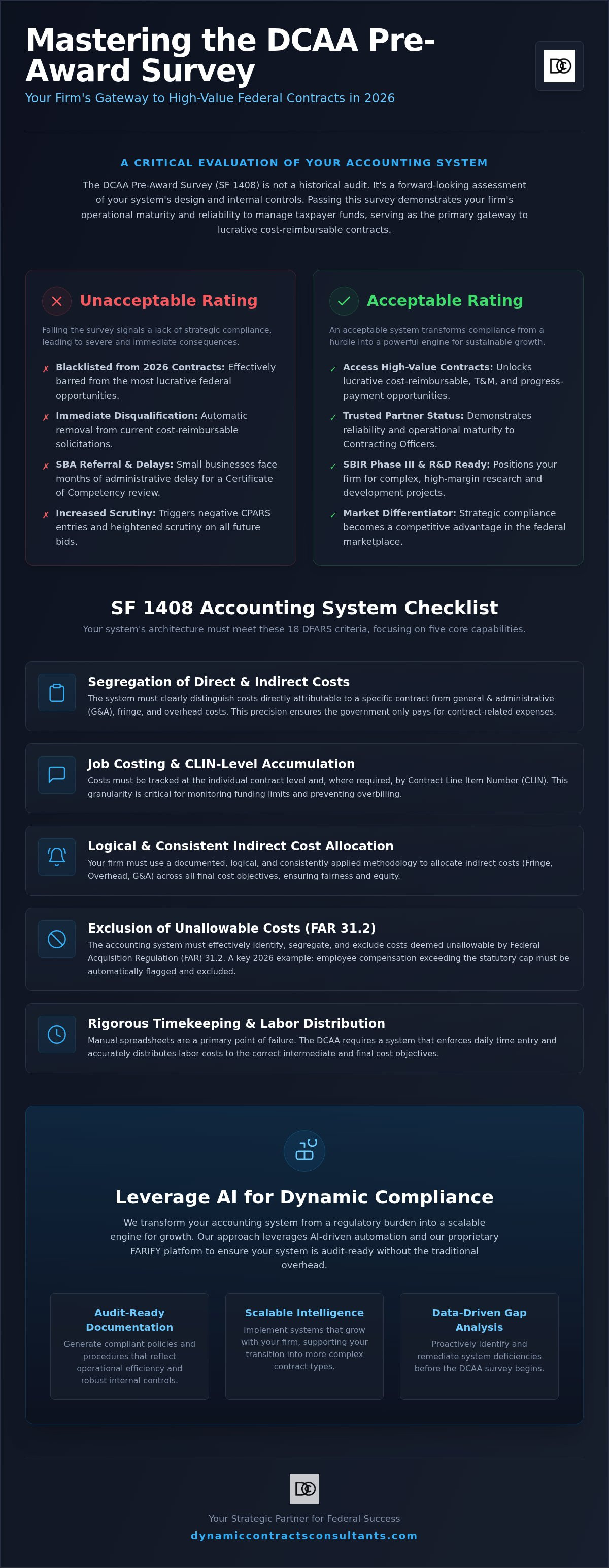
The DCAA Pre-Award Survey is a critical evaluation conducted before a contract award to determine if your accounting system design meets federal standards. It isn't a retroactive audit of your past spending. Instead, it's a prospective look at whether your internal controls and software can handle the complexities of government funds. We view this survey as the first true test of your firm's operational maturity within the federal ecosystem. By proving your system is capable of accumulating and segregating costs correctly, you demonstrate the reliability required to manage taxpayer dollars.
The role of the SF 1408 form is central to this process. It serves as the official record for the Defense Contract Audit Agency (DCAA) to document their findings. When a Contracting Officer (CO) considers you for a cost-reimbursable or progress-payment contract, they must first determine your "responsibility." An "unacceptable" accounting system is a primary reason for a CO to find a contractor non-responsible, which immediately halts the award process. Mastering this requirement is essential for any firm aiming to move beyond simple procurement into complex, high-value service and research contracts.
The Consequences of Non-Compliance
If you fail to meet the criteria on the dcaa pre-award survey checklist, the impact is immediate and severe. For large firms, it means an automatic disqualification from the solicitation. For small businesses, it may trigger a referral to the Small Business Administration (SBA) for a Certificate of Competency, adding months of administrative delay. Beyond the immediate loss, a failure signals to the government that your firm lacks a necessary strategic compliance framework. This can lead to increased scrutiny on every future bid and potentially negative entries in the Contractor Performance Assessment Reporting System (CPARS).
Fixed-Price vs. Cost-Reimbursable Scrutiny
The administrative burden shifts significantly when you move from firm-fixed-price (FFP) contracts to cost-reimbursable models. In an FFP arrangement, you bear the risk, so the government doesn't care as much about your internal cost allocation. However, in cost-plus scenarios, the government assumes the financial risk. This necessitates a robust system that segregates direct from indirect costs and excludes unallowable expenses. Demonstrating an "adequate" system isn't just a hurdle; it's a differentiator. It proves you can protect your profit margins in high-risk research and development environments while providing the transparency the government demands. Our approach focuses on operational efficiency, ensuring your system isn't just compliant but also a driver of long-term success. We help you bridge this gap through our post-award compliance services, ensuring your transition to cost-type work is supported by scalable intelligence.
Essential Components of the SF 1408 Accounting System Checklist
The SF 1408 isn't just a form; it's a blueprint for your accounting architecture. To pass the survey, you must demonstrate that your system can segregate direct costs from indirect costs with absolute precision. This segregation ensures that the government only pays for expenses directly related to contract performance while indirect pools, such as Fringe, Overhead, and G&A, are allocated fairly across all work. You can review the specific criteria auditors evaluate by accessing the Official SF 1408 Form. We've found that firms who treat this as a strategic compliance exercise rather than a clerical task are far more likely to secure high-value awards.
Your system must identify and accumulate costs at the contract and Contract Line Item Number (CLIN) level. This granularity is essential for tracking funding limits and ensuring that you don't overbill. Additionally, you must apply a logical and consistent method for allocating indirect costs. If your methodology fluctuates without a documented justification, it signals a lack of internal control. Finally, your system must effectively exclude unallowable costs as defined by FAR 31.2. For instance, in 2026, your system must automatically flag and exclude any employee compensation exceeding the $695,000 cap to maintain its "adequate" status.
Timekeeping and Labor Distribution Requirements
We've observed that manual spreadsheets are the primary reason many contractors fail labor audits. The DCAA requires daily time entry and rigorous supervisor approval protocols to prevent labor mischarging. Your system must link labor hours directly to specific project codes, ensuring that every hour billed is verifiable. Transitioning to automated timekeeping isn't just a regulatory necessity; it's a step toward the operational efficiency required for scalable growth. We help you implement these protocols as part of our comprehensive post-award compliance strategies.
Accumulation of Costs under General Ledger Control
A compliant system requires your General Ledger (GL) to reconcile perfectly with your job cost reports. This starts with a chart of accounts designed specifically for federal contracting. When you prepare your dcaa pre-award survey checklist, you must ensure every ledger entry is verifiable and that flow-down clauses are managed with subcontractors to maintain cost consistency. If you're concerned about your current system's readiness, you can consult with our strategic compliance experts to perform a detailed gap analysis. We integrate these technical requirements into a visionary framework, positioning your firm as a reliable partner for the most complex federal missions.
The Strategic Advantage of DCAA Compliance in 2026
We believe that viewing the dcaa pre-award survey checklist as a mere regulatory burden is a missed opportunity. In the competitive 2026 procurement lifecycle, an "Adequate" accounting system status serves as a powerful marketing differentiator. It provides Contracting Officers with the confidence that your firm can manage the risk associated with complex, flexibly priced awards. This trust is the foundation for securing high-margin contracts that competitors with lesser systems simply cannot bid on. By proving your operational maturity early, you establish a reputation for reliability that transcends a single solicitation.
For companies pursuing SBIR Phase III or large-scale R&D initiatives, compliance is non-negotiable. These projects typically involve cost-reimbursable structures where the government assumes the cost risk. Without a system that meets the SF-1408 accounting system requirements, your firm is effectively locked out of these innovation-driven opportunities. We help you transition from being a subcontractor to a reliable prime contractor by building this strategic compliance into your core operations, ensuring you're ready for the leap to larger, more complex missions.
Proactive system design also eliminates the "audit anxiety" that often paralyzes leadership during a survey. When your accounting framework is audit-ready by design, it becomes a pillar of your capture management strategy. You can confidently pursue cost-plus solicitations, knowing that your infrastructure supports the government's rigorous transparency demands. This level of preparation allows you to focus on the technical merits of your proposal rather than worrying about back-office deficiencies during the evaluation phase.
Expanding Your Federal Market Reach
Accessing major agencies like the DoD, NASA, and the DOE requires a sophisticated approach to cost accounting. These organizations prioritize contractors who demonstrate long-term stability and precise financial tracking. By aligning your system with federal standards, you position your firm as a top-tier candidate for prime awards. We encourage you to explore our strategic capture management services to see how we integrate compliance into your growth roadmap and help you win more business.
Operational Efficiency through Automation
Modern compliance shouldn't rely on manual entry. We advocate for AI-driven automation that transforms reactive bookkeeping into real-time financial intelligence. This scalable intelligence allows your organization to grow rapidly without being weighed down by administrative debt. Audit-ready records don't just help you pass the initial survey; they also significantly accelerate the contract closeout process. By reducing the time spent on final reconciliations, you can free up capital and resources for your next mission much faster than firms using legacy methods.
How to Prepare for Your DCAA Pre-Award Survey
Preparation for a government audit requires a methodical approach that transcends simply downloading a PDF. We recommend starting with a rigorous internal gap analysis. By applying the dcaa pre-award survey checklist against your current workflows, you can pinpoint exactly where your system falls short of the May 2026 updated standards. This proactive remediation ensures you aren't discovering deficiencies while the auditor is on-site.
Updating your written policies and procedures is equally vital. These documents must reflect your actual accounting practices; otherwise, an auditor will flag the discrepancy as a fundamental lack of internal control. We also emphasize the human element of strategic compliance. You must train your staff on daily timekeeping protocols and the specific identification of unallowable costs. Even the most sophisticated software fails if the team doesn't understand the nuances of FAR 31.2.
A mock survey serves as your final dress rehearsal. It allows you to identify potential red flags, such as unreconciled labor distributions or missing supervisor approval stamps, before they become official findings. This level of diligence transforms the survey from a source of anxiety into a routine validation of your operational maturity.
Documenting Your Internal Controls
We suggest creating a compliance matrix for your accounting manual that maps every SF 1408 requirement to a specific internal policy. This structure proves to the auditor that your system can produce a reliable Statement of Indirect Costs and maintain general ledger control. According to DCAA 2026 guidelines, an adequate accounting system must provide reasonable assurance that costs are accumulated and allocated in accordance with applicable regulations to ensure accurate billing and financial reporting. This documentation is the bedrock of your audit-ready status.
Collaborating with Professional Consultants
While automation provides the data, a human-in-the-loop review offers the strategic oversight necessary for complex environments. We help you address broader requirements such as Procurement System Reviews (CPSR) and the management of flow-down clauses to your subcontractors. This ensures that your entire supply chain maintains cost consistency and compliance. You can learn about our post-award compliance support to see how we maintain this standard throughout the contract lifecycle. To ensure your firm is fully prepared for the next solicitation, schedule a pre-audit gap analysis with our team today.
Leveraging Dynamic Compliance: AI-Driven Audit Readiness
Manual compliance tracking often creates a bottleneck that slows your entry into the cost-reimbursable market. We integrate AI-driven automation to transform this process, replacing static spreadsheets with dynamic, audit-ready documentation. By leveraging scalable intelligence, our approach ensures that every requirement on your dcaa pre-award survey checklist is addressed with technical precision. This transition from reactive bookkeeping to proactive financial management allows your leadership team to focus on mission execution rather than administrative debt.
The FARIFY.ai advantage lies in its ability to generate complex compliance outputs in minutes. While traditional consulting might take weeks to produce a gap analysis, we use AI to accelerate the generation of audit-ready documentation and acquisition strategies. This speed doesn't sacrifice accuracy; instead, it enhances it by removing human error from repetitive data mapping. We provide a human-in-the-loop assurance that ensures these automated outputs align perfectly with the specific nuances of your business operations and the latest 2026 DCAA priorities.
Precision through AI-Powered RFP Analysis
Our system uses advanced algorithms to extract critical DCAA requirements from Section L and Section M of your solicitations automatically. This ensures that your proposal cost volumes are perfectly aligned with your accounting system design from the very beginning. We don't just help you pass the survey; we help you build a proposal that proves your system's adequacy to the Contracting Officer. You can discover our AI-enhanced proposal writing services to see how we integrate these compliance matrices into a winning bid strategy.
Long-Term Success with Strategic Compliance
Strategic compliance extends far beyond the initial pre-award survey. As your federal portfolio grows, your system must evolve to handle more complex requirements, such as annual incurred cost submissions (ICE). We help you build a culture of compliance that scales with your business, ensuring that your accounting framework remains a strategic asset throughout the procurement lifecycle. Establishing this foundation early prevents the costly "clean-up" projects that often plague rapidly growing contractors. For a deeper dive into our methodology, read our sibling article on DCAA Compliance Consulting: A Strategic Framework. Partnering with us provides the end-to-end support you need to maintain operational efficiency and audit readiness in an increasingly complex regulatory environment.
Strategic Compliance as Your Competitive Edge in 2026
Strategic compliance is the foundation of every high-value federal partnership. By mastering the dcaa pre-award survey checklist and implementing the SF 1408 requirements, your firm moves from a reactive posture to a position of operational maturity. We've explored how a robust accounting system functions as a powerful marketing differentiator, unlocking access to DoD and R&D contracts that drive long-term growth and stability. This isn't just about passing a survey; it's about building a scalable framework for your future success.
Our team brings the collective expertise of Certified Professional Contracts Managers (CPCM) and the agility of a minority-owned small business to your procurement lifecycle. We integrate the AI-powered FARIFY platform to ensure your documentation isn't just accurate but generated with scalable intelligence. This combination of expert-led oversight and cutting-edge automation guarantees that your system remains audit-ready throughout the entire contract lifecycle. You don't have to face the complexities of federal regulations alone.
We invite you to secure your federal future with our expert DCAA compliance consulting today. Let's transform your back-office systems into a strategic engine for your next prime award. Your path to federal growth starts with a system you can trust.
Frequently Asked Questions
What is the SF 1408 checklist and why is it used?
The SF 1408 is the official "Pre-Award Survey of Prospective Contractor (Accounting System)" form used by auditors to evaluate your system's design. It serves as a critical gateway for Contracting Officers to determine your responsibility before awarding cost-reimbursable or other flexibly priced contracts. We utilize the dcaa pre-award survey checklist to ensure your internal controls can accurately accumulate and segregate costs, providing the transparency required for federal financial management.
Can a small business pass a DCAA pre-award survey without specialized software?
Yes, passing is possible without specialized software because the DCAA does not certify specific accounting products. Compliance depends on your overall system of internal controls, policies, and procedures. However, manual systems often struggle to meet the rigorous labor distribution and indirect cost allocation standards. We recommend integrating automated tools to ensure your records reconcile perfectly with your general ledger, eliminating the human error common in manual spreadsheet tracking.
How long does a DCAA pre-award accounting system survey typically take?
The actual audit phase usually lasts between one to three days, depending on the complexity of your organizational structure and system design. However, the entire procurement lifecycle process, from the initial request to the final report issuance, can span several weeks. We help you accelerate this timeline by ensuring all documentation is audit-ready before the auditor arrives, reducing the need for time-consuming follow-up requests or system remediation during the survey.
What are common reasons for failing a DCAA pre-award survey?
Most failures occur due to inadequate labor distribution protocols, a lack of written accounting policies, or the inability to segregate unallowable costs. If your system cannot reconcile job cost reports to the general ledger or lacks daily timekeeping entry requirements, the auditor will deem it unacceptable. We focus on these high-risk areas during our gap analysis to ensure your internal controls are robust enough to withstand formal government scrutiny.
Do I need a DCAA-compliant accounting system for fixed-price contracts?
Generally, firm-fixed-price (FFP) contracts do not require a DCAA-approved accounting system since you assume the financial risk. However, if your contract includes progress payments based on costs or if you win time-and-materials awards, a compliant system becomes mandatory. We suggest implementing a compliant framework early to ensure you don't lose out on high-value, cost-reimbursable opportunities as your business scales and pursues more complex federal missions.
What is the difference between a pre-award survey and a post-award audit?
A pre-award survey evaluates the design of your system to ensure it is capable of tracking costs before a contract is awarded. Conversely, a post-award audit, such as an Incurred Cost Audit, examines your actual historical transactions to verify that billed costs were allowable and allocable. We provide end-to-end support for both phases, ensuring your system remains compliant from the initial bid through the final contract closeout and submission.
How does FAR 31.2 affect my DCAA checklist preparation?
FAR 31.2 defines the cost principles used to determine which expenses are reimbursable by the government. Your dcaa pre-award survey checklist must include specific mechanisms for identifying and excluding unallowable costs, such as entertainment or excessive compensation. For 2026, your system must automatically flag any employee compensation exceeding the $695,000 cap. We align your chart of accounts with these principles to ensure your financial reporting meets every regulatory standard.
Can AI tools like FARIFY help with DCAA compliance documentation?
Our FARIFY.ai platform significantly reduces administrative burdens by generating audit-ready documentation in minutes. It extracts requirements from solicitations and creates compliance matrices that align with your accounting system design. This AI-driven automation provides a level of precision and speed that manual methods cannot match. We combine this technology with strategic oversight from our Certified Professional Contracts Managers to guarantee your system meets the highest standards of operational efficiency.


