

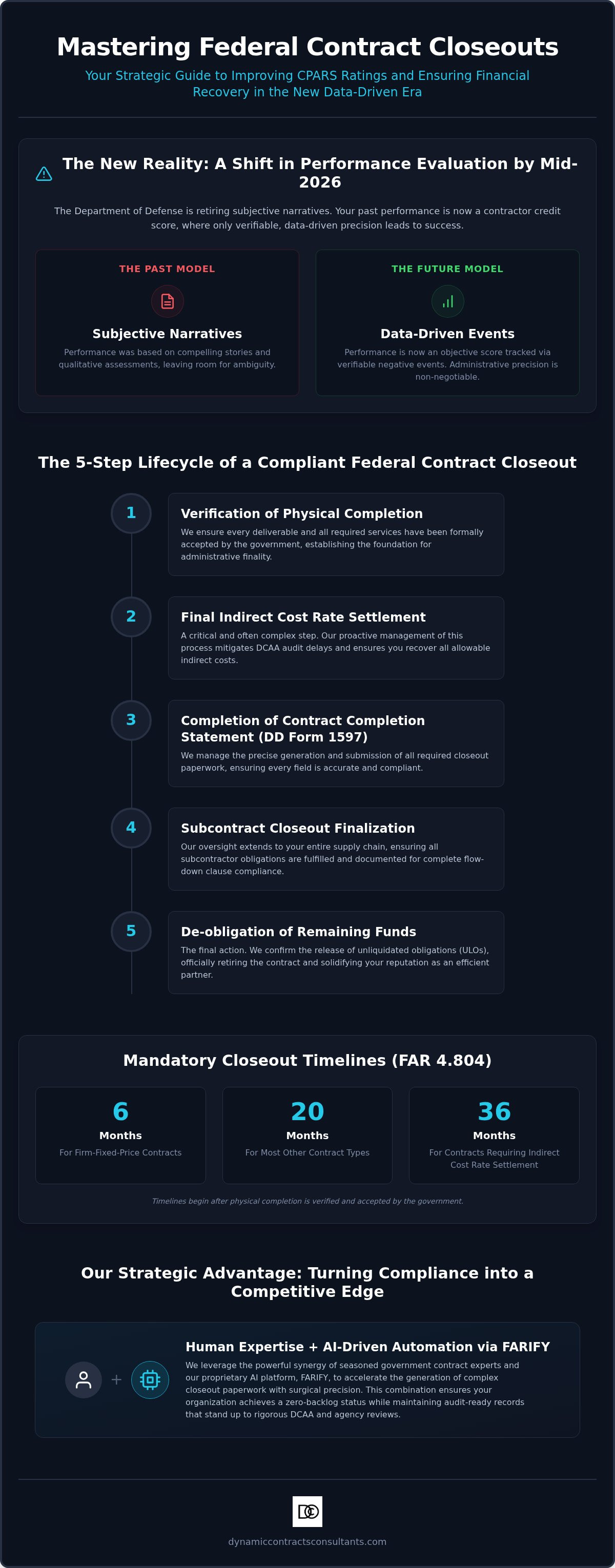
By mid-2026, the Department of Defense will officially retire subjective narratives in favor of a data-driven model that exclusively tracks verifiable negative performance events. This shift means that your past performance record is no longer about a compelling story; it's a contractor credit score where precision is the only path to improving CPARS ratings. We know that for many contractors, the administrative backlog of expired contracts feels like an anchor, preventing you from recovering final payments and risking your reputation with every missed deadline.
You shouldn't have to choose between executing new missions and managing the tedious documentation required for a clean exit. We've designed this guide to help you master the complexities of federal contract closeouts with expert strategies that ensure regulatory compliance, protect your standing, and maximize financial recovery. We'll walk you through achieving a zero-backlog status, recovering indirect costs in full, and maintaining audit-ready records that stand up to the most rigorous DCAA and agency reviews. By aligning your internal processes with these new objective standards, we can help you turn a closing contract into a strategic asset for future growth.
Key Takeaways
- Understand why transitioning from physical completion to administrative finality is a critical strategic lever for improving CPARS ratings and securing future contract awards.
- Master the end-to-end lifecycle of contract closeout, from the verification of deliverables to the final indirect cost rate settlement and voucher submission.
- Identify proven methods to resolve unliquidated obligations (ULOs) and mitigate the operational risks associated with historical DCAA indirect cost audit delays.
- Implement audit-ready internal controls and flow-down clause compliance to protect your organization during agency reviews and DCAA inspections.
- Leverage the synergy of human expertise and AI-driven automation via FARIFY to accelerate the generation of complex closeout paperwork with surgical precision.
Navigating the Strategic Impact of Federal Contract Closeout Services
Federal contract closeout represents the bridge between physical performance and administrative finality. While many teams celebrate when the final deliverable is accepted, the procurement lifecycle isn't complete until the contract is formally closed. This process involves verifying that all administrative actions have been concluded, all disputes are settled, and final payments are disbursed. We view this phase as a critical component of improving CPARS ratings. Under the 2026 NDAA mandates, the Department of Defense has shifted to a model that tracks verifiable negative performance events. An unmanaged backlog of expired contracts often signals administrative instability to agencies, potentially triggering negative events that degrade your objective performance score in the System for Award Management (SAM).
Beyond reputation, there's a clear financial imperative. Resolving unliquidated obligations (ULOs) releases funds back to the agency, which can be a powerful diplomatic tool for your firm. Conversely, a high volume of unclosed contracts increases your DCAA audit risk profile. Historical data shows the DCAA has faced significant backlogs for incurred cost audits, sometimes taking hundreds of days to complete. Don't let your records become part of an administrative bottleneck that prevents you from securing final payments or recovering indirect costs.
The Regulatory Framework: FAR Part 4.804
The Federal Acquisition Regulation (FAR) 4.804 provides the roadmap for this transition. Timelines are strict: firm-fixed-price contracts should close within six months of physical completion, while most other contract types have a 20-month window. For contracts requiring the settlement of indirect cost rates, the timeframe extends to 36 months. Physical completion occurs when you've performed all required services or delivered all items, and the government has formally accepted them. The Contracting Officer (CO) or Administrative Contracting Officer (ACO) must then lead the bilateral process of final settlement, ensuring all property is accounted for and all classified materials are handled.
Closeout as a Competitive Advantage
Efficient closeout processes demonstrate operational excellence to your government customers. When you proactively manage the administrative end of a contract, you position yourself as a low-risk partner for future awards. This discipline is essential for your long-term growth and integrates directly with strategic capture management services. By closing out multi-year performance periods promptly, you mitigate the risk of losing access to stale records or key personnel. This proactive stance ensures your final past performance record remains accurate, helping in improving CPARS ratings through a clean, verifiable history of compliance and administrative precision.
The Lifecycle of a Compliant Federal Contract Closeout
A successful closeout isn't a single event but a methodical five-step workflow that requires precision at every stage. We've refined this process to ensure that your administrative records are as flawless as your technical performance. The lifecycle begins with the verification of physical completion, where we ensure every deliverable has been formally accepted by the government. Following this, we address the final indirect cost rate settlement, a step that often creates bottlenecks if not managed proactively. We then move to the completion of the Contract Completion Statement (DD Form 1597) and ensure all subcontract closeouts are finalized and documented. The final stage is the de-obligation of remaining funds, which officially retires the contract in agency systems. This disciplined approach is a primary driver for improving CPARS ratings, as it prevents the administrative "negative performance events" that the new 2026 objective model tracks.
Physical vs. Administrative Closeout Requirements
It's vital to distinguish between a task order reaching its end date and the master contract's administrative retirement. During this limbo period, you must maintain rigorous documentation for government-furnished property (GFP) disposal and intellectual property rights. We help you manage these post-award compliance requirements to ensure no loose ends remain that could trigger an audit or a late-stage performance dispute.
Critical Documentation: From DD Form 1597 to Final Invoicing
The administrative burden of closeout centers on three critical documents: the Contractor’s Release, the Contractor’s Assignment of Refunds, and the final invoice voucher. These must align perfectly with your negotiated indirect rates to prevent DCAA friction. You should also verify that all patent reports and royalty disclosures are submitted, as missing these can stall the entire process. For the latest guidance on how these records impact your long-term standing, we recommend monitoring the Official CPARS Portal. If you find your team overwhelmed by this paperwork, you can reach out to our specialists to implement a more efficient, automated workflow. By ensuring every form is audit-ready, you protect your reputation and contribute significantly to improving CPARS ratings across your entire contract portfolio.
Overcoming Common Closeout Bottlenecks with Strategic Oversight
Administrative stagnation is the primary enemy of a healthy procurement lifecycle. Bottlenecks in the closeout phase don't just delay your final payment; they create risk profiles that federal agencies monitor closely. We often see "orphan contracts" where the original project personnel have moved on, leaving a vacuum of institutional knowledge. Without strategic oversight, these gaps lead to discrepancies between government and contractor property records, which can stall a closeout for years. Resolving these issues requires a forensic approach to documentation that ensures every record is audit-ready and accurate. This level of precision is essential for improving CPARS ratings, as it demonstrates to the government that your firm maintains operational control even after the technical work ends.
Managing Indirect Rate Settlements and DCAA Audits
The wait for a DCAA incurred cost audit is a notorious hurdle, with historical backlogs often reaching hundreds of days before an audit even begins. We mitigate this through specialized DCAA compliance consulting that prepares your team for final rate negotiations well in advance. By resolving potential audit findings before they reach the closeout stage, we accelerate the timeline for final settlement. For eligible contracts, we utilize Quick-Closeout procedures. Under current GSA deviations, the threshold for unsettled costs has increased to $2,000,000, allowing us to bypass certain audit requirements and secure your final payments faster than traditional methods allow.
Resolving Unliquidated Obligations (ULOs) and De-obligations
Unliquidated obligations (ULOs) represent trapped capital that federal agencies are eager to reclaim for new initiatives. Identifying excess funds for de-obligation is a powerful way to improve agency relations while cleaning up your financial statements. This is particularly critical in cost-plus-award-fee (CPAF) environments, where unrecovered costs directly impact your bottom line. We work as your strategic partner to coordinate with agency finance offices, ensuring final fund reconciliation is handled with surgical precision. Adhering to the Federal Acquisition Regulation (FAR) on CPARS mandates that performance evaluation includes these administrative duties, making proactive fund management a cornerstone of improving CPARS ratings and securing your competitive edge in 2026.
Implementing an Audit-Ready Closeout Strategy
We believe that a reactive approach to closeout is a significant operational liability. Establishing robust internal controls for post-award documentation management isn't just a regulatory hurdle; it's a strategic necessity for your firm's longevity. By maintaining lifecycle tracking from day one, you ensure that every modification and deliverable is accounted for long before the final invoice is submitted. This proactive stance is a key pillar in improving CPARS ratings, as it eliminates the administrative friction that leads to negative performance events in the new 2026 objective model.
Internal Controls for Post-Award Documentation
You need a centralized repository that serves as a single source of truth for all contract modifications, correspondence, and technical deliverables. We help our partners standardize their internal checklists for post-award contract administration, ensuring no compliance artifact is missing. Our approach focuses on three core areas:
- Centralized digital archives for all bilateral and unilateral modifications.
- Verification logs for every technical deliverable and formal government acceptance notice.
- Regular internal gap analyses to identify missing compliance artifacts before an agency official or auditor flags them during a review.
Flow-Down Clause Compliance in Subcontract Closeouts
The interplay between subcontract flow-down clauses and prime contract closeout is a complex area that many contractors overlook. You cannot officially close a prime contract until every subcontractor has met their final reporting and audit requirements. We've seen prime contractors face significant financial risk when subcontractor claims surface after the prime contract has been retired. To mitigate this, we verify that all flow-down requirements, including patent reports, royalty disclosures, and final overhead rate settlements, are satisfied and documented in the prime file. This ensures that your subcontract management reflects the same level of excellence as your prime performance.
Surviving a future audit requires more than just finishing the technical job. You must document and archive all Procurement Integrity Act and ethics requirements to ensure long-term protection for your leadership and your brand. Remember that the standard record retention period is six years post-closeout. If your records aren't organized and accessible now, they won't survive a DCAA review three years down the line. Maintaining this level of administrative rigor is essential for improving CPARS ratings and protecting your firm’s legacy in the federal marketplace. If you're ready to secure your records and streamline your compliance, contact our audit-readiness experts today to build a scalable closeout framework.
Optimizing Closeout Efficiency with Dynamic Contracts and FARIFY
We recognize that the administrative burden of closing out hundreds of contracts can paralyze even the most organized firms. While some industry reports suggest that AI implementation at the agency level remains slow, we've already integrated scalable intelligence into our internal workflows to solve this problem for you today. By combining seasoned contract expertise with AI-driven document generation, we transform the closeout phase from a bottleneck into a streamlined operation. This synergy is a critical asset for improving CPARS ratings, as it ensures your administrative record is as precise as your technical execution.
AI-Driven Document Generation for Rapid Closeouts
Utilizing FARIFY allows us to extract complex requirements and generate audit-ready compliance matrices in minutes rather than days. This technology significantly reduces the administrative load on your proposal writing and administration teams, allowing them to focus on new captures. We ensure our automated workflows deliver the following advantages:
- Rapid extraction of closeout requirements from complex FAR and DFARS clauses.
- Automated generation of compliance checklists tailored to specific contract types.
- Reduction of manual data entry errors that often lead to DCAA friction or rejected vouchers.
- Scalable processing of high-volume contract backlogs without the need for additional headcount.
Personalized Post-Award Administration and Compliance
Our CPCM and CFCM certified experts provide the essential "Human-in-the-Loop" oversight required for complex negotiations with the DoD, EPA, and NOAA. We don't just provide software; we offer a strategic partnership that includes customized templates aligned with specific agency protocols and the latest 2026 regulatory updates. This dual approach allows you to manage high-volume backlogs while maintaining the surgical precision needed for audit-ready outputs. As the Department of Defense moves toward its objective, data-driven performance model, the speed and accuracy of your closeout process will be a primary factor in improving CPARS ratings. If you're ready to secure your past performance record and maximize your financial recovery through a modern, audit-ready framework, Contact us for comprehensive closeout support. Together, we can turn administrative compliance into a long-term competitive advantage.
Securing Your Performance Legacy Through Strategic Closeout
The transition to a data-driven performance model in 2026 means that your administrative precision is now as important as your technical delivery. By viewing the closeout lifecycle as a strategic opportunity rather than a final hurdle, you protect your organization from negative performance events. We've shown how improving CPARS ratings depends on resolving unliquidated obligations and ensuring your records are audit-ready for the DCAA well before the final voucher is submitted.
Our approach combines the high-level oversight of Certified Professional Contracts Managers (CPCM) with the speed of AI-powered document generation via FARIFY. This ensures every file meets strict FAR and DFARS standards without draining your internal resources. You don't have to manage these complex backlogs alone. We're here to help you turn administrative compliance into a scalable competitive advantage for future captures.
Streamline your federal contract closeout with our expert consultants today. We look forward to helping you master the complexities of the procurement lifecycle and securing your business's long-term success.
Frequently Asked Questions
What is the standard timeline for a federal contract closeout?
Standard timelines are defined by FAR 4.804-1. Firm-fixed-price contracts should close within six months of physical completion. Most other contract types have a 20-month window. However, if your contract requires the settlement of indirect cost rates, the timeframe extends to 36 months. We help you meet these deadlines by proactively preparing documentation, so you don't stay in a state of administrative friction that could jeopardize your future bidding eligibility.
How does an efficient contract closeout help in improving CPARS ratings?
Efficient closeout is a primary lever for improving CPARS ratings under the 2026 data-driven model. The Department of Defense now tracks verifiable negative performance events rather than subjective narratives. Administrative backlogs or failures to de-obligate funds are often flagged as negative events. By closing contracts promptly, we ensure your record remains clean and your "contractor credit score" reflects operational excellence, making you a more attractive partner for future government awards.
What happens if a federal contract is not closed out within the FAR-mandated timeframe?
Exceeding mandated timeframes leads to significant administrative and financial liabilities. You'll face a higher DCAA audit risk profile and increased costs for maintaining stagnant records. Additionally, unliquidated obligations (ULOs) remain trapped, preventing agencies from reclaiming funds for new missions. In the 2026 regulatory environment, these delays are recorded as negative administrative events, directly hindering your efforts in improving CPARS ratings and potentially impacting your ability to secure award fees or contract options.
Can I close out a contract before the final DCAA audit is complete?
Yes, you can utilize Quick-Closeout procedures under FAR 42.708 to bypass certain audit delays. The GSA recently issued a class deviation increasing the threshold for unsettled direct and indirect costs to $2,000,000. This allows us to finalize closeouts without waiting for a full DCAA incurred cost audit, which historically takes over 800 days to complete. This strategy accelerates final payments and helps you maintain a current, audit-ready portfolio across all agencies.
What is the difference between physical and administrative closeout in government contracting?
Physical closeout occurs when you've delivered all services or items and the government has formally accepted them. Administrative closeout is the subsequent process of settling all remaining contractual obligations. This includes disposing of government-furnished property, resolving patent rights, and negotiating final indirect rates. We manage this transition to ensure that your administrative finality matches your technical success, preventing stale records from becoming a liability during future agency reviews or DCAA inspections.
What specific documents are required for a standard federal contract closeout?
A standard closeout requires a specific set of administrative artifacts to be audit-ready. These include the Contract Completion Statement (DD Form 1597), the Contractor’s Release, and the Contractor’s Assignment of Refunds. You must also submit a final invoice voucher that aligns with negotiated indirect rates, along with patent reports and royalty disclosures. We standardize these checklists to ensure every document is filed correctly, protecting your reputation and ensuring full recovery of indirect costs.
How can AI technology like FARIFY assist in the closeout process?
AI technology like FARIFY provides scalable intelligence by extracting requirements and generating compliance matrices in minutes. It's designed to eliminate manual data entry errors, ensuring that all closeout paperwork meets strict FAR and DFARS standards. We use these AI-driven tools to clear high-volume backlogs without increasing your headcount. This automation provides the speed and precision necessary for maintaining audit-ready records, allowing your team to focus on strategic growth and capture management.
What are the record retention requirements after a federal contract is closed?
Federal Acquisition Regulation (FAR) 4.703 generally requires contractors to retain contract records for six years after final payment. This period ensures you're protected during future DCAA audits or agency reviews. We help you establish centralized, digital repositories to archive all modifications, correspondence, and deliverables. Maintaining organized, accessible records for this full duration is essential for protecting your firm's legacy and demonstrating the long-term compliance required for sustained success.


