

While the federal government awarded nearly $179 billion to small businesses in FY2025, the total number of participating firms is actually declining. This suggests that success in the current $4.25 billion AI-driven procurement market isn't about the volume of your submissions, but the precision of your selection using a robust bid no-bid decision matrix template. You've likely experienced the internal friction and burnout that comes when gut-feeling decisions lead to high pursuit costs with zero ROI. We understand the frustration of a proposal team stretched thin by opportunities that were never a strategic fit from the beginning.
Our guide provides the framework you need to master opportunity qualification through a standardized, data-driven scoring system. We'll show you how to implement a process that increases your P-Win and ensures your operations remain perfectly aligned with capture goals. By the end of this article, you'll have a clear roadmap for optimizing resource allocation and maintaining a competitive edge in an increasingly complex regulatory environment. We'll examine the specific metrics that turn subjective guesses into objective, audit-ready strategic wins.
Key Takeaways
- Transition from subjective "gut feelings" to a quantitative framework that reduces pursuit costs and prevents team burnout.
- Identify the core components of a high-performance bid no-bid decision matrix template to evaluate technical capability and strategic alignment objectively.
- Learn to integrate FAR and DFARS compliance directly into your scoring models to mitigate risk throughout the procurement lifecycle.
- Establish a disciplined pursuit review workflow that utilizes rapid triage to filter out non-compliant RFPs before they drain your budget.
- Leverage AI-driven automation to transform your capture strategy, allowing you to generate audit-ready compliance documents and requirement extractions in minutes.
The Strategic Framework of a Bid No-Bid Decision Matrix
A bid/no-bid matrix isn't just a spreadsheet. It's a quantitative tool designed for objective opportunity qualification. In federal contracting, relying on "gut feeling" is a primary driver of low win rates and wasted overhead. By adopting a strategic decision-making framework, we help you replace subjective impulses with data-driven precision. Utilizing a standardized bid no-bid decision matrix template ensures that every pursuit aligns with your long-term growth objectives, especially as the AI in procurement market is projected to reach $4.25 billion in 2026. This growth makes a disciplined filter essential for navigating the increased volume of opportunities.
To better understand the strategic context of these decisions, we recommend watching this overview of the capture management process:
Every bid you pursue carries a significant opportunity cost. When your technical resources are tied up on a low-probability contract, they aren't available for the high-value opportunities where you have a genuine competitive advantage. We emphasize establishing a threshold for success, specifically a "Go" score, well before the RFP arrives. This discipline ensures that your team only engages when the probability of win (P-Win) meets your organization's specific risk-reward profile, protecting your operational efficiency from unnecessary strain.
The Psychology of the Pursuit: Overcoming "Bid Fever"
Business development teams often fall victim to "bid fever," a cognitive bias where the desire to win a contract overrides the reality of operational capacity. This aggressive pursuit of growth can lead to burnout and poor submission quality. A standardized bid no-bid decision matrix template depersonalizes the "No-Bid" decision. It shifts the internal conversation from "why don't we want this?" to "how does this score against our proven success criteria?" This structured approach allows you to balance ambitious targets with the reality of your team's bandwidth.
Key Benefits of a Formalized Qualification Process
Implementing a rigorous qualification process yields measurable results for federal contractors. By concentrating your efforts, you ensure that every proposal is a high-impact document rather than a rushed response. Our approach to capture management focuses on several key outcomes:
- Increased P-Win: Concentrating resources on fewer, higher-quality opportunities naturally leads to a higher win rate.
- Strategic Alignment: A matrix creates a bridge between sales, technical leads, and executive leadership, ensuring everyone understands the rationale behind each pursuit.
- Enhanced Credibility: Submitting high-quality, compliant responses builds a stronger reputation with federal contracting officers over time.
By leveraging these frameworks, you position your firm as a disciplined and reliable partner in the federal marketplace.
Anatomy of a High-Performance Decision Matrix Template
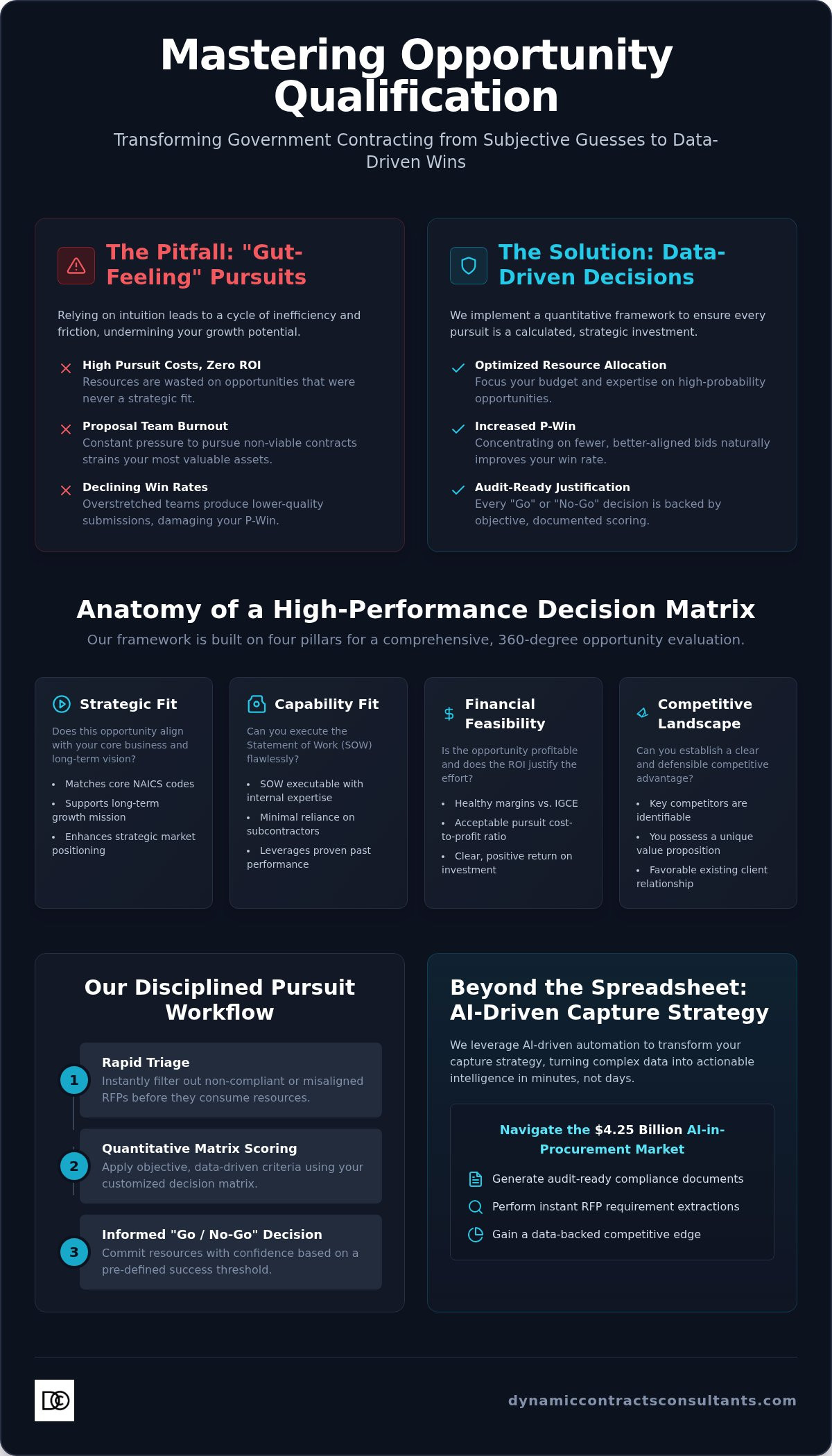
A high-performance bid no-bid decision matrix template must move beyond generic checklists to address the specific complexities of the federal contracting process. We categorize these evaluation criteria into four primary pillars: strategic fit, capability fit, financial feasibility, and competitive landscape. Strategic fit evaluates if the opportunity matches your NAICS codes and long-term mission. Capability fit requires a hard look at the Statement of Work (SOW). You must determine if you can execute the requirements with internal expertise or if you'll rely on heavy sub-contracting that erodes your control and profit.
Financial feasibility involves more than just a high contract value. We analyze profit margins against Independent Government Cost Estimates (IGCE) and calculate pursuit costs. If the cost of the proposal consumes a significant portion of the potential profit, the ROI may not justify the effort. Finally, we assess the competitive landscape. Identifying the incumbent and articulating your unique differentiators is vital. If you can't clearly state why your solution is superior, your P-Win remains low. This structured analysis ensures your resources are only committed to high-probability wins.
Weighting Your Scoring Criteria for Maximum Accuracy
Not every factor carries equal weight in a successful bid no-bid decision matrix template. We assign higher weights to "Must-Win" factors like technical capability and past performance. By calculating a Weighted Average (WA), you arrive at a definitive score that removes emotion from the room. Some variables act as "Killer Questions." For example, if a solicitation requires a Facility Clearance you don't possess, it triggers an automatic "No-Bid" regardless of other high scores. This binary filter saves your team weeks of wasted effort on unattainable goals.
Risk Assessment and Strategic Compliance
Federal contracts involve rigorous regulatory hurdles that require a commitment to strategic compliance. We evaluate DCAA compliance requirements and your accounting system's readiness early in the process. Complex flow-down clauses can impact your profitability and legal standing if not managed correctly. We also perform a gap analysis on past performance requirements to ensure you meet the agency's specific thresholds. If you're concerned about your current post-award compliance readiness, our team can help you audit your internal processes to ensure they meet federal standards.
For organizations seeking to refine their internal evaluation tools, you might consider reaching out to our specialists to discuss a customized scoring model tailored to your specific industry focus. This proactive approach ensures your pursuit strategy remains both aggressive and audit-ready.
Customizing Your Matrix for Federal vs. Commercial Bids
A one-size-fits-all bid no-bid decision matrix template is a recipe for failure in the complex federal marketplace. We recognize that federal procurement is governed by strict regulatory frameworks, while commercial deals often hinge on speed and long-term client lifetime value (LTV). Integrating FAR/DFARS compliance into your scoring model isn't optional for government work. You must look closely at Section L and Section M of the RFP. Section L provides the instructions for proposal preparation, while Section M outlines the evaluation criteria. Your matrix should mirror these factors to ensure your pursuit is viable from the start.
Teaming agreements add another layer of complexity to your evaluation. When scoring opportunities involving prime/sub relationships, we evaluate the partner's past performance and their commitment to meeting workshare requirements. This prevents you from pursuing contracts where a partner might become a liability during execution. Aligning your internal processes with PMI's bid/no-bid methodology helps create a knowledge-based approach that matures as your firm wins more work. This transition from reactive bidding to proactive selection is what separates market leaders from those just getting by.
Federal-Specific Scoring Metrics
Socioeconomic status impact is a critical metric for small businesses. If you hold certifications like 8(a), HUBZone, or SDVOSB, you should weigh opportunities that favor these set-asides more heavily. Security clearance requirements also act as a binary filter in your bid no-bid decision matrix template. If a project requires a Top Secret Facility Clearance (FCL) and you don't currently possess it, the timeline to acquire one often exceeds the proposal window. We also prioritize audit-readiness as a competitive differentiator. Being DCAA compliant reduces perceived risk for the contracting officer, making your firm a safer choice for complex cost-plus contracts.
Commercial and Grant-Specific Variations
Commercial matrices prioritize relationship depth and brand alignment. We focus on how a single project might lead to years of recurring revenue or strategic market entry. In contrast, grant opportunities are scored on mission impact and alignment with the grantor's specific objectives rather than pure profitability. If your organization is looking to expand into non-dilutive funding, you can learn more about our grant writing services to see how we tailor the qualification process for these unique pursuits. Whether it's a commercial RFP or a federal grant, the goal remains the same: optimizing your resources for the highest possible return.
Implementing the Matrix: The Pursuit Review Workflow
A bid no-bid decision matrix template only provides value when it's integrated into a disciplined, repeatable workflow. We've developed a four-step process that transforms raw data into strategic action. This workflow begins with an initial triage, where we rapidly filter out RFPs that fail basic compliance or eligibility checks. If an opportunity passes this phase, we convene a pursuit review meeting to perform deep-dive scoring. This collaborative approach ensures that the final "Go/No-Go" decision is based on collective intelligence rather than executive intuition. Once the decision is finalized, we document the rationale to maintain an audit trail for your capture strategy.
The transition from triage to decision requires a clear line of authority. We emphasize that the executive "Go" must be contingent on the matrix score meeting your pre-defined success threshold. After the decision, the workflow concludes with formal documentation, such as drafting a Letter of Intent for partners or a respectful decline for the buyer. This level of organization ensures that your team remains focused on high-probability wins while maintaining professional relationships across the federal marketplace.
Who Should Be in the Room? Roles and Responsibilities
High-stakes bids require a cross-functional team to vet the data within your bid no-bid decision matrix template. The Capture Manager leads the session, focusing on the strategic narrative and competitive positioning. The Technical Lead provides a reality check on the Statement of Work, ensuring you don't over-commit resources you don't have. Finally, the Compliance Officer evaluates the solicitation for FAR/DFARS requirements and DCAA readiness. This trio provides a 360-degree view of the opportunity, identifying risks that a single department might overlook.
Post-Decision Actions: Winning the "No-Bid"
There's a strategic art to declining an opportunity. We believe you can "win" a No-Bid by maintaining your reputation with the buyer. A professional decline letter that cites specific capacity or strategic alignment reasons keeps the door open for future, better-fitting RFPs. We also track these "No-Bid" reasons in a pipeline retrospective to refine our scoring models over time. If your team is struggling with the transition from pursuit to performance, you can explore our post-award compliance services to ensure your operations are ready for the contracts you do win.
If you're ready to move beyond gut-feeling decisions and implement a rigorous capture workflow, we invite you to contact the strategic experts at Dynamic Contracts Consultants LLC today to discuss your specific pipeline needs.
Beyond the Spreadsheet: AI-Driven Capture Strategy
The manual bid no-bid decision matrix template has served as the bedrock of disciplined capture for decades. However, the federal landscape in 2026 demands more than just a static spreadsheet. AI-driven automation is now transforming opportunity qualification from a multi-day research task into a rapid, strategic exercise completed in minutes. We use FARIFY as a technological accelerator to ingest thousands of pages of solicitation data, providing immediate clarity on whether a pursuit is worth your firm's resources. This shift allows your team to focus on the high-value strategic narrative rather than the administrative burden of data entry.
Predictive analytics represent the next frontier in capture management. By utilizing AI to forecast your P-Win based on historical performance data and real-time market intelligence, we help you move beyond reactive bidding. This synergy between human expertise and machine speed allows your executive team to make high-stakes decisions with unprecedented confidence. You aren't just guessing if you can win; you're looking at a data-backed probability that accounts for incumbent performance, agency spending trends, and your specific technical capabilities.
The FARIFY Advantage: Audit-Ready Document Generation
FARIFY's core strength lies in its ability to automatically extract Section L and M requirements to populate your scoring model. This automation ensures that your internal bid no-bid decision matrix template is instantly aligned with the specific evaluation criteria of the solicitation. It eliminates the hours usually spent manually cross-referencing instructions and evaluation factors, ensuring no mandatory clause is overlooked. For a deeper look at this evolution, read our article on AI for Bid-No-Bid Analysis: Transforming Federal Capture Strategy in 2026.
Strategic Partnership for Long-Term Success
Technology alone isn't a silver bullet in the federal sector. We maintain a "human-in-the-loop" approach to provide the regulatory assurance that AI cannot yet fully replicate. Our strategic consultants review AI-generated acquisition plans to ensure they meet the nuanced requirements of FAR and DFARS. This partnership between Dynamic Contracts Consultants LLC and FARIFY ensures that your capture strategy is both cutting-edge and audit-ready. To build a robust foundation for your technology, consult The Definitive Guide to Developing a Strategic Government Contract Capture Plan. This integrated approach ensures your firm doesn't just bid more, but bids smarter, securing scalable growth in a competitive marketplace.
Mastering Strategic Capture in the AI Era
Transitioning from a reactive posture to a data-driven strategy is essential for navigating the complexities of the modern federal marketplace. By implementing a robust bid no-bid decision matrix template, you replace subjective uncertainty with a quantitative framework that prioritizes high-probability wins. We've explored how a disciplined pursuit review workflow, supported by cross-functional expertise and AI-driven automation, ensures your technical resources aren't wasted on low-fit opportunities.
Our collective expertise in DCAA compliance and our proven prime contractor track record provide the foundation for your success. With the FARIFY platform, we accelerate the procurement lifecycle, allowing you to extract critical requirements and generate audit-ready documentation in minutes. This synergy between human strategy and scalable intelligence positions your firm for sustainable growth and operational excellence. We invite you to optimize your capture strategy with Dynamic Contracts Consultants LLC to transform your selection process into a competitive advantage. It's time to build a pipeline that reflects your true capabilities and maximizes your return on investment.
Frequently Asked Questions
What is a bid no-bid decision matrix?
A bid no-bid decision matrix is a quantitative tool used to evaluate government contract opportunities against specific criteria. It replaces subjective "gut feelings" with data-driven scoring. By using a standardized bid no-bid decision matrix template, your team can objectively determine if a pursuit aligns with your technical capabilities, mission, and financial goals. This structured approach ensures that resources are allocated only to contracts with a high probability of win (P-Win), protecting your firm's operational efficiency.
How do you calculate a bid/no-bid score?
Calculating a score involves assigning numerical values to criteria like strategic fit, technical capability, and the competitive landscape. Each factor is weighted based on its importance to your organization's success. You then multiply each score by its weight and sum the results to reach a weighted average. If the final score exceeds your pre-determined "Go" threshold, the opportunity proceeds to the proposal phase. This ensures that every decision is backed by measurable metrics and objective analysis.
What are the most important criteria in a federal bid matrix?
The most critical factors include technical capability fit, past performance relevance, and regulatory compliance, such as DCAA or CMMC requirements. You must also evaluate the competitive landscape, specifically identifying incumbents and your unique differentiators. A robust bid no-bid decision matrix template should also account for financial feasibility, analyzing pursuit costs against potential profit margins. Finally, socioeconomic set-aside eligibility often serves as a primary filter for small businesses seeking a competitive edge in the federal procurement lifecycle.
When should you choose to "No-Bid" a government contract?
You should choose to "No-Bid" when an opportunity fails to meet your minimum scoring threshold or triggers a "Killer Question" disqualification. Common reasons include a lack of mandatory security clearances, insufficient past performance, or a Statement of Work that requires excessive sub-contracting. If the pursuit cost outweighs the potential ROI, or if you cannot meet the compliance standards mandated by FAR/DFARS, declining the bid is the most strategic choice to preserve your team's bandwidth for winnable work.
Can AI automate the bid/no-bid decision process?
AI can significantly accelerate the analysis by automatically extracting requirements from Sections L and M of a solicitation. Tools like FARIFY ingest complex RFP documents to populate your scoring model with compliance and technical data in minutes. While AI provides speed and predictive analytics for P-Win forecasting, we recommend a "human-in-the-loop" approach. This ensures that strategic nuances and regulatory assurance are verified by experienced capture managers before your firm commits to a final "Go" decision.
How often should we update our decision matrix template?
We recommend reviewing your matrix at least annually or whenever significant regulatory shifts occur, such as the 2026 updates to FAR/DFARS clauses. Your internal criteria should also evolve as your firm gains new past performance or technical certifications. If your win rate remains stagnant, it's a clear signal to refine your weighting and scoring thresholds. Regular updates ensure your capture strategy stays aligned with the current federal marketplace and your organization's growing operational capacity and goals.
How does DCAA compliance affect the bid/no-bid decision?
DCAA compliance acts as a critical risk filter, especially for cost-reimbursable contracts. If a solicitation requires an approved accounting system that you don't currently possess, it may trigger an automatic "No-Bid" due to the lengthy audit timelines. Evaluating your audit-readiness early in the capture lifecycle prevents your team from wasting resources on opportunities where you're ineligible for award. We view compliance as a strategic differentiator that increases your credibility with federal contracting officers during the evaluation phase.
What is the difference between a go/no-go and a bid/no-bid analysis?
A go/no-go analysis is typically a broader strategic assessment performed early in the capture lifecycle to determine market interest and initial fit. A bid/no-bid analysis is a more granular, technical evaluation conducted once a formal RFP is released. The latter utilizes a detailed scoring model to evaluate specific solicitation requirements against your firm's immediate capabilities. Both processes are essential for maintaining a disciplined pipeline and ensuring that your proposal team focuses on high-probability, audit-ready opportunities.


