

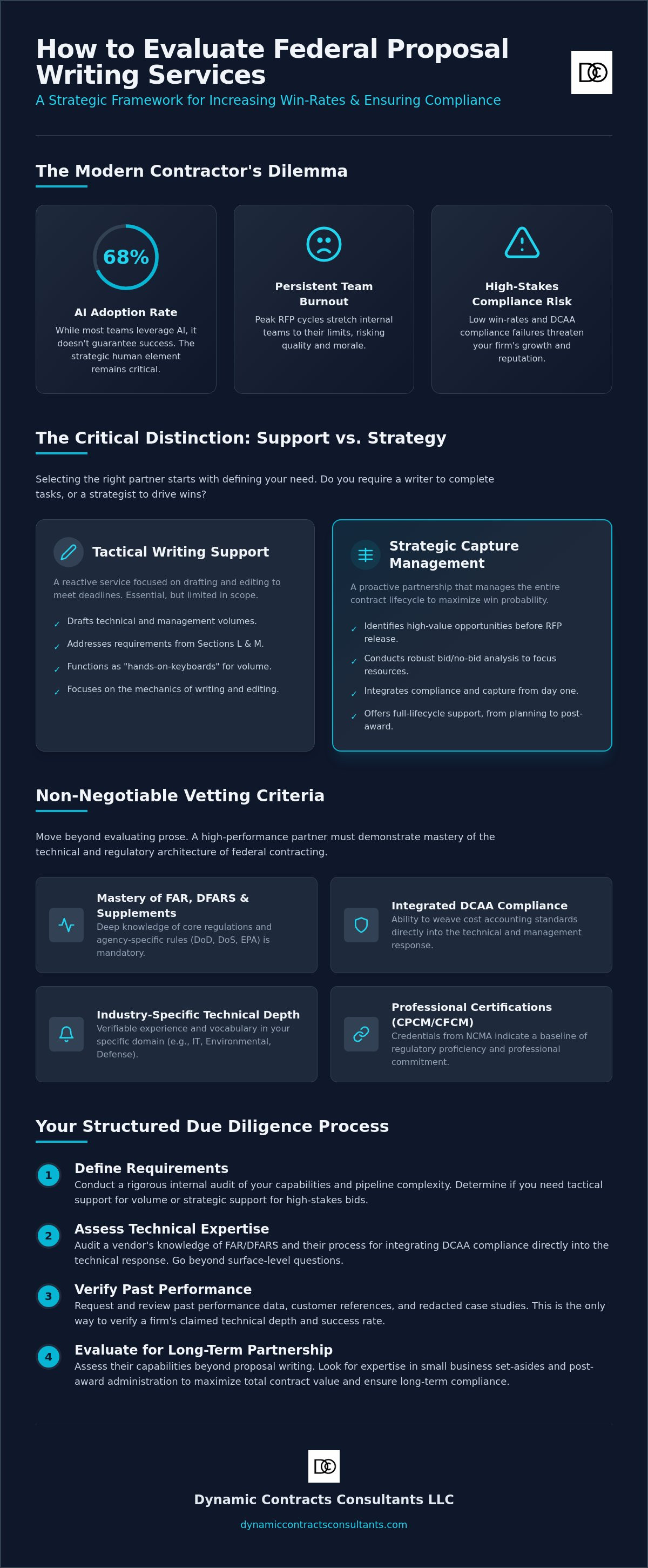
While 68% of proposal teams are now using AI in 2026, a significant number of federal contractors still face low win-rates and the threat of DCAA compliance failures. You've likely experienced the intense burnout that occurs when internal teams are stretched to their limits during peak RFP cycles. It's a common challenge to maintain high submission volumes without sacrificing the technical precision required by the Revolutionary FAR Overhaul Initiative. Learning how to evaluate proposal writing services is no longer just about finding a writer; it's about identifying a strategic partner that understands the nuances of the current regulatory environment.
We'll provide you with a repeatable framework to vet vendors based on their ability to integrate capture management with high-quality technical responses. You'll learn the specific criteria needed to distinguish between generic copywriting and expert-level compliance. This guide ensures you can select a high-performance partner that protects your firm from regulatory risk while significantly increasing your competitive edge in the federal marketplace.
Key Takeaways
- Distinguish between tactical writing support and strategic capture management to ensure your external resources align with the complexity of upcoming solicitations.
- Master how to evaluate proposal writing services by auditing a vendor's knowledge of FAR supplements and their ability to integrate DCAA compliance into technical responses.
- Assess the operational efficiency of AI-driven acquisition planning versus traditional manual drafting to optimize your bid-no-bid analysis and submission timelines.
- Implement a structured due diligence process that utilizes past performance data and redacted case studies to verify a firm's technical depth.
- Leverage specialized expertise in small business set-asides and post-award administration to maintain long-term compliance and maximize your total contract value.
Defining Your Requirements: Determining the Scope of Proposal Support
Before you begin the selection process, you must conduct a rigorous internal audit of your current capabilities and the complexity of your upcoming pipeline. Many firms mistakenly view every business proposal as a mere writing task, overlooking the underlying strategic and regulatory frameworks that dictate success in the federal sector. If your internal team is experiencing burnout during peak RFP cycles, it's a clear indicator that your current resource allocation is insufficient for your submission volume. Understanding how to evaluate proposal writing services starts with determining whether you require a simple volume drafter or a comprehensive strategic partner capable of managing the entire contract lifecycle.
We recommend categorizing your needs based on the maturity of your capture process. A targeted RFP response editing service might suffice for routine task orders under existing IDIQs. However, multi-year, high-stakes solicitations demand a partner that offers specialized proposal services, including technical drafting and rigorous compliance cross-referencing. You must decide if your organization requires full-lifecycle support, from acquisition planning to post-award administration, or if you simply need additional "hands on keyboards" to meet a deadline.
Tactical Writing vs. Strategic Capture Management
A tactical proposal writer focuses on the mechanics of drafting technical and management volumes. Their primary role is to ensure that the narrative addresses every requirement listed in Sections L and M of the solicitation. While essential, this role is reactive. Strategic capture management, conversely, identifies high-value opportunities long before the RFP is released. This proactive approach allows you to shape the requirements and build the necessary teaming agreements. At Dynamic Contracts Consultants, we emphasize that a robust bid/no-bid analysis is the foundation of a healthy resource allocation strategy. It prevents the dilution of your efforts on low-probability opportunities, ensuring your investment is directed toward wins that align with your long-term growth objectives.
Assessing Regulatory Complexity in Solicitations
The regulatory environment in 2026 is increasingly stringent, particularly following the "Revolutionary" FAR Overhaul Initiative. You must identify solicitations that require strict DCAA compliance or specialized cost accounting standards. General business writers often lack the specialized knowledge to navigate DFARS or agency-specific supplements from the DoD, DoS, or EPA. Using writers who don't understand these nuances introduces significant risk to your submission. Expert proposal writing must integrate acquisition planning and compliance from the start. This ensures that your technical response isn't just persuasive, but also legally and financially sound. Failing to verify a firm's mastery of these complex systems can lead to disqualification or, worse, post-award audits that jeopardize your firm's standing.
Core Evaluation Criteria: Assessing Technical Expertise and Compliance Knowledge
When you determine how to evaluate proposal writing services, you must move beyond stylistic prose and focus on the technical architecture of the response. A high-performance partner doesn't just write; they engineer a compliant solution that survives the rigors of a technical evaluation board. You should prioritize firms that demonstrate a deep mastery of the Federal Acquisition Regulation (FAR) and its various agency-specific supplements. This expertise is vital for ensuring that every claim in your technical volume is backed by a compliant management or cost strategy. It's also prudent to verify professional certifications such as the Certified Professional Contract Manager (CPCM) or Certified Federal Contract Manager (CFCM) from the NCMA, as these indicate a baseline of regulatory proficiency.
Industry-specific experience remains a non-negotiable criterion. A firm that excels in Environmental Services might lack the technical vocabulary required for an Aerospace or Engineering solicitation. You should request concrete evidence of their past performance as either a prime or subcontractor on federal awards. To effectively choose the right government proposal consultant, you must scrutinize their track record with Contractor Purchasing System Reviews (CPSR) and their internal quality control protocols. This level of due diligence ensures that your partner understands the operational realities of the work they are helping you bid on.
Regulatory Mastery: FAR and DFARS Proficiency
A sophisticated government proposal writing service must understand the implications of flow-down clauses from the very beginning of the drafting process. These clauses impact your teaming agreements and subcontractor management plans, which are often heavily weighted during evaluation. By integrating expert acquisition planning into the proposal phase, you reduce the risk of legal friction during the post-award period. This regulatory depth is especially critical when drafting Small Business Subcontracting Plans. These plans must be both ambitious and achievable to satisfy agency-specific goals while remaining compliant with the latest 2026 SBA regulations.
Financial and Audit Readiness (DCAA)
The cost volume is frequently the most scrutinized portion of a federal submission. You should evaluate a firm's capability to provide DCAA compliance consulting as an integrated part of their proposal support. They must be able to conduct rigorous cost and price analysis to ensure your submission is audit-proof. This involves a thorough understanding of allowable costs, indirect rate structures, and the documentation required for a successful audit. If you are concerned about your current level of financial readiness for an upcoming solicitation, you can request a professional compliance audit to identify potential gaps in your cost volume strategy.
Methodology and Technology: Comparing Traditional vs. AI-Driven Proposal Development
The federal procurement environment in 2026 has shifted drastically due to the rapid integration of artificial intelligence. Recent data indicates that 68% of proposal teams now utilize AI to enhance their workflows, resulting in a 17% decrease in average response times. When you consider how to evaluate proposal writing services, you must analyze whether a firm relies on outdated, purely manual drafting or if they've adopted a modern, AI-augmented development cycle. Traditional methods often struggle to keep pace with the compressed timelines of current RFPs, whereas AI-driven platforms like FARIFY.ai provide a distinct competitive advantage in both speed and initial compliance screening.
Technology alone is insufficient for high-stakes federal contracting. A firm's methodology must balance automated efficiency with deep human expertise. You should inquire about the security protocols of their proprietary tools and how they ensure that sensitive acquisition data remains protected. The most effective partners use AI as a force multiplier for their AI proposal writing services, allowing their senior consultants to focus on high-level strategy rather than administrative data entry. This synergy ensures that your submission isn't just fast, but also strategically superior to competitors using legacy processes.
The Role of AI in Federal Acquisition Planning
Modern acquisition planning now leverages AI to synthesize thousands of pages of solicitation requirements in minutes. These tools are particularly effective for rapid bid/no-bid analysis, where historical agency data is used to predict your probability of success. We utilize these technologies to ensure that your resources are only committed to the most viable opportunities. Additionally, customized proposal templates generated through AI ensure that your brand and compliance standards remain consistent across multiple volumes, regardless of the complexity of the project. This systematic approach reduces the risk of administrative rejection due to formatting or structural errors.
Human-in-the-Loop: Ensuring Strategic Accuracy
Despite the efficiency of automation, AI-generated content still requires rigorous review by certified contract managers. You shouldn't trust a service that relies solely on machine outputs. Strategic accuracy requires a nuanced understanding of "win-themes" that only an experienced human strategist can provide. This "human-in-the-loop" approach is essential for verifying that all content aligns with the most recent updates from the Revolutionary FAR Overhaul Initiative. Experts must manually refine the AI's output to reflect the specific political and operational context of the target agency, ensuring your narrative resonates with the technical evaluation board's specific priorities.
The Due Diligence Checklist: Verifying Performance and Strategic Fit
Executing a rigorous due diligence process is the final safeguard against selecting a partner that looks competent on paper but fails in the high-pressure environment of a live solicitation. When you determine how to evaluate proposal writing services, you must move beyond superficial testimonials and examine the structural integrity of their past performance. A firm's ability to scale is especially critical in 2026, as federal agencies increasingly release concurrent RFPs with overlapping deadlines. You need to verify that your chosen partner has the bench strength to handle multiple submissions without compromising the technical depth of any single response.
A comprehensive checklist should include a request for redacted case studies or sample proposals that demonstrate their ability to articulate complex technical solutions. Surface-level writing is easily identified by evaluation boards and often leads to lower scores in the technical volume. Additionally, you should evaluate their project management efficiency. Ask for a demonstration of their communication protocols and how they maintain version control during the rapid-fire drafting phases. Understanding their familiarity with your target agency's specific procurement trends and internal culture is equally vital, as this knowledge allows for a more tailored and persuasive narrative.
Vetting Past Performance and References
When speaking with references, focus your inquiries on contracts that mirror the size and scope of your current target. Generic success stories don't always translate to the complexities of multi-agency acquisitions or large-scale IDIQs. You should specifically ask about their "win-rate" methodology. Some firms report inflated percentages by only including qualified leads, while others provide a more transparent view of their total submission history. It's important to understand if they've successfully navigated the specific challenges of your industry, whether as a prime contractor or a specialized subcontractor. This distinction often determines how effectively they can manage the flow-down requirements discussed in previous sections.
Evaluating Strategic and Cultural Fit
The most successful engagements occur when the firm acts as a strategic partner rather than a transactional vendor. You should assess their level of transparency regarding project milestones and their willingness to provide candid feedback during the bid/no-bid phase. In the current regulatory climate, their protocols for protecting Controlled Unclassified Information (CUI) and proprietary data are non-negotiable. Review their internal security standards to ensure they meet the latest federal requirements for data handling. If you're ready to move forward with a partner that prioritizes both technical excellence and rigorous security, you can schedule a strategic capability briefing to discuss your upcoming pipeline.
Partnering for Long-Term Success: The Dynamic Contracts Consultants Advantage
Choosing a strategic partner requires a shift from viewing proposals as isolated events to seeing them as the start of a multi-year contractual relationship. When you master how to evaluate proposal writing services, you realize that the most valuable firms are those that simplify the complex regulatory environment rather than just reacting to RFPs. We provide a solution-driven approach that aligns your technical capabilities with the specific needs of federal agencies. Our status as a minority-owned firm provides us with specialized expertise in navigating small business set-asides, ensuring you can maximize your competitive advantages under various socio-economic programs.
Continuity is the cornerstone of a successful federal practice. Many contractors suffer from a disconnect between the capture phase and the execution phase. We solve this by offering integrated post-award contract administration, ensuring that the compliance standards established during the proposal are maintained throughout the contract's lifecycle. This holistic view protects your firm's reputation and ensures that your performance ratings remain high for future solicitations. We don't just help you win; we help you perform and grow.
Comprehensive Lifecycle Support
Our team bridges the gap between initial proposal development and long-term lifecycle management. We don't just hand over a document; we build a foundation for success. Our strategy is led by CPCM and CFCM certified experts who understand the nuances of the "Revolutionary" FAR Overhaul Initiative. By integrating FARIFY.ai into our workflow, we provide data-driven acquisition planning and bid-no-bid analysis that identifies the most profitable paths for your organization. This technological edge, combined with our human expertise, ensures your capture strategy is both aggressive and compliant. This lifecycle approach is a key differentiator when you determine how to evaluate proposal writing services for high-value contracts.
Securing Your Federal Future
Long-term stability in the federal market depends on more than just winning a single award. It requires a relentless focus on DCAA compliance and a deep understanding of acquisition strategy. We help you navigate the complex dynamics between prime contractors and subcontractors, ensuring that flow-down clauses and reporting requirements are handled with precision. Our goal is to position your firm as a reliable, low-risk partner for any federal agency. Contact Dynamic Contracts Consultants today for a comprehensive evaluation of your proposal needs and take the first step toward maximizing your federal win-rate and ensuring total regulatory compliance.
Securing Your Competitive Edge in the 2026 Federal Marketplace
Mastering the nuances of how to evaluate proposal writing services is the first step toward transforming your federal business development from a reactive process into a strategic asset. You now have a repeatable framework to prioritize technical depth and regulatory compliance over simple narrative drafting. By integrating capture management with expert-led proposal development, you ensure that every submission is audit-ready and positioned for a high-performance win. This shift in perspective protects your organization from the risks of DCAA compliance failures and internal team burnout.
Established in 2015, we bring over a decade of specialized federal expertise to your most critical solicitations. Our team includes Certified Professional Contracts Managers (CPCM) who oversee every stage of the contract lifecycle. As pioneers in AI-driven acquisition planning via FARIFY.ai, we provide the technological precision necessary to navigate the current regulatory environment. We invite you to Schedule a Strategic Consultation with Our Federal Acquisition Experts to discuss your upcoming pipeline. Your path to a higher win-rate and total regulatory security starts with a partner dedicated to your long-term success.
Frequently Asked Questions
What is the difference between a proposal writer and a capture manager?
A capture manager focuses on the pre-solicitation phase to position your firm for success, while a proposal writer executes the actual drafting of the technical and management volumes once the RFP is released. Capture management involves identifying high-value opportunities and building teaming agreements; proposal writing translates those strategies into a compliant, persuasive submission. Both roles are essential for a high-performance win-rate.
How do I know if a proposal writing service understands DCAA compliance?
To verify a firm's mastery of DCAA compliance, you should ask for their specific methodology for handling indirect rate structures and allowable costs within the cost volume. A qualified service should offer integrated DCAA compliance consulting and demonstrate a history of assisting clients through successful Procurement System Reviews (CPSR). They must understand how to engineer a cost volume that survives the rigors of a federal audit.
Can AI truly write a compliant federal proposal?
AI can significantly accelerate the drafting process and provide initial compliance screening, but it cannot produce a submission-ready federal proposal without expert oversight. Tools like FARIFY.ai are most effective when utilized by certified contract managers who provide the necessary "human-in-the-loop" strategic refinement. This ensure that all content aligns with the latest 2026 updates from the Revolutionary FAR Overhaul Initiative.
What certifications should I look for in a proposal writing consultant?
You should prioritize consultants who hold certifications from the National Contract Management Association (NCMA), such as the Certified Professional Contract Manager (CPCM) or Certified Federal Contract Manager (CFCM). These credentials verify a baseline of regulatory proficiency and a commitment to professional standards. These certifications ensure your partner understands the complex legal frameworks governing federal acquisitions.
How much should I expect to pay for professional proposal writing services?
Pricing for professional support typically depends on the complexity of the solicitation and the level of technical depth required for the response. When you determine how to evaluate proposal writing services, you'll find that firms may utilize hourly rates or project-based fees. The total investment is influenced by whether your organization requires a full-lifecycle response or targeted editing of an existing draft.
What is a bid/no-bid analysis and why is it included in evaluation?
A bid/no-bid analysis is a rigorous evaluation of your probability of win (pWin) compared to the resources required for a compliant submission. It's a critical component of how to evaluate proposal writing services because it demonstrates a partner's commitment to strategic resource allocation. A partner who insists on this analysis helps you avoid wasting capital on low-probability opportunities.
How does a proposal service handle technical information they aren't experts in?
Professional services utilize structured Subject Matter Expert (SME) interviews to extract technical knowledge from your internal team. They then translate this specialized data into a persuasive, compliant narrative that meets the specific requirements of Section L and Section M. This process ensures that your technical superiority is clearly communicated to the evaluation board without losing technical accuracy.
What happens after the contract is awarded?
After a successful award, the focus shifts to post-award contract administration to ensure ongoing compliance with flow-down clauses and reporting requirements. A comprehensive partner provides continuity by managing these administrative obligations and preparing your firm for potential audits. This long-term support protects your firm's performance ratings and secures your standing for future federal acquisitions.


