

A single subcontractor failure can jeopardize your entire prime contract and trigger a devastating Contractor Purchasing System Review that halts your operations. You already understand that managing external partners is no longer a passive administrative task; it's a high-stakes strategic necessity. With the TINA threshold recently increasing to 10 million dollars for defense contracts and new DEI requirements like FAR 52.222-90 becoming mandatory as of April 2026, the margin for error in subcontractor management for government contracts has never been thinner. The complexity of mandatory flow-down clauses often creates significant liability for prime contractors who lack a structured oversight process.
At Dynamic Contracts Consultants LLC, we master these complexities by providing a rigorous framework for flow-down execution and risk mitigation. You'll learn how to navigate the shift from the decommissioned eSRS to the new Subcontracting Plan Reporting system within SAM.gov while ensuring your business systems remain audit-ready. This guide examines the essential protocols for mandatory clauses, preparation for DCAA and DCMA reviews, and the strategic oversight required to maintain total contract compliance and improve your long-term win rates.
Key Takeaways
- Understand the critical nature of "Privity of Contract" and why prime contractors remain solely liable to federal agencies for subcontractor performance failures.
- Integrate rigorous responsibility determinations into your capture management strategy to ensure every partner meets stringent federal eligibility criteria.
- Master the execution of mandatory flow-down clauses to ensure comprehensive subcontractor management for government contracts while identifying optional provisions that mitigate your specific commercial risks.
- Establish a proactive post-award administration framework to monitor subcontractor performance and navigate complex change orders without compromising contract integrity.
- Leverage specialized expertise to streamline the oversight of multi-layered regulatory requirements and maintain a compliant, audit-ready business system.
The Fundamentals of Subcontractor Management in Federal Contracting
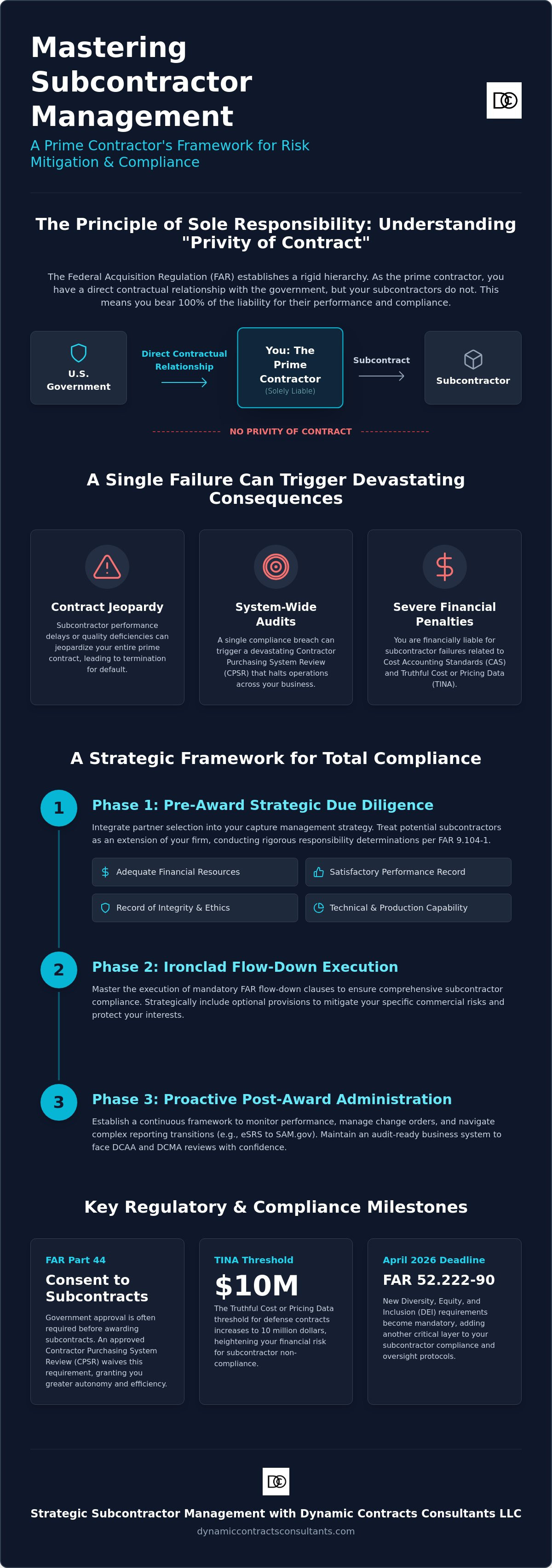
The Federal Acquisition Regulation (FAR) establishes a rigid hierarchy within the procurement process. At the center of this structure lies the prime contractor, who holds a direct contractual relationship with the government. Effective subcontractor management for government contracts begins with understanding "Privity of Contract." This legal principle dictates that no direct legal relationship exists between the government and the subcontractor. Consequently, the government looks solely to you, the prime contractor, for the successful execution of all contract requirements, regardless of which entity actually performs the work. This lack of privity means you bear the full weight of subcontractor failures, including performance delays, quality deficiencies, or compliance breaches.
To maintain a compliant posture, you must distinguish between your various partners. A Subcontractor Definition generally refers to an entity that performs a specific portion of the prime contract's scope of work. This differs from vendors or suppliers who provide "off-the-shelf" commercial products or general services not uniquely tailored to the government's specific requirements. Properly categorizing these entities is essential, as regulatory burdens often shift based on the nature of the relationship. Strategically, subcontracting remains a vital tool for meeting small business set-aside goals, which can significantly enhance your competitive position during the capture management phase.
Prime Contractor Responsibilities and Liabilities
Your role as a prime contractor is that of a central hub. You're responsible for all quality control and oversight, acting as the exclusive intermediary for all official government communications. Your primary obligations include:
- Verifying the technical and financial capability of all sub-tier partners.
- Ensuring strict adherence to quality assurance standards specified in the prime contract.
- Managing the timely flow of payments to prevent performance disruptions.
If a subcontractor fails to adhere to Cost Accounting Standards (CAS) or Truthful Cost or Pricing Data (TINA) requirements, the government will hold you financially liable for any overpayments or penalties. This financial risk is substantial, especially since the TINA threshold for defense contracts increased to 10 million dollars for awards after June 30, 2026. You must ensure your post-award compliance protocols are robust enough to catch these discrepancies before they trigger a federal audit.
The Regulatory Framework: FAR Part 44
FAR Part 44 provides the specific policies governing "Consent to Subcontracts." In many cost-reimbursement or high-value fixed-price contracts, you must obtain written government approval before awarding work to a subcontractor. This requirement is often waived if you've successfully passed a Contractor Purchasing System Review (CPSR). A CPSR is an exhaustive evaluation of your internal purchasing policies and procedures. Maintaining an approved purchasing system is a hallmark of professional subcontractor management for government contracts, as it grants you greater autonomy and reduces the administrative burden of seeking individual consent for every sub-tier award. Proactive management of these systems ensures that your procurement processes remain transparent and compliant with the latest federal standards.
Pre-Award Selection and Strategic Due Diligence
Strategic procurement begins long before a contract is awarded. Integrating partner selection into your broader capture management strategy ensures that your proposal reflects a cohesive, capable team rather than a fragmented group of vendors. High-performance subcontractor management for government contracts requires you to treat potential partners as extensions of your own firm during the pre-award phase. This involves more than just verifying technical capacity; it requires a rigorous "Responsibility Determination" to ensure every entity meets the standards of FAR 9.104-1. You must confirm that potential subcontractors possess adequate financial resources, the ability to comply with delivery schedules, and a satisfactory record of integrity and business ethics.
Evaluation should focus on how a subcontractor’s specific past performance aligns with the requirements of the Request for Proposal (RFP). Simply having a strong general reputation isn't enough. You need data-backed evidence of their success in similar federal environments. This due diligence is supported by resources like the SBA Guide to Prime and Subcontracting, which outlines the expectations for small business participation and prime responsibility. If you're unsure how to structure these early evaluations, you can consult with our strategic advisors to refine your vetting process.
Vetting Subcontractors for Compliance and Risk
Vetting is a multi-layered process that starts with the System for Award Management (SAM.gov). You must verify that a subcontractor isn't currently excluded or debarred from federal work. Beyond basic eligibility, you must assess their internal infrastructure. If the prime contract is cost-reimbursable, you need to verify their accounting system's readiness for DCAA oversight. With the Department of Defense enforcing Cybersecurity Maturity Model Certification (CMMC) requirements, a subcontractor’s cybersecurity posture is now a non-negotiable prerequisite. A single partner with inadequate data protection can disqualify your entire bid.
Drafting Compliant Teaming Agreements
A teaming agreement serves as the foundational document for your partnership, yet it shouldn't be treated as a mere formality. It must clearly define the subcontractor’s Statement of Work (SOW) to ensure it aligns perfectly with your prime proposal. These agreements must establish rigid protocols for handling proprietary data and intellectual property to prevent future disputes. Clear expectations regarding workshare percentages and exclusivity are also essential. By addressing these factors early, you mitigate the risk of performance failures after the contract is awarded. Setting these boundaries protects your interests while fostering a collaborative environment for the proposal phase.
Implementing Mandatory Contract Flow-Down Requirements
Contract flow down requirements are the mechanism that extends federal oversight to the entire supply chain. In the professional execution of subcontractor management for government contracts, these requirements ensure that the legal and regulatory obligations you accepted as a prime contractor are mirrored in your agreements with sub-tier partners. You must distinguish between mandatory flow-downs, which are required by the Federal Acquisition Regulation (FAR), and optional flow-downs, which you include to mitigate your own commercial risk. Failing to include a mandatory clause doesn't always absolve the subcontractor. Many provisions are "self-executing" under the Christian Doctrine. This means they apply by operation of law even if you omitted them from the written subcontract text.
Utilizing customized templates is essential for maintaining consistency across your supply chain. These templates should be dynamic enough to account for changing thresholds and new executive orders. For example, the threshold for requiring certified cost or pricing data under the Truthful Cost or Pricing Data (TINA) act increased to 10 million dollars for defense contracts entered into after June 30, 2026. Your templates must reflect these updates to avoid over-complicating agreements or, conversely, leaving gaps in your post-award compliance framework.
Critical FAR and DFARS Flow-Down Categories
Your compliance strategy must prioritize high-risk regulatory categories that trigger significant liability. Ethics and conduct clauses, such as FAR 52.203-13, are mandatory for subcontracts exceeding 6 million dollars with performance periods over 120 days. Socio-economic requirements are equally vital. As of April 24, 2026, the new DEI clause, FAR 52.222-90, must be included in all subcontracts above the 15,000 dollar micro-purchase threshold. For defense work, you must flow down DFARS 252.204-7012 to ensure subcontractors provide adequate security for controlled unclassified information. These FAR Subcontracting Policies dictate that prime contractors are responsible for ensuring their supply chain adheres to these evolving standards.
Best Practices for Subcontract Drafting
Efficiency in drafting requires a balance between legal precision and administrative brevity. While incorporating clauses by reference is common, providing the full text for critical compliance areas reduces the risk of subcontractor misunderstanding. We recommend developing a "Flow-Down Matrix" that maps the prime contract's requirements to specific tiers. This matrix should track specific thresholds, such as the 900,000 dollar limit for small business subcontracting plans in general contracts. Consider these steps for your drafting process:
- Require subcontractors to provide a signed acknowledgment of all regulatory obligations.
- Differentiate between "commercial item" subcontracts and those subject to full FAR coverage to avoid unnecessary burdens.
- Establish clear protocols for the subcontractor to report their own compliance data.
- Audit your subcontracts periodically to ensure self-executing clauses are properly managed.
By maintaining a structured approach to flow-downs, you protect your firm from the liability of subcontractor failures and ensure your business systems remain audit-ready for the DCMA.
Post-Award Administration and Compliance Monitoring Protocols
Transitioning from the selection phase to contract execution requires a shift toward active, documented oversight. Effective subcontractor management for government contracts isn't a passive administrative function; it's a continuous cycle of verification that ensures your partners remain compliant with the flow-down requirements established in the initial agreement. As the prime contractor, you bear the burden of proving that your subcontractors are meeting their technical and regulatory obligations. This oversight is critical for maintaining your business system's integrity, particularly when facing a Contractor Purchasing System Review (CPSR) or a DCAA audit. You must establish a monitoring framework that captures real-time performance data and financial accuracy throughout the contract lifecycle.
Your administration process must also account for the recent decommissioning of the Electronic Subcontracting Reporting System (eSRS). All subcontracting plan reporting functionality has been transferred to the new Subcontracting Plan Reporting (SPR) system within SAM.gov as of early 2026. Maintaining accurate records within this new system is mandatory for prime contractors with contracts exceeding the 900,000 dollar threshold for general work or 2 million dollars for construction. Failure to report accurately can negatively impact your past performance ratings and jeopardize future awards.
Performance Monitoring and Quality Assurance
Rigorous performance tracking begins with implementing regular status reports and technical reviews tailored to the subcontractor's specific Statement of Work. You don't just wait for the final deliverable; you track progress against the master contract schedule to identify potential delays before they impact the government's timeline. If a subcontractor underperforms, your protocols must include a clear, tiered process for corrective action. This includes formal deficiency notices and, if necessary, a structured default process. Managing change orders and equitable adjustments at the subcontract level also requires meticulous documentation to ensure any modifications are reflected in your prime contract communications.
Financial Oversight and DCAA Compliance
Financial administration is perhaps the most high-risk area of post-award management. You're responsible for reviewing subcontractor invoices for accuracy, ensuring that all billed costs are allowable, allocable, and reasonable under FAR Part 31. This is especially vital for cost-reimbursement subcontracts where the risk of overbilling is highest. You must also verify that subcontractors maintain their required insurance and bonding levels throughout the period of performance. We recommend integrating these checks into your broader post-award compliance strategy to ensure your firm is always prepared for a sudden government inquiry. Proper closeout procedures are the final step, ensuring all federal reporting is finalized and all proprietary data is returned or destroyed. If you're concerned about your current oversight framework, you should schedule a comprehensive audit readiness review to identify and mitigate potential liabilities.
Strategic Subcontractor Management with Dynamic Contracts Consultants LLC
Navigating the intricate landscape of federal regulations alone often leads to costly oversights and increased audit risk. Dynamic Contracts Consultants LLC provides the specialized expertise required to transform subcontractor management for government contracts from a persistent administrative burden into a robust competitive advantage. Our team understands that compliance isn't a one-time event but a continuous commitment to operational excellence. By integrating our proactive flow-down clause management with rigorous post-award administration, we ensure your organization remains resilient against shifting federal requirements and agency scrutiny. We don't just offer advice; we implement repeatable frameworks that protect your prime contract status.
Our approach leverages advanced technology to maintain precision in high-stakes environments. We utilize tools like FARIFY.ai and AI-driven acquisition planning to identify potential risks before they manifest in your supply chain. These digital resources, combined with our customized proposal templates, allow for the efficient execution of contract lifecycle management without sacrificing the detail necessary for DCAA audit readiness. Dynamic Contracts Consultants LLC is committed to protecting your organization from the cascading risks of subcontractor non-compliance, ensuring every partner in your supply chain adheres to the same standards of integrity and performance that you do.
Comprehensive Contract Administration Services
Our consultants provide deep industry knowledge that covers every phase of the procurement process. We offer expert guidance on DCAA compliance and acquisition planning, ensuring your internal business systems are prepared for the most demanding evaluations. During the pre-award phase, our capture management experts help you identify and vet high-value subcontracting partners who possess the technical maturity and past performance required for complex awards. By utilizing our outsourced contract management solutions, you reduce your internal administrative burden while maintaining total visibility into subcontractor performance and financial accuracy.
Achieving Compliance Excellence
Audit readiness is the cornerstone of our strategic methodology. Dynamic Contracts Consultants LLC prepares your firm's purchasing system for the rigors of CPSR and DCAA scrutiny by documenting every transaction and verifying every flow-down requirement. Our team creates customized flow-down matrices that track essential provisions, from cybersecurity protocols to the latest socio-economic mandates. These matrices serve as a definitive record of compliance, providing the transparency government auditors demand. You can contact our experts to optimize your subcontractor management and proposal writing strategies. We'll help you secure your current contracts and position your firm for sustainable growth in the federal marketplace.
Strengthening Your Supply Chain Resilience
Mastering subcontractor management for government contracts requires a shift from reactive administration to proactive strategic oversight. You've seen that the prime contractor bears the ultimate responsibility for every tier of performance, from initial vetting to final closeout. Success in this complex environment hinges on your ability to implement rigorous flow-down protocols and maintain an audit-ready business system that can withstand the scrutiny of federal agencies. By prioritizing these compliance frameworks, you protect your past performance ratings while securing your firm's long-term eligibility for high-value awards.
The team at Dynamic Contracts Consultants LLC brings deep expertise in FAR, DFARS, and DCAA regulations to your organization. Our Certified Professional Contracts Managers (CPCM) have a proven track record of supporting contractors across the DoD, NASA, and EPA, providing the meticulous oversight necessary to mitigate risk in multi-layered supply chains. Consult with our federal contract experts to secure your supply chain compliance and ensure your business remains a leader in the federal marketplace. You have the capability to turn regulatory complexity into a sustainable competitive advantage.
Frequently Asked Questions
What are mandatory flow-down clauses in government contracts?
Mandatory flow-down clauses are specific provisions within the Federal Acquisition Regulation (FAR) that prime contractors must legally include in their subcontracts to extend federal oversight. These clauses ensure that critical standards regarding ethics, socio-economic goals, and data security are maintained throughout the entire supply chain. Failure to include these mandatory provisions can lead to contract non-compliance and significant liability for the prime contractor during government audits.
How does a prime contractor manage subcontractor compliance?
A prime contractor manages compliance by implementing a rigorous oversight framework that begins with pre-award responsibility determinations and continues through real-time performance monitoring. Effective subcontractor management for government contracts relies on utilizing a flow-down matrix to track mandatory requirements and conducting regular technical reviews. This structured approach ensures that all deliverables meet the quality standards and regulatory obligations defined in the master contract while mitigating the risk of performance failures.
Is a prime contractor liable for a subcontractor’s DCAA audit failure?
Yes, the prime contractor remains solely liable to the government for any financial discrepancies or non-allowable costs identified in a subcontractor’s operations. Because the government lacks privity of contract with the subcontractor, they'll hold you responsible for overpayments or accounting failures. You must ensure your partners maintain DCAA-compliant accounting systems to avoid these cascading financial liabilities during your own audits and Contractor Purchasing System Reviews.
What is the difference between a mandatory and a non-mandatory flow-down clause?
Mandatory flow-down clauses are required by federal law or regulation to maintain the integrity of the procurement process, whereas non-mandatory clauses are optional provisions added to protect the prime contractor’s commercial interests. While mandatory clauses cover areas like small business subcontracting and labor laws, non-mandatory clauses often address dispute resolution, indemnification, or termination for convenience. Properly distinguishing between these allows for more efficient contract drafting and targeted risk management.
How do I prepare for a Contractor Purchasing System Review (CPSR)?
Preparing for a CPSR requires an exhaustive internal audit of your purchasing policies to ensure they align with FAR Part 44 requirements. You must document your entire procurement lifecycle, from competitive bidding and price analysis to the execution of flow-down clauses. Maintaining a centralized record of all subcontractor responsibility determinations is essential for demonstrating that your purchasing system is transparent, consistent, and compliant with the latest federal standards.
Can a prime contractor be penalized for a subcontractor’s lack of cybersecurity compliance?
Yes, a subcontractor’s failure to meet cybersecurity standards, such as those defined in DFARS 252.204-7012 or CMMC, can result in the prime contractor’s disqualification from current or future awards. The government views data protection as a collective supply chain responsibility. If a partner’s inadequate security leads to a data breach of controlled unclassified information, you're the entity that faces the regulatory consequences, potential contract termination, and negative past performance ratings.
What happens if a prime contractor fails to flow down a required FAR clause?
Failing to flow down a required FAR clause can trigger penalties for non-compliance, though many mandatory provisions are considered self-executing under the Christian Doctrine. This legal principle means the clause applies by operation of law even if omitted from the written subcontract. However, the omission itself suggests a failure in your internal purchasing system, which can negatively impact your CPSR results and lead to increased government oversight or financial penalties.
How does Dynamic Contracts Consultants assist with subcontractor management?
Dynamic Contracts Consultants simplifies subcontractor management for government contracts by providing expert-driven oversight throughout the contract lifecycle. We assist with DCAA-compliant accounting system reviews, the customization of flow-down matrices, and preparation for rigorous CPSR evaluations. Our team uses AI-driven tools and customized templates to identify regulatory risks early, ensuring your supply chain remains compliant while reducing your internal administrative burden and protecting your prime contract status.


