

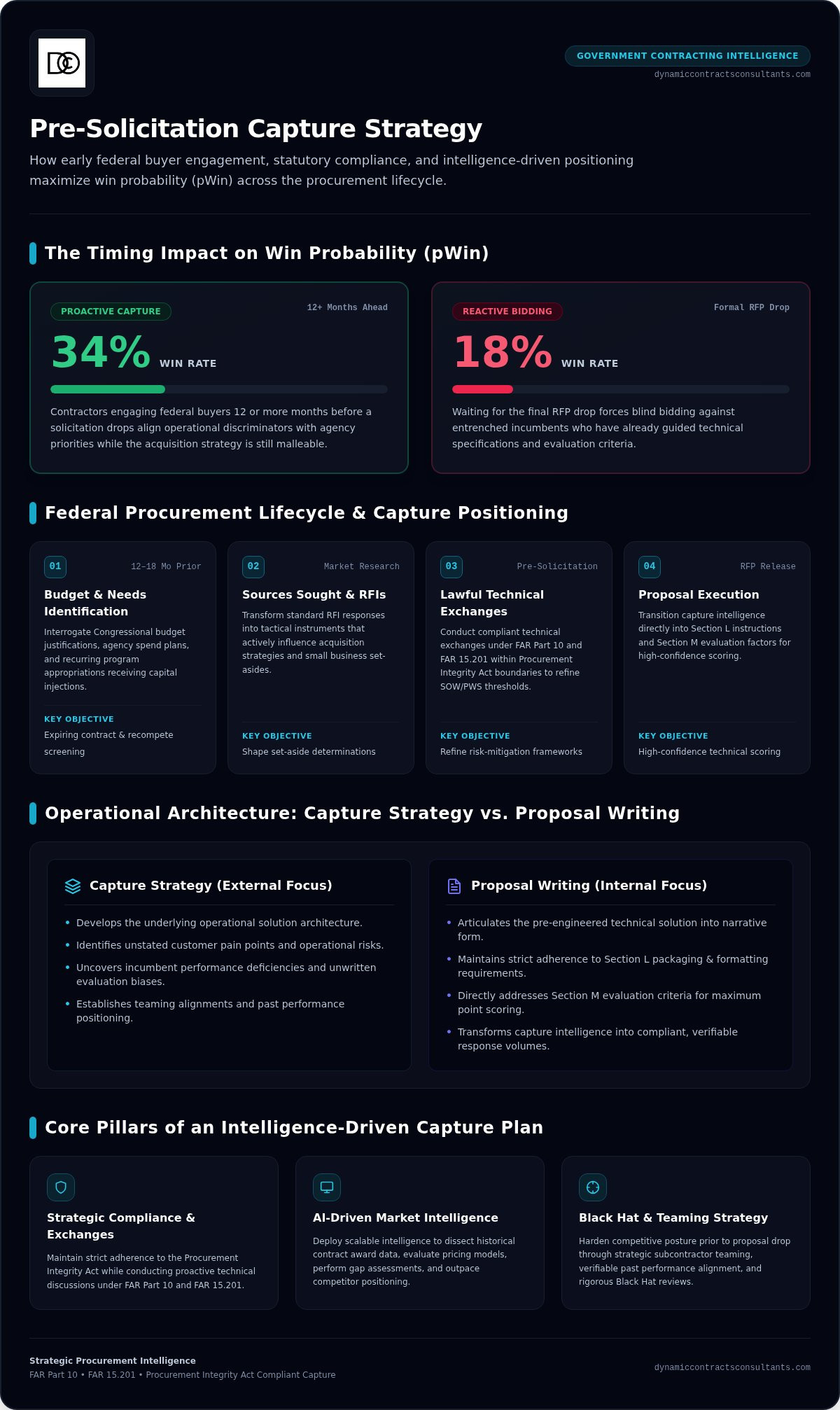
Contractors who engage federal buyers 12 or more months before a solicitation drops achieve a 34% win rate; waiting for the formal RFP cuts that probability to just 18%. Executing an intelligence-driven pre-solicitation capture strategy is what truly separates market leaders from teams constantly chasing low-probability solicitations. We understand how frustrating it is to discover an opportunity too late, when an entrenched incumbent has already guided the specifications and your team is left burning vital proposal resources on blind bids.
You can change that dynamic. Discover how to shape federal procurements, position technical capabilities, and maximize win-rates before the final RFP drops. In the guide ahead, we examine how to establish strategic positioning with agency program managers within Procurement Integrity Act boundaries, influence Statements of Work legally, and build a defensible capture plan backed by verifiable past performance across the entire procurement lifecycle.
Key Takeaways
- Align your business development pipeline 12 to 18 months ahead of RFP publication to execute a compliant pre-solicitation capture strategy that dramatically elevates your win probability.
- Master the structured framework required to ethically shape Statements of Work (SOW) and Performance Work Statements (PWS) while maintaining strict adherence to Procurement Integrity Act guidelines.
- Transform standard Sources Sought and RFI responses into tactical instruments that actively influence agency acquisition strategies and small business set-aside determinations.
- Deploy AI-driven automation and scalable intelligence to dissect historical contract award data, perform gap assessments, and outpace competitor positioning.
- Harden your competitive posture prior to proposal drop through aggressive teaming strategies, verifiable past performance alignment, and rigorous Black Hat reviews.
Deconstructing the Pre-Solicitation Capture Strategy: Why Timing Dictates Win Probability
A successful pre-solicitation capture strategy is the systematic positioning of your organization's technical capabilities long before an agency issues a formal solicitation. Reactive bidding forces contractors to respond blindly to requirements crafted by competitors. Proactive capture, by contrast, aligns your operational discriminators with agency priorities while the acquisition strategy is still malleable. When contractors formalize this process within a structured capture plan, their probability of win (pWin) increases dramatically because technical solutions directly reflect the customer's unstated operational risks.
To examine how proactive positioning alters your competitive posture, review this strategic briefing on federal pre-solicitations:
The Mechanics of the Federal Procurement Lifecycle
Agencies establish their technical scope and acquisition strategies months before public release. The procurement lifecycle begins with internal budget formulation, progresses through agency-level needs identification, and matures during formal market research. Agency program managers formulate requirements, determine contract types, and evaluate market maturity during these foundational phases.
Relying on public postings on SAM.gov leaves your team at a distinct disadvantage. By the time an opportunity appears publicly, requirements are largely fixed, often tailored around an incumbent's past performance. While many contractors step back after submitting market research responses, compliant post-RFI engagement under FAR Part 10 and FAR 15.201 allows vendors to hold structured technical exchanges with program personnel. These lawful exchanges allow you to clarify agency objectives, present risk-mitigation frameworks, and help contracting officers refine performance thresholds before the final solicitation emerges.
The Critical Difference Between Capture and Proposal Writing
Capture strategy develops the operational architecture; our proposal writing articulates that solution. Capture focuses externally on identifying customer pain points, uncovering incumbent performance deficiencies, and discerning unwritten evaluation biases. Proposal development focuses internally on compliance, narrative structure, and response packaging.
Without an active pre-solicitation capture strategy, proposal teams simply guess at what agency evaluators care about most. Early capture intelligence informs how you address Section L instructions and Section M evaluation factors, ensuring your proposal highlights precise past performance strengths, staffing approaches, and technical innovations that evaluators expect to see scored with high confidence.
A Step-by-Step Methodology for Shaping Federal Requirements Legally
Shaping government solicitations requires an operational framework that balances technical advocacy with strict statutory compliance. When executed properly, a disciplined pre-solicitation capture strategy guides agency decision-makers toward modern, cost-effective solutions while completely respecting federal ethical boundaries. We implement this through a systematic 5-step process designed to influence outcomes 12 to 18 months before formal solicitation.
Step 1 & 2: Agency Horizon Scanning and Opportunity Qualification
Strategic capture begins long before opportunities reach procurement offices. Teams must interrogate Congressional budget justifications, agency spend plans, and recurring program appropriations to identify programs receiving capital injections.
- Expiring Contract Analysis: Cross-reference contract expiration schedules to pinpoint incumbent recompetes, specifically screening for cost overruns, delivery delays, or scope creep.
- Bid/No-Bid Qualification: Filter prospective targets through strict capability criteria to ensure corporate past performance aligns with core agency objectives, preventing wasted business development capital.
Step 3: Strategic Customer Engagement Under FAR Part 10
Federal acquisition policy actively encourages early vendor dialogue. FAR Part 10 directs agencies to conduct comprehensive market research, giving you lawful avenues to engage Contracting Officers (COs) and Contracting Officer Representatives (CORs) before a procurement lock-down takes effect.
Participate actively in pre-solicitation conferences, agency industry days, and authorized one-on-one discovery sessions. During these touchpoints, your objective is not hard selling; it is technical consultation. Ask pointed questions regarding operational roadblocks, data migrations, or sustainment risks. You must operate strictly within Procurement Integrity Act parameters: never solicit proprietary source selection data or non-public procurement information, and ensure every exchange remains transparent to avoid organizational conflicts of interest (OCIs).
Step 4 & 5: Influencing Performance Work Statements and Evaluation Criteria
The final phase translates customer intelligence into tangible solicitation language. When agencies monitor industry capability through Sources Sought notices and preliminary drafting sessions, vendors have an opening to provide educational white papers and technical frameworks.
Demonstrate how specific commercial metrics, ANSI or ISO standards, and personnel certifications reduce federal transition risks. Help agency stakeholders structure their Performance Work Statements (PWS) and Statements of Work (SOW) around measurable outcomes rather than outdated, restrictive processes. If you bring eligible socio-economic designations, demonstrate that sufficient small business capacity exists to justify a set-aside under Federal Acquisition Circular rules. To implement this disciplined framework for your target pursuits, consult with our capture management specialists to refine your pipeline strategy.
Maximizing RFI Responses and Sources Sought Notices for Capture Positioning
Most contractors treat Requests for Information (RFIs) and Sources Sought notices as administrative hurdles. They submit recycled marketing collateral, check basic compliance boxes, and hope for the best. Within an aggressive pre-solicitation capture strategy, these notices serve as offensive instruments. They represent your most formal opportunity to influence acquisition strategies, shape technical scopes, and eliminate competitors before formal solicitation release.
Influencing Acquisition Strategies and Set-Aside Determinations
Contracting officers use Sources Sought responses to execute mandatory market research under FAR Part 19. Under the Rule of Two, an agency must set aside an acquisition for small businesses if there is a reasonable expectation that at least two responsible small businesses will submit offers at fair market prices.
A reactive contractor simply states their business size. A capture-aligned response delivers granular past performance that proves technical capacity to execute programs at scale. Beyond socioeconomic positioning, strategic responses advocate for favorable contracting conditions:
- Vehicle Selection: Recommend specific Government-Wide Acquisition Contracts (GWACs) or Multiple Award Schedules where you hold prime positioning.
- Contract Structure: Provide quantitative rationale supporting Firm-Fixed-Price or Cost-Reimbursement task orders based on requirement maturity.
- Evaluation Criteria: Urge the agency to prioritize proven past performance metrics over lowest-price evaluation models.
Structuring High-Impact Technical White Papers and Responses
When an agency releases an RFI outlining vague requirements, your submission should function as a blueprint for the eventual Performance Work Statement. Address the government's operational pain points directly with concrete technical architectures, risk-allocation models, and validated commercial solutions.
Government evaluation panels look for risk reduction. While presenting technical capabilities, showcase verifiable business systems, facility clearances, and DCAA compliance consulting experience to prove fiscal accountability. Demonstrating that your accounting systems satisfy federal audit standards removes risk immediately. To ensure your business development investments yield returns, incorporate these tactical disciplines across your comprehensive capture management lifecycle.
Below is a comparative breakdown showing how strategic execution changes RFI outcomes:
- Reactive Response: Submits generic capability statement; ignores contract type; confirms NAICS code passively; outcome yields generic RFP favoring incumbent.
- Capture-Aligned Response: Supplies drafted PWS language and labor category mapping; proves Rule of Two viability; demonstrates audit-ready accounting; outcome shapes restricted competition favoring your technical discriminators.
Leveraging AI-Driven Automation and Market Intelligence in Pre-Solicitation Capture
Traditional capture workflows rely on manual spreadsheets, fragmented agency portals, and institutional memory. Modern business development demands faster, data-backed execution. Incorporating AI-driven automation into your pre-solicitation capture strategy allows your team to process thousands of pages of procurement records, historical pricing trends, and past agency modifications in minutes. By coupling scalable intelligence with certified human oversight, contractors turn sprawling federal data into actionable pursuit advantages.
AI-Powered Opportunity Qualification and Teaming Optimization
Sifting through multiple procurement databases manually burns valuable business development hours. Algorithmic intelligence extracts actionable trends directly from historical contract actions:
- Spending Trend Extraction: Uncover agency obligation velocity, expiring task order obligations, and vehicle preferences across prime and subcontract data.
- Automated Partner Evaluation: Identify subcontractors whose verified capabilities fill specific technical, socio-economic, or past performance gaps within your delivery model.
- Predictive Opportunity Scoring: Screen upcoming opportunities against weighted corporate past performance criteria to produce data-backed bid/no-bid recommendations.
Pairing automated scoring models with CPCM-, CFCM-, and CCCM-credentialed capture specialists ensures your team pursues only the opportunities that offer genuine mathematical and strategic viability.
Drafting Compliant Early-Stage Acquisition Deliverables
Speed during early capture phases often establishes the technical baseline. Using purpose-built platforms like FARIFY.ai, teams rapidly ingest draft Performance Work Statements and Statements of Work to conduct automated gap analyses. The system extracts implicit operational requirements, allowing you to build compliance matrices and technical white papers with unmatched efficiency.
Automation also tracks iterative revisions across initial synopses, industry-day Q&A sessions, and draft RFPs. It flags subtle shifts in evaluation factor weighting, enabling your team to adjust teaming matrices immediately. Speed without regulatory precision invites disqualification; every automated output must preserve strict alignment with the FAR, DFARS, and agency supplements. Integrating human-in-the-loop compliance ensures that while machine intelligence generates structural drafts, verified acquisition practitioners validate statutory integrity.
Modernize your acquisition pipeline with cutting-edge tools and seasoned contract experts. Partner with our team today to deploy scalable capture intelligence across your next pursuit.
Executing the Win Strategy: Teaming, Black Hat Reviews, and Transitioning to Proposal Mode
A rigorous pre-solicitation capture strategy culminates in operational readiness. Gathering agency intelligence is meaningless without translating customer insights into an actionable win strategy. This final pre-proposal phase aligns strategic partners, stress-tests competitive assumptions, and locks in your solution architecture before the formal RFP drops.
Strategic Teaming and Subcontractor Selection
Few contractors possess every single capability an agency demands. Formulate strategic teaming arrangements early to fortify technical scores and eliminate past performance deficiencies under Section M evaluation factors. Solidify these relationships through structured Teaming Agreements that delineate precise Statement of Work workshares and mandate flow-down clause compliance from day one. Selecting qualified teammates early ensures you satisfy socioeconomic subcontracting goals while demonstrating unified delivery capability to the evaluation board.
Black Hat Competitive Analysis and Win-Theme Formulation
Black Hat reviews challenge internal assumptions by simulating how competitors will approach the procurement. We examine rival technical frameworks, pricing baselines, and incumbent vulnerabilities against known customer pain points:
- Pricing Models: Project competitor wrap rates and staffing structures to establish your competitive price-to-win target.
- Incumbent Ghosting: Target known incumbent delivery failures by emphasizing proven risk-reduction strategies in your baseline narrative.
- Feature-Benefit Discriminators: Draft customer-centric win themes that directly address the priorities of the source selection authority.
Completing this exercise months ahead of solicitation ensures your technical solution provides distinct operational value rather than generic promises.
Transitioning Capture Intelligence into Proposal Development
The handover from capture planning to proposal development must be disciplined. Convene a formal Blue Team review prior to RFP release to finalize your solution blueprint, pricing parameters, and compliance matrices. Capture managers must systematically package their customer meeting notes, agency priorities, and competitor profiles for the technical writers.
Connecting your early capture discoveries with professional proposal writing services eliminates reactionary drafting when the solicitation goes live. Your writing team starts on day one with a vetted technical strategy, proven win themes, and clear compliance outlines, positioning your bid for high-confidence evaluation scores.
Position Your Pipeline for Sustainable Federal Contract Wins
Winning federal awards doesn't happen during the narrow proposal submission window. Sustainable public sector growth demands a disciplined pre-solicitation capture strategy that establishes technical credibility, influences performance work statements, and secures high-value teaming partners long before the solicitation drops. Engaging program offices within statutory boundaries and utilizing data-backed market analysis allows you to systematically neutralize incumbent advantages and pursue procurements with measurable confidence.
We bring verified prime contractor experience supporting the DoD, Department of State, EPA, and NOAA, backed by certified acquisition professionals holding CPCM and CFCM designations. By pairing seasoned regulatory oversight with advanced AI document intelligence, we assist contractors in qualifying high-probability pursuits, drafting authoritative white papers, and engineering audit-ready bids. Take command of your business development pipeline today. Partner with our capture and proposal strategists to position your business for upcoming federal contract wins.
Frequently Asked Questions
What is the primary objective of a pre-solicitation capture strategy in federal contracting?
The primary objective is positioning your technical solution and operational past performance before an agency finalizes its acquisition framework. Rather than reacting blindly to published solicitations, an effective pre-solicitation capture strategy shapes performance work statements, clarifies customer pain points, and establishes competitive discriminators early. This systematic positioning elevates your win probability and prevents proposal teams from wasting resources on unvetted, low-probability procurements.
How early should a contractor begin capture management before an RFP release?
Contractors should ideally initiate capture management 12 to 18 months ahead of anticipated RFP publication. This runway allows business development teams to track agency budget lines, analyze recompete timelines, and conduct legal pre-solicitation market discovery. Beginning at the formal RFP release leaves teams with only a few weeks to digest complex technical instructions, which severely restricts solution development and teaming flexibility.
Can contractors legally communicate with government personnel prior to solicitation release?
Yes, contractors can lawfully engage government personnel under the guidelines established in FAR Part 10 and FAR 15.201. Agencies actively conduct market research to assess industry capabilities, hold industry days, and issue draft requirements. Communication remains entirely legal as long as contractors avoid soliciting proprietary source selection data, non-public procurement details, or engaging in actions that create organizational conflicts of interest under the Procurement Integrity Act.
What is the difference between an RFI response and a formal proposal submission?
An RFI response is an early market research submission designed to inform agency requirements, acquisition vehicles, and competition types. A formal proposal submission is a legally binding offer submitted under Sections L and M of a published solicitation that includes definitive pricing and contractual commitments. Strategic RFI responses influence the eventual Statement of Work, whereas proposals focus strictly on scoring maximum evaluation marks against finalized criteria.
How does pre-solicitation capture influence small business set-aside decisions?
Pre-solicitation capture influences set-aside determinations by demonstrating market capability under the statutory Rule of Two. Contracting officers must set aside procurements for small businesses if market research shows at least two qualified small entities can perform the work at fair market prices. Delivering robust capabilities and past performance narratives during the Sources Sought stage directly persuades contracting officers to reserve the procurement for small business competition.
What role does AI-driven automation play in modern federal capture management?
AI-driven automation accelerates the extraction of procurement intelligence, enabling teams to parse thousands of historical contract actions, agency spend profiles, and draft work statements rapidly. Platforms like FARIFY.ai instantly generate compliance matrices and conduct gap assessments against draft solicitations. When paired with human-in-the-loop regulatory oversight from certified contracts managers, AI automation dramatically compresses preparation timelines while ensuring audit-ready statutory fidelity.
How do Black Hat reviews enhance the pre-solicitation capture process?
Black Hat reviews enhance capture by critically evaluating upcoming bids from the perspective of direct competitors. Capture teams simulate competitor operational solutions, pricing baselines, and past performance strengths to isolate incumbent vulnerabilities. By diagnosing where rival contractors fall short, your team can adjust teaming arrangements, develop counter-messaging, and formulate customer-centric win themes that directly highlight your distinct technical discriminators during formal proposal writing.


