

With the Truthful Cost or Pricing Data threshold for defense contracts surging to $10 million as of July 2026, the margin for error within your supply chain has never been thinner. We recognize that managing subcontractor agreements in federal contracts often feels like navigating a labyrinth of shifting regulations, where a single administrative oversight in flow-down integration can lead to severe financial liability or a diminished CPARS rating. You're likely grappling with the administrative weight of monitoring performance while ensuring every tier of your supply chain remains audit-ready under the latest DCAA standards.
We've engineered this strategic guide to transform that burden into a competitive advantage. By mastering the complexities of the recent FAR Part 19 overhaul and the migration of subcontracting reporting to SAM.gov, you'll secure your position as a reliable prime partner. We'll provide an expert framework for integrating mandatory clauses, mitigating legal risks, and utilizing AI-driven oversight to streamline your post-award administration. This article details the essential regulatory updates for 2026 and our methodology for achieving operational excellence through precise, scalable intelligence.
Key Takeaways
- Understand how the principle of privity of contract shifts compliance liability entirely onto the prime contractor and learn how to protect your organization from subcontractor non-compliance.
- Master the structural mechanics of managing subcontractor agreements in federal contracts by seamlessly integrating mandatory flow-down clauses and Section L and M requirements.
- Evaluate the strategic distinctions between teaming agreements and subcontracts during the capture phase to optimize your overall government contract award success.
- Establish a systematic post-award administration workflow that synchronizes statement of work expectations with rigorous milestone tracking systems.
- Accelerate your operational efficiency and secure audit-ready precision by combining AI-driven automation with expert human-in-the-loop assurance.
Navigating the Regulatory Landscape of Federal Subcontracting
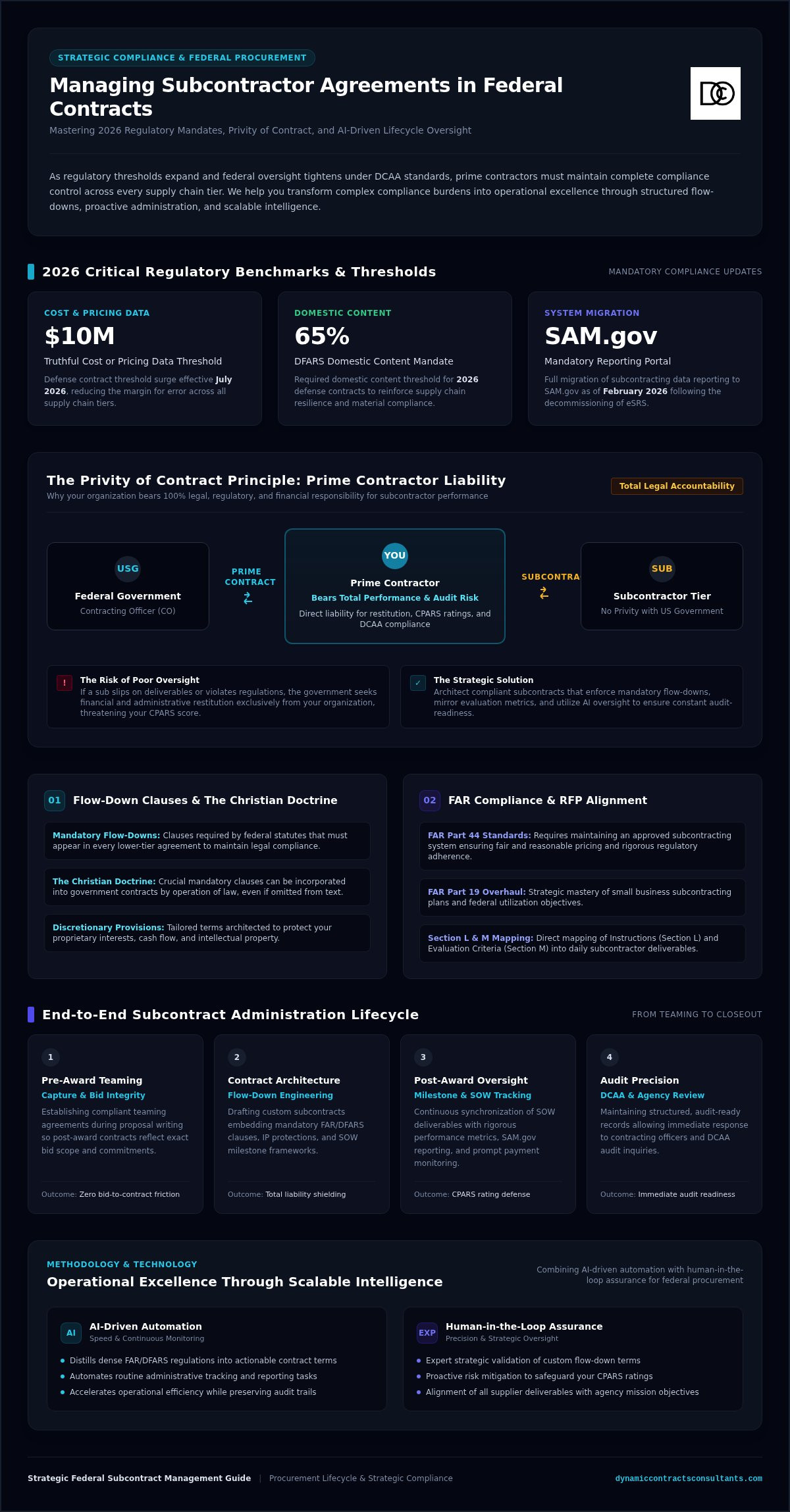
We view the relationship between a prime contractor and a subcontractor as a high-stakes partnership defined by the federal procurement lifecycle. You must understand that the government generally lacks "privity of contract" with your subs. This means you, as the prime, bear the total legal and financial liability for their performance, or lack thereof. If a sub fails to meet a deadline or violates a regulation, the government looks to you for restitution. It's a heavy burden that demands a proactive, rather than reactive, management style.
Success in managing subcontractor agreements in federal contracts requires more than just administrative tracking. It demands a "strategic compliance" mindset where you align every subcontractor deliverable with your prime contract objectives. We've seen how effective oversight prevents the performance slippage that often leads to poor CPARS ratings. By treating compliance as a strategic asset, you ensure your entire supply chain is working toward a unified goal, protecting your reputation and your bottom line.
To better understand this concept, watch this helpful video:
The Critical Role of FAR and DFARS Compliance
FAR Part 44 sets the standard for subcontracting policies and procedures, requiring you to maintain a system that ensures fair pricing and regulatory adherence. As of February 2026, you must report subcontracting data through SAM.gov following the decommissioning of eSRS. You'll need to distinguish between mandatory flow-down clauses, which must appear in every agreement, and discretionary clauses that protect your specific interests. When handling defense-related contracts, DFARS requirements intensify this oversight, particularly regarding supply chain resilience and domestic content thresholds which now require 65% domestic content for 2026.
Establishing the Foundation for a Successful Teaming Agreement
The transition from a pre-award teaming agreement to a post-award subcontractor agreement is a critical juncture. You can't afford discrepancies between what was promised in your bid and what is executed in the final contract. We ensure that our proposal writing services lay a compliant foundation, so your post-award agreements reflect the exact scope, milestones, and flow-down requirements needed for success. This consistency reduces friction and ensures your partners are ready to perform from day one, maintaining the integrity of your capture strategy.
Architecting Compliant Federal Subcontractor Agreements
Constructing a robust agreement is the cornerstone of managing subcontractor agreements in federal contracts. You can't simply replicate your prime contract; you must architect a document that maps specific performance requirements to the government's expectations. We focus on integrating Section L (Instructions) and Section M (Evaluation Criteria) directly into the subcontracting framework. This ensures that your subcontractors aren't just performing tasks, but are actively contributing to the metrics that define your contract's success. It's about creating a direct line of sight from the sub's daily activities to your agency's mission.
Our approach centers on the philosophy of delivering simple solutions to complex problems. Federal regulations are dense, but your operational documents shouldn't be. We help you distill thousands of pages of FAR and DFARS requirements into actionable, audit-ready records. This strategic compliance ensures that when an auditor asks for documentation, your response is immediate and precise, reflecting the scalable intelligence we bring to your procurement lifecycle.
Essential Flow-Down Clauses and Mandatory Provisions
You must prioritize the accurate integration of flow-down clauses to protect your organization from prime contractor liability. Under the Christian Doctrine, certain mandatory clauses are considered part of the contract by law, even if they're physically absent. However, relying on this legal safety net is a high-risk strategy. We recommend a meticulous Federal Acquisition Regulation (FAR) Subpart 19.7 analysis to ensure all provisions, such as Termination for Convenience, Disputes, and Changes, are explicitly stated. Our specialized flow-down clause analysis service identifies these gaps before they become legal liabilities, ensuring your agreements are airtight and enforceable.
DCAA Compliance and Financial Oversight
Financial oversight is the most volatile element of managing subcontractor agreements in federal contracts, particularly under DCAA scrutiny. As of mid-2026, the threshold for requiring certified cost or pricing data for defense subcontracts has increased to $10 million, while CAS applicability now stands at $35 million. You're responsible for ensuring your subcontractors maintain accounting systems that meet DCAA standards, especially in cost-plus environments. We provide the necessary DCAA Compliance Consulting to help you manage indirect rates and mitigate the financial risks associated with sub-tier spending. If you're concerned about your current oversight framework, we invite you to reach out for a strategic review of your subcontracting systems.
Strategic Selection and Teaming vs. Subcontracting
We view the capture phase as the blueprint for your long-term operational success. Effective strategies for managing subcontractor agreements in federal contracts begin long before a contract is awarded. You must distinguish between a teaming agreement, which governs the pre-award relationship and proposal efforts, and a formal subcontract executed after the award. Selecting the wrong partner at this stage doesn't just jeopardize your bid; it creates a lingering liability throughout the procurement lifecycle. We utilize a rigorous Bid/No-Bid analysis to ensure your partners enhance your government contract award success rather than diluting your technical score.
Strategic selection also involves leveraging specific socio-economic statuses to meet agency goals. Whether you're a large prime seeking minority-owned small businesses or a small business forming a mentor-protégé joint venture, your partner's status must align with the solicitation’s set-aside requirements. For a deeper dive into these roles, we recommend reviewing the SBA's guide on prime and subcontracting to ensure your team structure is compliant from the start.
Evaluating Small Business Subcontracting Plans
If you're a large prime contractor, FAR 19.7 mandates a small business subcontracting plan for contracts exceeding $900,000, or $2 million for construction. You're required to demonstrate a "Good Faith Effort" to meet these participation goals. Failure to do so can result in liquidated damages or a negative impact on your future CPARS ratings. We leverage AI-driven automation to monitor these goals in real-time, ensuring you remain compliant with the latest 2026 reporting requirements in SAM.gov. Our scalable intelligence tools help you transition from manual spreadsheets to automated, audit-ready tracking systems that satisfy even the most stringent agency oversight.
Performing Rigorous Subcontractor Due Diligence
You can't afford to skip a comprehensive due diligence process. We recommend a multi-layered approach that begins with verifying every partner's status on SAM.gov to ensure they aren't debarred or suspended. Beyond simple eligibility, you must assess their technical capabilities and past performance data. A subcontractor's failure to adhere to ITAR, EAR, or FCPA standards becomes your failure in the eyes of the government. We provide the expertise needed to evaluate these complex compliance profiles, ensuring your partners possess the necessary cybersecurity maturity and regulatory discipline to support high-value federal acquisitions. If you're unsure about a potential partner's compliance standing, we invite you to contact our team for a professional risk assessment.
A Step-by-Step Guide to Post-Award Subcontract Administration
Transitioning from contract award to performance execution requires a methodical shift in focus. We prioritize operational efficiency by establishing a clear administrative rhythm from day one. Managing subcontractor agreements in federal contracts involves a rigorous lifecycle that ensures every partner remains in lockstep with your technical and regulatory obligations. Our framework for post-award management follows four critical steps:
- Step 1: Kick-off and Alignment. We facilitate a formal alignment of the Performance Work Statement (PWS), Statement of Work (SOW), and Statement of Objectives (SOO). It's vital that your subcontractors understand the technical nuances and performance metrics expected by the agency.
- Step 2: Tracking Systems. We implement robust deliverable and milestone tracking systems. You can't rely on manual check-ins; you need scalable intelligence that provides real-time visibility into subcontractor progress.
- Step 3: Compliance Monitoring. Continuous verification of flow-down adherence is non-negotiable. We ensure that your subs maintain the required cybersecurity postures and labor standards throughout the contract life.
- Step 4: Performance Evaluation. We help you develop performance narratives that support your CPARS ratings. By documenting subcontractor excellence, you strengthen your own profile for future acquisitions.
Managing Contract Flow-Down Clause Requirements
The administrative burden of identifying which clauses apply to which sub can be overwhelming. We utilize FARIFY.ai to automate this process, ensuring that every mandatory provision is correctly identified and integrated. This AI-driven precision eliminates the risk of missing critical updates, such as the 2026 changes to small business reporting deadlines in SAM.gov. By maintaining audit-ready documentation through our post-award compliance services, you protect your organization from the financial penalties associated with prime contractor liability.
Navigating the Subcontract Closeout Process
A contract isn't truly successful until it's properly closed out. We guide you through the verification of final invoices and the formal release of claims to prevent trailing liabilities. It's equally important to ensure that intellectual property and data rights are transferred according to the prime contract's specific provisions. Our expertise in post-award contract administration ensures that every administrative loose end is tied, allowing you to focus on your next strategic win. If you're ready to modernize your administration workflow, contact our specialists today to discuss your specific contract needs.
Optimizing Subcontract Management with Strategic Consulting and AI
We believe that the traditional approach to managing subcontractor agreements in federal contracts is no longer sufficient in an environment defined by rapid regulatory shifts and heightened audit scrutiny. You need a visionary strategy that integrates AI-driven automation directly into your procurement lifecycle. By transitioning from manual oversight to "AI-powered speed," you gain the unique ability to respond to complex contract modifications with unmatched precision. This isn't just about administrative efficiency; it's about building a resilient, audit-ready infrastructure that supports your scalable growth and long-term intelligence objectives.
Our methodology combines cutting-edge technology with deep regulatory expertise. We recognize that while automation provides speed, the "human-in-the-loop" assurance we provide guarantees the technical accuracy required for high-stakes defense and civilian acquisitions. This hybrid approach ensures that your strategic compliance remains airtight, protecting your organization from the liabilities associated with subcontractor non-compliance while freeing your team to focus on mission-critical execution.
Leveraging FARIFY.ai for Rapid Document Generation
We utilize FARIFY.ai to revolutionize how you handle high-volume administrative tasks. This platform allows you to generate fully compliant Statement of Work (SOW) documents and detailed compliance matrices in minutes rather than days. When a prime contract modification occurs, the AI instantly analyzes the text to determine the specific impact on your existing subcontracts, flagging necessary flow-down adjustments automatically. You'll reduce your procurement turnaround time significantly without sacrificing the regulatory rigor that auditors demand. This level of operational efficiency is essential for maintaining a competitive edge in the 2026 federal market.
Partnering with Dynamic Contracts Consultants LLC for Long-Term Success
We provide comprehensive, full-cycle acquisition support that extends far beyond simple document generation. Our team acts as a strategic partner, offering customized templates and sophisticated capture management strategies that align your subcontractor performance with your agency's broader goals. We don't just solve immediate compliance gaps; we build the frameworks that ensure your ongoing government contract award success. We invite you to leverage our expert insights for your business growth by engaging with our consultants for a strategic review of your current systems.
Our core value proposition is simple: we deliver simple solutions to complex problems. By integrating our specialized knowledge of FAR and DFARS with the latest in AI-driven automation, we ensure that your subcontract administration is a source of strength rather than a source of risk. We're committed to your success as a prime contractor, providing the scalable intelligence you need to navigate the complexities of the federal procurement landscape with absolute confidence.
Securing Your Competitive Edge through Strategic Sub-Management
We've demonstrated that managing subcontractor agreements in federal contracts requires a sophisticated fusion of regulatory precision and forward-thinking oversight. You've seen that success isn't just about drafting a document; it's about architecting a compliance framework that protects your CPARS ratings and mitigates prime contractor liability. By integrating mandatory flow-down clauses and maintaining audit-ready records, you transform administrative burdens into a strategic advantage that drives long-term growth.
We bring a proven track record of supporting complex acquisitions for the DoD, State Department, and EPA to every partnership. Our methodology combines expert DCAA compliance consulting with the scalable intelligence of AI-powered document generation via FARIFY.ai. This unique synergy ensures your procurement lifecycle is both efficient and resilient against the shifting mandates of the 2026 landscape. It's time to modernize your approach and ensure your supply chain is as sophisticated as the missions you support.
Contact Dynamic Contracts Consultants LLC to Optimize Your Subcontractor Management Strategy and secure the operational excellence your organization deserves. We're ready to help you navigate these complexities with absolute confidence.
Frequently Asked Questions
What are mandatory flow-down clauses in federal contracts?
Mandatory flow-down clauses are specific provisions from your prime contract that you must legally incorporate into your sub-tier agreements to ensure regulatory continuity. These typically include clauses regarding termination for convenience, equal opportunity, and government property. We emphasize that managing subcontractor agreements in federal contracts requires a precise analysis of FAR Part 44 to identify which provisions are strictly required versus those that are discretionary for your specific procurement lifecycle.
How do I ensure my subcontractor is DCAA compliant?
Ensuring DCAA compliance requires verifying that your subcontractor maintains an adequate accounting system capable of segregating direct and indirect costs. You should conduct a pre-award survey or review their previous audit results to mitigate financial risk. We provide specialized DCAA compliance consulting to help you evaluate these systems. This ensures your entire supply chain remains audit-ready and prevents cost-allowability issues that could jeopardize your prime contract's financial integrity.
What is the 'Christian Doctrine' in federal subcontracting?
The Christian Doctrine is a legal principle establishing that mandatory federal contract clauses are deemed part of the agreement by law, even if they're physically omitted. You shouldn't use this as a safety net; it often leads to costly litigation. We recommend proactive management through our flow-down clause analysis services. This ensures your agreements are explicitly compliant from the start, providing the clarity needed for effective operational efficiency and risk mitigation.
Can AI tools like FARIFY.ai replace legal review for subcontractor agreements?
AI tools like FARIFY.ai are designed to accelerate document generation and compliance mapping, not to replace professional oversight. While the platform produces audit-ready SOWs and matrices in minutes, we utilize a human-in-the-loop assurance model to guarantee technical accuracy. This visionary approach combines AI-driven automation with our deep regulatory expertise. We provide strategic consulting and document support; we don't offer formal legal representation or lobbying services as part of our professional offerings.
What happens if a subcontractor fails to comply with a FAR requirement?
Because the government lacks privity of contract with your subcontractors, you bear the total liability for their non-compliance. A subcontractor's failure to adhere to FAR requirements can result in liquidated damages, contract termination, or severe damage to your CPARS ratings. We help you implement rigorous pre- and post-award compliance monitoring to detect these risks early. This proactive oversight is essential for maintaining your status as a reliable strategic partner in complex environments.
When is a small business subcontracting plan required?
A small business subcontracting plan is required under FAR 19.7 for prime contracts exceeding $900,000, or $2 million for construction projects, when awarded to a large business. You must demonstrate a good faith effort to meet these goals to avoid financial penalties. As of 2026, all reporting has migrated to SAM.gov. We leverage AI-driven automation to track these participation goals, ensuring your reporting is accurate, timely, and fully compliant with current standards.
How often should I monitor subcontractor performance for CPARS purposes?
We recommend monitoring subcontractor performance continuously, with formal evaluations conducted at every major milestone or at least quarterly. This systematic approach ensures you have the documentation necessary to support your annual CPARS narrative. Managing subcontractor agreements in federal contracts effectively means capturing technical performance and compliance data in real-time. Our post-award contract administration services provide the framework for this rigorous oversight, helping you maintain high ratings and secure future acquisition success.
What is the difference between a teaming agreement and a subcontract?
A teaming agreement is a pre-award document that outlines how you and your partner will pursue a specific solicitation during the capture phase. In contrast, a subcontract is the post-award legal agreement that governs the actual performance of work. We help you transition smoothly from teaming to subcontracting, ensuring that the technical scope and milestones defined in your proposal are accurately reflected in the final contract to maintain operational integrity and success.


