

The safest contract vehicle on paper often conceals your greatest operational liability. When evaluating firm-fixed-price vs cost-reimbursement contracts, many leadership teams assume a fixed price shields them from administrative scrutiny, only to watch unforeseen scope creep dismantle their margins on complex federal programs.
We know the frustration of balancing unpredictable performance costs against the demanding DCAA-approved accounting system standards required for cost-reimbursement work, especially when a solicitation's statement of work remains vaguely defined. Choosing the wrong vehicle doesn't just compress your margins; it exposes your business to severe audit vulnerabilities, unallowable cost disallowances, and cash-flow-crippling payment withholds under federal regulations.
This strategic guide delivers the insight you need to master the critical distinctions, financial risks, and regulatory compliance obligations governing firm-fixed-price and cost-reimbursement federal contract vehicles. Together, we examine how each structure shifts financial risk, what FAR and CAS mandates demand of your operational systems, and how to execute competitive proposals that protect your bottom line.
Key Takeaways
- Understand the structural mechanisms governing firm-fixed-price vs cost-reimbursement contracts under FAR Part 16 to determine how vehicle selection impacts your operational flexibility.
- Evaluate the shifting spectrum of financial risk and cost liability across the procurement lifecycle to safeguard your profit margins against inflation and scope volatility.
- Identify mandatory requirements for DCAA-approved accounting systems to maintain strategic compliance with FAR Part 31 cost allowability, allocability, and reasonableness standards.
- Assess statement-of-work clarity and market benchmarks to align your bid-no-bid strategies with agency acquisition objectives and risk preferences.
- Establish rigorous post-award administration protocols under FAR Part 43 to effectively manage scope modifications, maintain audit readiness, and protect cash flow.
Defining Firm-Fixed-Price and Cost-Reimbursement Contracts Under FAR Part 16
Federal procurement revolves around risk allocation codified within Part 16 of the Federal Acquisition Regulation (FAR). Understanding the structural mechanics of firm-fixed-price vs cost-reimbursement contracts determines how your organization manages cash flow, pricing models, and compliance obligations. While commercial acquisitions prioritize definitive pricing, complex developmental efforts demand flexible cost-recovery instruments.
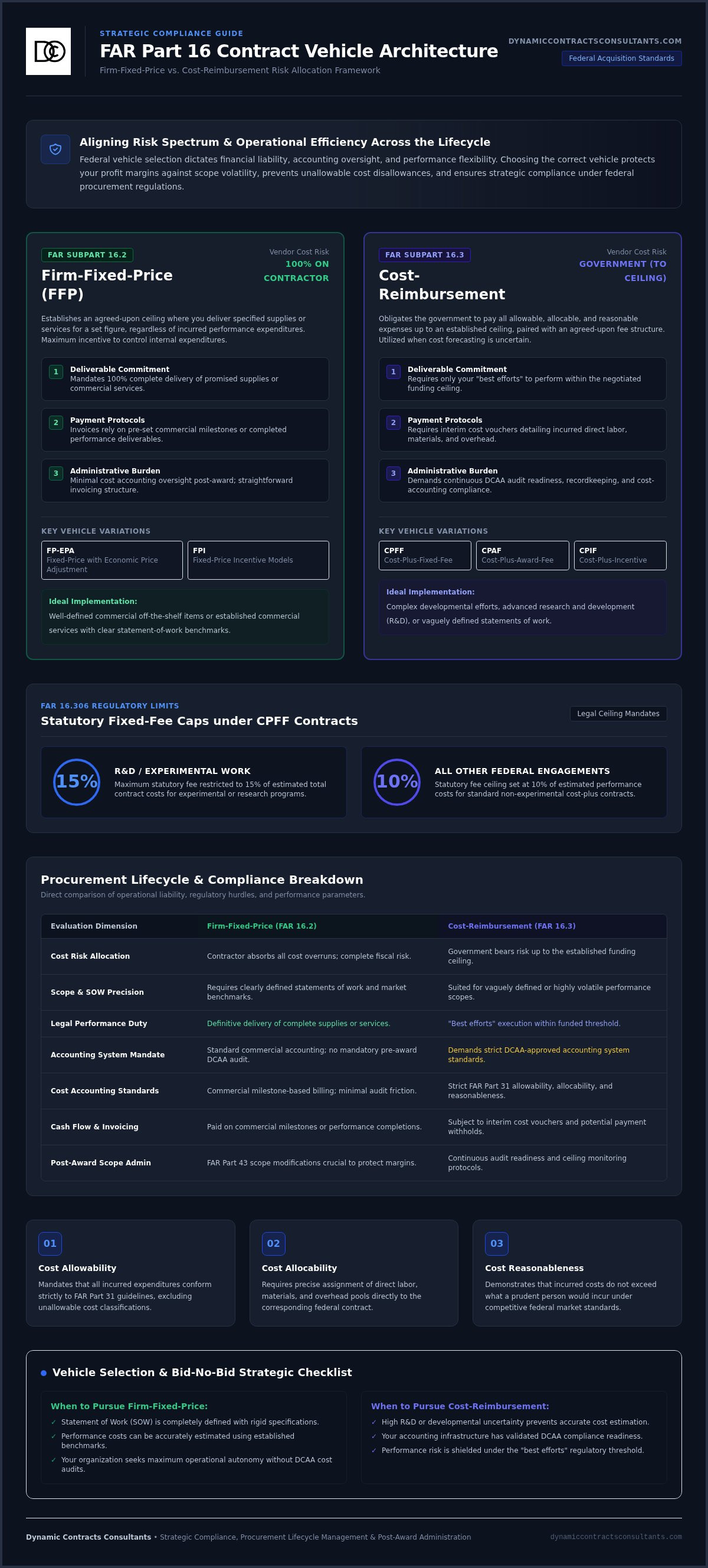
A standard fixed-price contract establishes an agreed-upon ceiling where the vendor delivers specified supplies or services for a set figure, regardless of incurred performance expenditures. In contrast, cost-reimbursement vehicles obligate the government to pay all allowable, allocable, and reasonable expenses up to an established ceiling, paired with an agreed-upon fee structure.
To visualize the operational differences between these primary contracting frameworks, watch this practical comparison:
Anatomy of Firm-Fixed-Price (FFP) Vehicles
Governed by FAR Subpart 16.2, FFP agreements place total cost risk on the contractor. You maintain complete responsibility for cost overruns, which provides the maximum incentive to control expenditures and streamline operational efficiency. Variants include Fixed-Price with Economic Price Adjustment (FP-EPA), designed to mitigate market volatility, and Fixed-Price Incentive (FPI) models that share cost savings. These vehicles are ideal for well-defined commercial off-the-shelf items or established commercial services.
Structure and Variations of Cost-Reimbursement Contracts
FAR Subpart 16.3 details cost-reimbursement vehicles, utilized when uncertainties prevent accurate performance cost forecasting, such as advanced research and development. Under Cost-Plus-Fixed-Fee (CPFF) arrangements, statutory rules restrict the fixed fee to 15% of estimated costs for experimental or research work and 10% for other engagements under FAR 16.306. Additional variations include Cost-Plus-Award-Fee (CPAF) and Cost-Plus-Incentive-Fee (CPIF) models, designed to motivate performance across specific milestones.
Key Distinctions at a Glance
Choosing between firm-fixed-price vs cost-reimbursement contracts requires analyzing specific legal and administrative distinctions across the procurement lifecycle:
- Deliverable Commitment: FFP mandates complete delivery of promised supplies or services. Cost-reimbursement requires only your "best efforts" to perform within the negotiated funding ceiling.
- Payment Protocols: FFP invoices rely on commercial milestones or performance completions. Cost-reimbursement relies on interim cost vouchers detailing incurred labor, materials, and overhead.
- Administrative Burden: FFP carries minimal cost accounting oversight. Cost contracts demand extensive audit readiness and continuous recordkeeping to satisfy regulatory authorities.
Our team provides specialized support across the acquisition lifecycle, from proposal writing that accounts for pricing risk to comprehensive post-award compliance strategies tailored to federal audit standards.
Financial and Operational Risk Allocation: Evaluating the Balancing Act
Every federal solicitation establishes a clear spectrum of operational and fiscal liability between government agencies and commercial vendors. When analyzing firm-fixed-price vs cost-reimbursement contracts under FAR Part 16, the primary variable is which party absorbs unexpected cost variance. While fixed structures insulate agency budgets from cost overruns, cost-reimbursement frameworks insulate contractors against volatile performance parameters.
The Contractor Burden in Fixed-Price Environments
Under FFP terms, the contractor assumes 100% of the financial risk. Defective pricing, unpredicted supply chain bottlenecks, or sudden wage spikes erode your target margins immediately. If project expenses double, your payout remains static. Winning these opportunities requires disciplined capture management and predictive cost estimating. You must price anticipated risks without inflating your proposal beyond competitive agency evaluation benchmarks.
Government Exposure and Cost Uncertainty
Federal agencies deploy cost-reimbursement vehicles when high developmental uncertainty prevents definitive scope formulation. The government absorbs the primary cost risk, funding all allowable expenditures while paying a fee. To safeguard taxpayer dollars against unchecked spending, federal contracts incorporate strict statutory clauses:
- Limitation of Cost (FAR 52.232-20): Mandatory for fully funded cost-reimbursement contracts, obligating you to alert the contracting officer in writing when cumulative costs reach 75% or 80% of the estimated total.
- Limitation of Funds (FAR 52.232-22): Governs incrementally funded vehicles, requiring formal notice when expenditures approach allotted increments within a specified notification window.
- Scope Adjustments: The agency retains authority to stop work or inject additional funds; contractors aren't obligated to perform beyond the funded ceiling.
Macroeconomic shifts and unexpected scope evolution can quickly destabilize your contract margins. Whether you need to assess solicitation viability during capture management or ensure tight compliance with funding limitations, you can consult with our contracts advisory team to mitigate procurement risk across the entire lifecycle.
Accounting Standards and DCAA Scrutiny: Meeting Federal Compliance Mandates
When evaluating firm-fixed-price vs cost-reimbursement contracts, accounting infrastructure serves as the ultimate gatekeeper. Standard commercial bookkeeping is entirely insufficient for cost-type vehicles. The federal government will not award a cost-reimbursement contract unless your accounting architecture passes exhaustive regulatory scrutiny before solicitation award.
Prerequisites for Cost-Reimbursement Contracting
FAR 16.301-3 dictates that cost-reimbursement vehicles may be utilized only when your accounting system is adequate for determining costs allocable to the project. The Defense Contract Audit Agency (DCAA) verifies this capability using Standard Form 1408 (SF 1408) pre-award survey criteria. Your job-cost ledger must reliably isolate direct project expenses from indirect pools, implement total-hour daily timekeeping, and track labor distribution across contract line item numbers. Implementing proactive DCAA compliance consulting ensures these accounting controls exist before agency contracting officers initiate an audit.
Direct Costs vs Indirect Cost Pools
Under FAR Part 31, every claimed cost must satisfy three criteria: allowability, allocability, and reasonableness. You must segment direct contract expenditures from indirect cost pools, including fringe benefits, overhead, and general and administrative (G&A) expenses. During contract execution, you invoice costs via provisional billing rates. Within six months of your fiscal year-end, you must submit an Incurred Cost Electronically (ICE) package to reconcile actual indirect costs against billed rates. Inadvertently booking unallowable expenses like lobbying or entertainment into overhead pools will trigger audit disallowances and financial penalties.
Audit Preparedness and Record-Keeping Infrastructure
Regulatory compliance demands continuous post-award discipline. DCAA maintains audit oversight through unannounced timecard floor checks, billing system reviews, and incurred cost investigations. System deficiencies can trigger formal disapproval and mandatory 5% payment withholds across your active billing vouchers. Safeguarding operational efficiency requires precise audit trails, tight subcontractor management, and mandatory flow-down clause enforcement. We deliver end-to-end post-award compliance frameworks that protect your cash flow and keep your business audit-ready nationwide.
Strategic Evaluation Framework: How Contractors and Agencies Choose Vehicles
Agency acquisition personnel balance complex variables when structuring a solicitation under FAR 16.104. For commercial vendors, evaluating firm-fixed-price vs cost-reimbursement contracts demands an internal governance framework that balances contract vehicle requirements against organizational capacity. Success requires systematically stress-testing solicitation terms before allocating capture resources.
Assessing Statement of Work Maturity
Work statement clarity determines vehicle feasibility. Performance-based work statements with well-defined deliverables and historical metrics support fixed pricing. Conversely, vague performance scopes or evolving developmental milestones conceal severe financial risks within fixed solicitations. When you encounter ambiguous performance criteria paired with an FFP requirement, submit pre-proposal inquiries during the formal question-and-answer window to clarify specifications or prompt agency vehicle reconsideration.
The Five-Step Contract Type Decision Matrix
To establish bid-readiness and protect enterprise capital reserves, our acquisition advisory teams guide leadership through five disciplined gates:
- 1. Requirement Clarity: Audit the performance work statement to verify measurable deliverables and clear acceptance criteria.
- 2. Systems Verification: Confirm your general ledger and job-costing processes satisfy applicable accounting thresholds or pre-award audit guidelines.
- 3. Supply Chain Volatility: Model inflationary variables across critical equipment, tier-one vendors, and key labor categories.
- 4. Risk-Adjusted Margin: Calculate net profit across best-case and worst-case execution scenarios rather than relying on standard markups.
- 5. Disciplined Bid/No-Bid Decision: Execute a firm go/no-go determination powered by capture intelligence to protect balance sheet liquidity.
Incentive Structures and Profit Optimization
Selecting the right vehicle directly influences operational stability and contractor past performance evaluations in CPARS. Fixed-price vehicles offer maximum margin upside through production efficiency, yet cost-plus vehicles provide sustainable baseline profitability on high-risk research. Aligning your technical delivery approach with precise cost proposals avoids margin erosion and delivery disputes down the road.
Winning complex federal procurements demands proposal volumes calibrated to specific agency evaluation criteria. Partner with our team for comprehensive proposal writing services to sharpen your competitive positioning. To align your upcoming pursuits with an optimal contracting strategy, schedule a strategic consultation with Dynamic Contracts Consultants LLC today.
Mastering Post-Award Contract Administration and Lifecycle Performance
Execution determines whether an award yields planned profit margins or triggers catastrophic operational losses. When comparing firm-fixed-price vs cost-reimbursement contracts, post-award performance hinges on how aggressively you govern baseline scope, manage invoice streams, and safeguard past performance ratings across the contract lifecycle. Without structured oversight, administrative drift erodes contractor profitability under both vehicle structures.
Managing Contract Modifications and Scope Variations
Scope variations require formal treatment under FAR Part 43. Contracting officers issue unilateral modifications for administrative adjustments, such as updating accounting line data, but substantive scope changes demand bilateral agreement. In an FFP arrangement, executing customer requests without an executed modification creates uncompensated work. When an agency alters technical specifications or directs out-of-scope tasks, prepare a detailed Request for Equitable Adjustment (REA) establishing cost impact and schedule adjustment. Our specialized post-award contract administration guidance ensures your baseline modifications remain fully supported by historical labor and material tracking.
Billing Processes and Interim Fee Administration
Billing mechanics differ fundamentally across contract types:
- Firm-Fixed-Price Invoicing: Relies on predetermined commercial milestones, completed CLIN deliverables, or performance-based progress payments without itemizing underlying labor ledgers.
- Cost-Reimbursement Vouchers: Submitted via Standard Form 1034/1035, breaking down direct labor hours, travel receipts, subcontractor costs, and provisional indirect expense rates.
- Fee Withholding: Contracting officers frequently withhold up to 15% of the total fixed fee or a reserve ceiling until final performance acceptance.
We deploy comprehensive acquisition consulting services to assist contractors with rate true-ups, provisional billing oversight, and compliant invoice preparation.
Securing Favorable CPARS Ratings and Audit-Ready Closeout
Contract closeout represents the final regulatory hurdle. For cost-reimbursement vehicles, closeout can take years while final overhead rate negotiations, DCAA incurred cost audits, and funding de-obligations occur. In fixed-price environments, closeout concludes promptly upon final delivery acceptance and formal release of claims. Documenting cost-control initiatives throughout performance protects your past performance record in the Contractor Performance Assessment Reporting System (CPARS), positioning your enterprise for future wins.
Protecting enterprise profitability across firm-fixed-price vs cost-reimbursement contracts requires deep regulatory insight and operational precision. Connect with Our Acquisition Specialists Today to ensure your contract administration practices remain audit-ready and profitable nationwide.
Position Your Enterprise for Profitable Contract Execution
Successfully navigating firm-fixed-price vs cost-reimbursement contracts isn't merely an administrative exercise. It defines your company's financial risk profile, operational agility, and accounting prerequisites. Aligning your bid strategies with well-defined statements of work while maintaining DCAA audit readiness protects your profit margins and ensures resilient lifecycle performance.
Our nationwide advisory team combines Certified Professional Contracts Manager (CPCM) and Certified Federal Contracts Manager (CFCM) credentials with proven prime and subcontract expertise across DoD, State, EPA, and NOAA acquisitions. We unite AI-accelerated compliance documentation with senior regulatory oversight to help you price solicitations accurately, establish compliant accounting infrastructure, and safeguard your past performance record.
Accelerate Your Federal Acquisition Strategy and Compliance with Our Specialists today, and build the competitive edge your business needs to scale with confidence.
Frequently Asked Questions
What is the primary difference between firm-fixed-price and cost-reimbursement contracts?
The core distinction centers on risk allocation and deliverable commitment. In firm-fixed-price vs cost-reimbursement contracts, fixed vehicles require you to deliver specified requirements for a set price regardless of actual expenses. Cost-reimbursement agreements obligate you to provide your best efforts up to an estimated cost ceiling, with the government covering allowable, allocable expenses plus a fee.
Can a small business accept a cost-reimbursement contract without a DCAA-approved accounting system?
No, small businesses cannot receive a cost-reimbursement award without an accounting system deemed adequate by the government. Contracting officers require a formal pre-award survey, typically evaluated against SF 1408 standards by DCAA or another cognizant audit agency. If your system cannot isolate direct project costs from indirect pools, the government will find you non-compliant and withhold award eligibility.
Who bears the greatest financial risk under a firm-fixed-price contract?
The contractor absorbs 100% of the financial risk under a firm-fixed-price vehicle. If material costs surge, technical challenges arise, or labor rates escalate, your reimbursement remains fixed. You must absorb every dollar of overrun directly from operating profit, making rigorous capture management and realistic cost estimation essential before submitting your proposal.
What happens if a contractor experiences unexpected cost overruns on a cost-reimbursement contract?
You aren't obligated to continue performance beyond the funded ceiling once you provide mandatory notifications under limitation of cost or funds clauses. If the contracting officer declines to allocate additional funds, work stops without default termination. However, if you incur cost overruns without delivering timely written notice, the government isn't obligated to reimburse those excess expenditures.
Why does the federal government prefer firm-fixed-price contracts over cost-reimbursement types?
Federal procurement policy explicitly favors fixed-price structures because they protect taxpayer funds from open-ended financial liability. Under Executive Order 14402, agencies must treat fixed-price agreements as the default vehicle, requiring written justifications to issue cost-reimbursement awards. Fixed-price vehicles also require far less agency oversight and eliminate post-award incurred cost audits.
What are the common fee structures utilized in federal cost-reimbursement agreements?
Agencies utilize three primary fee variations governed by FAR Subpart 16.3. Cost-Plus-Fixed-Fee (CPFF) provides a set fee negotiated before award. Cost-Plus-Incentive-Fee (CPIF) adjusts fee payouts upward or downward based on target cost formulas. Cost-Plus-Award-Fee (CPAF) grants an incentive pool evaluated subjectively by an agency board based on contractor quality, schedule, and management metrics.
How do contract modifications differ between fixed-price and cost-reimbursement mechanisms?
Scope adjustments in firm-fixed-price vs cost-reimbursement contracts require fundamentally different administrative tracking. Fixed-price modifications demand formal Requests for Equitable Adjustment (REAs) to increase target prices before undertaking new work. Cost-type modifications adjust the estimated cost ceiling and statutory fee allocations, allowing you to absorb expanded scope as long as total incurred costs remain within funded parameters.


