

We help you assess whether an SDVOSB set-aside opportunity is viable before you commit resources to a bid. According to the Federal Acquisition Regulatory Council, an agency may award a competitive SDVOSB set-aside when the contracting officer reasonably expects offers from at least two responsible eligible businesses and a fair-market-price award. The U.S. Small Business Administration states that a service-disabled veteran must unconditionally own 51% of an SDVOSB.
We help you evaluate more than veteran ownership or proposal requirements. The solicitation’s agency requirements, assigned NAICS code, applicable size standard, competition conditions, and market research all shape whether the set-aside is appropriate and whether your offer can compete.
In this article, we explain how these factors work together, including what agencies assess before restricting competition and what eligibility and size standards mean for your bid. We also cover when a competitive set-aside can proceed and how we can support capture planning and proposal development to align your response with the procurement’s requirements.
Key Takeaways
- We help you assess how ownership, control, and certification affect your eligibility for SDVOSB set-aside opportunities.
- We help you determine whether your business can compete by reviewing the solicitation’s NAICS code and corresponding size standard.
- We help you assess how expected competition and fair-market pricing influence an agency’s decision to use a competitive set-aside.
- We explain how agency market research informs set-aside decisions and shapes your procurement opportunity.
- We help you organize and review proposal documents, then support your transition into post-award administration.
What are Agency Requirements for SDVOSB Set-Aside Contracts?
We connect your company’s eligibility to the acquisition method and solicitation terms. When we support your bids on SDVOSB set-aside contracts, we assess these elements together: qualifying status alone does not ensure your offer meets the agency’s requirements.
SDVOSB Certification and Eligibility
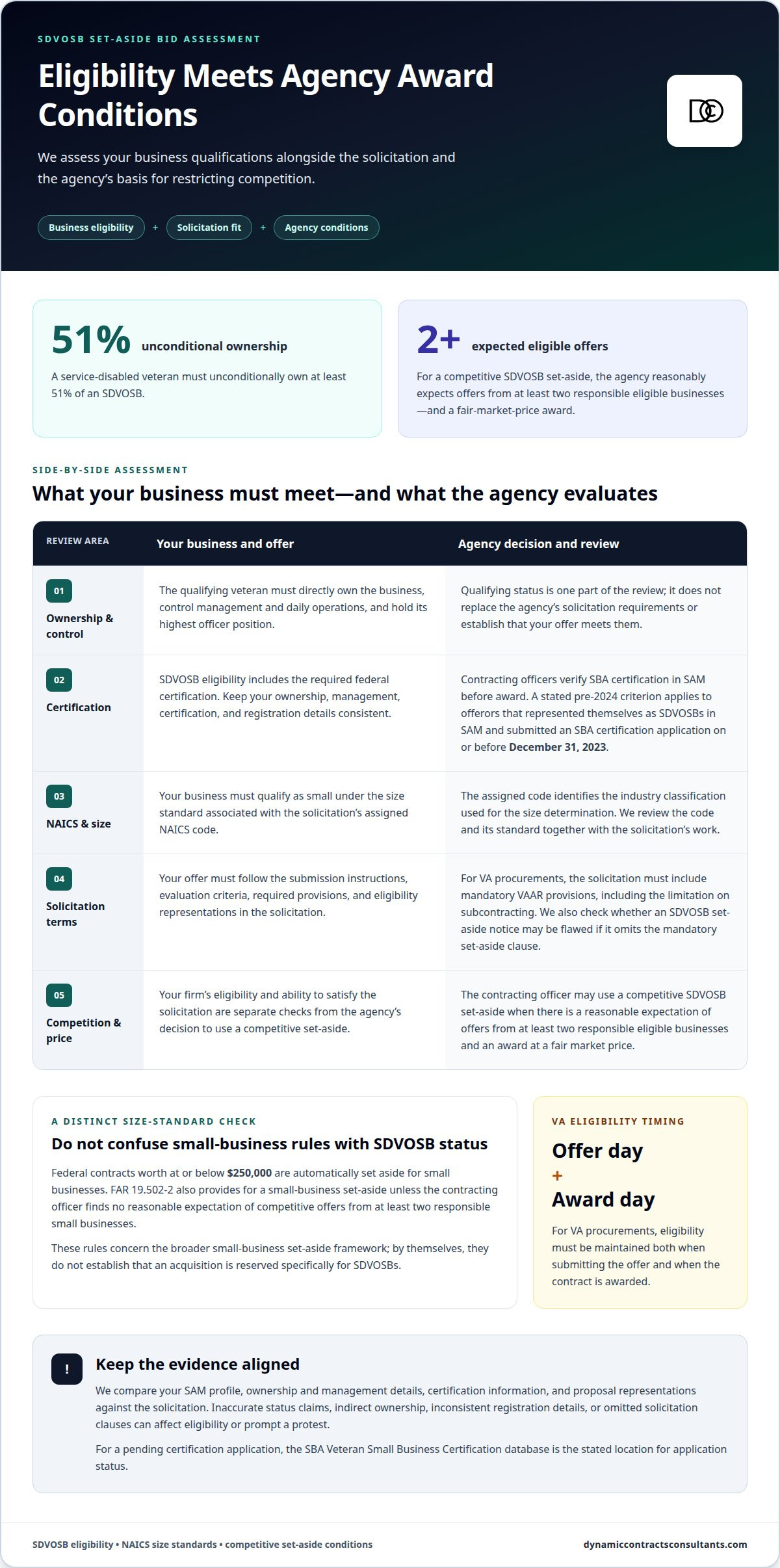
We assess SDVOSB eligibility based on qualifying veteran ownership and control, service-connected disability, and the required federal certification. According to the U.S. Small Business Administration, a service-disabled veteran must unconditionally own 51% of an SDVOSB. The veteran must also directly own the business, control its management and daily operations, and hold its highest officer position.
We treat certification and procurement eligibility as related but distinct checks. Contracting officers verify SBA certification in SAM before award, subject to a stated pre-2024 application criterion. That criterion applies to an offeror that represented itself as an SDVOSB in SAM and submitted an SBA certification application on or before December 31, 2023.
Solicitation Clauses and Bid Eligibility
We review solicitation clauses to identify the terms and representations your offer must address. We assess the full solicitation because SDVOSB status does not replace its submission instructions, evaluation criteria, or required provisions. For VA procurements, the solicitation must include mandatory VAAR provisions, including the limitation on subcontracting.
We check whether a VA notice identified as an SDVOSB set-aside may be flawed because it omits the mandatory set-aside clause. We verify that your eligibility representations align with the solicitation and your registration information. For VA procurements, you must maintain eligibility both when submitting the offer and when the contract is awarded.
Professional Support for SDVOSB Bid Registrations, Documents, and Forms
We coordinate registration details and solicitation documents so your offer presents consistent information. We organize the required forms and compare their representations with the details your team provides about ownership, management, and certification. This review can help us identify gaps between your SAM profile and bid package.
Your team supplies accurate company and eligibility details, along with the solicitation and proposal inputs. We structure these materials around the agency’s instructions, identify required attachments, and review the submission for completeness. For a pending certification application, the SBA Veteran Small Business Certification database is the stated location for application status.
Bidding Mistakes and Compliance Risks
We check for common risks, including inaccurate status representations, indirect ownership, inconsistent registration details, and omitted solicitation clauses. These issues can affect eligibility or prompt a protest. Under FAR 19.1406, the Federal Acquisition Regulatory Council requires contracting officers to consider SDVOSB set-asides before SDVOSB sole-source awards or small-business set-asides.
APEX Accelerators and SBA offices provide free federal contracting assistance, including help understanding registration, certification, and procurement processes. This support can clarify general requirements, while we help you address the specific solicitation in your proposal.
Small-business size standards and NAICS codes
We help you assess how a solicitation’s NAICS code identifies the industry classification used to determine small-business size eligibility. For an SDVOSB offer, your business must qualify as small under the standard associated with the procurement’s assigned code. That code can determine whether your company may compete, even when its services appear relevant. We can help you identify potential mismatches between the solicitation’s work and its NAICS classification that may raise questions about the acquisition’s structure.
For a requirement within any other NAICS code, the anticipated award price, including options, will not exceed $5 million. We help you distinguish these applicable acquisition thresholds from the size standard used to determine whether your firm qualifies for a particular solicitation.
For example, we help manufacturers reviewing a solicitation distinguish the manufacturing category from a service or other nonmanufacturing category. The applicable threshold depends on the assigned NAICS classification, so your company’s general industry label does not settle the question. We recommend reading the solicitation’s code together with the relevant size standard. This distinction can affect whether your firm qualifies to submit an offer under the procurement’s small-business requirements.
Federal contracts worth at or below $250,000 are automatically set aside for small businesses. FAR 19.502-2 also provides for a small-business set-aside unless the contracting officer finds no reasonable expectation of receiving competitive offers from at least two responsible small businesses. We help you understand how these rules concern the broader small-business set-aside framework. They do not, by themselves, establish that an acquisition is reserved specifically for SDVOSBs.
For a federal total small-business set-aside, firms generally self-certify their size in SAM.gov registration against the solicitation’s NAICS size standard. We help you verify that your representation corresponds to the code selected for the procurement, not a different code used elsewhere in your company’s profile. In an SDVOSB competition, small-business size and SDVOSB eligibility are distinct considerations. The size representation addresses the assigned NAICS standard; SDVOSB status addresses separate program eligibility criteria.
We guide you through a disciplined bid review that records the solicitation’s NAICS code, corresponding size standard, set-aside type, and any stated representation requirements. We then help you assess whether your company’s size representation matches that procurement and whether your offer addresses its specific terms. This analysis can inform acquisition planning and bid decisions before proposal preparation begins. For support aligning procurement strategy with solicitation requirements, discuss your acquisition planning needs.
Competitive SDVOSB set-aside award conditions
We help you evaluate SDVOSB bids against the solicitation’s requirements and stated criteria. Price reasonableness concerns whether the agency expects to award at a fair market price, not simply whether your offer is the lowest.
The Federal Acquisition Regulatory Council explains that a competitive SDVOSB set-aside may proceed when the contracting officer reasonably expects offers from at least two responsible eligible businesses and expects an award at a fair market price. We use these conditions to help you prepare competitive, compliant offers, connecting market research on competition with the expected price outcome.
“Two responsible businesses” describes an expectation about competition, not a requirement that two offers ultimately be received. The contracting officer considers whether eligible businesses can perform the requirement and compete responsibly. We help you assess your ability to meet the solicitation’s technical, performance, or delivery requirements, since SDVOSB status alone does not establish that capability.
Evaluation then follows the solicitation. The agency assesses proposals using the criteria and instructions stated there. We help you ensure your offer is eligible for consideration and meets material requirements and information requests. For example, a proposal that addresses technical capability but omits a required response may not satisfy the solicitation as written.
Price reasonableness is assessed against the government’s requirement and the market information available to the contracting officer. The fair-market-price condition does not promise that the lowest-priced offer will win. We help you understand that a low price alone cannot make a technically unacceptable offer acceptable, and that a higher price must be considered under the solicitation’s evaluation terms.
Competition can also change after solicitation. Under FAR 19.1405, if the contracting officer receives only one acceptable offer from an eligible SDVOSB concern, the Federal Acquisition Regulatory Council says the officer should make an award to that concern. We help you distinguish this single-offer outcome from the initial expectation of offers from at least two responsible concerns.
If no acceptable offers arrive from eligible SDVOSB concerns, the set-aside must be withdrawn, and the still-valid requirement may be set aside for small businesses as appropriate. We help you focus on acceptability: your offer must come from an eligible concern and satisfy the solicitation’s requirements. A nonresponsive or otherwise unacceptable proposal may not preserve the SDVOSB competition.
For bidders, our practical guidance is to align your proposal with both eligibility conditions and the agency’s evaluation framework. We help you keep the technical response, price submission, required representations, and supporting documents consistent. When bidding on SDVOSB set-aside contracts, prepare for the agency’s actual criteria rather than relying on status or price alone.
Agency market research for SDVOSB set-asides
We help you interpret agency market research, which enables contracting officers to determine whether an SDVOSB set-aside fits the requirement and available market. It connects the acquisition’s scope with businesses that may be eligible, capable, and positioned to compete. Research also informs the acquisition strategy before solicitation terms are finalized. For potential bidders, we help explain how these findings provide context for why an opportunity is reserved, structured, or open to broader competition.
Under 13 CFR 125.19(b)(2)(i), contracting officers must consider procurements for service-disabled veteran-owned small businesses. FAR 19.1405 requires officers to comply with FAR 19.203 before deciding whether to set aside an acquisition under the SDVOSB Program. These provisions place market assessment within broader acquisition planning. We help you assess how the officer’s decision reflects the requirement and market evidence, not simply the presence of an SDVOSB designation.
Research can examine the work’s technical scope, delivery expectations, performance location, and required capabilities. We help you use these details to distinguish a qualified potential source from a company whose general industry profile does not match the requirement. For example, an agency seeking specialized technical support may assess relevant experience and capacity rather than relying solely on small-business status. Clear scope analysis helps align the resulting competition with the agency’s needs.
Market research also informs how the agency identifies potential SDVOSB sources. Relevant considerations include the procurement’s NAICS classification, the corresponding size standard, and whether businesses appear capable of performing the work. We help you assess these factors and understand the competitive field. A broad list of registered businesses does not, by itself, show that those firms can meet the solicitation’s performance requirements.
Pricing research serves a separate purpose: it helps the agency assess whether an acquisition can support an award at a fair market price. The officer may consider available information about the requirement and likely performance costs. This does not assure bidders that a particular price will be accepted. Instead, we help you understand how the agency uses its market understanding to shape the procurement and assess whether proposed approaches fit the government’s needs.
Research findings can influence the solicitation’s structure, evaluation approach, and set-aside decision. If the agency receives no acceptable offers from eligible SDVOSBs, the set-aside must be withdrawn; the still-valid requirement may then be set aside for small businesses as appropriate. We help you assess how market awareness matters beyond initial planning: the agency’s understanding of available capability affects how it frames competition and responds to offers.
For a prospective bidder, the practical value is context. We help you interpret how the solicitation’s scope, NAICS code, eligibility terms, and evaluation criteria show the agency’s translation of its market assessment into a procurement. Comparing these elements can help you judge whether the opportunity matches your company’s capabilities and whether your proposal directly addresses the stated requirement. That alignment gives your bid a stronger foundation than relying on SDVOSB status alone.
How Can We Prepare the Documents and Forms Required for a Federal Contract Bid?
We turn the solicitation’s instructions into a controlled document package. We identify every requested form, attachment, certification, narrative, and submission instruction. Because each federal solicitation defines its own requirements, we use that specific package as the source of truth. A response may include technical, management, and pricing volumes, but only when the solicitation calls for them.
We begin by organizing the solicitation into a requirements matrix. We record each instruction with its location, required response, responsible contributor, and review status. For example, we treat a request for relevant experience as a distinct response item, not a detail buried in a general capability statement. This mapping helps us identify missing inputs and align proposal sections with agency evaluation criteria.
Next, we coordinate the information supplied by your team. Useful inputs may include company background, relevant project details, staffing approach, pricing assumptions, and required representations. We do not substitute generic company language for solicitation-specific evidence. Instead, we connect each requirement to an appropriate supporting fact, explanation, or attachment.
- Solicitation instructions: We capture required formats, file types, page limits, submission method, and deadlines stated in the notice.
- Technical response: We organize the proposed approach around the agency’s requested tasks and evaluation factors.
- Pricing materials: We align proposed prices and supporting assumptions with the solicitation’s requested structure.
- Representations and attachments: We identify each requested form and ensure the response uses consistent company information.
During drafting, we check traceability: each solicitation requirement should connect to a response location. If an agency requests a staffing plan, for example, we explain roles and responsibilities rather than merely mentioning available personnel. We check that attachments are labeled correctly and referenced wherever the narrative relies on them. These controls reduce omissions and make your submission easier to evaluate.
Our quality review tests the package for consistency across sections. Company names, project descriptions, staffing details, and pricing assumptions should not conflict between the narrative and supporting documents. We also check compliance with the solicitation’s formatting and delivery instructions. A complete technical response can still face avoidable risk if a required attachment is missing or a file does not follow the specified submission process.
Before submission, we conduct a final requirement-by-requirement review and record unresolved gaps for your team. Your subject-matter experts remain responsible for validating the accuracy of business and performance details. This division keeps the proposal process structured while preserving source knowledge with the people who own it. Discuss support for your federal bid documents.
Dynamic Contracts Consultants: Post-Award Contract Administration
We support your transition from a successful bid into contract performance through Post-Award Contract Administration. Our support can help your team manage contract requirements, documentation, and compliance obligations across the procurement lifecycle. For upcoming opportunities, we can use Proposal Writing to structure a response around the solicitation’s requirements and your company’s capabilities.
Consider post-award support when your team needs an organized approach to contract administration or when performance obligations require consistent oversight. We tailor our focus to the contract’s terms and your operational needs. Contact us to discuss support for your federal contracting work.
Build a Repeatable Path from Opportunity to Performance
The next step is to connect opportunity selection, proposal development, and contract execution across your procurement lifecycle. Our AI Proposal Writing brings AI-driven automation into proposal development, with your team retaining oversight of the content and decisions. A disciplined approach to bidding on SDVOSB set-aside contracts can help build a consistent process and apply lessons from each pursuit.
Dynamic Contracts Consultants LLC supports this work through Proposal Writing, Grant Writing, and DCAA Compliance Consulting. We align support with your objectives, whether you need a solicitation-focused proposal, a grant application, or help with compliance processes.
As you plan your next move, focus on capabilities that support both pursuit and performance. Contact Dynamic Contracts Consultants LLC to discuss your federal contracting priorities and identify a practical path toward scalable growth.
Frequently Asked Questions
What Can Unsuccessful Bidders Do When the Requirements Are Not Met?
An unsuccessful bidder can document the specific solicitation or award issue and assess whether it affected its competitive position. A protest is limited to an interested party under GAO Bid Protest Regulations at 4 CFR 21.0(a)(1). For example, a concern about an omitted set-aside clause differs from disagreement with an evaluation judgment. We help you organize the solicitation, submitted offer, and agency communications around the alleged issue so you can assess next steps and prepare for future opportunities.
What if You Did Not Submit a Service-Disabled Veteran Set-Aside Contracts Proposal?
If your business did not submit an offer, the agency has no proposal from your company to evaluate for that procurement. Use the missed opportunity to identify what prevented submission, such as late opportunity awareness, incomplete information, or a decision not to pursue. We help you refine capture planning and proposal readiness for future notices. If the agency changes or reissues a requirement, we can help you assess the new notice on its own terms.
What is a small business set-aside?
A small-business set-aside reserves a federal procurement for competition among eligible small businesses rather than the broader marketplace. Under FAR 19.502-2, the contracting officer generally sets aside a purchase unless there is no reasonable expectation of competitive offers from at least two responsible small businesses. The set-aside category matters: a general small-business restriction is different from an SDVOSB-specific competition, which adds program eligibility considerations.
What is the SBA’s Rule of Two?
The Rule of Two refers to an agency’s assessment of whether at least two qualified small businesses are expected to compete at fair market prices. In an SDVOSB procurement, the relevant businesses must also meet the program’s eligibility requirements. The VA Rule of Two concerns setting procurements aside for service-disabled veteran-owned small businesses. It guides the set-aside decision, but does not mean every qualifying procurement will receive two actual offers.
What is the difference between a competitive and a sole-source set-aside?
A competitive set-aside invites eligible businesses to submit offers, while a sole-source award selects a single eligible concern without competing offers. The distinction affects how an opportunity is pursued: a competitive bid must respond to evaluation criteria and competing proposals, whereas a sole-source action follows a different acquisition path. Under FAR 19.1406, contracting officers must consider SDVOSB set-asides before SDVOSB sole-source awards or small-business set-asides.
What qualifies a business as an SDVOSB for federal contracting?
A qualifying SDVOSB must meet the SBA’s ownership and control standards, and its service-disabled veteran owner must have a service-related disability. The veteran must own the business directly, not through another business entity. The business also needs the applicable SBA certification or qualifying status for the procurement. For VA procurements, eligibility must be maintained both when the offer is submitted and when the contract is awarded.
How Can a Contracting Professional Identify SDVOSB Set-Aside Contract Opportunities on SAM.gov?
A contracting professional can search SAM.gov notices for SDVOSB set-aside designations, then narrow the review by agency, NAICS code, and work description. We help you assess each notice for its scope, eligibility language, submission requirements, and amendments. A matching keyword is not enough if the notice’s actual work falls outside your company’s capabilities. Tracking relevant notices and changes helps us focus your capture efforts on viable opportunities.
How Can a Professional Support SAM.gov Registration and Your Entity Profile for Federal Contract Bidding?
A professional can help organize registration information and review whether your entity profile presents consistent business details for procurement use. Your team supplies accurate company, ownership, and capability information; we can map it to profile fields and proposal representations. This support is useful when details need to align with a specific opportunity. Registration assistance does not replace your company’s responsibility for accurate representations.


