

The strongest proposal operation is not necessarily the one that keeps every task in-house. When deadlines overlap, internal staff may lack capacity. External writers, meanwhile, need timely access to the information and people who can explain your capabilities. To make the in-house vs outsourced proposal writing decision, compare workload, control, expertise, and risk against your federal contracting needs.
Proposal quality, compliance, and institutional knowledge are central concerns, but they don’t require an all-or-nothing model. They do require clear ownership of strategy, source information, review, and final approval. This article compares the approaches so you can choose a model that fits your proposal volume, available expertise, and deadlines.
It also covers how to define responsibilities and approval checkpoints, including where external writing support or AI-assisted document workflows may complement your team. The goal is a repeatable process that supports demanding submission schedules while keeping critical knowledge and decision-making under your control.
Key Takeaways
- Decide which proposal tasks your employees own and where external support could fill a specific capability or workload gap.
- Map responsibilities across the proposal workflow, from the bid decision through submission, for internal staff, specialists, and AI-assisted tools.
- Evaluate in-house vs outsourced proposal writing based on control, capacity, expertise, continuity, coordination, and oversight. Neither model is right for every organization.
- Assess your team’s capture, compliance mapping, technical writing, and review capabilities before choosing an approach for a bid.
- For outsourced or blended support, define deliverables, client inputs, accountable owners, review milestones, and final approval authority.
In-House vs. Outsourced Proposal Writing: What the Decision Actually Covers
In-house proposal writing is performed primarily by your employees, who draw on internal knowledge to develop or review a submission. Outsourced proposal writing assigns defined tasks or complete workstreams to external specialists. Either way, clarify who provides authoritative information and who makes key decisions before work begins.
A proposal responds to an opportunity by explaining how a business can meet requirements and deliver value. The Business proposal overview describes several proposal types. In federal contracting, the solicitation and your company’s capabilities shape the response. The sourcing decision is therefore about who owns each task and decision, not simply who drafts the content.
For a general comparison of in-house and external writing support, this video offers additional context:
Which proposal responsibilities can be sourced externally?
Tasks that may be assigned externally include capture strategy support, technical content development, compliance mapping, editing, and production. The right division depends on your team’s capacity and the solicitation’s requirements. External writers can organize and clarify information, while company leaders and subject-matter experts validate strategic choices, technical claims, and commitments.
For example, an external specialist could prepare a compliance matrix and draft sections from approved source material. Internal technical leads could then confirm the solution, while leadership approves the final positioning. Dynamic Contracts Consultants LLC provides proposal writing support. Before work begins, define deliverables, client inputs, review roles, and approval checkpoints.
Why proposal ownership matters in federal contracting
A credible response connects solicitation requirements to your actual capabilities and relevant past performance. Even when external writers support development, accurate information must come from your organization. Assign internal owners to provide source material, answer questions, and verify claims before approval.
Outsourcing tasks does not transfer your organization’s responsibility for the submission’s accuracy or final decisions. A blended model can preserve internal ownership of capture strategy and approval while adding capacity for defined workstreams. The aim is a manageable workload and disciplined oversight, not outsourcing for its own sake.
How In-House and Outsourced Proposal Teams Divide the Work
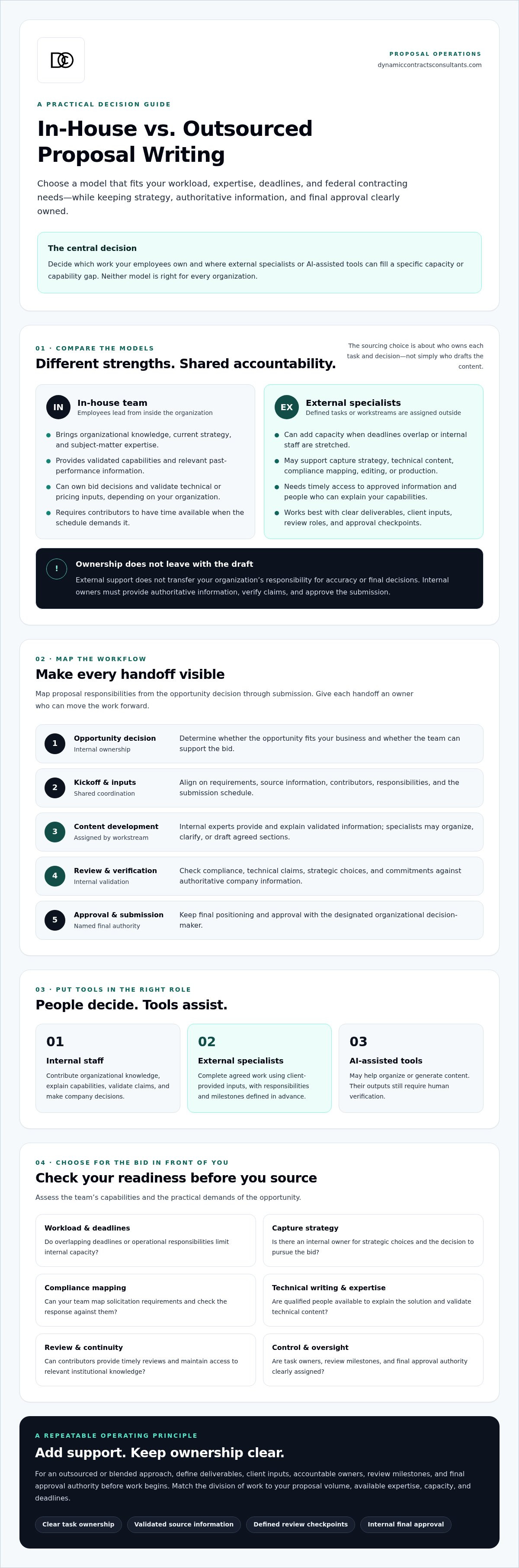
A proposal workflow involves a series of handoffs, and each needs an owner who can move the work forward. Map the process from the opportunity decision and kickoff through content development, review, approval, and submission. This can reveal delays, especially when internal contributors are balancing proposal work with operational responsibilities.
In the in-house vs outsourced proposal writing model, employees, external specialists, and AI-assisted tools have different roles. Internal staff contribute organizational knowledge and make company decisions. Specialists complete agreed work using client-provided inputs. Tools can help organize or generate content, but their outputs still need human verification. Distinguishing these roles helps assign work without confusing drafting assistance with decision-making authority.
What an in-house proposal team typically owns
Internal contributors provide the context that connects an opportunity to your business: current strategy, subject-matter expertise, past performance, and validated capabilities. Depending on your organization, internal leaders may decide whether to pursue a bid, while technical and pricing owners validate their respective inputs. Confirm that these contributors have time to participate when the schedule requires it. Do not assume they will be available.
What an outsourced proposal partner can support
An external partner can take responsibility for defined deliverables and coordinate their development against an agreed schedule. Dynamic Contracts Consultants LLC provides proposal writing support. Review the proposal writing services scope and confirm deliverables, client inputs, and review responsibilities before engagement. Treat every draft as a working product until your designated internal reviewers have assessed it.
To make the workflow practical, document handoffs in a responsibility matrix. For each stage, name the owner, required input, reviewer, and decision checkpoint. For example:
- Opportunity and kickoff: The internal opportunity lead records the pursuit decision and confirms priorities, work assignments, and the schedule.
- Content development: Writers use designated source materials. Subject-matter experts answer questions and verify technical details.
- Review and resolution: Reviewers consolidate comments, and assigned owners resolve conflicts or gaps before approval.
- Finalization: The authorized company approver confirms the response. The submission owner checks that approved files are assembled and ready to transmit.
A clear handoff structure supports coordination while keeping decision ownership visible. It also gives your team a repeatable workflow to refine after each submission.
In-House vs. Outsourced Proposal Writing: Compare Control, Capacity, and Risk
The in-house vs outsourced proposal writing decision involves trade-offs among control, capacity, and the expertise an opportunity requires. Neither model is inherently lower-risk. Results depend on clear responsibilities, validated information, and disciplined review. A blended approach can retain internal decision-making while adding specialist capacity where your team needs it.
| Factor | In-house | Outsourced | Blended |
|---|---|---|---|
| Control | Direct access to internal decision-makers and source knowledge. | Requires a clear scope, access boundaries, and approval checkpoints. | Internal leaders retain strategy and final approval. |
| Capacity | Depends on staff availability and competing responsibilities. | Adds defined external capacity, with onboarding and coordination needs. | Internal staff focus on decisions while external support handles assigned work. |
| Expertise | Draws on company and technical knowledge; proposal experience varies. | May add relevant proposal skills. Assess experience against the solicitation. | Combines organizational knowledge with selected outside expertise. |
| Continuity | Knowledge can remain internal, though staff changes may affect access. | Continuity depends on documentation and agreed knowledge transfer. | Keep approved templates, source records, and lessons learned internally. |
| Coordination and oversight | Requires coordination across internal contributors and reviewers. | Requires timely client inputs, defined reviewers, and active oversight. | Named owners coordinate handoffs and manage review gates. |
Evaluate control, confidentiality, and quality
Before work begins, specify who approves company claims, technical content, past performance references, and the final response. Confirm confidentiality terms, permitted information access, and handling procedures with any external provider or platform. Match these safeguards to the information involved and your organization’s requirements.
Set documented review checkpoints for requirement coverage, factual accuracy, and unsupported assertions. For example, a writer can flag a capability statement that lacks an approved source, but an accountable internal reviewer should confirm the claim before it enters the final submission. Treat provider or platform performance claims as claims, not proof. Request substantiation relevant to your use case and evaluate it independently.
Assess capacity, expertise, and continuity
Compare the proposal schedule with actual staff availability and concurrent commitments. Then check whether internal or external contributors have experience relevant to the solicitation’s requirements, rather than relying on broad claims of federal expertise. A blended model may fit when internal leaders can provide direction and validation but lack drafting capacity. An in-house model may fit when the team has both the expertise and the time.
Whichever approach you choose, keep approved templates, source records, and lessons learned accessible to your organization. If you’re considering external proposal-writing support, discuss your proposal-writing requirements and clarify the scope, review roles, and information-handling procedures.
How to Choose the Right Proposal-Writing Model for Your Next Bid
Choose a delivery model by identifying what your next submission requires and what your team can reliably provide on schedule. The in-house vs outsourced proposal writing decision should follow a capability assessment, not a general preference for internal or external resources.
1. Assess workload, timeline, and capacity. Map the solicitation schedule against staff availability and concurrent commitments. Account for the time needed for technical input, review, and approval, not just drafting.
2. Test the capabilities the bid requires. Assess whether your team can lead capture, map requirements in a compliance matrix, draft clear technical content, and conduct a thorough final review. A gap in one area may call for targeted support rather than outsourcing the entire response.
3. Assign decision rights. Keep bid strategy, authoritative source facts, technical validation, and final approval with the appropriate internal owners. Define external responsibilities by deliverable, such as drafting a specific volume or analyzing requirement coverage.
4. Set review checkpoints. Schedule reviews that give owners time to resolve questions, correct unsupported claims, and confirm that the response reflects the solicitation and your organization’s capabilities. An independent government proposal review may provide an additional perspective, but it does not replace your team’s validation and approval.
When in-house proposal writing may fit
An internal model may be practical when proposal work recurs, experienced staff have room in their schedules, and subject-matter experts can contribute and review on time. Before relying on that model for your next bid, identify process gaps to address. You may need to improve templates, prepare contributors, or clarify review ownership.
When outsourced or blended support may fit
External or blended support may suit a defined capacity or expertise gap, provided you retain internal ownership of strategy, source facts, technical validation, and approval. Avoid open-ended assignments without agreed deliverables, client inputs, and review roles. If your assessment points to external writing support, review the scope of proposal writing services and align it with your specific needs.
Once you have assessed your workload and support requirements, review proposal-writing support options to determine whether a defined external or blended approach fits your next bid.
How to Implement an Outsourced or Blended Proposal-Writing Process
A defined process makes external support coordinated proposal capacity rather than another handoff to manage. For the in-house vs outsourced proposal writing decision, implementation should make responsibilities visible: who provides source information, who develops each deliverable, who resolves questions, and who has authority to approve the response.
Prepare the proposal team and source materials
Start with a kickoff package that gives contributors a common, approved foundation. Assemble the solicitation, current capability information, relevant past performance records, and validated technical inputs. Identify an internal subject-matter expert for each response area and confirm when each person can answer questions and review drafts against the schedule.
Before sharing materials, establish who may access them and what information-handling expectations apply to every participant. Confirm these arrangements with external providers and any tools used in the workflow. Assign an internal owner to resolve conflicting source records and approve organization-specific statements. External writers should not have to infer capabilities or commitments.
Set scope, milestones, and review gates
Document the scope of work, including deliverables, required client inputs, responsible owners, reviewers, and final approval authority. Set a shared schedule with milestones for initial drafts, technical validation, compliance review, consolidated comments, and final authorization. A clear process for resolving questions helps prevent assumptions from becoming unverified claims. For example, route each open issue to a named internal owner and set a response deadline.
Assign reviewers to check requirement coverage and factual accuracy, and identify who can approve the final response. Keep review comments consolidated where practical, and record decisions so contributors work from the same direction. For broader support across the acquisition lifecycle, review our acquisition lifecycle services.
Measure process effectiveness and preserve lessons
After submission, review how the workflow performed without treating any process measure as a promise of award. Record where inputs arrived late, questions remained unresolved, review stages found omissions, or responsibilities were unclear. Capture reusable lessons in approved templates and source records, and note which material needs validation before it is reused on a future bid.
This retrospective gives your team a practical basis for refining workload, access controls, review gates, and future scopes of work. It also helps preserve institutional knowledge when internal staff and external specialists share proposal responsibilities.
Once you have identified the work to delegate and the decisions your team will retain, contact our proposal team to discuss a defined support requirement.
Build a Proposal Model That Scales With Your Workload
The right in-house vs outsourced proposal writing approach is one your team can sustain while protecting proposal quality and accountable review. Match support to the bid’s requirements and your actual capacity. Define external deliverables clearly, and retain internal ownership of strategy, verified company information, technical validation, and final approval. A blended model can add specialist capacity without making responsibility unclear.
Dynamic Contracts Consultants LLC has served as a prime contractor on contracts for the Department of Defense, Department of State, EPA, and NOAA. Its services include proposal writing, capture management, compliance matrix development, and gap analysis. Its affiliate FARIFY provides AI-assisted government-contracting document generation, with human-in-the-loop review. These capabilities may inform your assessment, but the appropriate scope depends on your workload and support needs.
Start by identifying the gap you need to address, then establish owners, inputs, review checkpoints, and approval authority before work begins. Discuss your proposal-writing needs with our team to explore an approach for your next opportunity. Clear roles and disciplined coordination can strengthen proposal capacity while keeping important decisions in your hands.
Frequently Asked Questions
Is outsourced proposal writing better than using an in-house team?
Neither model is automatically better. The right choice depends on workload, available expertise, deadlines, and the need for internal control. In-house teams may have direct access to company knowledge, while external writers can add capacity or specialized proposal experience. A blended approach may suit organizations that want outside drafting or compliance support but need leaders and subject-matter experts to retain strategy, factual validation, and approval.
What does an outsourced proposal writer do?
An outsourced proposal writer performs the tasks defined in the engagement. These may include organizing response content, drafting specified sections, supporting compliance mapping, editing, or coordinating proposal development. The writer typically relies on the contractor for accurate source material, technical details, and past performance information. Before work begins, agree on deliverables, client inputs, review responsibilities, timelines, and who resolves questions or approves final content.
Can a company outsource a federal proposal and retain control?
Yes. A contractor can assign defined proposal tasks externally while keeping internal ownership of bid strategy, authoritative company information, technical validation, and final approval. Retaining control takes more than reviewing a finished draft. Identify internal decision-makers, set information-access boundaries, and establish review checkpoints. The contractor should confirm organization-specific claims and commitments are accurate before approving the completed response for submission.
How do you protect proposal quality when outsourcing?
Protect quality with a documented workflow and accountable reviewers. Provide approved source materials, assign subject-matter experts to validate technical statements, and designate reviewers for requirement coverage and factual accuracy. Set milestones for draft review and correction, and route unresolved questions to named internal owners. Confirm information-handling expectations before sharing proposal materials, and ensure the person authorized by your organization approves the final response.
When should a government contractor outsource proposal writing?
Consider external support when a specific capability or capacity gap threatens the proposal schedule, such as overlapping deadlines or limited experience with a required response task. Compare available staff time with the work needed for drafting, compliance mapping, technical review, and approval. Outsourcing may be less suitable if internal experts cannot provide timely inputs or reviewers are unavailable to validate the work.
Can AI replace an in-house or outsourced proposal-writing team?
AI can support document workflows, such as extracting solicitation requirements or organizing draft content, but it should not replace company knowledge, strategic judgment, or accountable human review. AI-generated content can contain errors or unsupported statements, so qualified reviewers must validate it against the solicitation and approved source information. FARIFY LLC, an affiliate of Dynamic Contracts Consultants LLC, provides AI-assisted government-contracting document generation.
What should a proposal-writing outsourcing agreement include?
Specify the scope and deliverables, client-provided materials, assigned owners, review responsibilities, schedule, and final approval authority. Document how questions will be raised and resolved, what access the provider needs, and the confidentiality and information-handling expectations that apply. Clarify how revisions and handoffs will work, including access to completed files and reusable materials. These details help align external work with your internal governance and submission process.


