

The most productive grant search doesn’t start with the longest list of funding notices. It starts with a clear test of whether an opportunity fits your mission, eligibility, and capacity. Finding federal grant opportunities for nonprofits can be challenging when information is spread across government sources and notice requirements take time to interpret.
That complexity can be difficult to manage alongside program delivery and limited staff time. A promising funding announcement may still be a poor fit if your nonprofit can’t meet its stated requirements or carry out the proposed work. This guide explains how to use authoritative federal sources and apply a repeatable screening process before committing resources to an application.
You’ll learn where to search, including Grants.gov and agency sources, and how to use SAM.gov Assistance Listings to research federal programs. You’ll also see how to assess a notice for eligibility, mission alignment, and operational fit, then establish a practical approach for tracking opportunities and deciding whether to proceed. This creates a disciplined path from discovery to an informed next step.
Key Takeaways
- Approach finding federal grant opportunities for nonprofits as a mission and capacity screening process, not simply a search for available funding.
- Use Grants.gov, SAM.gov Assistance Listings, and agency program pages for distinct but complementary information. Verify current notice details at the source.
- Check applicant type, project purpose, eligible activities, and submission conditions before investing in proposal development.
- Maintain an opportunity tracker with notice identifiers, deadlines, eligibility questions, assigned owners, and decision status.
- For a strong prospect, organize project information, organizational documents, partner inputs, and unanswered requirements questions to support the next planning step.
Finding Federal Grant Opportunities for Nonprofits Starts with a Clear Funding Fit
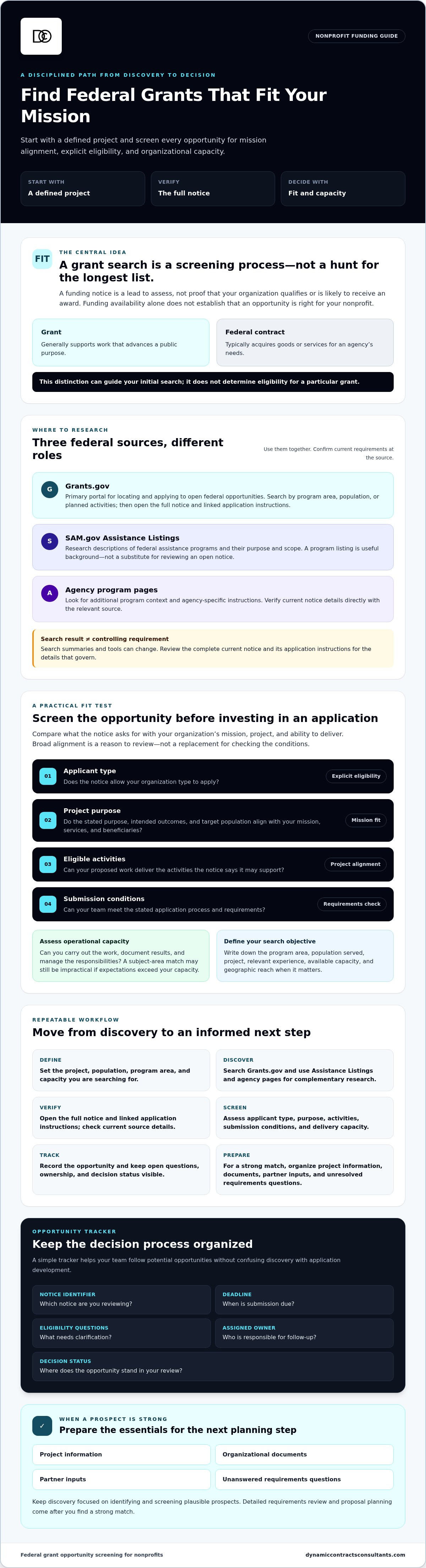
Finding federal grant opportunities for nonprofits is most effective when it begins with a defined project, not a broad search for available money. A federal grant opportunity is an agency-issued notice that describes a program’s purpose, applicant conditions, activities it may support, and application process. Treat each notice as a lead to assess, not proof that your organization qualifies or is likely to receive an award.
Grants and federal contracts also serve different purposes. A grant generally supports work that advances a public purpose, while a contract typically acquires goods or services for an agency’s needs. This distinction can guide your initial search, but it doesn’t establish that a nonprofit is eligible for a particular grant. For a foundational overview of what a grant is and how it differs from a loan, see this general reference.
This video offers a practical introduction to searching for nonprofit grants:
What makes a federal grant opportunity relevant to a nonprofit?
Relevance has two parts: program alignment and explicit eligibility. First, compare the notice’s stated purpose, intended outcomes, and target population with your mission, services, and beneficiaries. For example, a program serving a population your nonprofit works with may seem relevant, but the notice could limit applicants to a particular organization type or specify activities your project doesn’t provide. Broad alignment is a reason to review the notice, not a substitute for checking its conditions.
Funding availability alone doesn’t establish fit. Consider whether your organization can deliver the described work, document results, and manage the associated responsibilities. An opportunity may sound right for your subject area but still be impractical if the program expectations exceed your organization’s capacity.
Why a search needs a defined funding objective
Before searching, write down the program area, population served, and project you intend to advance. Summarize your relevant experience and available capacity as well. Note geographic reach when it matters to the project or the notice. This brief gives your search direction and helps distinguish opportunities worth examining from loosely related listings.
Keep discovery separate from application development. At this stage, identify and screen plausible prospects. Detailed requirements review and proposal planning come after you find a strong match. This sequence makes the search more useful without assuming every nonprofit or project will qualify.
Where to Find Federal Grant Opportunities: Grants.gov, SAM.gov, and Agency Sources
Use federal sources for different stages of research rather than treating every search result as an open funding opportunity. Grants.gov is the primary portal for locating and applying to open federal opportunities. SAM.gov Assistance Listings provide broader descriptions of federal assistance programs, while agency websites can add program context and agency-specific instructions. For an official overview of the federal grant lifecycle, consult Grants.gov’s guide.
Using Grants.gov to locate open federal opportunities
Search Grants.gov with terms connected to your program area, population, or planned activities. Then narrow the results using the agency or opportunity details available in the current interface. Search tools and filters can change, so check Grants.gov directly for current options. A search summary is only an initial lead: open the full notice and review its linked application instructions for the controlling details.
Using SAM.gov Assistance Listings and agency websites
Assistance Listings can help you research the purpose and scope of federal assistance programs, but a program description is not the same as an active opportunity notice. Check SAM.gov for current terminology and navigation. Agency program pages may offer additional context, announcements, and instructions. Use them alongside, not instead of, the current notice from the issuing agency. Technology-assisted research can help organize information, but it doesn’t replace checking the original source. For a related discussion, see AI for Grant Writing: A Strategic Guide to Federal Funding Success in 2026.
Use this distinction: a program listing helps explain what an assistance program supports; an opportunity notice describes a specific competition and its application requirements. If details appear inconsistent, verify them against the issuing agency’s current notice and application instructions.
| Source | Purpose | Useful information | Appropriate follow-up |
|---|---|---|---|
| Grants.gov | Find open federal opportunities | Opportunity notices, issuing agencies, and application materials | Read the full notice and linked instructions |
| SAM.gov Assistance Listings | Research federal assistance programs | Broader program descriptions and purpose | Look for a current competition notice |
| Agency program pages | Understand agency-specific context | Program information, announcements, and guidance | Confirm details against the current official notice |
When finding federal grant opportunities for nonprofits, use each source according to its role. Record the official notice and the agency’s instructions as the basis for further screening. AI-assisted research may help organize searches and source notes, but verify award details and requirements at their origin.
How to Screen Federal Grant Notices for Nonprofit Eligibility and Mission Fit
A structured screen helps your nonprofit distinguish a promising lead from a feasible opportunity. Finding federal grant opportunities for nonprofits is only the discovery stage. Each prospect still requires a review of the current notice and its application instructions. Treat unclear terms as questions to resolve, not assumptions to build into a proposal.
Which eligibility details should nonprofits verify first?
Start with the notice’s applicant categories and any stated limits. Compare the project scope with your planned work, including eligible activities, required partners, and geographic conditions when specified. Review submission conditions and instructions in the same source. If a condition is unclear, seek clarification from the issuing agency rather than assuming your organization or project qualifies.
- Applicant type: Is your organization included in the eligible applicant categories, and are any limitations stated?
- Project fit: Do the proposed activities match the notice’s purpose, outcomes, and target population?
- Participation conditions: Are partners, locations, or other project conditions specified?
- Submission requirements: What does the current notice say about application materials, process, and deadlines?
Keep organizational registration readiness separate from notice-specific eligibility. If you advance toward an application, consult the official register your nonprofit with SAM.gov guidance and verify the registration and submission requirements stated for that opportunity.
How to evaluate strategic and operational fit
Compare the proposed project with your nonprofit’s strategic priorities, documented program experience, and ability to serve the stated population. A strong thematic match may still be impractical if delivery depends on staff, partners, data, or administrative capacity that isn’t available. Assess the work needed to coordinate the project and meet any reporting expectations described in the notice.
Use a short decision record so your team can explain its recommendation and revisit it if circumstances change:
- Pursue: The notice appears aligned, key conditions are understood, and the organization can plan for delivery.
- Investigate: The fit may be strong, but eligibility, partner commitments, or workload needs confirmation.
- Decline: A stated condition rules out the applicant or project, or the operational demands don’t fit available capacity.
For each decision, record the evidence from the notice, unresolved questions, capacity assumptions, and who reviewed the opportunity. This provides a consistent basis for prioritization without treating an initial screen as a final eligibility determination or a prediction of funding.
Build a Repeatable Federal Grant Search and Opportunity Tracking Workflow
A reliable search process is one your team can sustain. Set a review cadence that reflects staff capacity and strategic priorities, whether you check sources regularly or focus on planned program cycles. A consistent process helps staff focus on relevant opportunities without letting routine searches displace program delivery. Use saved searches or alerts where the current platform supports them, and check that their settings still match your criteria.
Create a usable opportunity tracker
Build each record so a colleague can return to the original source and understand its status. Include the source link, notice identifier, issuing agency, deadline, assigned owner, and decision status. For sound compliance planning, distinguish requirements confirmed in the current notice from unresolved questions and internal assumptions. This helps prevent preliminary interpretations from becoming the basis for planning.
- Source and identification: Record the platform, direct notice link, notice identifier, and agency.
- Timing and responsibility: Capture the stated deadline, review owner, and next decision date.
- Fit and uncertainty: Note eligibility questions, mission alignment, capacity considerations, and details that need confirmation.
- Status and updates: Record whether the team will pursue, investigate, or decline. Assign responsibility for reviewing changes and raising approaching decisions.
Assign an owner to monitor relevant updates and bring open questions to the appropriate decision-maker. AI-driven workflows may help organize search records and administrative information, but they shouldn’t replace review of the current official notice. Human verification helps distinguish sourced requirements from automated summaries.
Turn search results into a documented go or no-go decision
Apply the same mission, eligibility, capacity, and timing criteria to each candidate. Record why the team advances an opportunity, what must be confirmed, or why it declines. This structured decision analysis provides a consistent basis for prioritization and can help your organization develop a more scalable process as its funding pipeline grows.
For an opportunity marked “investigate,” specify the unresolved question, who will resolve it, and which official source can confirm the answer. For questions about notice requirements, refer to the issuing agency’s current instructions. A related discussion of structured decision analysis appears in AI for Bid-No-Bid Analysis: Transforming Federal Capture Strategy in 2026. Apply the same disciplined logic here, without treating an initial screen as a funding prediction.
A repeatable workflow turns finding federal grant opportunities for nonprofits into an organized pipeline instead of disconnected searches. If you’ve identified a well-aligned prospect and need support with grant or proposal development, discuss grant and proposal support with our team.
After Finding a Strong Match, Prepare the Nonprofit for the Next Step
A prospect that passes initial screening is ready for a closer requirements review, not an assumption of eligibility or funding. Compare the current notice and application instructions with your project plan, organizational information, and capacity. Confirm unclear conditions with the issuing agency, then document whether your nonprofit has made an internal decision to proceed.
What to assemble before developing an application
Prepare a concise record of the proposed project so your team can assess what the notice asks for and identify gaps. Include:
- Project facts: The need being addressed, intended outcomes, beneficiaries, and implementation approach.
- Organizational materials: The information and supporting documents requested in the specific notice.
- Partner inputs: Roles, contributions, and information needed from collaborators, when relevant.
- Open questions: Unresolved requirements, the person assigned to each, and how the answer will be confirmed.
Assign owners and confirm the organization’s decision to proceed before substantial proposal development begins. This keeps planning grounded in the notice’s actual requirements and the nonprofit’s available resources.
When specialized grant-writing support may be useful
External support may be useful when your team needs additional capacity to analyze requirements, develop a proposal, or assess financial information related to the proposed work. Dynamic Contracts Consultants LLC provides grant writing and financial analysis for proposals. Learn more about its grant and proposal writing services. This support can assist with development, but it isn’t direct government funding, legal representation, or a guarantee of an award.
Technology-assisted workflows may also help organize research and drafting, with human review remaining important for accuracy and notice-specific requirements. For a separate discussion of this topic, see AI for Grant Writing: A Strategic Guide to Federal Funding Success in 2026. Post-award planning should reflect the type of award and its applicable terms. For separate federal contract administration needs, review post-award contract administration.
Finding federal grant opportunities for nonprofits is only the beginning. Moving from screening to requirements review and proposal planning gives your organization a clearer basis for its next decision. To discuss your grant opportunity and proposal needs, contact our team.
Turn Your Grant Search Into a Disciplined Next Step
Effective finding federal grant opportunities for nonprofits depends on more than locating open notices. Define your funding objective, use authoritative federal sources, and assess each prospect against the notice’s eligibility conditions, mission alignment, and your organization’s capacity. A consistent tracker helps your team document decisions, follow up on open questions, and focus proposal effort on stronger matches.
Once an opportunity merits further review, move from discovery to careful requirements analysis and proposal planning. Dynamic Contracts Consultants LLC provides grant writing, proposal writing, and financial analysis for proposals. Its work combines acquisition expertise with AI-supported workflows and human review, while keeping recommendations grounded in the opportunity’s requirements. No search process or writing support can guarantee an award.
Ready to discuss your organization’s next step? Discuss your federal grant and proposal needs with our team. A focused, evidence-based process can help your nonprofit pursue opportunities that better align with its mission and capacity.
Frequently Asked Questions
Is a nonprofit automatically eligible for federal grants?
No. Eligibility depends on each opportunity’s stated applicant categories, project scope, and other conditions. A nonprofit’s tax status or mission alone doesn’t establish eligibility. Review the complete notice and agency instructions, including conditions that may affect your proposed activities or partnerships. If a requirement is unclear, record the question and seek confirmation from the issuing agency before committing substantial staff time to proposal development.
Where can nonprofits find federal grant opportunities?
Grants.gov is a central source for searching open federal funding opportunities. SAM.gov Assistance Listings can help you research federal assistance programs, while agency websites may provide program details, announcements, and instructions. Treat search results as starting points, not final guidance. Before deciding whether to pursue an opportunity, confirm its deadline, eligibility conditions, and submission requirements in the current notice and the agency materials linked to it.
How can a nonprofit tell whether a federal grant is a good fit?
Compare the opportunity’s purpose and eligible activities with your mission, proposed project, and relevant experience. Then verify applicant eligibility, required partners, submission conditions, and the work needed to develop and administer an application. Finding federal grant opportunities for nonprofits is more effective when each prospect is assessed against the same criteria. A documented pursue, investigate, or decline decision helps distinguish genuine fit from general subject-area relevance.
Do nonprofits need SAM.gov registration to apply for a federal grant?
Yes. A nonprofit needs an active SAM.gov registration to apply for and receive federal grants; obtaining a Unique Entity Identifier alone isn’t sufficient. Check registration and renewal status early, and follow the specific opportunity’s instructions for identifiers and submission steps. Confirm current registration status directly in SAM.gov rather than relying on an old checklist or assuming that a previous application means the registration remains active.
Can a newly established nonprofit apply for federal grants?
Possibly, but an organization’s age alone doesn’t determine eligibility. Each opportunity sets its own applicant and project conditions, which a newer nonprofit should review in the full notice. Also assess whether your organization can demonstrate the relevant experience, partnerships, operational capacity, and supporting information requested for the proposed work. If a condition is unclear, ask the issuing agency for clarification before investing in a full application.
How often should nonprofits search for federal grant opportunities?
Set a search cadence your team can sustain, based on organizational priorities, staff capacity, and the programs you intend to pursue. Regularly reviewing relevant official sources can help your team identify notices, record changes, and leave time to evaluate fit. Assign an owner to maintain the opportunity tracker and review updates. The right cadence supports deliberate decisions without diverting resources from core programs.
What should a nonprofit do after finding a promising federal grant?
Review the complete notice and application instructions, verify eligibility, and assess mission alignment, project readiness, staff and partner capacity, and unresolved requirements. Document the decision to proceed or decline before beginning application development. If proceeding, assemble project facts and requested organizational materials, then assign responsibilities for remaining questions and proposal tasks. Grant-writing support may assist with requirements analysis and proposal development, but it can’t guarantee an award.


