

A proposal executive summary isn’t a shortened proposal. It’s a decision brief grounded in the solicitation. If you’re weighing how to write a compelling proposal executive summary, the challenge is to distill a technical solution without losing the distinctions that matter, while keeping every claim consistent with the evidence elsewhere in your response.
That balance can be difficult under a tight deadline. Follow the solicitation’s priorities, show why your approach is relevant, and distinguish your team with specific claims the proposal supports. The summary should make the evaluation decision clearer, not introduce promises or details reviewers can’t verify in the technical volume.
This article explains how to build a decision brief from solicitation requirements, evidence, and meaningful differentiators. You’ll learn how to connect your solution to stated priorities, select supportable proof points, and keep the summary concise and consistent with the full proposal. Structured requirements analysis and AI-assisted drafting can support the process, but qualified human review is needed to check the final language against the solicitation and proposal.
Key Takeaways
- Use the executive summary as a concise, decision-oriented overview that clarifies your offer, its relevance, and its strongest support.
- Learn how to write a compelling proposal executive summary by tracing its claims to solicitation priorities and evidence, rather than relying on boilerplate.
- Present your approach, relevance, and proof in a clear sequence, and replace broad promotional language with specific, supportable statements.
- Apply a final review checklist to test responsiveness, evidence, clarity, consistency, and alignment with solicitation instructions.
- Identify when additional proposal-writing capacity, requirements traceability, or objective gap analysis could help strengthen your summary.
What a Proposal Executive Summary Must Accomplish
A proposal executive summary is a concise, decision-oriented overview of your proposed response. It should help readers understand what you offer, why the approach fits the customer’s stated needs, and which proposal evidence supports its principal strengths. A general Executive summary reference can clarify the format’s purpose. In a proposal, however, the active solicitation determines what the summary must address. Understanding how to write a compelling proposal executive summary starts with treating it as a focused account of the offer, not a miniature version of every section.
To see one approach to structuring a proposal summary, watch this video:
Who reads the summary and what must they understand?
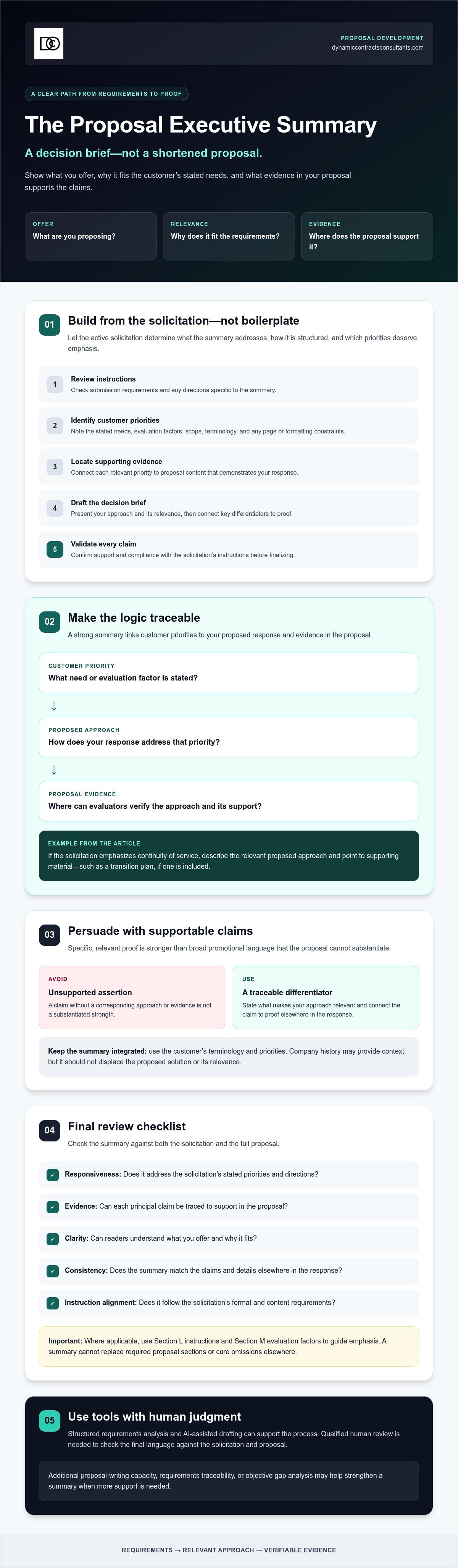
Evaluators and decision-makers need a clear account of the proposed response. The summary should answer three connected questions: What are you offering? Why does it fit the customer’s requirements and desired outcomes? What evidence in the proposal supports your claims? Shape each answer around the solicitation, rather than assumptions about what a particular reader values.
For example, if the solicitation emphasizes continuity of service, describe the relevant proposed approach and point to supporting material in your response, such as a transition plan, if one is included. A claim about continuity without a corresponding approach or evidence is an assertion, not a substantiated strength.
How the summary relates to the solicitation
The active solicitation governs instructions, required content, and submission structure. Review its directions before deciding what belongs in the summary, including any stated format or content requirements. Section L and Section M alignment is relevant where those sections apply: use the solicitation’s instructions and evaluation factors to guide emphasis, then verify that the summary’s claims are supported in the corresponding proposal sections.
A responsive summary uses the customer’s actual terminology and priorities, not language carried forward from an unrelated template. Company history may provide context, but it shouldn’t displace the proposed solution or its relevance. A well-written summary also can’t replace required proposal sections or cure omissions elsewhere in a noncompliant response. It should work as an integrated part of proposal development, consistent with the broader proposal writing services Dynamic Contracts Consultants LLC provides to support technical drafting and solicitation alignment.
Build the Summary from Requirements, Not Boilerplate
Start executive-summary development with traceability, not a polished opening paragraph. Before drafting, connect the solicitation’s stated priorities to your response and the evidence that supports it. This makes it easier to decide which differentiators belong in the summary and which claims should be left out. A requirement-aligned executive summary is an overview traceable to solicitation priorities and proposal evidence.
Use this sequence:
- Review instructions: Check the active solicitation for submission requirements and any directions specific to the summary.
- Identify priorities: Record customer needs, evaluation factors, scope, and defined terminology.
- Select evidence: Locate proposal content that supports a response to each relevant priority.
- Draft: Present the proposed approach and its relevance, then connect key differentiators to proof.
- Validate: Confirm that each claim is supported and the summary follows the solicitation’s instructions.
Extract priorities and constraints from the solicitation
Review the submission instructions, evaluation factors, scope, and terminology before adapting reusable language. Record page limits, formatting requirements, and summary-specific directions when stated. If a requirement is ambiguous, flag it for appropriate internal review rather than making an unsupported assumption. A template can help organize the work, but it can’t establish what this customer prioritizes.
Map customer needs to proof points
Build a compliance matrix or another traceability tool before drafting summary claims. A simple working table can link each customer priority to the proposed response and the location of its supporting evidence in the proposal. For instance, a stated need for a particular technical capability should connect to the relevant solution description and documented proof, not an unsupported statement that your team is uniquely qualified.
Include past performance, technical evidence, or capabilities only when they’re documented and applicable to the requirement. A differentiator earns space in the summary when it addresses a stated customer need and the proposal substantiates it. Remove claims that can’t be traced to evidence elsewhere in the response. That discipline helps you determine how to write a compelling proposal executive summary without letting boilerplate or broad promotional language displace the offer’s actual strengths.
Use the customer’s terminology where it accurately reflects the proposed response, while preserving the distinction between a requirement and your solution to it. Then validate the summary against both the traceability tool and the completed proposal. Edits to technical content may affect whether a claim remains supported. If your team needs added capacity for requirements analysis, compliance matrix development, or proposal drafting, you can discuss proposal support with Dynamic Contracts Consultants LLC.
Write a Persuasive Summary Without Overclaiming
Make the connection between the customer’s need and your supported response easy to follow. State your proposed approach, explain how it addresses a documented priority, then identify the evidence readers can find in the proposal. This sequence gives differentiators practical meaning instead of presenting them as isolated capabilities.
Every material summary claim should be supported by identifiable proposal content. Apply this standard to statements about technical performance, staffing, experience, or expected outcomes. If readers can’t locate supporting detail in the relevant volume, revise the claim, add substantiation where appropriate, or remove it.
Turn differentiators into customer-relevant value
A differentiator matters when it responds to a stated requirement and can be demonstrated. If the solicitation calls for a defined transition approach, for example, describe the relevant feature of your proposed transition plan and point to its detail in the proposal. Don’t present a capability as valuable simply because it’s distinctive to your organization.
Use precise wording to distinguish proposed performance from historical experience. “Our team has delivered similar work” describes experience, if documented. “Our proposed team will use the transition approach described in the management volume” describes a planned response, if that commitment appears there. Avoid turning past performance into a promise about future results, or relying on unsupported superlatives, guarantees, and claims of superiority.
Vague promotional language: “We provide the best, most innovative solution.” This offers no specific basis for comparison or evidence to verify.
Specific, supportable language: “Our proposed approach uses the phased transition activities described in the management volume to address the solicitation’s transition requirement.” This ties the claim to a stated need and identifiable proposal content.
Keep claims consistent with the full proposal
Treat the summary as part of the submission, not a separate source of commitments. Before finalizing it, compare its statements with the relevant technical and management volumes. Confirm that staffing descriptions, schedule, technical approach, and commitments match. A summary that promises a deliverable or level of performance absent from the detailed response creates uncertainty rather than confidence.
Use defined terms and factual descriptions consistently across the submission. If the summary calls an activity a “phased transition,” the detailed volume should describe the same approach, not a materially different one under another name. This consistency check is central to how to write a compelling proposal executive summary: persuasive language must remain accurate when read alongside the complete response. Keep claims concise, specific, and traceable so the summary highlights genuine strengths without overstating what your proposal offers.
Review the Executive Summary Against a Practical Checklist
A final review should test the summary’s accuracy and its usefulness as a decision brief. Set it beside the latest proposal draft and active submission requirements, then confirm that it reflects the response as it will actually be submitted. A polished paragraph can still create risk if it uses outdated details, omits required content, or describes a commitment that changed during drafting.
Check compliance, clarity, and consistency
Use a structured checklist to review the summary:
- Responsiveness: Does the summary address the solicitation’s stated priorities and any summary-specific content requirements?
- Instructions: Does its format follow the active solicitation’s applicable page, formatting, and submission directions?
- Evidence: Can each principal claim be verified in the relevant technical, management, or past-performance content?
- Clarity: Is the proposed solution understandable on a first reading, with unexplained acronyms and vague claims removed?
- Consistency: Do staffing, schedule, technical approach, defined terms, and commitments match the latest proposal draft?
- Focus: Does the summary communicate the response’s most relevant strengths without restating the full proposal?
Check the source material, not just the summary in isolation. If a claim refers to a capability described in a technical volume, confirm that the language accurately represents that description. Repeat the cross-check after proposal revisions, since an edit to staffing or schedule can make an earlier summary statement inaccurate.
Test the summary from an evaluator’s perspective
Ask an independent reviewer who hasn’t drafted the summary to read it without additional explanation. Can they identify what your team is proposing, how it relates to the customer’s stated priorities, and where the proposal supports the main claims? If the reviewer needs background that appears only in an internal discussion, add the necessary context or revise the wording. If they can’t find evidence for a principal claim, investigate before retaining it.
This test also exposes summaries that try to carry too much detail. The objective isn’t to reproduce every technical point, but to provide a clear path from customer priority to proposed response and supporting content. This disciplined review is central to how to write a compelling proposal executive summary, because accuracy and readability must hold together at submission.
For a broader review framework, consult our article on government proposal review services. If your team needs support aligning proposal content with solicitation requirements, contact Dynamic Contracts Consultants LLC about proposal support.
When Proposal-Writing Support Can Strengthen the Summary
Additional proposal support can help when your internal team has limited drafting capacity, needs a clearer link between solicitation requirements and response content, or would benefit from an objective gap analysis. These needs often affect more than the executive summary. When technical details, evidence, and evaluation priorities aren’t coordinated across the proposal, the summary can be difficult to write accurately and consistently.
What external proposal support can contribute
Proposal specialists can support technical volume drafting, compliance matrix development, gap analysis, and alignment with Section L and Section M where those sections apply to the solicitation. A compliance matrix helps your team trace requirements to response locations, while gap analysis can identify areas that need clarification, evidence, or further development before summary claims are finalized.
The right scope depends on the active solicitation and your team’s needs. You may need focused drafting support for a technical volume, structured requirements analysis, or broader proposal-writing capacity. Review the available proposal writing services to see how this support may fit into your development process. Specify which volumes, requirements, and review activities need support so the work stays aligned with the response you are preparing.
Apply a human-reviewed approach to AI-assisted work
AI-driven automation can assist with document generation and analysis, including early drafting tasks. It can help organize material, but it shouldn’t be treated as proof that extracted requirements are complete or that proposed language is accurate, responsive, or supported. Each output needs qualified human review against the active solicitation and the current proposal draft.
That review should confirm that requirements have been interpreted in context, claims match documented evidence, and the summary introduces no unsupported commitments. FARIFY is an AI-powered affiliate platform for government-contracting document generation. AI-assisted work remains a drafting and analysis aid, not a replacement for human judgment.
For teams considering how to write a compelling proposal executive summary while managing a complex response, support is most useful when it strengthens traceability and consistency across the proposal, rather than treating the summary as an isolated deliverable. We can help assess proposal-writing needs, requirements alignment, and drafting support in relation to your solicitation. Contact Dynamic Contracts Consultants LLC to discuss proposal support.
Turn Your Executive Summary Into a Clear Decision Brief
A compelling executive summary gives evaluators a concise view of your proposed response, its relevance to solicitation priorities, and the evidence that supports its key claims. The process is systematic: build from the active requirements, connect differentiators to documented proof, then check that every statement matches the complete proposal. That’s the foundation of how to write a compelling proposal executive summary without relying on boilerplate or overstating your offer.
When your team needs added capacity or an objective review, proposal support can strengthen the process. Dynamic Contracts Consultants supports proposal development with technical volume drafting, compliance matrix development, and gap analysis. FARIFY, an AI-powered affiliate platform, provides AI-supported document generation with human-in-the-loop assurance described in the company materials. AI can assist with drafting and analysis, while qualified reviewers verify outputs against the solicitation and proposal.
Your summary should be concise, traceable, and consistent with the response you submit. If you’re ready to assess your team’s requirements and proposal development needs, discuss your proposal development needs with our team. A disciplined process can help you present your solution with clarity and confidence.
Frequently Asked Questions
What should a proposal executive summary include?
A proposal executive summary should concisely explain your proposed solution, its relevance to the customer’s stated needs, and the strongest substantiated reasons the response merits consideration. The active solicitation determines the required content and format. Connect important claims to evidence elsewhere in the proposal, and avoid introducing commitments that aren’t supported in the full response. The summary should help readers understand the offer, not replace required technical or compliance sections.
How long should an executive summary be in a government proposal?
Follow the solicitation’s instructions first, including any stated page limit or formatting requirements. If it doesn’t specify a length, include only what’s needed to explain the solution, its relevance, and its supportable differentiators. Before submission, check the final length against all applicable requirements. Concision matters, but don’t cut information the solicitation requires or that readers need to understand the proposed response.
Should you write the executive summary before or after the proposal?
Develop its strategic outline after reviewing the solicitation and identifying the proposed solution and key evidence. Finalize the summary after the technical and management content is sufficiently stable. This lets you shape the central message early while verifying that the final language reflects the actual response. It also reduces the risk of retaining claims, schedules, or commitments that changed as the proposal developed.
How do you make an executive summary persuasive without sounding promotional?
Anchor persuasive statements in customer priorities and documented proposal evidence. Explain what your team proposes, why that approach addresses a stated need, and where the response supports the claim. For example, describe a relevant feature of the proposed transition approach rather than calling it “best in class.” Avoid vague assurances, unsupported superlatives, and guarantees. Precise, requirement-focused language is more credible than promotional wording that could fit any bidder.
Can an executive summary compensate for a weak technical proposal?
No. An executive summary can make the proposal’s logic and relevance easier to follow, but it can’t replace required technical detail or correct unsupported content elsewhere. Readers may need to assess the full response against the solicitation. Use the summary to guide readers to a coherent, evidence-backed proposal, and address technical gaps or compliance issues in the appropriate sections. A stronger summary cannot make missing or inconsistent proposal content sufficient.
How do you align an executive summary with Section L and Section M?
Where the solicitation includes Section L and Section M, review the applicable instructions and evaluation criteria, then map relevant requirements to your response and its supporting evidence. Use the actual solicitation rather than assuming every procurement follows the same structure. Check that the summary reflects the solicitation’s terminology and priorities, and confirm that each claim is consistent with the proposal sections addressing those requirements.
Can AI help write a proposal executive summary?
Yes. For teams considering how to write a compelling proposal executive summary, AI may assist with drafting, document analysis, or organizing extracted requirements, but qualified human review remains necessary. Verify each requirement, factual statement, and proposed commitment against the active solicitation and current proposal. Don’t treat generated text as accurate or compliant by default. FARIFY is an AI-powered affiliate platform for government-contracting document generation; AI supports the work, while your proposal team validates the submission.


