

Completing an activity is not, by itself, evidence of impact. A report may show workshops held, people served, or materials distributed, yet leave a central question unanswered: did the grant-funded work lead to meaningful change? Understanding how to demonstrate grant impact and outcomes starts with separating what your team did from what it delivered and what changed as a result.
That distinction can be difficult to maintain when deadlines, limited staff capacity, and incomplete data shape the process. A credible account doesn’t require an elaborate measurement system. It requires a clear connection between grant objectives, planned activities, outputs, and outcomes, supported by evidence you can explain.
This practical framework shows how to build that chain, select feasible indicators, document evidence, and report results transparently, including limitations and lessons learned. It also explains how to avoid overstating what your data can establish. A clear evidence plan, developed from the outset, helps your reporting communicate both what happened and what the evidence can reasonably support.
Key Takeaways
- Learn how to demonstrate grant impact and outcomes by tracing a clear link from funded objectives to activities, outputs, and measurable change.
- Build an outcomes framework with indicators that are observable, relevant to your objectives, and practical for your team to track.
- Choose evidence sources by weighing their relevance, consistency, verification needs, and burden on participants and staff.
- Assign responsibility for data collection and review, then keep source records traceable to each reported indicator.
- Use verified findings to refine future objectives and proposals, while communicating limitations without overstating what the evidence proves.
How to Demonstrate Grant Impact and Outcomes: Start With the Results You Promised
Start with the result the funded work was intended to support. Completing planned activities matters, but activity alone doesn’t establish impact. Your report should connect the approved objective to the work your team performed, the services or products delivered, and the changes the project was designed to contribute to.
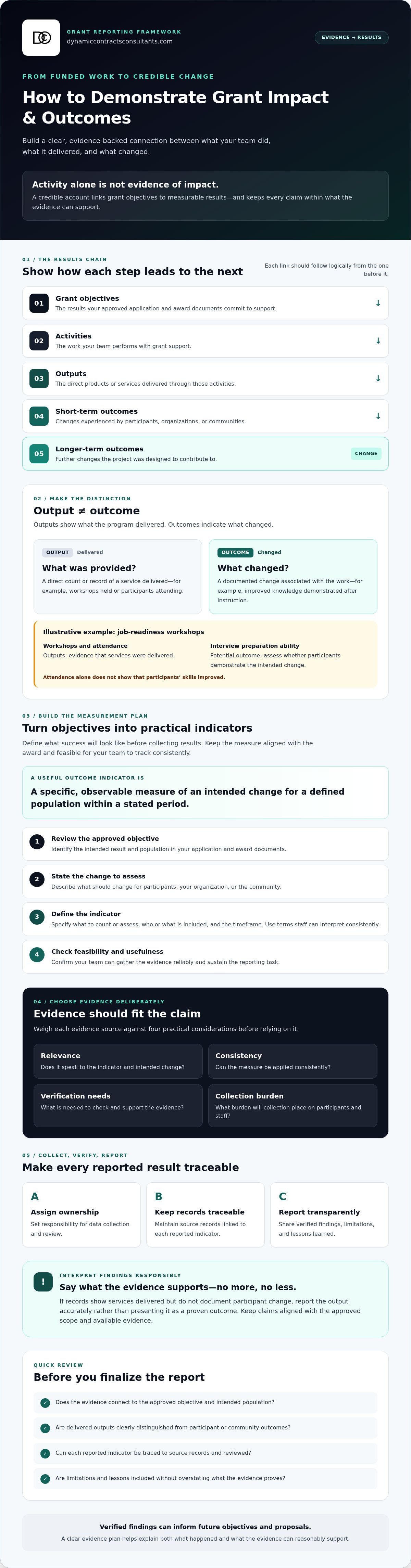
A results chain makes this connection visible: grant objectives → activities → outputs → short-term outcomes → longer-term outcomes. Each step should follow logically from the one before it. For a foundational overview of how programs are assessed systematically, see Program evaluation.
To see how impact can be framed in a proposal, watch this video:
What is the difference between grant outputs and outcomes?
Outputs are the direct products or services delivered through funded activities. Outcomes are changes experienced by participants, organizations, or communities. Outputs show what the program delivered; outcomes indicate what changed. Short-term outcomes may precede longer-term changes, but each claim needs evidence appropriate to its scope.
Definition box: Outputs vs. outcomes
- Output: A direct count or record of a service delivered, such as workshops held or participants attending.
- Outcome: A documented change associated with the work, such as participants demonstrating improved knowledge after instruction.
Hypothetical example: Suppose your team delivers grant-funded job-readiness workshops. The workshops and attendance are outputs. Participants’ demonstrated ability to prepare for interviews could be an outcome if the project defines how that change will be assessed. Attendance alone doesn’t show that participants’ skills improved.
How do grant objectives shape the impact story?
Begin with the objective or result stated in your application and award documents. Identify the intended population, the change the project aims to support, and the relevant timeframe. Then check that activities and measures remain aligned with those commitments. Reporting expectations vary by award, so verify the applicable requirements against your award documents.
Keep claims within the approved project scope and the evidence available. If records show services delivered but don’t document participant change, report the output accurately rather than presenting it as a proven outcome. This alignment helps communicate what happened and what the evidence can reasonably support.
Build a Grant Outcomes Framework From Objectives to Measurable Indicators
Translate approved objectives into a measurement plan your team can apply consistently. To determine how to demonstrate grant impact and outcomes, define each measure before collecting results. Confirm that it reflects the award’s intended results and that your organization can gather the evidence reliably.
A grant outcome indicator is a specific, observable measure used to assess whether an intended change has occurred for a defined population within a stated period. A useful indicator helps decision-makers understand progress without creating a reporting task your team cannot sustain.
How do you select indicators that demonstrate grant outcomes?
Use this sequence to move from objectives to practical evidence sources:
- Review the approved objective. Identify the intended result and population in your application and award documents.
- State the change to assess. Describe what should change for participants, your organization, or the community.
- Define the indicator. Specify what your team will count or assess, who or what is included, and the timeframe. Use terms staff can interpret consistently.
- Check feasibility and usefulness. Confirm your team can collect the information with reasonable effort and that it can inform decisions about progress.
- Assign an evidence source. Identify where the information will come from, such as program records, a participant assessment, or documented observations.
For example, if your objective concerns improved access to a service, choose an indicator that measures a relevant change in access, not just the number of outreach activities. The University of Missouri’s program evaluation tools describe approaches to collecting, analyzing, and reporting qualitative and quantitative information. When assessing a measure, consider its relevance, whether it can be interpreted consistently, and the capacity of staff and participants to support data collection.
How should a grant team set baselines and targets?
Keep these four elements distinct in your measurement plan:
- Baseline: Your documented starting condition and its source.
- Target: The intended level of progress, grounded in your approved plan and available operational evidence.
- Actual result: What your collected evidence shows, including when results differ from the target.
- Timeframe: The period covered by the baseline, target, and actual result.
Without a baseline, later results may show what was observed but not whether conditions changed. Set targets based on the project’s stated scope and capacity, not simply because they seem ambitious. If a target needs to change, document why and verify the grantor’s process and award-specific requirements before adjusting or reporting it.
If you need support aligning objectives, measures, and proposed results in an application, explore our grant writing services.
Compare Evidence Sources and Explain What Grant Results Can Prove
Choose evidence that fits your indicator, can be collected consistently, and supports a clearly bounded claim. Program records may reliably show that a service was delivered, while participant feedback may explain how people experienced it. Neither source automatically proves lasting change or that grant-funded work caused it. Match each claim to the available evidence and make clear what that evidence can and cannot establish.
As you review possible sources, consider their different strengths and limitations:
- Administrative records, such as enrollment or service logs, can document participation and delivery. Check that definitions are clear, entries are complete, and records are kept consistently.
- Structured participant feedback, including surveys, can capture reported knowledge, experience, or perceived change. Consider response rates, question clarity, and the time required of respondents.
- Interviews or focus groups can add context about how participants describe change. Use a consistent approach to collection and interpretation, while recognizing that findings reflect the people who took part.
- Direct observation can document behaviors or conditions using a defined method. Shared criteria help observers apply that method consistently.
For each indicator, document the source, collection method, responsible owner, and schedule. Record definitions and procedures so staff collect information consistently, and maintain a clear history of corrections. Where appropriate, compare different forms of evidence. Service records, for example, may confirm participation, while feedback adds context about participant experience. This triangulation can strengthen your account, but it doesn’t eliminate data gaps or establish causation by itself.
Which data sources can support a grant impact claim?
Select sources based on the claim your team intends to make, not simply on what is easiest to collect. A count of completed services may support a delivery claim, while a claim about changed knowledge calls for evidence that assesses knowledge. Consider relevance, consistency, verification, and respondent burden together. If a source cannot be checked or interpreted reliably, qualify the conclusion and explain the limitation.
How can you discuss contribution without overstating causation?
A change observed during a grant-funded project doesn’t prove the project alone caused it. Other services, external conditions, or participants’ circumstances may also influence results. Unless your evaluation design and evidence substantiate a causal conclusion, use measured language such as “the project contributed to” or “results were associated with,” and identify plausible influences. Disclose missing data and gaps so readers can understand the limits of your findings.
Transparent reporting is stronger than an unsupported claim. State what your evidence shows, how it was gathered, and where its limits lie, giving funders the context they need to assess results appropriately.
How to Collect, Verify, and Report Grant Outcome Evidence
A sound evidence process turns the framework into a consistent operating practice. To understand how to demonstrate grant impact and outcomes, make responsibilities, collection intervals, and review steps explicit before reporting begins. This gives staff a shared method for recording results and helps keep each reported figure traceable to its supporting documentation.
How do you create a grant evidence collection plan?
For each indicator, document the source, collection method, responsible person, collection interval, and review date. Specify who checks entries for completeness and who resolves discrepancies. Documented data definitions make outcome reporting more consistent because every team member knows what to record and how to interpret it.
Use the same definitions and collection procedures throughout the project, and follow your organization’s approved data-handling practices. Establish a documented process for missing, corrected, or conflicting information. For example, staff should record when an entry is corrected and preserve enough context to explain the change, rather than silently replacing a value. These controls support consistency without implying that the underlying data are automatically complete or error-free.
What belongs in a clear grant impact report?
Organize the report so a reader can move from the approved objective to the evidence and reported result. A concise table can provide that traceability. If a table isn’t practical, use the same fields in a structured list:
- Approved objective: The result described in the application or award documents.
- Activities and outputs: The work performed and the direct services or products delivered.
- Outcome indicator: The measure used to assess the intended change.
- Actual finding and timeframe: What the evidence shows for the reporting period.
- Evidence source: The record or collected information supporting the finding.
Before submission, reconcile the report with the award’s approved reporting instructions, including required measures, formats, and submission details. Verify grantor-specific requirements against the applicable award documents rather than assuming one standard applies to every award. If actual results differ from expectations, explain the variance, relevant limitations, and corrective actions. Report unfavorable or incomplete findings transparently; excluding them can make the account less credible.
A traceable record connects every reported indicator to its source evidence and any review or correction history. This helps your team substantiate its report and respond consistently to questions about how a result was calculated. For support aligning grant objectives, measures, and proposed outcomes in a funding narrative, review our grant writing services.
Turn Demonstrated Grant Outcomes Into Stronger Proposals and Next Steps
Verified findings can inform the next funding proposal, but they should guide planning rather than serve as automatic proof that a future project will achieve the same results. Use the evidence to identify which activities were delivered, what changes were documented, where implementation encountered constraints, and what the available data could not establish. This creates a more defensible basis for refining program design and setting future expectations.
How can grant outcomes strengthen a future application?
Carry forward findings that are traceable to their source records, and explain how they relate to the next proposed project. If evidence indicates that a particular activity was associated with a reported change, describe that relationship accurately. Don’t turn an association into a guarantee or assume results will transfer to a different population, setting, or timeframe without support.
Use documented lessons to refine the next application’s objectives, activities, indicators, and evidence plan. For example, if prior reporting showed that a measure was difficult to collect consistently, select a more feasible indicator or clarify collection responsibilities in the new plan. Keep established findings separate from future projections, and ensure proposed outcomes are proportionate to the resources and evidence available. For related context on AI in grant writing, consult this guide to AI for grant writing.
When should an organization seek grant-writing support?
Writing support may be useful when objectives, proposed measures, evidence sources, and narrative claims don’t align, or when a team needs to translate prior findings into a clear, supportable funding narrative. Dynamic Contracts Consultants LLC provides grant writing and proposal writing, with financial analysis for proposals. This support can help structure and communicate an application; it does not guarantee an award or replace verification of the applicable funding opportunity’s requirements.
Before drafting, organize the approved objectives, available findings, source documentation, limitations, and lessons learned. Then check that each proposed outcome connects to planned activities and a feasible measurement method. Our grant writing services and proposal writing support can help teams develop clear, evidence-conscious narratives. Review these services to identify the type of application-development assistance that fits your needs.
Make Your Grant Evidence Work for What Comes Next
A credible impact narrative starts with the result your award set out to support, then connects activities and outputs to measurable outcomes. Select indicators your team can track consistently, maintain a clear link between findings and source evidence, and report limitations alongside results. This disciplined approach to how to demonstrate grant impact and outcomes helps you communicate progress without claiming more than the evidence supports.
Verified findings can also strengthen future applications. Use them to refine objectives, program design, and evidence plans, while keeping proposed outcomes realistic and aligned with available support. Clear grant writing and proposal development bring these elements together. Dynamic provides grant writing and financial analysis for proposals, and supports proposal development and acquisition lifecycle requirements.
If your objectives, measures, or narrative claims need closer alignment, discuss your grant-writing and proposal needs with our team. With a clear evidence plan and carefully supported claims, your organization can present its work with greater precision and build a stronger foundation for future funding efforts.
Frequently Asked Questions
How do you measure the impact of a grant?
A practical approach to how to demonstrate grant impact and outcomes begins with the approved objectives. Define the intended outcomes, indicators, evidence sources, collection schedule, and responsible roles. Record a baseline where available, then compare actual findings with the grant’s targets and timeframe. Interpret results in context and disclose data limitations. Observed change may support a conclusion that the project contributed to a result, but it doesn’t necessarily prove grant funding alone caused it.
What indicators should be used to demonstrate grant outcomes?
Choose indicators that directly reflect an approved objective and that your team can collect consistently with its available resources. Define what will be measured, who or what is included, the source, and the timeframe. Depending on the program, indicators may be quantitative, qualitative, or both. For example, a service count can document delivery, while structured feedback may capture participants’ reported experience. Don’t choose an indicator only because it’s easy to count.
How can a nonprofit prove a grant made a difference?
A nonprofit can present a clear connection between funded activities and documented changes, supported by relevant records, participant feedback, or other appropriate evidence. Explain how the information was collected, which period it covers, and any gaps or limitations. Evidence may show that change occurred during the project, but that alone doesn’t establish the grant as its sole cause. Unless the evaluation design supports a causal conclusion, describe the grant’s contribution carefully and accurately.
What is a grant impact report supposed to include?
A grant impact report should connect approved objectives with activities, outputs, outcome indicators, findings, and supporting evidence. Identify the reporting period and explain material deviations, missing data, and limitations so readers can interpret results appropriately. Follow the applicable award instructions for required content, formats, and submission details, since expectations may differ by grantor and award. A clear structure helps funders trace each reported result back to its objective and evidence source.
How do you demonstrate grant impact when you have limited data?
Be transparent about what information is available and what it can support. Use relevant existing records, clearly defined observations, or carefully gathered participant feedback, and explain any gaps. Don’t replace missing evidence with unsupported estimates or present incomplete data as representative of everyone served. You can also document measurement constraints and describe how future collection practices will address them. A candid account is more credible than a stronger claim the available evidence cannot substantiate.
Can grant outcomes be measured without a formal evaluation?
Grant teams can often monitor defined indicators and report evidence without conducting a formal evaluation, but the suitable approach depends on award instructions and the claims being made. Routine monitoring can document implementation and observed results; it may not establish why a change occurred or whether the grant caused it. Check the award documents, report what the evidence supports, and qualify conclusions where necessary. A formal evaluation may be appropriate when stronger causal claims are required.


