

The lowest price can become the most expensive commitment when it does not reflect the solicitation’s requirements, delivery assumptions, and risks. A defensible government proposal pricing strategy balances competitiveness with the cost basis needed to perform the work as proposed. Dynamic Contracts Consultants helps teams connect those elements so the pricing rationale is clear and supportable.
That balance takes more than a spreadsheet. Pricing assumptions need to match the technical approach and proposal while following the solicitation’s instructions and evaluation priorities. If the rationale is unclear, reviewers may question whether the proposed price supports the promised level of performance.
This guide explains how to build traceable pricing assumptions and connect them to the work your team proposes to deliver. You’ll learn how to interpret solicitation requirements, align pricing with your technical and management approach, assess delivery risk, and find gaps before submission. The aim is to make informed tradeoffs without treating competitiveness and cost recovery as opposing goals.
Key Takeaways
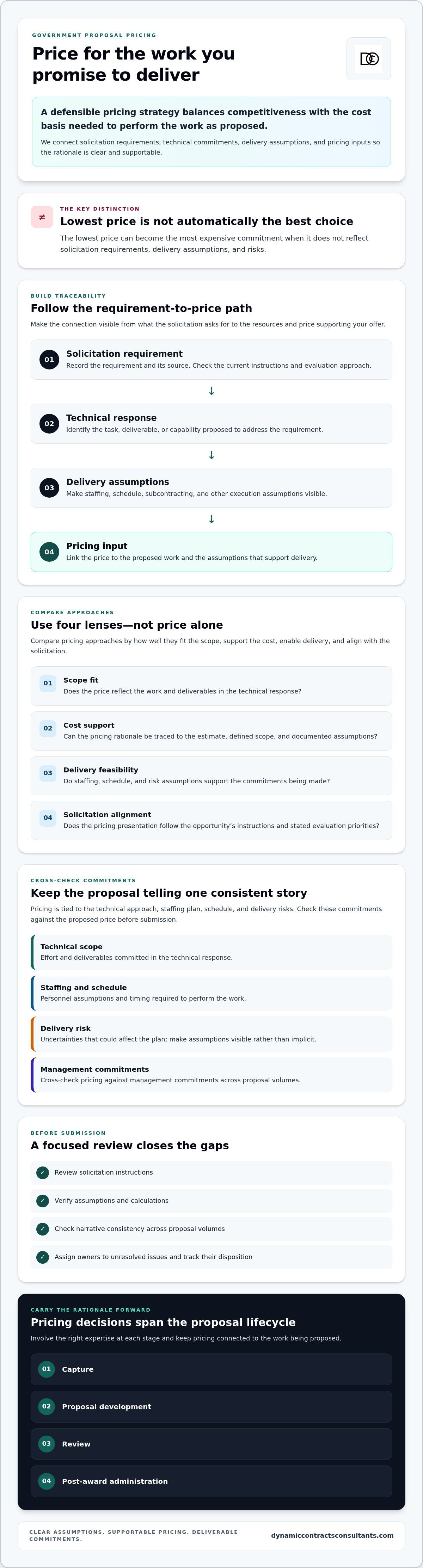
- Build your government proposal pricing strategy around solicitation requirements. Link each requirement to the technical response, delivery assumptions, and pricing inputs that support it.
- Compare pricing approaches by scope fit, cost support, delivery feasibility, and solicitation alignment. Do not assume the lowest price is automatically the best choice.
- Before submission, review instructions, assumptions, calculations, and narrative consistency. Assign owners to unresolved issues and track their disposition.
- Cross-check pricing against technical, staffing, schedule, and management commitments to catch inconsistencies across proposal volumes.
- Carry pricing decisions through capture, proposal development, review, and post-award administration, involving the right expertise at each stage.
What Government Proposal Pricing Strategy Must Accomplish
A government proposal pricing strategy is the method your team uses to develop and explain a proposed price in relation to the solicitation, your solution, and the resources required for delivery. It is more than a price point or cost estimate. A useful strategy connects the reasoning behind your offer to the work you propose, without implying that a particular price will determine the outcome.
Price is tied to your technical approach, staffing plan, schedule, and delivery risks. If the solution requires more effort or a different sequence than your assumptions allow, the proposed price may not support the commitments elsewhere in the proposal. Check the current instructions and evaluation approach for every opportunity. The solicitation and its stated criteria govern each bid.
For a brief introduction to government contract pricing, watch this video:
How pricing strategy differs from a cost estimate
Cost analysis examines the inputs and assumptions behind anticipated costs. Proposal pricing strategy uses that analysis, your defined scope, and solicitation requirements to develop and explain the price you offer. An estimate can inform your offer, but by itself it does not show how the estimated resources map to required work. Document assumptions about included work, staffing, and delivery schedule so reviewers can trace how the estimate supports your solution. The Federal Acquisition Regulation (FAR) provides background on the federal acquisition framework. Check current solicitation instructions and applicable authoritative sources for opportunity-specific requirements.
Why competitive pricing must remain deliverable
Your price should support the resources needed for the work you propose. Before finalizing your offer, check that it reflects:
- Technical scope: The effort and deliverables your technical response commits to provide.
- Staffing and schedule: The personnel assumptions and timing required to perform the work.
- Delivery risk: Uncertainties that could affect your plan, with assumptions made visible rather than left implicit.
This alignment gives your team a clear basis for review and helps identify gaps before submission. Dynamic Contracts Consultants’ proposal writing services can support the connection between proposal content and solicitation requirements.
Build a Government Proposal Pricing Strategy from Solicitation Requirements
Build the price from the work the solicitation requests, not from a generic estimate detached from your technical response. A practical government proposal pricing strategy creates a traceable path from each relevant requirement to the proposed solution, delivery assumptions, and pricing input. This helps your team identify scope without supporting resources, as well as cost assumptions with no clear basis in the offer.
Translate Section L and Section M into pricing inputs
Review the specific solicitation’s instructions, including Section L and Section M when those sections are used. Confirm submission requirements and the stated evaluation factors that affect how price must be presented or explained. Do not infer an evaluation method from a familiar template or past procurement. If language is ambiguous, flag it for appropriate review rather than treating an interpretation as confirmed direction.
Use a requirement-to-price map to make the connections visible:
- Requirement: Record the solicitation requirement and its source.
- Technical response: Identify the task, deliverable, or capability proposed to address it.
- Delivery assumption: Note relevant staffing, schedule, subcontracting, or other execution assumptions.
- Pricing input: Link the assumption to the cost element or pricing rationale it informs.
For example, if a requirement calls for a defined deliverable, the technical response should describe the work that produces it. The delivery assumptions should clarify the planned effort and timing. Review the corresponding pricing input against that documented approach rather than considering it in isolation.
Document cost assumptions and supporting rationale
Separate confirmed solicitation direction from internal assumptions that still need validation. Organize relevant labor, materials, subcontracting, schedule, and scope inputs, then record the source or rationale for each. Clearly mark exclusions, dependencies, and uncertain inputs. If an estimate depends on an unconfirmed staffing assumption, label it provisional until the team validates it.
Maintain this record as an internal traceability tool. The FAR proposal analysis techniques reference describes approaches used in federal proposal analysis. It can inform your understanding of how pricing may be examined, but the solicitation and applicable current guidance must govern bid-specific decisions.
When your team needs help connecting solicitation instructions to proposal content, specialist proposal writing services can support compliance matrices, gap analysis, and Section L and M alignment. The objective is a coherent, reviewable offer, not an assumption that any particular price ensures selection.
Compare Pricing Approaches Without Confusing Low Price with Best Value
Compare pricing approaches against the opportunity’s scope, support for cost assumptions, delivery feasibility, and solicitation terms. A low proposed price is not automatically the right choice. If it relies on fewer resources than the technical solution requires, your team may have a mismatch it cannot explain or support. A higher price is not inherently more persuasive either. The right approach depends on the solicitation and its verified evaluation criteria.
The comparison below is an internal decision aid, not a prediction of how an agency will evaluate a proposal. The Best Value Procurement Guide offers a public-sector perspective on best-value concepts, but the specific solicitation governs each procurement.
Price-focused approach
Rationale: Prioritize a competitive price while meeting the stated scope. Potential benefit: A clear, efficient offer when its resources and assumptions support performance. Principal risk: Omissions or unsupported reductions may undermine the delivery plan.
Scope-supported approach
Rationale: Build the offer around documented work, staffing, schedule, and other relevant assumptions. Potential benefit: Stronger traceability between the proposed solution and its price. Principal risk: The rationale may be unclear if assumptions are not explained or the solicitation’s pricing instructions are missed.
Risk-aware approach
Rationale: Examine delivery uncertainties and dependencies alongside the proposed resources. Potential benefit: Helps the team identify feasibility concerns before submission. Principal risk: Treating unverified risks as established facts can distort the analysis.
Assess price against scope, risk, and performance commitments
Test whether the proposed resources and delivery assumptions support each technical and management commitment. If the narrative promises a deliverable on a stated schedule, for example, check whether the staffing and work assumptions behind the price support that promise. Flag omissions, unresolved dependencies, or conflicting commitments across proposal volumes. Keep documented competitive analysis separate from speculation about competitors’ prices. An unsupported guess is not a reliable basis for changing your offer.
Use cost and price analysis responsibly
Analysis can help your team test internal assumptions, compare pricing inputs with the proposed scope, and uncover gaps before submission. It should clarify the basis for decisions, not substitute invented benchmarks, standard margins, or universal thresholds. Connect opportunity-specific positioning to strategic capture planning, then validate it against the solicitation and available evidence. A disciplined government proposal pricing strategy makes tradeoffs visible while keeping the proposed solution and delivery plan coherent.
Validate Pricing Narratives, Assumptions, and Proposal Consistency
A final pricing review should test more than arithmetic. Confirm that the proposed figures, supporting rationale, and commitments across the proposal describe one coherent offer. Assign owners to prepare, check, and approve pricing inputs. Keep review records showing what was examined and which issues remain open. These controls support disciplined internal review, but they do not guarantee compliance or an award.
Run a structured pricing review before submission
Use a defined review sequence, working from the current solicitation and approved proposal inputs:
- Confirm instructions: Verify the current solicitation version, pricing format, required schedules, and instructions affecting the price narrative.
- Reconcile assumptions: Check that scope, staffing, schedule, dependencies, exclusions, and exceptions are visible and stated consistently.
- Check calculations: Trace totals and supporting figures to approved source inputs, and resolve unexplained differences.
- Cross-check proposal volumes: Compare price support with technical deliverables, staffing levels, management commitments, and the proposed schedule.
- Assign open issues: Record discrepancies, identify the appropriate reviewer, and document the resolution before final approval.
If the technical volume describes a level of effort or delivery sequence that differs from the assumptions behind the price, pause the review until the responsible teams reconcile the difference. A polished narrative cannot compensate for conflicting commitments.
Keep pricing support traceable and current
Maintain records that distinguish documented inputs from estimates. For key assumptions, identify the source, date, owner, and status, along with relevant dependencies and exclusions. If an input is provisional, label it as an estimate and record what validation is still needed. Update supporting files when approved proposal inputs change so reviewers can follow the rationale used for the submitted version.
Traceable records can support internal review and provide useful context for later contract administration. Do not describe them as proof of audit acceptance or regulatory sufficiency. Those conclusions depend on applicable requirements and the specific circumstances. Dynamic Contracts Consultants’ proposal writing services include compliance matrix generation, gap analysis, and alignment of proposal content with Section L and Section M. Specialist support can provide an additional review of proposal consistency and documented pricing rationale.
Apply the Pricing Strategy Across the Proposal Lifecycle
Keep pricing decisions connected from opportunity selection through performance. During capture planning, assess whether the opportunity fits your capabilities and identify factors that may shape the response. Proposal development translates the solicitation into a technical and management approach, with pricing inputs tied to the work, staffing, and delivery assumptions. Review brings those elements together before submission. After award, the proposal’s documented assumptions and commitments can provide context for contract administration.
This continuity matters because pricing is connected to the rest of the procurement lifecycle. If the technical approach changes, the associated staffing, schedule, and cost assumptions may need to be revisited. Clear ownership and coordinated review help teams track changes instead of allowing proposal volumes to drift out of alignment.
Know when to involve proposal pricing specialists
Additional expertise may be useful when requirements are complex, internal assumptions conflict, or your team has limited capacity for a thorough review. Dynamic Contracts Consultants works alongside teams, providing proposal writing, cost and price analysis, and compliance support to help develop a consistent, traceable response. Your organization remains responsible for validating its inputs, approving its offer, and confirming that the final submission reflects its delivery plan.
Dynamic Contracts Consultants provides government proposal writing services, including technical volume drafting, compliance matrix generation, gap analysis, and Section L and M alignment. These capabilities can help connect solicitation requirements with the proposal’s technical and pricing rationale. Specialist input supports disciplined decision-making, but it does not guarantee an award or replace your team’s review.
Maintain continuity after award
Once a contract is awarded, the submitted proposal can help internal teams understand the assumptions and commitments that informed the offer. Preserve relevant pricing rationale and proposal records so those teams can refer to them during contract administration. If performance needs or circumstances raise questions, use the applicable contract documents and established internal processes to determine next steps. Proposal pricing support does not change contract terms or replace legal advice.
For lifecycle context, review Dynamic Contracts Consultants’ post-award contract administration support. A connected government proposal pricing strategy helps teams carry documented decisions from capture through delivery, while maintaining clear boundaries between proposal development and post-award responsibilities.
Information about discussing your solicitation requirements, pricing assumptions, and proposed approach is available on our contact page.
Move Forward with a Pricing Strategy You Can Explain
A defensible government proposal pricing strategy connects solicitation requirements, documented assumptions, evaluation priorities, and the resources needed to deliver your technical approach. It is not simply a target price. Before submission, verify that the pricing narrative, calculations, staffing, schedule, and management commitments are consistent, and flag unresolved assumptions for review.
Proposal support can include cost and price analysis, compliance matrices, and Section L and M response alignment to help teams maintain traceability across proposal elements. FARIFY’s AI-enabled document support can assist with document generation, with human-in-the-loop assurance. These capabilities support informed review and consistency, not guaranteed award outcomes.
Each opportunity has its own solicitation requirements and evaluation criteria. An evidence-based pricing process helps you make tradeoffs with greater clarity and carry relevant proposal assumptions into post-award administration.
Frequently Asked Questions
What is a government proposal pricing strategy?
A government proposal pricing strategy is the method for developing and explaining a proposed price in relation to the solicitation, proposed solution, and resources required for delivery. It connects cost assumptions to scope, staffing, schedule, and risk. Unlike a price point or estimate alone, it documents why the offer is structured as proposed. It does not guarantee an award. The solicitation’s requirements and evaluation criteria govern each opportunity.
How do you develop pricing for a government proposal?
Start with the current solicitation, identify relevant requirements, and map each one to the technical response, delivery assumptions, and pricing inputs. Document the basis for key assumptions, including applicable labor, materials, subcontracting, schedule, and scope. Separate confirmed solicitation direction from internal estimates that still need validation. Before submission, reconcile the pricing narrative and calculations with the proposal’s technical, staffing, and management commitments.
What factors should a government contractor consider when pricing a proposal?
Consider the requested scope, resources needed to perform it, delivery timing, dependencies, subcontracting assumptions, and risks that could affect performance. Check that the proposed price aligns with technical and management commitments throughout the response. Verify the solicitation’s pricing instructions and evaluation criteria for that specific opportunity. Keep assumptions and supporting rationale traceable, and flag estimates or unresolved inputs instead of presenting them as confirmed facts.
Is the lowest price always the best strategy for a federal proposal?
No. The lowest price is not automatically the best strategy. The solicitation states the evaluation approach and how price relates to other factors. A lower figure may be difficult to support if it does not account for the resources needed to deliver the proposed solution. A higher price is not inherently more persuasive either. Evaluate each approach against the solicitation, scope, cost support, and delivery feasibility without assuming how competitors will price.
How do Section L and Section M affect government proposal pricing?
Section L and Section M can provide solicitation-specific instructions and evaluation information relevant to how a proposal, including its pricing narrative, should be prepared and assessed. Review the actual solicitation instead of relying on a standard template or assumptions from another procurement. Identify the applicable submission directions and evaluation factors, then align the pricing presentation accordingly. If language is ambiguous, seek appropriate clarification or review rather than inferring an evaluation rule.
Can AI help with government proposal pricing analysis?
AI can assist with document-related work, such as organizing information and supporting document generation, but its output requires human review. FARIFY provides AI-driven contracting document support with human-in-the-loop assurance. Teams should independently validate solicitation requirements, source data, calculations, assumptions, and final proposal language. AI assistance does not replace cost analysis or internal approval, and the contractor remains responsible for ensuring the proposed price reflects its intended approach.
When should a contractor seek professional proposal pricing support?
Consider professional support when solicitation requirements are complex, pricing assumptions conflict with the technical approach, or your team lacks capacity for a thorough review. Dynamic Contracts Consultants provides cost and price analysis, proposal writing, compliance matrix generation, and Section L and M alignment. The team can work alongside you to improve consistency and traceability. Your organization remains responsible for validating its inputs and approving the final offer. No support can guarantee an award.
To review how your solicitation requirements, pricing assumptions, and proposed approach fit together, contact Dynamic Contracts Consultants.


