
We treat a proposal library as a managed source of reusable material, not a folder of old submissions. To create one your team can rely on, focus on content that is accurate, easy to find, and tailored to each bid.
Past proposals, resumes, project descriptions, and company information can save teams from rebuilding every response from scratch. Reuse verified content selectively so each proposal reflects its own requirements, evaluation criteria, and customer priorities.
This guide explains how to assess existing materials, organize them with clear categories and naming conventions, and choose a centralized platform for collaboration and version control. It also covers keeping content current and training teams to find and adapt library materials. The goal is a practical foundation for consistent proposal development, with reuse supporting your strategy rather than replacing it.
Key Takeaways
- Build the library from past proposals, contracts, resumes, and company information, then assess each item for accuracy, relevance, and compliance.
- Use consistent categories, searchable tags, and clear file names so teams can locate and apply the right content efficiently.
- Choose a centralized platform with collaboration and version control to reduce the risk of outdated or conflicting materials.
- Assign responsibility for content updates and train proposal teams to find, customize, and provide feedback on library materials.
- Reuse content as a starting point, then tailor each proposal to its specific requirements, evaluation criteria, and customer priorities.
Content organization, tagging, and naming conventions
We work with you to structure reusable content around clear categories, searchable tags, and consistent file names. For federal, state, and local bids, we shape templates around common sections, then tailor each version to the solicitation’s instructions and evaluation criteria.
-
Organize and tag proposal content
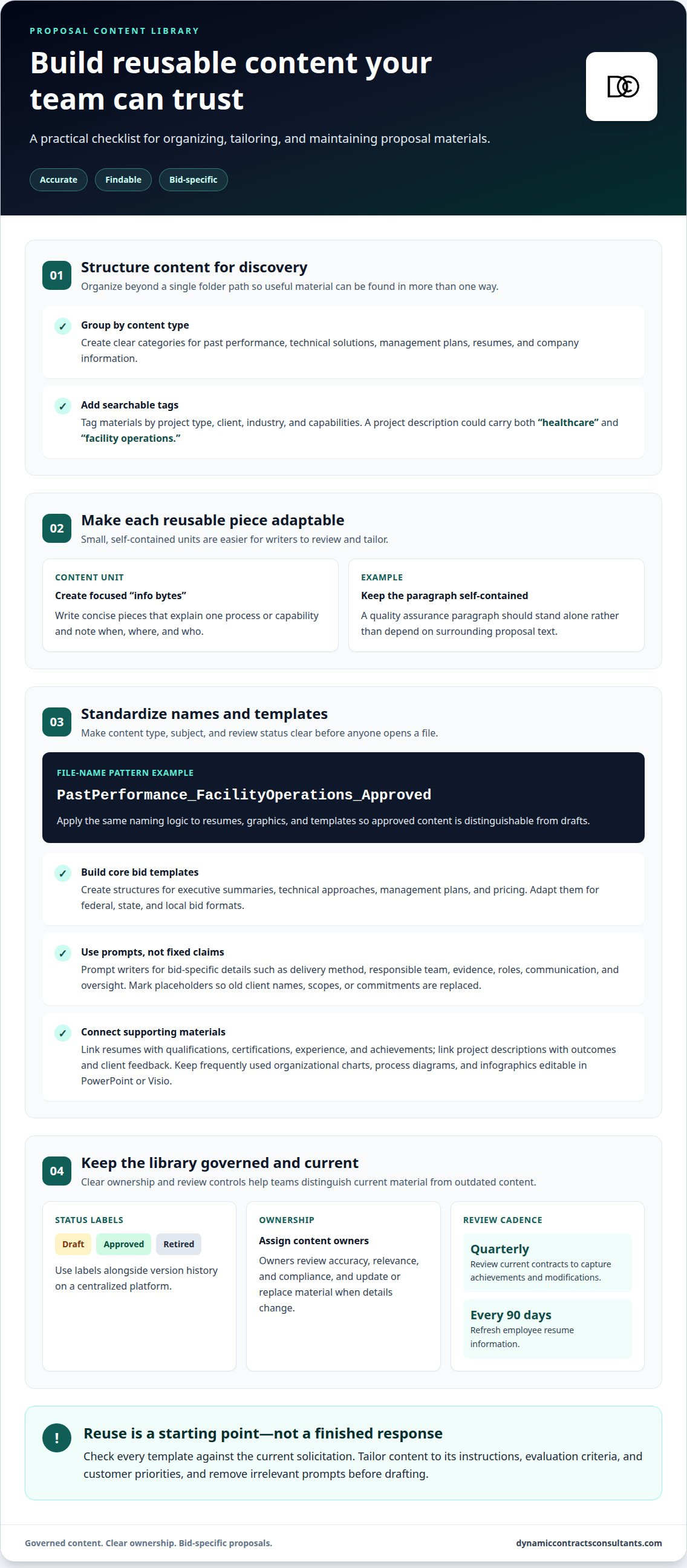
Group materials by type, including past performance, technical solutions, management plans, resumes, and company information. Apply tags for project type, client, industry, and capabilities so teams can find useful material across categories. For example, a project description might carry both “healthcare” and “facility operations” tags. Avoid relying on a single folder path for every search.
- We divide reusable content into focused units. Our team can help shape concise “info bytes,” each explaining one process or capability and noting when, where, and who. For example, a quality assurance paragraph should stand alone rather than depend on surrounding proposal text. Smaller units give your writers specific material to review and adapt.
- Set a file-naming convention before adding materials to the library. A consistent pattern can identify content type, subject, and review status, such as “PastPerformance_FacilityOperations_Approved.” Apply the same naming logic to resumes, graphics, and templates. This helps your team distinguish approved content from drafts without opening every file.
-
Create reusable bid templates
Develop core templates for sections such as executive summaries, technical approaches, management plans, and pricing. Adapt the structure for federal, state, and local bids when solicitation formats or instructions differ. Label versions by jurisdiction and content type, then compare each template with the current solicitation and remove irrelevant prompts.
- Use prompts rather than fixed claims in reusable sections. A technical approach template can ask for the delivery method, responsible team, and supporting evidence. A management plan can prompt for roles, communication, and oversight. Mark fields that require bid-specific details so writers replace placeholders instead of carrying forward an old client name, scope, or commitment.
- Connect supporting materials to relevant template sections. Resumes can include qualifications, certifications, experience, and achievements; project descriptions can capture outcomes and client feedback. Keep frequently used organizational charts, process diagrams, and infographics editable in formats such as PowerPoint or Visio, so your team can revise details without rebuilding each graphic.
- Define how each item is approved and revised. Use labels such as “draft,” “approved,” and “retired,” while preserving version history on a centralized platform. Assign an owner to replace outdated project descriptions, resumes, or templates when details change. Regular reviews help keep retrieved materials current and relevant.
Proposal content library definition and benefits
We define a proposal library as a governed source of reusable material, not a repository of complete bids to copy unchanged. We work with you to establish its purpose and controls, so each proposal can draw on useful content while remaining specific to its solicitation.
- We help scope the library around the materials your team needs, such as past performance descriptions, technical solutions, management plans, resumes, company introductions, and compliance certifications. A project record, for example, can provide a starting point for describing relevant experience. We keep its original context visible, so reuse supports drafting without replacing solicitation-specific development.
- Establish a process for sensitive information before adding any material to the collection. Your organization’s applicable procedures should govern CUI, classified information, and export-controlled data. Keep such material out of a general proposal library unless its storage environment and access arrangements are approved for that information. A label alone does not make a system suitable.
- We work with you to assign content owners and define review decisions. Owners can assess accuracy, relevance, and compliance, then replace outdated project descriptions and resumes, add recent work, or revise templates when requirements or branding change. Government contractors should review current contracts quarterly to capture achievements and modifications; employee resume information can be refreshed every 90 days.
- Translate access needs into platform permissions. Define who may view, edit, approve, or retire materials, then use version history to distinguish current content from prior drafts. Audit logs and an approval workflow can help show who changed a file and when. For sensitive information, follow your organization’s applicable security procedures and access permissions.
- The cost to build and maintain a library depends on the case and is provided after a quote request. We consider factors such as source-material volume and condition, platform needs, migration, review, and ongoing maintenance. A focused collection needing limited organization presents different work from scattered files requiring extensive cleanup and approval.
- Measure library use through searches, downloads, frequently accessed items, and unsuccessful searches. Compare proposal outcomes with the materials and strategies used, but don’t treat reuse alone as proof of why a bid succeeded or failed. Repeated use of one section may indicate valuable content or a need for additional material.
- We advise against copying complete narratives across bids. Earlier content may contain inaccurate details, and a response developed for different evaluation criteria may miss the current buyer’s concerns. We retain supported facts as inputs, then tailor language and evidence to the solicitation. If your team needs help evaluating its content governance, discuss your library workflow.
Training proposal teams to use the library
We train your proposal staff to find, assess, and adapt library content within an active bid workflow. With your team, we use a walkthrough, hands-on practice, and a feedback loop to make reusable materials easier to apply without assuming old language is automatically suitable.
- We guide your team through the library’s actual categories and search tools. We show where approved past performance, resumes, technical content, and templates are stored. We demonstrate a search, such as locating projects by industry, then explain how tags and file names help narrow results. We ask participants to repeat the search independently.
- We teach your staff to assess a result before inserting it. Together, we review its approval status, subject, relevance, and supporting details. For example, a project description may fit the same industry but describe a different scope. We help your team identify what applies, what needs updating, and what does not support the current response.
- We demonstrate how to adapt reusable content to a solicitation. Using a sample requirement, we show how a writer selects supporting evidence, then revises the wording to address the buyer’s stated need. We emphasize that a past narrative is a starting point, not a substitute for reviewing instructions, evaluation criteria, and customer concerns.
- We explain the library’s contribution and approval workflow with your team. We show how a writer proposes an edit, how a subject matter expert reviews technical details, and how an authorized owner marks content approved. We clarify the difference between a working draft and approved material to help prevent unreviewed language from appearing authoritative in a deadline-driven response.
- We practice with your team using a realistic bid scenario rather than an isolated software demonstration. We give a small group a fictional requirement, then ask them to locate relevant past performance and a technical approach. We have them explain why each item fits and identify missing evidence. This exercise tests both search skills and judgment.
- We collect usability feedback after the exercise. We ask participants to record failed searches, unclear labels, duplicate materials, and missing content. For example, if users search “maintenance” but relevant items use “facility operations,” we update tags or search guidance. We route proposed changes to the library owner for review rather than allowing inconsistent edits.
- We provide role-specific job aids for your proposal managers, writers, and subject matter experts. A writer’s guide can cover search and adaptation; a reviewer’s guide can explain approval criteria. We include a brief process map showing how content moves from draft to review, approval, use, and eventual replacement.
- We reinforce training during proposal work and onboarding. We have a manager observe whether staff can find and adapt content during a live response, then address recurring obstacles in a follow-up session. We track common search gaps and user feedback to prioritize updates to training materials and library organization.
Centralized library platforms
We help you choose a controlled location where proposal teams can find and collaborate on approved material. Together, we evaluate each platform against your content workflow, user access, search needs, and version control.
- We map the work with you before selecting a platform. List who contributes, reviews, approves, and uses proposal content. For example, writers need searchable past performance, while reviewers need clear approval status. We use these tasks to define platform requirements instead of choosing based only on familiar features.
- We help you centralize approved materials rather than link to scattered personal folders. A shared location gives your proposal teams a consistent source for technical approaches, resumes, and project descriptions. We recommend keeping working drafts distinct from library content so users can identify the authoritative version before incorporating material.
- We assess collaboration with you through a realistic workflow. Have a writer locate a project description, share it with a reviewer, and incorporate approved feedback. We confirm that contributors can work without creating parallel copies that become difficult to reconcile. The platform should support the handoffs your proposal process actually requires.
- We help you use version control to distinguish current content from prior revisions. A technical approach might change after a project update, while an older version remains relevant for historical reference. We make the latest approved version easy to identify and preserve revision history so reviewers can understand what changed.
- We configure search with you around the language proposal teams use. Test queries for project type, client, industry, and capability. If a search for “facility operations” misses a relevant record tagged only “maintenance,” we refine the metadata or search guidance. We use actual search failures to improve findability.
- We help you set permissions and ownership in the platform. Define who may view, edit, approve, or retire content, then assign responsibility for maintaining each category. For example, a resume owner can route employee updates to an authorized reviewer before replacing the approved version.
- We monitor usage with you to guide library improvements. Review which content teams access, which searches return few useful results, and which materials appear repeatedly. Frequent use can indicate valuable content, while repeated searches with no result may reveal missing tags, content gaps, or unclear terminology.
- We test the platform with you using a current proposal task before broader adoption. Ask users to find relevant evidence, confirm its status, and share it with a teammate. We record obstacles, then adjust permissions, labels, or workflows. Together, we revisit platform performance as team needs and library content evolve.
Inventorying and assessing existing materials
We recommend starting with a documented inventory, then partnering with you to assess each item before it enters the library. Past proposals, contracts, resumes, and corporate records can provide useful source material, but we review them with you first.
-
Inventory existing materials
We work with you to collect files from proposal folders, contract records, resume repositories, and corporate information systems. Together, we record each item’s title, format, source, owner, date, and related project in an inventory. We include winning proposals, while confirming with you that each section is reusable. This register helps us identify duplicates, missing source details, and files whose original context may be unclear.
-
Assess existing materials
We review each item with you for relevance, accuracy, writing quality, and compliance before approving it. We compare successful proposal content with the underlying contract or project record, then confirm with you that descriptions still represent the work performed. A polished paragraph can still contain an outdated scope or unsupported claim. We mark uncertain items for review rather than treating them as ready to use.
- We help you classify materials by their evidence and intended use. A contract description may support past performance, while a corporate overview may provide approved company background. We compare resumes with current employee information and check technical narratives against project records. We record the evidence source so future reviewers can trace a statement to supporting material.
- We help you separate content into clear disposition groups: approved for library use, requiring revision, retained for reference, or excluded. For example, a proposal section written for a different customer can remain a historical reference without being promoted as reusable narrative. This distinction helps prevent your team from copying a prior response into a bid with different requirements.
- We prioritize review with you based on proposal relevance and content risk. We start with materials likely to support current opportunities, such as recent project descriptions and key personnel resumes. We scrutinize claims about results, scope, and compliance closely. A clear evidence trail makes it easier for your team to resolve discrepancies before material enters an approved collection. This source-based review is central to creating a government proposal library your teams can rely on.
- We assign an owner and a next action to every item that needs work. We specify whether the owner must confirm project details, revise language, obtain approval, or retire the file. Together, we avoid vague inventory labels such as “check later.” To create a government proposal library, we define these actions clearly with you so questionable content does not remain in circulation.
- We convert approved source material into library-ready content only after completing its review with you. We preserve the original record separately and link the reusable summary to its source. This creates a distinction between evidence and proposal language. If your team needs support turning reviewed source materials into bid-ready content, discuss your proposal content needs.
Dynamic Contracts Consultants LLC
We can align your proposal content with bid strategy and each opportunity’s requirements. When your team needs help turning relevant source material into a tailored response, we support your work with Proposal Writing and Capture Management, providing a structured path from opportunity assessment to submission.
Our Customized Proposal Templates can also establish consistent starting points for recurring proposal sections. We design templates to guide your team’s response without encouraging uncritical reuse; each bid still needs content shaped around its solicitation and evaluation criteria. This keeps your library connected to practical proposal development.
Contact us to discuss your proposal library and how it supports your contracting goals.
Turn Your Library Into a Strategic Asset
A proposal library should evolve alongside your organization’s capabilities and contracting priorities. Connect its content governance with the decisions that shape each opportunity: which bids align with your strategy, what evidence supports your approach, and where additional proposal development is needed.
Creating a government proposal library is most valuable when the process strengthens broader business readiness rather than simply storing past work. We offer Proposal Writing, Grant Writing, and DCAA Compliance Consulting to support your organization across these related priorities. Each engagement can address a distinct need, from developing a bid response to strengthening compliance practices.
Consider which library challenge matters most to your team now, such as turning source material into proposal-ready content or aligning proposal effort with opportunity strategy. We can help clarify a practical next step for your organization through a focused discussion.
Contact us to discuss your goals and move forward with greater clarity.
Frequently Asked Questions
What Is a Proposal Content Library?
We define a proposal content library as a governed collection of reusable information that supports future bids. Unlike an archive, our approach organizes content for practical retrieval and reuse, with context explaining what each item supports. For example, a project record can connect a performance summary to its source contract and identify the scope it describes. We use that traceability to help you distinguish supported evidence from language that needs further review.
What is a government proposal library and what should it include?
We consider a government proposal library a structured resource for preparing responses to public-sector opportunities. It can include approved past performance, technical and management material, staff qualifications, corporate information, and section templates. We recommend including context with each item, such as the project’s scope, the organization’s role, and the evidence supporting stated outcomes. This helps your proposal team select material that accurately represents your company’s experience for a particular opportunity.
How do you organize and tag government proposal content for reuse?
We recommend using a consistent taxonomy that reflects how your proposal teams search, then applying the same terms across folders and records. For example, decide whether “cybersecurity” and “information security” are separate tags or synonyms that lead to the same content. We suggest including fields for content type, capability, customer sector, and approval status. A short taxonomy guide helps your contributors apply labels consistently and reduces fragmented search results as your library grows.
What software is best for building a government proposal knowledge library?
We recommend choosing software that supports your content governance and retrieval workflow, rather than focusing on a particular brand. We can help you assess whether users can search metadata, control access, track revisions, and route content for review. Test those functions with a representative task, such as finding an approved technical narrative and identifying its source. Also consider how easily the platform fits your team’s existing collaboration practices.
How do you collect past performance, resumes, case studies, and proposal examples?
We recommend gathering source records from completed projects, contract files, employee-submitted experience details, and prior proposals. Create a consistent intake record for each item, capturing its source, the work performed, the organization’s role, and supporting evidence. For a case study, we advise separating documented outcomes from general narrative; for a resume, route experience details to the appropriate employee for review. Keep proposal examples as references, not automatically approved copy.


