

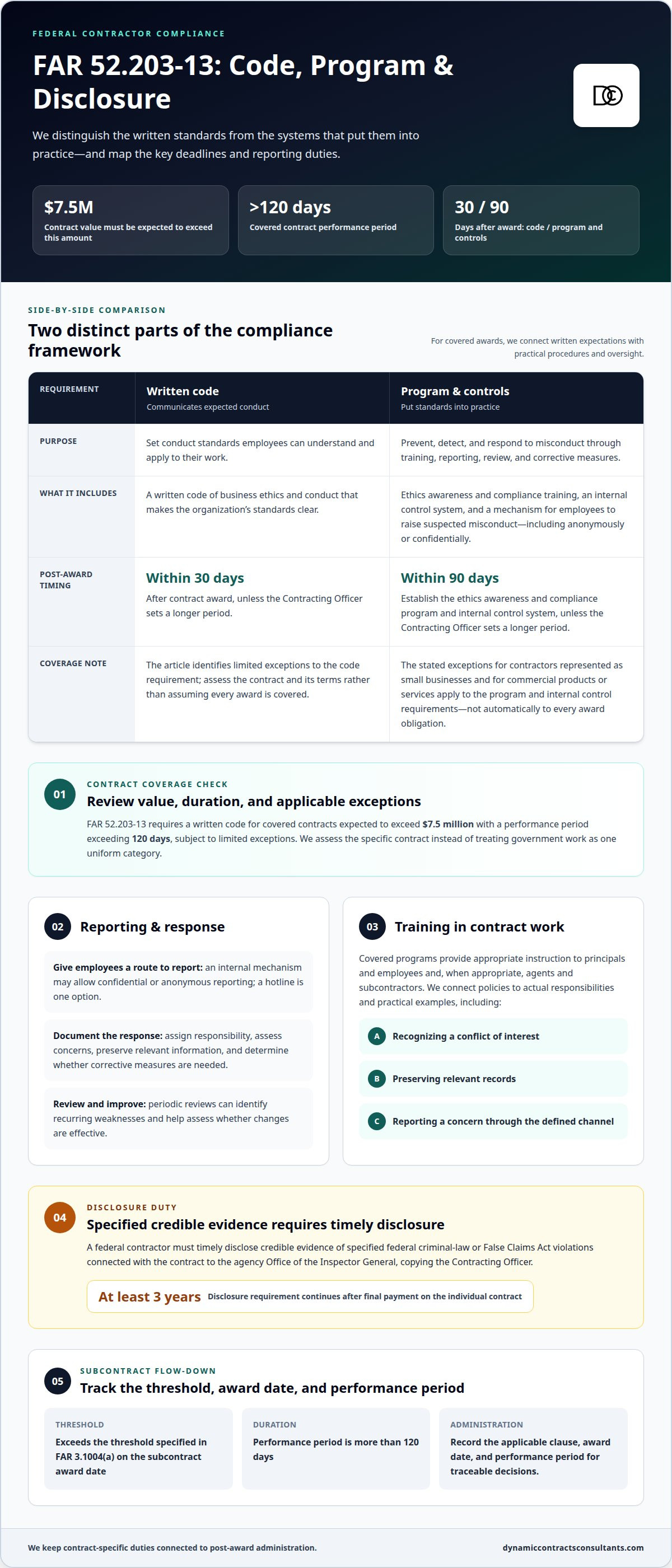
We recognize that federal contractor code of business ethics compliance requirements depend on the contract, not simply on whether your organization does business with the government. According to the Federal Acquisition Regulation Council, FAR 52.203-13 requires a written code for covered contracts expected to exceed $7.5 million with a performance period exceeding 120 days, subject to limited exceptions. For applicable awards, the code is due within 30 days after contract award, unless the Contracting Officer sets a longer period.
We also recognize that a written code is only one part of the compliance framework. The substance matters: employees need to understand the standards that guide their work, how to raise concerns, and how the organization responds to suspected misconduct. Covered contractors must also establish an ethics awareness and compliance program and internal control system within 90 days after award, unless the Contracting Officer sets a longer period, according to the Federal Acquisition Regulation Council.
We explain which contractors are covered, what a written code should address, and how training, internal controls, and disclosure duties fit together. We also distinguish the code itself from the broader program that puts ethical requirements into practice.
Key Takeaways
- We determine whether your contract falls within the requirements by reviewing its value, performance period, and applicable exceptions.
- For covered contracts, FAR 52.203-13 requires a written code when the contract or subcontract is expected to exceed $7.5 million and its performance period exceeds 120 days, subject to limited exceptions.
- We design internal controls to support confidential or anonymous reporting, timely detection of misconduct, and corrective action.
- We connect ethics training and disclosure procedures to your employees’ actual contract responsibilities and reporting channels.
- We use post-award contract administration to keep compliance obligations integrated into contract performance.
Must all contractors implement a code of business ethics and conduct?
No. The ethics awareness, compliance program, and internal control requirements do not apply to contractors that represented themselves as small businesses or contracts for commercial products or commercial services. For covered awards, we help you apply FAR 52.203-13 training and controls to identify, report, and address potential misconduct.
Internal Controls and Corrective Measures
An internal control system includes procedures to prevent, detect, and respond to misconduct. We help your organization establish controls that support the timely discovery and disclosure of improper conduct related to government contracts. The FAR encourages prompt corrective action. For example, if a review identifies an approval gap, we can help you revise procedures and monitor their use to address the weakness and assess whether the change is effective.
Internal Reporting and Anonymous Hotlines
An internal reporting mechanism gives employees a defined way to raise suspected misconduct, including anonymously or confidentially. FAR 52.203-13 calls for this mechanism as part of the internal control system. A hotline is one option. We can help you establish a process for receiving, documenting, and assessing concerns, so employees know where to report a conflict or questionable contract charge and management can route it for review.
Training helps principals and employees apply the organization’s standards to their contract responsibilities. Covered programs provide appropriate instruction to principals and employees and, when appropriate, agents and subcontractors. We can help you make training practical by connecting policies to examples, such as recognizing a conflict of interest, preserving relevant records, and reporting a concern.
The stated exceptions apply to the ethics awareness and compliance program and internal control requirements, not automatically to every obligation in a federal award. We recommend treating each contract’s terms and incorporated clauses separately. This distinction helps you avoid mistaking an exception for a blanket exemption from federal contract compliance requirements.
For covered work, we help you connect each report to a documented response. Your process can assign responsibility, assess the concern, preserve relevant information, and determine whether corrective measures are needed. Periodic reviews of practices and controls can reveal recurring weaknesses. We help you keep findings and follow-up actions visible in post-award records during performance, alongside post-award compliance requirements.
Covered federal contracts and statutory disclosure requirements
FAR 52.203-13 connects a covered contract’s ethics code with a broader compliance program. Its duties also affect subcontract flow-downs, reporting decisions, and contract records.
FAR Ethics and Compliance Requirements
FAR ethics requirements establish conduct standards and compliance duties for contractors with covered awards. FAR 52.203-13 calls for a written code, an ethics awareness and compliance program, and internal controls. The code and program serve different functions: the code communicates expected conduct, while controls support prevention, detection, and response. This distinction helps contractors assign responsibility instead of treating a document as the entire compliance system.
Disclosure is another part of the framework. A federal contractor must timely disclose credible evidence of specified federal criminal-law or False Claims Act violations connected with the contract to the agency Office of the Inspector General, copying the Contracting Officer, according to the Office of the Law Revision Counsel, U.S. House of Representatives, under 31 U.S.C. 3729-3733. The Federal Acquisition Regulation Council states that the disclosure requirement for an individual federal contract continues until at least 3 years after final payment on that contract.
Subcontractor Ethics Requirements
Subcontract flow-downs extend applicable ethics clause obligations through the contracting chain. According to the Federal Acquisition Regulation Council, a federal contractor must include the substance of the clause in subcontracts exceeding the threshold specified in FAR 3.1004(a) on the subcontract award date and with a performance period of more than 120 days. The award date and subcontract term therefore matter when determining whether this flow-down applies.
A prime contractor should tie flow-down decisions to its subcontract award records. Documenting the applicable clause, award date, and performance period, for example, creates a traceable basis for administration. The subcontractor’s role also informs communication and reporting procedures, since the prime contractor’s compliance program must account for obligations that extend into subcontract performance.
FAR, FCPA, and Whistleblower Rules
FAR ethics requirements govern contract-related conduct, compliance systems, and specified disclosures; the FCPA addresses bribery and other corrupt practices. Federal whistleblower protections concern reporting-related rights, while FAR 52.203-13 establishes contractor reporting mechanisms and government disclosure duties. These frameworks are distinct, even where one event raises concerns under more than one. A contractor should route a reported concern through its internal process and assess the applicable contract and legal obligations.
Finding FAR Clauses and Agency Requirements
FAR Part 52 contains the contract clauses incorporated into federal awards, while agency supplements may add agency-specific requirements. FAR 3.1004(a) addresses when the contractor ethics clause is prescribed for inclusion. The signed contract and its incorporated clauses show which terms apply to a particular award; agency requirements may appear in the relevant supplement or solicitation. Comparing those documents helps align the written code, subcontract language, and reporting procedures.
When clause flow-downs or post-award obligations require structured administration, you can discuss post-award compliance support with our team.
Ethics awareness and compliance training
For covered contractors, we translate written ethics policies into practical guidance that helps your employees make decisions during contract performance. FAR 52.203-13 connects employee instruction with your broader compliance program and internal controls.
Our program must provide appropriate training to principals and employees, and to agents and subcontractors when appropriate. We help you relate the code’s standards to each person’s role. A project employee, for example, may need to recognize a conflict of interest and know where to report it. A supervisor needs to understand how concerns are routed and addressed.
The Federal Acquisition Regulation recommends training and internal controls suited to your organization’s size and federal contract portfolio. This supports relevant instruction instead of relying on one generic presentation for every role. We help you organize topics around the written code, contract procedures, reporting channels, and disclosure responsibilities. Your policies should explain how employees can raise concerns about suspected misconduct.
We help you distinguish this training threshold from the separate applicability criteria for the written-code requirement. The contract clause and award terms establish the obligations for your specific contract.
We recommend effective instruction based on realistic work situations. Training can explain how to identify a possible conflict, preserve relevant records, and report suspected improper conduct through an internal channel. It should also clarify what happens after your organization receives a concern. Employees should know the designated reporting route, while managers should understand their role in escalating issues.
We help keep training connected to your operations after its initial delivery. Contractors can align instruction with changes in contract duties, internal policies, or identified control weaknesses. Periodic reviews of practices and procedures can reveal topics that need renewed attention. The FAR calls for a program suited to your size and portfolio, so instruction can reflect actual work rather than abstract rules.
We can help you document how your program operates. Records may identify the materials used, the roles addressed, and how training relates to your code. When an employee reports a concern, procedures should connect the report to the appropriate review and response. This alignment helps your training, disclosure processes, and internal controls work together as parts of contract compliance.
Written code of business ethics and conduct
We use a written code to set out the conduct standards you can expect across government contract work. FAR 52.203-13 links the code requirement to contract value, performance period, and limited exceptions.
Adopting a Written Ethics Code
Under FAR 52.203-13, a written code of business ethics and conduct is mandatory for a U.S. government contract or subcontract expected to exceed $7.5 million when its performance period exceeds 120 days, subject to limited exceptions, according to the Federal Acquisition Regulation Council. We help you determine whether these thresholds make the clause applicable and distinguish them from other ethics obligations in your award.
We approach the exception question with care. The ethics awareness and internal control requirements do not apply to contractors that represented themselves as small businesses, or to contracts for commercial products or commercial services. A contract under $6 million does not meet the stated $7.5 million code threshold, but we recommend not treating that fact alone as an exemption from every contract or regulatory duty.
Written-Code Implementation Deadline
For a covered award, you must have your written code within 30 days after contract award, unless the Contracting Officer sets a longer period, according to the Federal Acquisition Regulation Council. We help you coordinate drafting, approval, and employee access after award, making early ownership important.
You must make the code available to each employee engaged in contract performance. We recommend making the governing standards accessible to people whose work affects the award, rather than keeping the code solely in management files. A documented delivery process can help you show when employees received access.
Your code should set out the organization’s expectations for integrity and honesty, compliance with law, and prevention of criminal conduct. We recommend explaining how employees can raise concerns about suspected misconduct and how your organization handles reports. For example, a reporting provision can identify a confidential or anonymous channel and direct employees to established reporting procedures.
A written document alone does not show that your organization has put its standards into practice. We help you connect each provision to relevant policies, responsible personnel, and procedures used during contract performance. If your code prohibits conflicts of interest, related procedures can explain how employees disclose concerns and how your company reviews them.
We also account for subcontract administration. When a subcontract meets the applicable flow-down conditions, you must include the substance of the clause. Aligning the code, subcontract terms, and employee access procedures helps you maintain consistent expectations across government contracts. The code then serves as an operational reference, not merely an award document kept for the record.
Contractor ethics codes and compliance programs
We connect written standards to your organization’s contract structure through a federal contractor code of business ethics compliance framework. FAR 52.203-13 provides the governing clause, while we support implementation with clear ownership and consistent alignment across contract documents.
Ethics Code Development
The Federal Acquisition Regulation Council identifies FAR 52.203-13 as titled “Contractor Code of Business Ethics and Conduct.” As we develop your code, we map its provisions to existing corporate policies and contract-specific commitments. This crosswalk can expose inconsistent terminology or conflicting instructions before employees rely on them. Our controlled document structure also helps distinguish company-wide standards from procedures that apply only to particular awards.
We assign an owner to maintain your code and coordinate revisions. For example, a change to company policy can prompt a review of related contract materials, helping keep your organizational documents aligned. This governance approach makes the code easier to manage as your federal portfolio changes.
Compliance Program Implementation
We support implementation with defined governance, document ownership, and a method for connecting contract obligations with internal policies. According to the Federal Acquisition Regulation Council, a covered federal contractor must establish its ethics awareness and compliance program and internal control system within 90 days after contract award, unless the Contracting Officer sets a longer period.
We use an obligation map to assign each applicable requirement to a responsible organizational function. We link contract clauses to the policies and records that support their administration. This gives your leadership a structured view of ownership and helps your teams identify where contract-specific terms intersect with company-wide procedures.
FAR 52.203-13 also calls for full cooperation with government agencies responsible for audits, investigations, or corrective actions. To operationalize that commitment, we establish document-retention and access protocols that identify record owners and preserve relevant materials. These protocols should support timely retrieval while respecting applicable protections, including attorney-client privilege and attorney work-product protections.
Our governance framework can clarify how your leadership receives program-level information without duplicating operational processes. We define the records used to track assigned obligations, policy versions, and completed administrative actions. For example, a contract file index can connect an award’s ethics-related clauses to current internal policy references. This creates traceability across the procurement lifecycle and supports consistent administration.
We keep the framework proportionate to your organization’s federal work. Our federal contractor code of business ethics compliance model should reflect your contract portfolio, organizational structure, and governance practices. Defined ownership and aligned documents help sustain your program as responsibilities or awards change.
Dynamic Contracts Consultants LLC: Post-Award Contract Administration
We provide Post-Award Contract Administration to help you manage obligations after award. Our support is useful when ethics requirements, reporting procedures, subcontract flow-downs, and performance records need coordinated administration throughout the contract lifecycle.
Post-award work connects the written code and compliance program to contract execution. Clear administration keeps obligations visible as contract activity, subcontract relationships, and reporting needs evolve. If your organization also needs support with accounting-system requirements, DCAA Compliance Consulting addresses that separate compliance area.
Contact us to discuss your post-award contract administration needs.
Make Compliance Part of Contract Execution
A federal contractor code of business ethics compliance framework can support strategic compliance when it informs organizational decisions. Consider how your policies, responsibilities, and contract workflows fit together as your federal portfolio develops.
Operational efficiency depends on processes that make obligations visible without adding unnecessary friction. Technology can support this goal: AI-driven automation and scalable intelligence can help organize information and streamline work when applied appropriately. These tools complement, but do not replace, accountable oversight and informed judgment.
Dynamic Contracts Consultants LLC offers Proposal Writing, Grant Writing, DCAA Compliance Consulting, and Post-Award Contract Administration. We can discuss which of these capabilities aligns with your organization’s contracting priorities. Contact Dynamic Contracts Consultants LLC to explore a practical next step for your business.
Frequently Asked Questions
What should a written code cover?
We recommend that a written code explain the standards employees must apply to government contract work. It should address lawful conduct, conflicts of interest, bribery, reporting concerns, and our response to suspected violations. We encourage practical examples tied to employees’ roles, such as disclosing a personal relationship that could affect a procurement decision. Clear reporting instructions show employees where concerns go and who handles them, without treating the code as a substitute for contract-specific procedures.
What are the potential consequences of failing to comply with the FAR Code of Conduct?
Noncompliance can expose your organization to suspension or debarment, which can restrict participation in federal contracting. The outcome depends on the conduct and circumstances, so a failure does not automatically produce a particular sanction. FAR 9.406-1(a)(1) identifies an effective written code and compliance program as a potential mitigating factor in a debarment decision. We can help you use prompt corrective action and well-documented controls to demonstrate how your organization addressed a compliance issue.
What is FAR code of conduct training, and why is it important?
FAR code of conduct training explains your organization’s ethics standards and how employees apply them in contract-related work. For covered contractors, training should be appropriate for principals and employees, and for agents or subcontractors where appropriate. We recommend sessions that walk through realistic scenarios, such as a potential conflict of interest, and explain the reporting route. Role-specific instruction helps your personnel connect written policies with workplace decisions.
What should employees do if they have concerns about potential misconduct?
Employees should promptly report suspected misconduct to a supervisor, your company ethics hotline, or an appropriate government agency, and preserve relevant evidence. For example, an employee who notices questionable invoice documentation should record the concern and retain related records under approved procedures. They should avoid unnecessarily altering or circulating sensitive materials. We can help establish clear reporting channels so your organization can assess concerns and determine whether further review or disclosure is required.
Why is this important?
An ethics program gives your organization a structured way to identify concerns, assign responsibility, and respond before problems spread across contract work. It can clarify expectations for employees, managers, and subcontractors working on the same procurement. Defined escalation paths, for example, reduce uncertainty when a staff member identifies a possible improper payment. We help connect your program to day-to-day decisions, where its practical value lies, rather than simply relying on written policies.
Which federal contractors must have a written ethics and compliance program?
Under FAR 52.203-13, a written code is generally required for a U.S. government contract or subcontract expected to exceed $7.5 million when its performance period exceeds 120 days, subject to limited exceptions. The broader ethics awareness and internal control requirements do not apply to contractors that represented themselves as small businesses or to contracts for commercial products or services. We can help you assess which requirements apply to an award based on its terms and applicable exceptions.
When must a federal contractor disclose credible evidence of fraud, bribery, or False Claims Act violations?
A contractor must timely disclose credible evidence of specified federal criminal-law or False Claims Act violations connected with the contract to the agency Office of the Inspector General, copying the Contracting Officer. The Office of the Law Revision Counsel, U.S. House of Representatives, identifies the False Claims Act provisions at 31 U.S.C. 3729-3733. Relevant criminal conduct includes specified fraud, bribery, conflict-of-interest, or gratuity violations connected with contract award, performance, or closeout. We can help your team understand and manage its disclosure obligations.
How soon must contractors establish a written code of business ethics after contract award?
A federal contractor must have its written code within 30 days after contract award, unless the Contracting Officer sets a longer period, according to the Federal Acquisition Regulation Council. To manage that deadline, we recommend assigning an owner for drafting and approval during award transition, then coordinating employee access and distribution. The code should be usable by personnel performing contract work, rather than remaining only in a central policy repository.


