

The firm with the most polished writing sample may still be the wrong choice for your opportunity. Knowing how to choose a proposal consulting firm means looking beyond presentation to check solicitation-specific experience, compliance practices, and whether the proposed workflow fits your team.
Provider claims can be difficult to compare. A generic approach may overlook solicitation requirements or your organization’s differentiators, while unclear responsibilities can leave reviews, compliance checks, and submission tasks exposed to risk. A suitable partner should explain its process, scope, and accountability before work begins.
This guide offers a practical framework for evaluating a firm’s experience, delivery method, and quality controls. It also explains how to define roles, reviews, and deliverables, and how to assess AI-assisted work with human oversight. The goal is a documented selection decision and a partner whose services fit your opportunity and procurement lifecycle.
Key Takeaways
- To decide how to choose a proposal consulting firm, define the support your opportunity requires, then assess each firm’s relevant experience, process, controls, and scope.
- Match a firm’s experience to your solicitation type, technical subject matter, and role as a prime contractor or subcontractor.
- Compare delivery models by reviewing deliverables, your team’s expected participation, review ownership, traceability, and internal workload.
- Before signing, validate provider claims with relevant references or examples you’re permitted to review, and clarify communication practices and responsibilities.
- Document the selected firm’s scope, assign internal owners, and set review gates that fit your opportunity and procurement lifecycle.
Why Choosing the Right Proposal Consulting Firm Matters
A federal bid depends on more than persuasive writing. Your proposal consultant can affect how clearly you present your solution, how closely the response follows solicitation requirements, and how much work remains for your internal team. A missed instruction, unsupported technical claim, or unanswered requirement can create avoidable risk. Look for a provider that makes its review process and each party’s responsibilities clear.
Start by defining what you need the firm to do. A proposal consulting firm helps an organization plan, develop, or review a response to a business opportunity, with specific services and responsibilities defined by the engagement. A proposal is a structured business document, and its purpose and components vary by context, as described in this overview of the business proposal.
To better understand what a consulting proposal can include, watch this introductory video:
What proposal consulting can include
Depending on the provider and scope, support may include opportunity assessment, solicitation analysis, compliance matrix development, technical-volume drafting, gap analysis, and structured review. A compliance matrix, for example, can map solicitation instructions to response sections, assign an owner to each requirement, and make gaps visible before submission. Dynamic Contracts Consultants’ proposal capabilities include technical-volume drafting, compliance matrix development, gap analysis, and alignment with solicitation Sections L and M. Review the proposal writing services, then confirm the specific deliverables in your engagement agreement.
Scope varies by engagement. Document which tasks the consultant will perform, what information your team must provide, who validates technical claims, and who controls final approval and submission. Keep related services distinct: capture management informs opportunity strategy, proposal development produces the response, and post-award contract administration supports work after award. If you need more than one service, define each one and its responsibilities.
When outside proposal support may be appropriate
Outside support may help when your team has limited proposal capacity, faces unfamiliar solicitation requirements, or needs a more structured review process. The work should be collaborative: your subject-matter experts provide the knowledge needed to validate facts, substantiate claims, and explain what differentiates your solution. A consultant should strengthen that expertise, not replace it.
Set clear boundaries, too. Proposal consulting provides advisory or development support. It is not legal representation or direct government funding, and no consultant can guarantee an award. A provider can help organize the response process, but your organization’s knowledge and the government’s procurement decision remain essential.
How to Evaluate a Proposal Consulting Firm’s Expertise and Process
A consistent evaluation makes provider claims easier to compare. Assess how each firm’s experience and working method match your bid, your internal capacity, and the support you need. Apply the same criteria to every firm so you can compare fit and identify unanswered questions before making a decision.
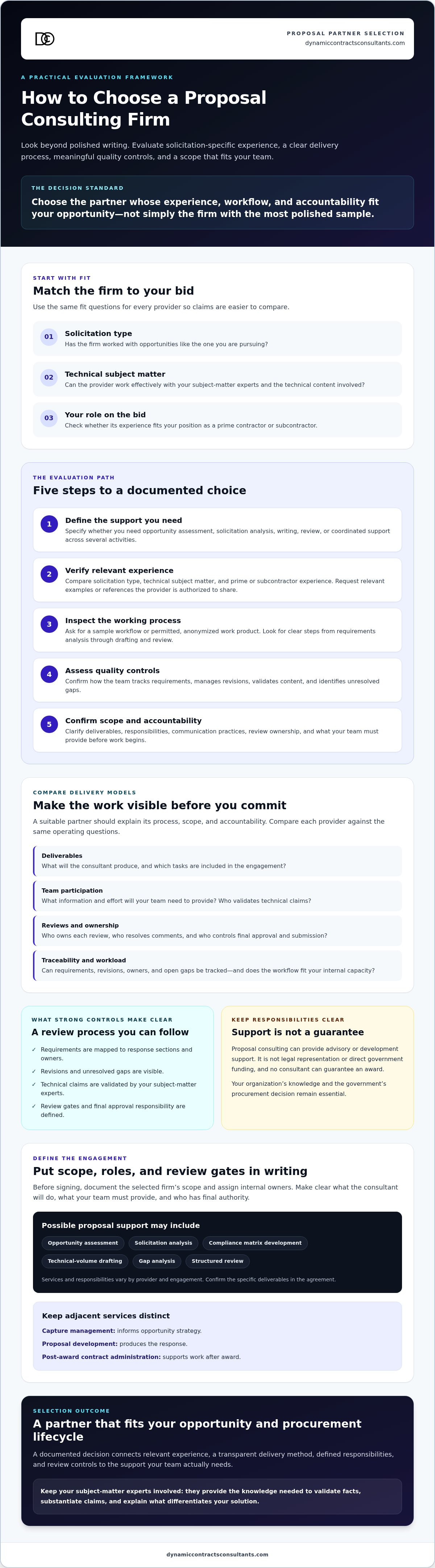
Use this five-step framework:
- Define your needs. Specify whether you need opportunity assessment, solicitation analysis, writing, review, or coordinated support across several activities.
- Verify relevant experience. Compare the firm’s work with your solicitation type, technical subject matter, and role as a prime contractor or subcontractor. Request relevant examples or references the provider is authorized to share.
- Inspect its process. Ask for a sample workflow or anonymized work product, subject to confidentiality and permission. Look for clear steps from requirements analysis through drafting and review.
- Assess controls. Confirm how the team tracks requirements, manages revisions, validates content, and identifies unresolved gaps.
- Confirm scope. Document deliverables, responsibilities, review checkpoints, communication expectations, and the tasks that remain with your organization.
Verify solicitation and compliance experience
Ask each firm to explain how it maps solicitation instructions and evaluation criteria to the response structure. A compliance matrix can show where each instruction is addressed and who owns the corresponding content. Gap analysis can help identify missing information before review. Look for specific review checkpoints rather than relying on a general promise to “ensure compliance.”
For federal solicitations, ask how the team approaches Section L and Section M alignment. In practice, this means organizing the response around the solicitation’s instructions and connecting its content to the stated evaluation criteria. Ask the provider to explain its method using your actual solicitation, without assuming requirements that aren’t there.
Assess the proposed team and working method
Establish who leads the engagement, drafts or edits content, coordinates with your subject-matter experts, and performs reviews. Your technical experts remain essential: they validate facts, substantiate claims, and explain what differentiates your solution. Confirm who has approval authority on your side, how versions will be controlled, how the team will communicate, and how questions or schedule risks will be raised.
Compare the proposed workflow with your bid timeline and your team’s available capacity. If the process relies on frequent input from busy specialists, clarify how the consultant will organize requests, decisions, and approvals. You can also review Dynamic Contracts Consultants’ proposal writing services as an example of a defined offering, then confirm whether the proposed engagement scope fits your requirements.
If you’re clarifying the requirements for a federal bid, you can discuss your proposal requirements with our team.
How to Compare Proposal Consulting Delivery Models and Review Controls
Delivery models differ in who produces the work, how closely the consultant coordinates with your team, and where review accountability sits. Compare each workflow with your internal capacity and the controls your bid requires. AI-assisted tools may support analysis, drafting, or document generation, but you should be able to review how the output was developed and checked. The labels below are comparison categories, not standardized service definitions, so confirm each provider’s actual scope.
| Model | Typical deliverables | Participation, review, and workload |
|---|---|---|
| Advisory-only | Recommendations, solicitation analysis, or review comments | Your team drafts and owns most content. Internal workload remains higher, so confirm who evaluates and resolves feedback. |
| Writing support | Drafted or edited proposal sections and supporting compliance tools | Your experts provide source material and validate claims. Clarify who reviews drafts, tracks changes, and checks requirements against the solicitation. |
| Integrated capture-and-proposal | Capture management connected with response planning and development | Coordination may span opportunity strategy and proposal work. Define which decisions remain with your organization and how strategic choices inform the submission. |
| Technology-assisted | AI-assisted analysis, drafting, or document-generation support | Tools may assist production, but you and the provider should define source validation, human review, approvals, and traceability. |
What human review and AI-assisted drafting should mean
Ask what information a tool uses, who verifies its output, and how edits are approved and recorded. Check generated text against the solicitation and authoritative source material. Fluent language alone does not establish accuracy or compliance. FARIFY, Dynamic Contracts Consultants’ AI-powered affiliate platform for government-contract document generation, uses human-in-the-loop review. Treat automation as workflow support, not a substitute for accountable professional judgment.
Compare ownership, confidentiality, and quality assurance
Put ownership and decision rights in writing. Identify who controls source content, working drafts, revisions, and the final submission decision. Ask how sensitive company information will be handled, and clarify applicable access and retention expectations without assuming a particular security certification.
Set review gates that match your response process. Assign checkpoints for solicitation alignment, technical accuracy, consistency across volumes, and authorized approval. Clear ownership and traceable review help maintain quality as work moves between your team, consultants, and any technology-assisted tools.
How to Vet a Proposal Consulting Firm Before You Sign
Before selecting a provider, check how its stated capabilities translate into accountable work on your bid. A structured review helps distinguish relevant experience and clear processes from broad claims. Ask for evidence you can assess, not assurances you cannot test.
Questions to ask during provider discussions
Use these questions to test whether the firm’s approach fits your solicitation and internal workflow:
- Experience: Can you describe work relevant to this solicitation type, subject matter, and prime or subcontractor role? Can you provide references or examples you have permission to share?
- Process: How do you track solicitation instructions and changes, maintain compliance traceability, and coordinate internal reviews?
- People: Who leads, drafts, reviews, and coordinates with our subject-matter experts? What information and decisions will you need from us, and when?
- Deliverables and approvals: What work products will we receive, what are the review and approval milestones, and who has final approval authority?
- Quality: How do you assess process quality, such as requirement coverage, review completion, and resolution of identified gaps, without promising a contract award?
Validate claims with references where possible, and request relevant work samples only when the provider is authorized to share them. General statements about expertise are not a substitute for evidence connected to your needs. A guaranteed award claim is a warning sign: a consultant can describe its process and deliverables, but cannot control the procurement decision.
What the engagement scope should make explicit
Review the proposed scope for included services and exclusions, deliverables, client responsibilities, revision procedures, communication expectations, and approval milestones. Clarify who manages changes, how proprietary information will be handled, and which client approvals are required before content is finalized or submitted. Vague language can leave critical tasks unassigned, especially final validation and submission authority.
If the relationship may extend beyond proposal development, define that work separately rather than assuming it is included. For example, post-award contract administration concerns work after an award and should have its own clearly stated responsibilities and deliverables.
For a proposal engagement with defined scope and review responsibilities, discuss your proposal requirements with our team.
Select a Proposal Consulting Partner That Fits Your Procurement Lifecycle
Choose a provider based on more than credentials or presentation. Match its capabilities to the opportunity’s complexity, your team’s available capacity, and the lifecycle support you need. A focused proposal-writing engagement may suit a team with an established capture strategy. A bid requiring coordinated capture and compliance support may call for a broader scope.
Build a defensible selection decision
Use a weighted scorecard to compare providers against criteria that matter to your organization. Set the weighting before scoring so one impressive sales conversation does not overshadow a material gap. Assess:
- Relevant experience: Fit with your solicitation type, technical subject matter, and role as prime or subcontractor.
- Process: Clear steps for planning, drafting, coordinating inputs, and reviewing the response.
- Team: Defined roles for the engagement lead, writers, reviewers, and your internal contributors.
- Controls: Traceability, version management, review gates, and approval responsibilities.
- Scope clarity: Specific deliverables, client dependencies, exclusions, and communication expectations.
Record unresolved risks and obtain written answers before authorizing work. Do not give undue weight to unverified credentials or unsupported success-rate claims. Instead, look for evidence you can validate, such as relevant references or permitted examples. The scorecard documents the rationale for your decision and shows where scope or governance needs clarification.
Start the engagement with clear governance
Before work begins, name the decision-maker, subject-matter contributors, reviewers, and final approver. Agree on where working documents will be maintained, how versions and revisions will be controlled, when review gates occur, and who is responsible for final submission. These details align the consultant’s workflow with your procurement lifecycle and help prevent key decisions or inputs from going unassigned.
If opportunity strategy is part of the engagement, clarify how capture activities connect to proposal development, including who owns decisions about positioning and customer priorities. A government contract capture plan can inform that strategic work, but its responsibilities should be distinguished from drafting and reviewing the proposal itself.
Dynamic Contracts Consultants may be a potential fit for organizations seeking proposal writing connected to capture support and compliance-oriented workflows. Its broader acquisition and proposal support spans acquisition planning through post-award administration. Define which lifecycle activities your opportunity requires rather than assuming every service is included in one engagement.
Use this framework to make a selection based on documented fit, accountable delivery, and clear governance. To discuss your requirements and potential scope, discuss your proposal consulting needs.
Choose a Partner Built for Your Next Federal Bid
A sound selection rests on three decisions: match the firm’s expertise to your opportunity, establish clear deliverables and review responsibilities, and choose a working model that fits your team’s capacity and procurement lifecycle. This is the practical foundation for choosing a proposal consulting firm without relying on broad claims or award guarantees.
Dynamic Contracts Consultants has served as a prime contractor on work for the Department of Defense, Department of State, EPA, and NOAA. Its proposal capabilities include technical-volume drafting, compliance matrices, gap analysis, and alignment with solicitation Sections L and M. FARIFY, its AI-powered affiliate platform, uses human-in-the-loop review to keep professional accountability central to technology-assisted work.
These capabilities may be relevant if you need proposal writing connected to capture and compliance considerations. As you evaluate fit, document the scope, assign internal owners, and agree on review gates before work begins. A clear framework helps your organization maintain control of the response.
Discuss your proposal consulting needs with our team to identify support aligned with your opportunity. With clear requirements and accountable collaboration, you can move forward with a more structured proposal process.
Frequently Asked Questions
How do I choose a proposal consulting firm?
Begin by defining the opportunity, the support you need, and your internal capacity. Compare firms on relevant government proposal experience, their method for mapping solicitation requirements, team roles, review controls, and scope clarity. Request examples or references they’re authorized to share, then validate them where possible. Ask how the provider handles risks and dependencies. Avoid firms that guarantee awards. Before work starts, document deliverables, responsibilities, approval authority, and review stages.
What should I ask a proposal consulting firm before hiring it?
Ask who will lead and review the work, how solicitation requirements will be tracked, and which deliverables are included. Clarify how your subject-matter experts will contribute, who approves content, how revisions are managed, and how the team will communicate. Discuss confidentiality, exclusions, and the provider’s quality-control process. Specific answers help you determine whether the proposed approach fits your opportunity and whether responsibilities are understood before the engagement begins.
How can I verify a proposal consulting firm’s federal experience?
Request examples relevant to your agency, solicitation type, technical domain, and role as a prime contractor or subcontractor, while respecting confidentiality restrictions. Ask what work the firm performed and how it mapped requirements and organized reviews. Validate references when available and permitted. Broad experience claims or client logos don’t establish specific proposal results, so look for evidence that directly relates to the work you need and can be confirmed.
Can AI be used in government proposal writing?
AI-assisted tools can support document generation and workflow tasks, but generated content isn’t automatically accurate or compliant. Ask what source material informs the output, who checks it against the solicitation, and how corrections and approvals are handled. Confirm who is accountable for the final response and how sensitive information is treated. A responsible process includes human review and source validation, and doesn’t present automation as a guarantee of compliance or award.
What should a proposal consulting engagement include?
The written scope should identify services, deliverables, provider and client responsibilities, review stages, communication expectations, and approval authority. Depending on your needs, work may include solicitation analysis, compliance matrices, gap analysis, technical-volume support, or proposal review. Confirm exclusions, revision procedures, and who makes final submission decisions. Don’t assume capture management or post-award support is included; specify those services separately if they’re required for your procurement lifecycle.
How much does it cost to hire a proposal consulting firm?
Fees depend on the engagement’s scope, solicitation complexity, deliverables, schedule, and level of support. Request a written proposal that lists included work, assumptions, exclusions, and your team’s responsibilities. Compare the scope and review controls, not just the quoted amount, and ask how additional work would be authorized. Generic market figures may not reflect your requirements, so obtain pricing and terms directly from providers before making a decision.
Can a proposal consulting firm guarantee a government contract award?
No. A consulting firm can describe its experience, work process, quality controls, and deliverables, but it can’t control the government’s award decision. Outcomes depend on the solicitation and evaluation, among other factors. Treat a guaranteed award claim as a reason to request clarification and examine the proposed scope carefully. A credible provider should explain what its team is responsible for without promising a result it cannot determine.


