

An award does not automatically create alignment. A government contract kickoff meeting checklist helps turn award documents into clear ownership before deliverables, reporting, or subcontractor coordination fall between teams. The key is to translate contract requirements into practical work without relying on assumptions from similar contracts.
We help you prepare a contract-specific agenda and use the meeting to establish a shared understanding of scope, deliverables, roles, communications, and risks. Aim to leave with decisions recorded, actions assigned, and a reliable foundation for contract administration and follow-through.
This checklist covers what to review before the meeting, what to resolve with government and contractor stakeholders, and what to record and track afterward. Use it to connect compliance expectations to day-to-day execution and establish accountability from the start of the post-award phase.
Key Takeaways
- Adapt the government contract kickoff meeting checklist to the award, agency process, contract type, and participant roles.
- Prepare source documents, attendees, and an agenda so the discussion stays anchored to the contract baseline.
- For each requirement, identify its owner, evidence, timing, and unresolved dependencies.
- Separate contract-defined obligations from internal procedures and questions that need resolution.
- Close by recording decisions, assigning follow-up owners, and maintaining minutes and an action register alongside formal contract records.
Government Contract Kickoff Meeting Checklist: Define the Contract Baseline
A kickoff meeting should convert the award into a shared, workable execution approach, not rely on assumptions about how similar contracts were managed. The right preparation depends on the award, agency process, contract type, and participant roles. Use a government contract kickoff meeting checklist to organize the discussion and keep each requirement tied to the applicable contract documents.
The meeting aligns government and contractor participants on the awarded work, coordination, and items requiring follow-up. It supports execution planning, but does not itself modify the contract, negotiate new terms, or constitute formal approval. Contract obligations remain grounded in the award documents and authorized processes.
A general overview of project kickoff principles is available in What is a Kickoff Meeting?. The following video offers a broader project-team checklist. Apply its general coordination ideas within the boundaries of your contract and agency process.
What the meeting is meant to accomplish
Use the session to establish a shared understanding of scope, deliverables, milestones, acceptance details, reporting provisions, and communication paths. Clarify who owns each execution activity and where coordination is needed. If participants identify an ambiguity, record it for resolution through the appropriate process rather than treating the discussion as a change to the award.
Establish the award-document baseline
Before convening, review the executed contract, statement of work or performance work statement, and applicable attachments. Compare the stated requirements with the planned execution approach. For each point needing clarification, record the source, the question, the follow-up owner, and the current status. This source-linked log helps distinguish verified obligations from assumptions, open questions, and internal planning choices.
Use this checklist to frame preparation and follow-through:
- Preparation: Gather the award documents and identify contract-specific topics for discussion.
- Agenda: Cover scope, roles, deliverables, communications, risks, and immediate actions.
- Decisions: Capture agreed interpretations and distinguish them from unresolved questions.
- Records: Maintain meeting minutes and a source-linked question log alongside formal contract records.
- Follow-up: Assign an owner and a clear next step to each open item.
Structured post-award administration helps organize compliance records and action tracking after kickoff. Our post-award compliance support helps structure that process while your team retains accountability for contract execution.
Prepare the Kickoff Checklist: Documents, Attendees, and Agenda
Preparation makes the meeting specific to the award rather than a generic project discussion. Adapt this sequence to the contract and agency process. Connect each document, agenda item, and attendee to a practical execution need.
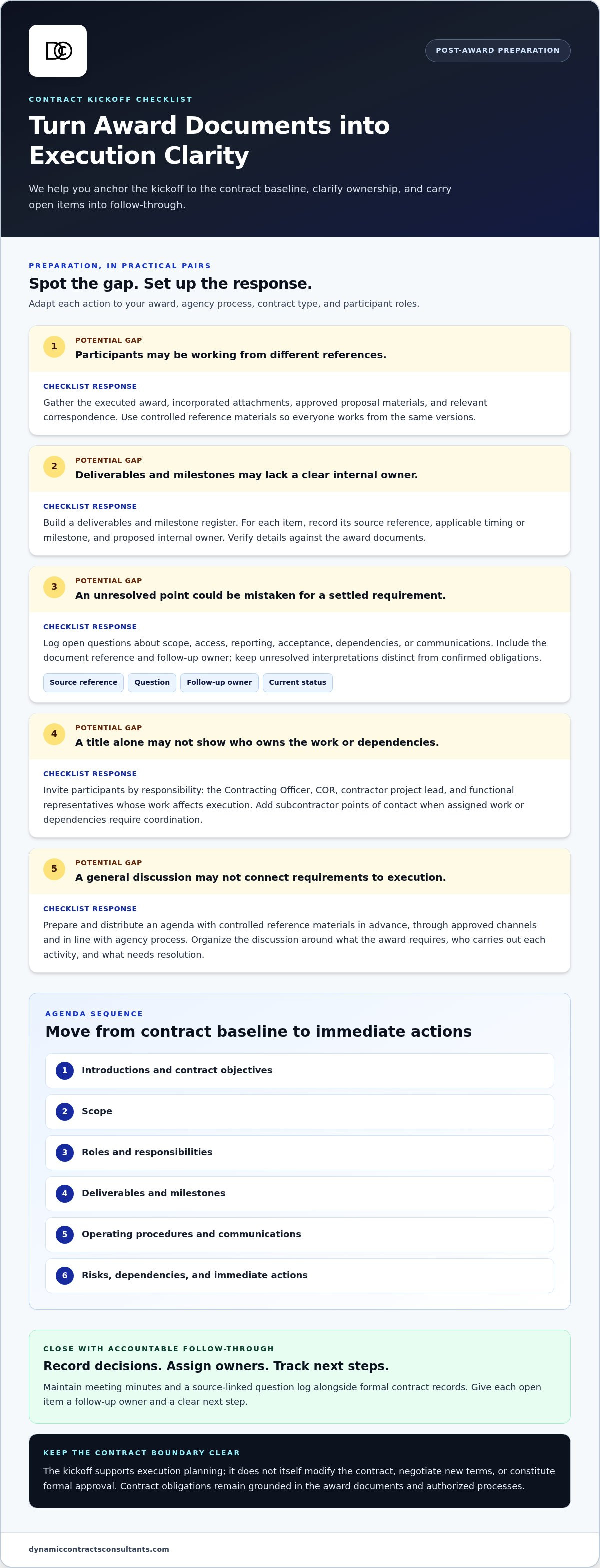
- Assemble the source documents. Gather the executed award, incorporated attachments, approved proposal materials, and relevant correspondence. Use controlled reference materials so participants work from the same versions.
- Build a deliverables and milestone register. For each item, record its source reference, applicable timing or milestone, and proposed internal owner. Verify contract-specific details against the award documents.
- Log open questions. Capture unresolved points about scope, access, reporting, acceptance, dependencies, and communications. Include the document reference and follow-up owner. Do not present an open interpretation as a settled requirement.
- Identify participants by responsibility. Include the Contracting Officer, COR, contractor project lead, and functional representatives whose work affects execution. Add subcontractor points of contact when applicable, especially where deliverables or dependencies require coordination.
- Prepare and distribute the agenda. Share the agenda and controlled reference materials in advance through approved channels, adapting access and distribution to the agency process.
Structure the agenda around execution
Organize discussion around introductions and contract objectives, scope, roles, deliverables and milestones, operating procedures and communications, risks and dependencies, and immediate actions. Move from what the award requires to who will carry out each activity and what needs resolution. Guidance on Contracting Officials' Responsibilities in Kickoff Meetings addresses communication of roles and responsibilities, performance expectations, and deliverables.
Invite attendees based on contract responsibilities and operational dependencies, not simply organizational title. A functional representative responsible for a deliverable can clarify internal ownership. A subcontractor point of contact may be needed to coordinate assigned work. Confirm participant roles against the award and applicable agency process.
Use the government contract kickoff meeting checklist as a working tool, not a replacement for contract records. Make clear which topics need confirmation, which decisions participants can make within their authority, and which items require follow-up through an authorized channel. This distinction helps the meeting produce practical direction without implying that discussion alone changes the award.
After the meeting, organized compliance records and action tracking help carry decisions into contract administration. Our post-award compliance support helps structure that follow-through. To align preparation with post-award execution, discuss your contract administration needs.
Run the Meeting: Resolve Roles, Deliverables, Risks, and Communications
Trace each requirement to its source document, responsible owner, evidence of completion, applicable timing, and unresolved dependencies. This gives you a practical connection between the award and daily execution. If a detail remains unclear, record it as an open question rather than letting discussion turn an assumption into an accepted requirement.
Confirm roles, authority, and communication paths
Document operational roles and appropriate channels for contract-related communications. Distinguish government points of contact from contractor decision-makers, and identify who coordinates internal work, prepares submissions, and tracks follow-up. Confirm authority against the award or an authorized process rather than assuming a point of contact can approve a decision.
As you review escalation routes and approval dependencies, document who raises an issue, who coordinates the response, and where a decision must be referred. This helps your team respond consistently without implying that a meeting participant can authorize a change or resolve a matter outside their role.
Review deliverables, risks, and subcontractor coordination
Walk through deliverables one by one. Compare each source requirement with the proposed owner, internal review, submission route, timing, and acceptance reference. Review scope, schedule, access, data handling, security, and reporting against your actual contract and applicable agency procedures. Where a detail needs confirmation, identify the question and assign a follow-up owner.
Use a simple classification to keep the discussion precise:
- Contract-defined obligation: Record the source reference and relevant owner, evidence, and timing.
- Internal procedure: Identify your workflow, review steps, or control for meeting the requirement.
- Question for resolution: Capture the ambiguity, dependency, or approval path without treating it as settled.
Discuss potential delays and other risks as matters to monitor, not as conclusions about contract consequences. Assign each risk an owner and identify the next practical step. For subcontracted work, review applicable flow-down clauses and coordination responsibilities against the relevant documents. Clarify how subcontractor outputs connect to prime-level deliverables, reporting, and internal review.
A kickoff action register is the working record of meeting decisions, assigned owners, and agreed due dates. Use it to track the next step for each unresolved issue, dependency, or decision, while keeping formal contract records in their appropriate channels. Our post-award compliance workflow helps organize this follow-through while your team retains accountability for execution.
This approach makes your government contract kickoff meeting checklist a facilitation tool that connects requirements to ownership, makes uncertainty visible, and provides a traceable basis for coordinated performance.
Close the Kickoff with an Action Register and Follow-Through Plan
A kickoff meeting is useful only when its decisions carry into execution. Before participants leave, read back the agreed points, confirm who owns each action, set dates agreed by the team, and identify unresolved questions that require follow-up. This final review gives participants a chance to correct misunderstandings while the discussion is fresh.
Document decisions and open items accurately
Meeting minutes should capture attendees, agenda topics, decisions, action owners, agreed due dates, and outstanding questions. For each open item, record its source or context, next step, and responsible owner. If an item depends on further review or an authorized response, state that clearly rather than presenting it as resolved.
Minutes and action logs preserve accountability, but they do not replace formal contract documentation. Do not treat a meeting record as a formal notice, approval, modification, or other contract record. Distribute notes through appropriate channels and retain them under established document controls, keeping formal records in their designated systems.
Turn meeting actions into ongoing post-award controls
Translate each action into a trackable entry with an owner, status, agreed date, supporting evidence, relevant dependency, and escalation path. For example, a pending deliverable review can show who coordinates the review, what evidence demonstrates completion, and which dependency could affect the next step. Use your organization’s established controls to monitor actions and maintain traceability.
Carry the register into internal coordination so the team can review deliverables, risks, reporting activities, and subcontractor actions as work progresses. Update status when evidence is available, document changes in the appropriate record, and keep unresolved items visible until addressed through the applicable process. This makes the kickoff a structured starting point for post-award administration, while your organization remains accountable for contract execution.
Our post-award compliance support helps contractors organize compliance records, action tracking, and administration workflows. Use the government contract kickoff meeting checklist to connect each meeting decision to a responsible owner and a documented next step.
Discuss post-award action tracking and contract administration with our team.
Apply the Checklist to Your Contract and Strengthen Post-Award Execution
A kickoff checklist is most useful when it reflects the actual award, agency procedures, and your organization’s internal controls. Treat it as a framework to adapt, not a universal template. Verify contract-specific deliverables, reporting provisions, acceptance details, named roles, and communication processes against source documents. Applied consistently, it can connect kickoff planning to execution across the procurement lifecycle.
Readiness checkpoints before, during, and after the meeting
- Before: Confirm the award-document baseline, relevant participants, agenda, open questions, and access to controlled reference materials.
- During: Validate roles, requirements, deliverable controls, risks, communication paths, and decisions. Record unresolved matters for follow-up through the appropriate process.
- After: Distribute records through approved channels, assign action owners, track supporting evidence, and schedule internal follow-up using established controls.
Tailor these checkpoints to the contract rather than treating them as a fixed meeting format. Where your organization uses approved AI-driven automation, it can support established workflows for organizing action status or surfacing dependencies, while contract interpretation and accountability remain with the appropriate people. The objective is scalable intelligence: useful visibility that supports sound execution without displacing your organization’s controls.
When structured post-award support can help
Additional structure can help when your team needs to coordinate contract administration, compliance monitoring, or flow-down clause management across multiple owners and records. Our post-award contract administration support helps organize administration workflows, compliance records, and action tracking. This work supports your team’s processes and does not replace its accountability for contract execution.
Consistent ownership and well-maintained records support audit-ready post-award administration by connecting requirements with actions, evidence, and follow-up. That traceability helps your team identify what needs attention, who is responsible, and where supporting records belong, while keeping formal contract documentation within established controls.
Use the checklist to establish a contract-specific execution baseline, then carry its decisions into your organization’s ongoing processes. For expert support structuring post-award administration, compliance monitoring, or flow-down coordination, discuss your contract execution needs with our team.
Turn Kickoff Alignment into Consistent Contract Execution
A disciplined kickoff connects award requirements to accountable owners, coordinated work, and documented follow-through. Use the government contract kickoff meeting checklist as a contract-specific framework, tailored to the award and agency process rather than as a substitute for formal contract records. Clear decisions, tracked actions, and maintained evidence help your team carry alignment into post-award performance.
Dynamic Contracts Consultants LLC provides post-award contract administration and compliance support, including flow-down clause analysis and audit-ready record preparation. Our experience includes serving as a prime contractor on federal agency contracts, bringing practical perspective to the execution demands contractors face.
For structured support that strengthens your contract administration workflows, discuss post-award support for your contract with our team. Clear ownership and consistent follow-through give your team a stronger foundation for execution.
Frequently Asked Questions
What should be included in a government contract kickoff meeting?
Cover contract scope, objectives, participant roles, deliverables, milestones, reporting provisions, communication paths, risks, dependencies, and immediate actions. Use the award documents to guide the discussion, and record the source and owner for each requirement. Your government contract kickoff meeting checklist should distinguish contract-defined obligations from internal procedures and unresolved questions, so discussion does not turn an assumption into a settled requirement.
Who should attend a government contract kickoff meeting?
Invite participants whose responsibilities or operational dependencies affect contract execution. Depending on the award and agency process, this may include the Contracting Officer, COR, your project lead, relevant functional representatives, and subcontractor points of contact. Confirm each person’s role and communication path, while distinguishing government points of contact from contractor decision-makers. Attendance should support coordination without implying approval authority beyond the award or authorized process.
Is a government contract kickoff meeting required?
Whether a kickoff meeting is required depends on your contract and the applicable agency process. Review the award documents and relevant instructions rather than assuming every contract follows the same meeting practice. Even when a meeting is not specified, a structured kickoff can help your team align on execution, responsibilities, communications, and open questions. It does not modify the award or replace formal contract procedures.
What documents should we review before a contract kickoff?
Review the executed award, statement of work or performance work statement, incorporated attachments, approved proposal materials, and relevant correspondence. Prepare a deliverables and milestone register with source references and proposed internal owners. Also list questions about scope, access, reporting, acceptance, dependencies, and communications. Verify contract-specific clauses and named roles against the actual documents, then share controlled reference materials through approved channels.
What should be documented after a government contract kickoff meeting?
Document attendees, agenda topics, decisions, assigned action owners, agreed dates, and unresolved questions. Your action register can also track status, dependencies, supporting evidence, and follow-up responsibility. Distribute minutes and logs through appropriate channels and retain them under established document controls. Meeting notes help preserve accountability, but they do not replace formal notices, approvals, modifications, or other contract records, which should follow applicable processes.
How do we handle an unresolved contract requirement during the kickoff?
Record the question, its source document or context, the dependency to review, and an owner for follow-up. Do not treat an unresolved interpretation as a confirmed requirement or meeting discussion as authorization to change the award. Route the issue through the applicable communication and approval process, and keep its status visible in your action log until addressed. This preserves traceability while your team works within verified requirements.
How does a kickoff meeting support post-award compliance?
A kickoff supports post-award compliance by connecting requirements with responsible owners, expected evidence, reporting processes, and follow-up controls. Use the discussion to identify coordination needs for subcontracted work and applicable flow-down clauses. Organized records give your team a clearer basis for ongoing compliance monitoring and contract administration. The meeting establishes alignment, while your organization remains accountable for contract performance and required records.


