

A conflict risk is rarely resolved by a last-minute disclosure. It takes decisions documented across the procurement lifecycle. For teams focused on avoiding conflicts of interest in federal contracting, the practical questions are often whether a concern is organizational or individual, who owns the assessment, and how to escalate it without unnecessarily disrupting an award or performance.
A disclosure alone doesn’t determine whether a contractor is eligible, and silence is not a sound risk strategy. You need a repeatable process to identify relevant relationships, information access, and potential objectivity issues early. Then document the facts, assessment, mitigation steps, and escalation path. Agency officials make agency determinations, and legal questions belong with qualified counsel. Compliance support can help organize the operational record without replacing either.
In this guide, we explain how to identify and assess risks before award and during performance, distinguish individual conflicts from organizational conflicts, assign documentation responsibilities, and manage escalation. We also show how acquisition planning, proposal documentation, and post-award contract administration can support consistent lifecycle oversight.
Key Takeaways
- Distinguish organizational conflicts from individual financial or professional interests so each risk is assessed on its own facts.
- Map review points across opportunity qualification, teaming, award, performance, and closeout, with clear roles for the teams involved.
- Compare controls, reassignment, access restrictions, or withdrawal based on the circumstances, contract terms, applicable rules, and agency direction.
- Use a consistent process for avoiding conflicts of interest in federal contracting: identify risks, assess them, assign ownership, document decisions, implement controls, and monitor.
- Connect acquisition planning, proposal development, and post-award administration to maintain documented oversight, while keeping operational support distinct from legal advice and agency determinations.
Avoiding Conflicts of Interest in Federal Contracting Starts with Identifying the Risk
A potential conflict is a reason to examine the facts, not proof that a contractor or employee has violated a rule. A potential conflict of interest is a circumstance that may affect impartiality or create an unfair advantage and therefore requires assessment under the applicable rules and contract facts; a confirmed violation is a conclusion that depends on that assessment. This distinction helps teams respond proportionately instead of treating every concern as either harmless or disqualifying.
For contractors, identifying the category matters. A company’s work, relationships, or access to information may create an organizational risk, while an employee’s financial or professional interests present a separate screening issue. These concerns can overlap, but one does not automatically establish the other. A general Conflict of interest overview can help explain the concept; federal contracting assessments also require attention to applicable acquisition rules and the specific facts.
The USDA video below offers a concise introduction to recognizing conflicts of interest.
How organizational conflicts differ from individual conflicts
An organizational conflict of interest (OCI) involves circumstances related to the company, such as its relationships, access to nonpublic information, or work that could affect its objectivity. For example, helping develop requirements for a competition and later seeking work under those requirements may raise a question about whether the company had an opportunity to shape the playing field. Similarly, a contractor’s role in evaluating work it performed could call its objectivity into question.
The FAR organizational conflict framework, including FAR Subpart 9.5, provides a federal reference point for evaluating company-level risks. Verify the current text and any applicable agency supplements before relying on a specific provision. Individual interests require their own fact-specific review: an employee’s financial or professional relationship may affect judgment even when the organization’s role presents no apparent OCI. Keep the categories distinct, then assess whether the facts connect them.
Why disclosure is important but not a complete control
Timely disclosure gives the contracting agency information it can review. It does not, by itself, establish that a situation is acceptable, eliminate an unfair advantage, or resolve an objectivity concern. Support a sound review by documenting relevant roles, relationships, information access, work history, and proposed controls. Separate confirmed facts from assumptions that need follow-up.
The contractor’s assessment and the agency’s decision are separate. The agency determines how the disclosed circumstances affect the procurement or contract, and the appropriate response depends on the facts, applicable rules, solicitation terms, and agency direction. Some questions also turn on legal interpretation. Those fact-specific legal issues may require qualified legal counsel; compliance support can help structure the record and operational review, but it does not replace legal advice or agency determinations.
Early identification supports fair procurement, credible performance, and defensible records. As a practical starting point, flag circumstances that could affect impartiality or create an information advantage, identify who may be affected, and preserve the basis for the initial assessment. Revisit the record as roles and contract work evolve, rather than waiting for a concern to surface after it has become harder to address.
Map Conflict Risks Across the Federal Contracting Lifecycle
We recommend making conflict screening part of the work from opportunity qualification through closeout, rather than treating it as a single checkpoint. A relationship or role that appears straightforward during capture may warrant another look if your scope changes or a team member takes on a new responsibility. Screen again when relationships, work scope, or information access change, because those changes can alter the facts behind your assessment.
At opportunity qualification, your capture team can flag current or prior work that may intersect with the opportunity. During teaming and proposal development, review partner relationships, proposed roles, and information access. Before award, your contracts and compliance teams can compare open questions with the solicitation and the record to date. During performance and closeout, program and contracts teams can revisit the review when tasking, staffing, or access changes.
The Federal Acquisition Regulation (FAR) standards of conduct offer a relevant reference for impartiality and integrity in government business. Verify current FAR text and any applicable agency supplements before relying on a specific provision for your procurement.
Screen relationships, information access, and work scope
Use consistent prompts at each review point, tailored to the opportunity and its facts. Consider current and prior roles, affiliations, financial or professional interests, and organizational relationships that could intersect with your work. For example, if a teaming partner helped develop technical requirements, examine whether that role overlaps with the work your proposed team may later perform.
Assess whether personnel have access to nonpublic procurement information that could be relevant to a later competition. Advisory, evaluation, and technical assignments merit attention if they could affect a contractor’s ability to assess its own work or another party’s performance. Record the facts and potentially affected work, and distinguish what you know from what still needs review.
Assign review ownership and preserve the record
A practical risk register gives your teams a shared way to track an issue. For each concern, record the opportunity or contract, relevant facts, affected work, responsible reviewer, decision owner, next action, and review date. Include the assessment rationale and follow-up status, then update the entry when new facts emerge. Dated entries make it easier to trace how the concern was handled over time.
- Capture: Your capture team flags opportunity history, teaming relationships, and relevant prior work.
- Proposal and program teams: These teams identify proposed roles, information access, and scope changes.
- Contracts and compliance: These teams coordinate the documented review and escalation path.
Limit sensitive records to personnel with a defined business need, and make escalation ownership clear. This helps your teams avoid gaps without assuming one function can make every determination. Our acquisition planning and compliance services support documented processes across these review points.
Compare Conflict Responses Before Choosing a Mitigation
Once your team identifies a concern, the response should address its source, not simply create the appearance of a control. Restricting access may help when the concern involves information, but it may not address a role that could compromise the objectivity of the work itself. As you evaluate options, ask whether the proposed measure addresses the facts and can remain workable throughout performance.
No single mitigation fits every scenario. Options may include continued work with controls, reassignment, restricted access, or withdrawal, each with different operational consequences. Assess the circumstances, solicitation terms, applicable rules, and agency direction before selecting a path. The comparison below can support your internal analysis, but it does not determine whether an agency will accept a proposed approach.
| Response | Risk addressed | Operational impact | Documentation and decision authority |
|---|---|---|---|
| Continue work with controls | A defined risk that can be separated or independently reviewed. | Your team continues the work with assigned restrictions and oversight. | Record the control, owner, review triggers, and follow-up. Your organization implements internal controls; agency decisions remain with the agency. |
| Reassign personnel or work | A concern tied to a particular individual, role, or task. | You may need to change staffing or responsibilities. | Document what moved, who approved the change internally, and how your team will maintain continuity. |
| Restrict access | Potential advantage or concern arising from access to sensitive or nonpublic information. | Your team may need to limit access and adjust related workflows. | Record the scope of the restriction, authorized access, and how you will monitor compliance with it. |
| Withdraw from the work | A concern that available controls may not adequately address, or a situation where continued participation is not viable. | You may relinquish the opportunity or affected work. | Document the basis and internal approvals, and follow applicable solicitation terms and agency direction. |
When internal controls may address an identified risk
Map each control directly to the concern. Role separation can keep a person who helped develop an approach from reviewing the resulting work. Restricted access can limit exposure to information that creates an advantage. Independent review can add objective scrutiny to a deliverable or decision, while documented approval can show who authorized the control and why. Assign an owner, define what evidence will show the control is operating, and set triggers for review when scope, staffing, or access changes.
When to escalate rather than decide internally
Escalate questions that turn on solicitation language, uncertain regulatory application, or a decision reserved to the contracting agency. Preserve the relevant facts, the question raised, your proposed response, and any direction received. Don’t describe a mitigation as approved unless the appropriate authority has made that determination. Our compliance consulting can help structure operational reviews and records, but it isn’t legal representation or legal advice. Refer fact-specific legal questions to qualified counsel.
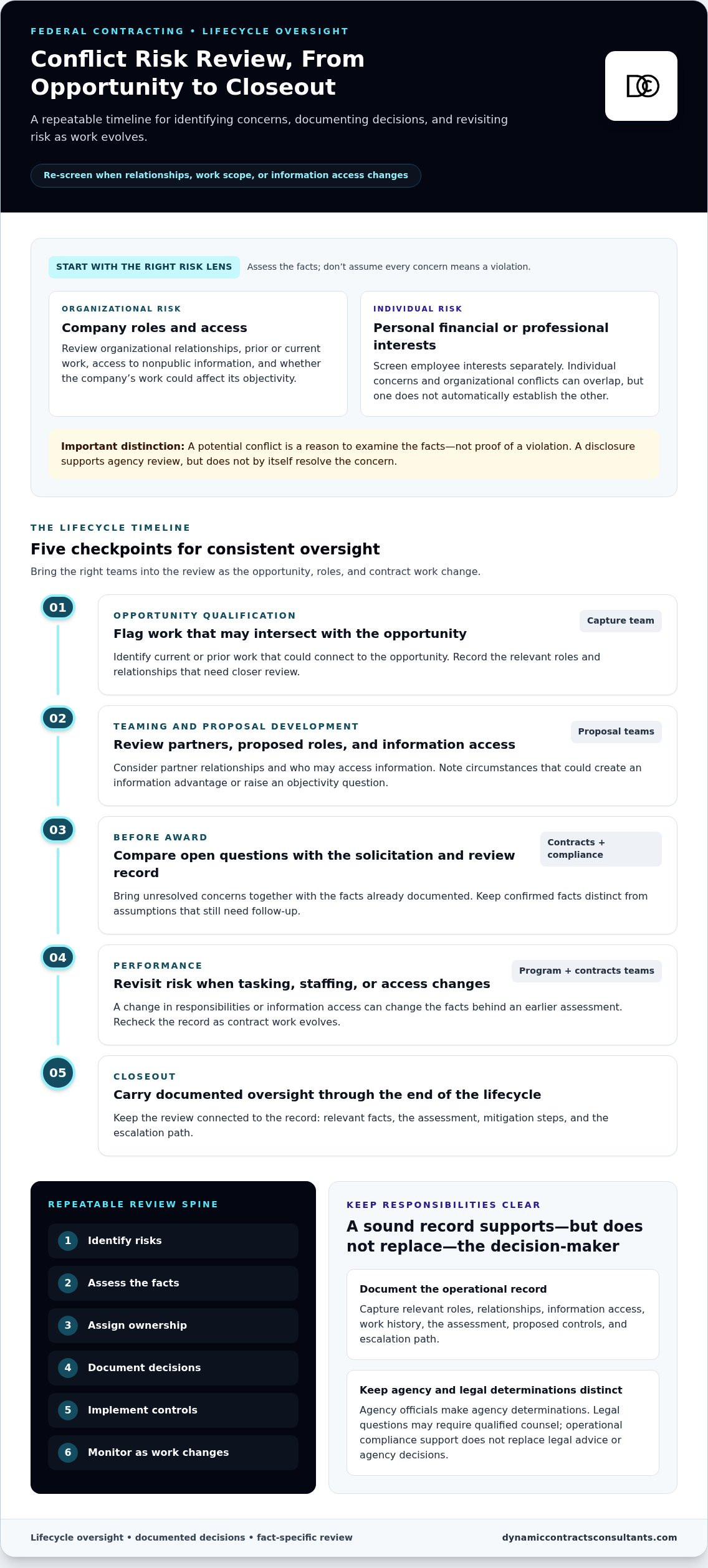
Use a Repeatable Process for Avoiding Conflicts of Interest
A consistent workflow makes conflict screening part of ordinary contract decisions, rather than an exercise triggered only by an urgent concern. Apply the same review logic during opportunity pursuit and after award, updating the assessment when facts or work change. The process below is an internal operating approach, not an official government form or a substitute for agency direction.
- Identify: Flag relevant relationships, roles, financial or professional interests, information access, and work scope connected to the opportunity or contract.
- Assess: Describe the concern in factual terms, identify the work potentially affected, and determine what remains uncertain.
- Assign ownership: Name a reviewer, a decision owner, and an escalation route so the issue does not sit between teams.
- Document: Record the facts considered, assessment, decision rationale, proposed actions, and any required follow-up.
- Implement controls: Assign owners and define how each control will operate, including any limits on roles, access, or review responsibilities.
- Monitor: Set review dates and triggers for reassessment, then record updates, corrective actions, and closure status.
Build screening into capture and proposal decisions
At opportunity qualification, include conflict prompts alongside the team’s review of fit and readiness. Before committing to a teaming arrangement or assigning proposal responsibilities, capture relevant organizational relationships and personnel access that could affect the planned work. This sequencing helps teams identify questions before roles and information flows are established.
As proposal responsibilities take shape, connect the documented assessment to the compliance review where relevant. A proposal review should consider whether the planned approach, assigned personnel, and supporting work align with identified controls. Our federal proposal review services support structured proposal development and review; the documented risk assessment remains specific to your opportunity and facts.
Maintain controls during performance and closeout
After award, compare changes in personnel, subcontracting relationships, scope, and information access with the controls already in place. A new subcontracting arrangement or revised task assignment may require an updated review, even if the original assessment was well documented. At closeout, record whether actions were completed, any outstanding follow-up, internal approvals, and the final status of the concern.
A useful internal record might include the opportunity or contract identifier, screening date, relevant facts, affected work, reviewer and decision owner, assessment rationale, controls, approvals, review triggers, follow-up dates, and closeout status. Tailor access to sensitive records according to business need. This structure supports traceability without implying that the template is prescribed by the government. For lifecycle administration, post-award compliance support can help maintain organized contract records and follow-through.
To strengthen your documented process across pursuit and performance, discuss your acquisition and compliance support needs with our team.
Integrate Conflict Controls with Acquisition and Compliance Support
A documented concern has practical value only if its status and controls remain visible as work moves from planning to proposal development and contract performance. Consistent records help teams understand what was identified, who owns the next action, and whether a planned control still fits the work. AI-assisted document generation with human review can support efficient preparation of acquisition and contract records, while people remain responsible for evaluating facts and decisions.
Align planning, proposal, and post-award records
Acquisition planning can establish where conflict screening fits into opportunity decisions, teaming discussions, and assignment of proposal responsibilities. As the proposal develops, teams can carry forward relevant assessments and controls so that the proposed work, roles, and information access are considered in context. AI can assist with document generation, but human review is essential to ensure the record reflects current, project-specific information rather than treating automated output as a compliance determination.
After award, post-award administration can maintain continuity by connecting the original assessment to performance records, approved changes, and follow-up actions. For example, if personnel or subcontracting arrangements change, the contract record can show whether existing controls were reviewed and whether further action was assigned. A consistent record structure supports traceability across functions without suggesting that documentation itself resolves a conflict.
Dynamic Contracts Consultants LLC supports acquisition planning, compliance consulting, and post-award contract administration as operational functions across the acquisition lifecycle. Our acquisition and contract consulting services can help you strengthen the processes that connect planning, proposal, and performance documentation. AI-driven tools can support workflow efficiency, while compliance assessments and agency determinations remain with the appropriate people and authorities.
Determine the next operational step
Begin by reviewing how your organization currently handles screening. Confirm that teams know who initiates a review, who assesses and documents the facts, how concerns are escalated, and where follow-up is recorded. Then examine whether the same information can carry forward from opportunity pursuit into performance, rather than being recreated or left behind at award.
- Ownership: Identify the function responsible for initiating and maintaining each review.
- Escalation: Establish how unresolved questions reach the appropriate internal decision-maker and, where relevant, the contracting agency.
- Records: Align screening documentation with proposal and contract records, including decisions, control updates, and follow-up status.
Our consulting support is tailored to your acquisition and compliance workflows, helping organize operational processes and lifecycle records while preserving the distinction between compliance support and legal determinations. The next step is to identify where your current process has gaps, such as unclear ownership, inconsistent handoffs, or controls that are not revisited as work changes. Discuss your federal contracting requirements with our team to explore practical support for strengthening those workflows.
Make Lifecycle Oversight Your Next Operational Priority
Build conflict oversight into the way your organization plans, pursues, and performs federal work. Start by reviewing who owns screening, how concerns reach the right decision-makers, and whether records remain useful as contract conditions evolve. A process designed for avoiding conflicts of interest in federal contracting should support informed action while leaving legal determinations and agency decisions to the appropriate authorities.
Dynamic Contracts Consultants LLC has supported federal contractors since 2015. Our team includes professionals with CPCM, CFCM, and CCCM-NCMA credentials, and we bring prime contractor experience on Department of Defense, Department of State, EPA, and NOAA contracts. We provide operational acquisition and compliance support tailored to your contracting workflows, not legal representation or a guarantee of an award or outcome.
Take a deliberate next step. Discuss your federal contracting compliance and acquisition needs with our team and identify practical ways to strengthen your lifecycle processes. A clearer operating framework can help your people move forward with greater confidence.
Frequently Asked Questions
What is a conflict of interest in federal contracting?
It is a situation in which an interest, relationship, role, or access to information could affect impartial judgment or create an advantage in a federal procurement. For example, a contractor’s prior role in shaping technical requirements may raise a concern if the same organization later competes to perform the work. Whether the circumstances create a prohibited conflict depends on the applicable rules and the specific procurement facts.
What is the difference between an organizational conflict and a personal conflict?
An organizational conflict concerns the company’s work, relationships, or information access; a personal conflict concerns an individual’s interests or relationships. For example, a firm’s prior advisory role and an employee’s outside financial interest are distinct issues, even if they relate to the same opportunity. They may require separate fact gathering and different controls, so a company-level review should not be treated as a substitute for individual screening.
Does disclosing a potential conflict resolve it?
No. Disclosure provides information for review, but it does not automatically make continued participation acceptable or remove the underlying concern. After raising an issue, document what was disclosed, identify any immediate operational steps, and track questions or direction from the contracting agency. Avoid treating a proposed internal control as agency-approved unless the agency has provided that determination through the appropriate process.
How can a federal contractor identify conflicts before submitting a proposal?
Before proposal assignments are finalized, compare the opportunity’s scope with the company’s current and prior work, proposed teammates, personnel roles, and relevant information access. Review the solicitation alongside team biographies, project histories, and internal records that may reveal overlapping responsibilities. For example, determine whether a proposed technical lead previously supported related government planning or evaluation work, then route any concern for review before proposal content or access is assigned.
Can a conflict of interest be mitigated instead of ending a contract?
Sometimes, depending on the facts, contract terms, applicable rules, and agency direction. A concern tied to one employee’s role might be addressed through reassignment, while a concern involving sensitive information may require a carefully scoped access restriction. Neither step guarantees the risk is resolved. If controls cannot address the concern adequately, or the agency directs another course, continued participation may not be appropriate.
Which FAR provisions address organizational conflicts of interest?
FAR Subpart 9.5 addresses organizational and consultant conflicts of interest. Its provisions include FAR 9.501 on definitions, 9.502 on applicability, 9.503 on waivers, 9.504 on contracting officer responsibilities, and 9.505 through 9.507 on general rules, procedures, and solicitation provisions or contract clauses. Check the current FAR text and any applicable agency supplements before relying on a provision for a specific procurement.
What records should a contractor keep when managing a potential conflict?
Maintain records that allow an authorized reviewer to understand the issue and its handling, such as the relevant project or opportunity, dated facts and source documents, internal review notes, decision rationale, approvals, control instructions, and evidence of follow-up. Preserve updates when personnel, work scope, or access changes, along with the status at closeout. Apply appropriate access safeguards, since screening files may contain sensitive business or personal information.


