

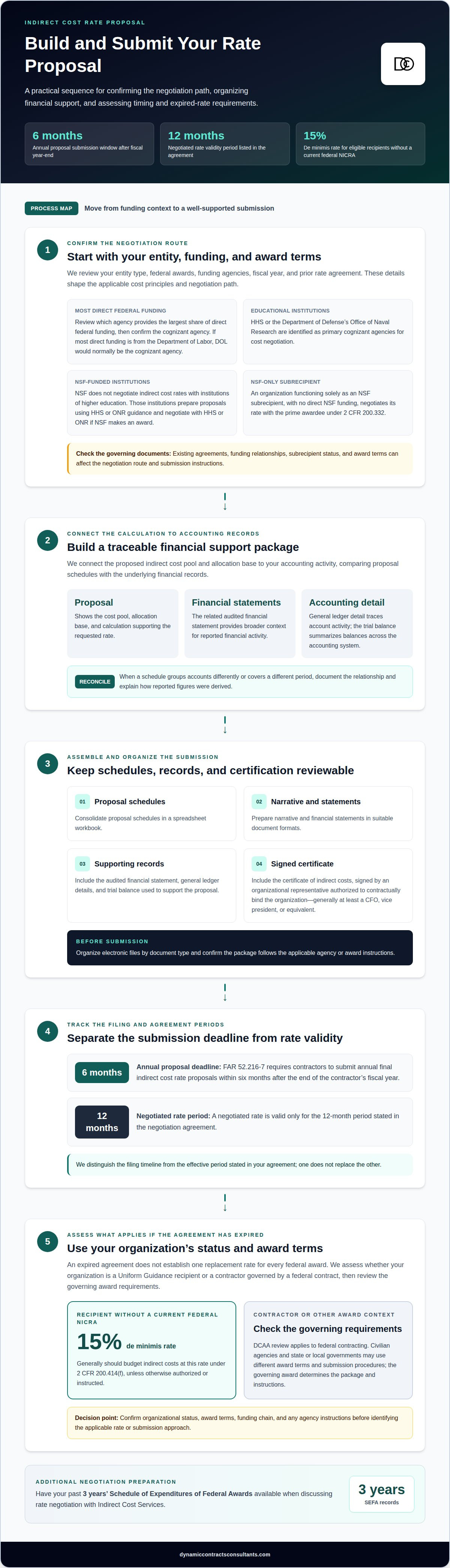
When your negotiated rate expires, we don’t assume one replacement rate automatically applies to every federal award. For a final indirect cost rate proposal submission, FAR 52.216-7 requires contractors to submit annual proposals within six months after the end of the contractor’s fiscal year, according to the Federal Acquisition Regulatory Council. We also account for the agreement’s stated period: a negotiated rate is valid only for the 12-month period listed in it.
To assess what applies after expiration, we consider your organization’s circumstances and award requirements. Recipients without a current federal NICRA generally should budget indirect costs at the 15% de minimis rate under 2 CFR 200.414(f), unless otherwise authorized or instructed. We help you distinguish an expired agreement from the rate or method applicable to a particular award.
This guide explains what to prepare for submission, how to organize proposal schedules and financial records for electronic delivery, and which timing requirements apply. It also covers how to assess the appropriate rate when a negotiated agreement is no longer current, so you can plan your submission and understand the records and decisions involved.
Key Takeaways
- Confirm which federal agency is responsible for negotiating your rate before preparing the submission, since the appropriate agency can depend on your organization and funding relationships.
- Prepare the proposal alongside its supporting financial records, including audited financial statements, general ledger details, and a trial balance.
- Organize electronic files by document type, with proposal schedules consolidated in a spreadsheet workbook and narrative and financial statements prepared in suitable document formats.
- Have your past 3 years’ Schedule of Expenditures of Federal Awards available when discussing rate negotiation with Indirect Cost Services.
- Professional DCAA compliance consulting can help coordinate proposal preparation, supporting records, and submission procedures when your rate agreement has expired or a filing is due.
What is an indirect cost rate proposal?
An indirect cost rate proposal explains how your organization assigns shared operating expenses to federal work. It establishes a rate and allocation base for distributing costs that cannot be readily identified with a single direct cost objective. We begin by reviewing your entity type, federal awards, funding agencies, fiscal year, and prior rate agreement. These details shape the applicable cost principles and negotiation path.
We first identify the agency responsible for rate negotiation. We review your funding records to determine which federal agency provides the largest share of your direct federal funding, then confirm the cognizant agency. For organizations receiving most of their direct federal funding from the U.S. Department of Labor, the Department of Labor would normally be the cognizant agency. We also review existing agreements and award documents, since prior rates and funding relationships can affect the negotiation route.
Educational institutions have a distinct route. Under 2 CFR §200, Appendix III(c)(11), HHS or the Department of Defense’s Office of Naval Research are identified as primary cognizant agencies for educational institutions’ cost negotiation. NSF does not negotiate indirect cost rates with institutions of higher education; those institutions prepare proposals using HHS or ONR guidance and negotiate with HHS or ONR if NSF makes an award. An organization functioning solely as an NSF subrecipient, with no direct NSF funding, negotiates its rate with the prime awardee under 2 CFR 200.332.
After identifying the responsible agency, we organize cost pools, allocation bases, and supporting records into a proposal for review. We coordinate questions and requested revisions with the government negotiator, clarifying how expenses were classified and allocated. Negotiation may result in a rate agreement identifying the approved rate, base, and effective period. A negotiated rate is valid only for the 12-month period listed on the negotiation agreement.
If your agreement has expired, we assess whether your organization is a recipient subject to the Uniform Guidance or a contractor governed by a federal contract. Recipients without a current federal NICRA generally should budget indirect costs at the 15% de minimis rate under 2 CFR 200.414(f), unless otherwise authorized or instructed. We consider your award terms and organizational status when identifying the applicable approach.
Requirements can differ for DCAA-reviewed federal contracts, civilian agency awards, and state or local government programs. DCAA review applies to federal contracting, while civilian agencies and state or local governments may use different award terms and submission procedures. The governing award determines which package and instructions apply.
For subrecipient rate negotiations, we examine your funding chain and award terms, then help present your cost allocation to the prime awardee or applicable federal agency. This distinction matters when your organization receives federal funds through a prime rather than directly, because the negotiation counterpart may differ from the agency funding the overall program.
Financial reports and audit documentation
We use financial records to connect your proposed indirect cost pool and allocation base to your organization’s accounting activity. A typical package includes the proposal, a related audited financial statement, and supporting records such as the general ledger and trial balance. Reviewing these together lets us trace the rate calculation to its underlying financial information instead of treating the proposal as a standalone spreadsheet.
Your audited financial statement provides broader context for reported financial activity. The general ledger shows account-level detail, while the trial balance summarizes balances across your accounting system. We compare these records with the proposal schedules to see how the figures relate. If a schedule groups accounts differently or covers a different period, we document the relationship and explain how the reported figures were derived.
We also prepare the certificate of indirect costs for inclusion with your proposal. It must be signed by an organizational representative authorized to contractually bind the organization, generally at least a chief financial officer, vice president, or equivalent. We account for this signature requirement when organizing the package, so the certificate and supporting schedules can be reviewed together.
Our documentation checklist can include:
- Your completed indirect cost rate proposal. It presents the cost pool, allocation base, and calculation supporting the requested rate.
- Your related audited financial statement. It provides reporting context for the figures in the proposal.
- General ledger detail used in the calculations. We use account-level records to trace proposal totals to recorded transactions.
- The trial balance for the relevant accounting records. It gives us a consolidated view of ledger balances used to build the schedules.
- Your signed certificate of indirect costs. The authorized representative’s signature certifies the submitted proposal information.
- Explanations accompanying schedules where needed. We can document how source account balances were grouped into proposal categories.
For example, if your proposal combines several ledger accounts into one indirect cost category, we identify the accounts included and show how the total was calculated. If your financial statement and proposal present expenses differently, we document how they relate rather than leaving the reviewer to infer it. These connections make the supporting records easier to follow.
We can help organize your proposal documentation and prepare supporting schedules through a focused review of your submission materials.
Professional electronic submission of rate proposals and financial statements
Electronic delivery is easier to review when each file has a clear purpose and matches the submission checklist. Indirect Cost Services recommends sending the proposal narrative as a Word or PDF file, proposal data preferably as an Excel file, and financial statements as PDFs. Separating explanatory material, calculations, and financial reporting gives reviewers distinct documents to examine.
For new customers, proposal files should be emailed as separate electronic files that correspond to the checklist items. Financial schedules should be consolidated in one Microsoft Excel workbook or a similar format. Keeping schedules together lets reviewers follow related calculations in one file, while separate narrative and statement files preserve their distinct purposes. Avoid sending an unexplained collection of attachments.
- Save the proposal narrative as a Word or PDF file. The format preserves the written explanation of the proposed rate and its supporting methodology.
- Prepare proposal data in Excel where practical. A spreadsheet lets the reviewer examine schedule values and formulas directly.
- Consolidate financial schedules in one workbook or similar format. This keeps connected calculations together instead of scattering them across attachments.
- Provide financial statements as PDF files. A fixed document format maintains the presentation of the organization’s financial reporting.
- Separate files according to the submission checklist. Matching each attachment to a checklist item makes the package easier to review.
Before transmission, map each checklist item to a corresponding filename. For example, identify the proposal narrative, schedule workbook, and financial statement as separate components rather than combining them in one unlabeled document. Consistent filenames can include the organization, fiscal year, and document type, helping distinguish a provisional rate schedule from a final rate proposal when both are included.
Before sending, check that each electronic file opens, the schedule workbook contains the intended proposal data, and the financial statements are legible. Confirm that the attachments match the applicable checklist, since a complete narrative does not replace a missing financial statement. Clearly distinguish revised schedules from earlier versions to avoid confusion during review.
Submission format does not change the underlying cost analysis. The proposal narrative, spreadsheet schedules, and financial statements must use a consistent accounting period and calculation. If a schedule total differs from the amount in a financial statement, for instance, explain the reconciliation rather than leaving the discrepancy unresolved. This traceable relationship supports the reviewer’s assessment of the provisional or final rate requested.
Organized electronic files also create a clearer submission record. Retain the final transmitted versions with the checklist so your organization can identify exactly which narrative, workbook, and statements were sent. This record is useful if the reviewing agency later requests clarification or a corrected schedule, because it distinguishes the submitted package from subsequent revisions.
Information to prepare before engaging a consultant for Indirect Cost Services
Preparation begins with records that identify your federal funding profile and the period under review. Have your past 3 years’ Schedule of Expenditures of Federal Awards available when contacting Indirect Cost Services about rate negotiation. This schedule helps establish which federal awards funded your organization and supports an initial discussion about the responsible agency, award relationships, and proposal scope.
The consultant also needs the rate history and award context that define the assignment. The following records help frame the review:
- Provide prior rate negotiation agreements and related correspondence. These documents show the negotiated rate, allocation base, effective period, and any conditions communicated by the agency.
- Identify the fiscal year covered by the proposal. The period determines which financial activity and records belong in the rate calculation.
- Summarize federal awards and funding relationships. Distinguish direct awards from work received through a prime awardee, since the negotiation counterpart may differ.
- Include notices or requests from the cognizant agency. A request may define submission requirements, specific schedules, or questions needing a documented response.
- Describe any expired, provisional, or fixed rate arrangement. Its status helps the consultant assess the proposal objective and applicable award terms.
Organize financial records around the same fiscal period. The trial balance, general ledger, audited financial statement, and existing cost schedules help show how your organization records expenses. If accounting labels differ from proposal categories, include a chart of accounts or mapping schedule to explain the classification. This preparation helps identify missing support and trace proposal figures to source records.
Include details about your organization’s structure and operating model, such as departments, locations, and functions that incur shared expenses. These details help explain why costs are grouped into particular pools and how an allocation base reflects organizational activity. For example, staffing records can show how shared personnel support multiple programs, while an expense schedule can distinguish central administrative costs from program-specific activity.
The applicable regulations also depend on the organization type and award relationship. Nonprofit organizations follow 2 CFR Part 200, Appendix IV for indirect cost identification, assignment, and rate determination; educational institutions follow Appendix III. For-profit organizations prepare proposals under Federal Acquisition Regulation Part 31 cost principles. Providing the entity type and relevant award documents allows the consultant to align the review with the applicable framework.
Before work begins, use these materials to define the proposal period, identify unresolved record gaps, and determine which schedules need reconciliation. A complete starting package does not replace the analysis; it gives it a traceable foundation and focuses the review on your actual awards, accounting records, and rate history.
Professional support with indirect cost rate proposal submission procedures
Federal contractors covered by FAR 52.216-7 must submit annual final indirect cost rate proposals. The Federal Acquisition Regulatory Council states that proposals are due within six months after the end of the contractor’s fiscal year. The requirement concerns contractors with covered federal contracts, not every organization receiving federal assistance.
Start by identifying the contract type, fiscal year, applicable clause, and proposal period. This establishes whether a final rate proposal is required and which submission instructions apply. For a nonprofit, align the package with the applicable federal cost requirements and the organization’s award relationship. This is a key step in planning a final indirect cost rate proposal submission.
Rate preparation connects recorded costs to the proposed calculation. Review the fiscal-year cost pool and allocation base, check how costs were categorized, and reconcile proposal schedules to financial records. The calculation must show how the proposed rate follows from those costs and the selected base. For any schedule adjustments, explain their basis and effect.
A controlled submission process can include these checks:
- Confirm the covered contract and proposal year. The contract clause and fiscal period define the submission being prepared.
- Reconcile the cost schedules. The consultant compares calculated totals with the supporting accounting records and explains differences.
- Review the proposal package against the applicable checklist. Each requested schedule and document should be present and clearly identifiable.
- Submit through the required channel. The consultant follows the agency’s stated delivery instructions and retains the transmitted package.
- Track agency questions and responses. A response log connects each request to its supporting record and submitted explanation.
Late or incomplete proposals can prompt agency follow-up, delay review, and leave the final rate unresolved while required information is outstanding. The consequences depend on the contract and agency action, so distinguish the complete filing from later corrections or supplemental responses in your submission record.
After submission, connect each agency question to the relevant schedule, source record, or calculation. For example, a question about a cost-pool total should be answered by identifying the supporting schedule and explaining any adjustment. This keeps the negotiation focused on traceable proposal details rather than disconnected explanations.
Final rate resolution also requires careful document control. Keep the proposal version, supporting schedules, transmittal evidence, and agency correspondence together. This record connects the submitted calculation to the eventual negotiated rate agreement and supports consistent post-award administration, completing a well-managed final indirect cost rate proposal submission.
Request support preparing and submitting your final rate proposal when your contract requires a coordinated filing, schedule reconciliation, and agency response process.
Dynamic Contracts Consultants LLC
Dynamic Contracts Consultants LLC helps government contractors coordinate proposal preparation and compliance work when an indirect cost rate agreement has expired, a submission is due, or supporting records need alignment. We can assist with proposal development, review how financial documentation supports the submission, and help identify the appropriate next steps for your award context. Our DCAA Compliance Consulting is relevant when federal contract requirements shape the rate proposal process, while Proposal Writing supports the preparation of clear, organized submission materials. The right support depends on your contracts, existing records, and the work needed to prepare the package. If you are planning a submission or resolving questions about an expired rate, contact Dynamic Contracts Consultants LLC to discuss your requirements.
Move Your Rate Proposal Forward with a Clear Plan
Your next step is to align proposal work with your organization’s contracting and funding priorities. A final indirect cost rate proposal submission is more than a document handoff: it is part of a broader compliance process that affects how your organization supports federal work. A deliberate plan connects the proposal, financial records, agency communications, and ongoing contract administration.
Dynamic Contracts Consultants LLC supports this work through Proposal Writing and DCAA Compliance Consulting. We also provide Grant Writing for organizations pursuing funding opportunities alongside their contracting priorities. We help prepare required materials, organize financial records for submission, and assess which rate approach applies when a negotiated agreement has expired. The right support depends on your proposal needs and the records involved.
Contact Dynamic Contracts Consultants LLC to discuss your submission requirements and identify a practical path forward. With a well-coordinated process, you can move into your next contracting phase with greater clarity and control.
Frequently Asked Questions
Your negotiated rate has expired: how can a consultant help determine which rate to use?
A consultant reviews your award terms, organization type, funding relationship, and prior rate agreement to identify the applicable approach. For example, a direct federal recipient and an organization funded only through a prime awardee may have different negotiation paths. Recipients without a current federal NICRA generally should budget indirect costs at the 15% de minimis rate under 2 CFR 200.414(f), unless otherwise authorized or instructed.
What format shall I use for the electronic submission?
Prepare the narrative in Word or PDF, proposal data preferably in Excel, and financial statements in PDF. Keep financial schedules together in one Excel workbook or similar format, and separate files to match the submission checklist. Clear filenames identifying the organization, fiscal year, and document type help distinguish related records, especially when a package includes both provisional and final rate information.
What is a Final Rate?
A final rate is the negotiated indirect cost rate established for a completed accounting period after the related costs and allocation base have been reviewed. It reflects the rate determined through that review, rather than a provisional rate used before final costs are established. The final rate agreement identifies the rate and its applicable period, giving the organization and federal agencies a basis for applying indirect costs.
What is a final indirect cost rate proposal?
A final indirect cost rate proposal is the organization’s submission supporting the rate it seeks for a completed period. It connects the proposed indirect cost pool and allocation base to financial activity and supporting records. It differs from the negotiated rate agreement: the proposal presents the calculation for review, while the agreement records the rate reached through negotiation with the responsible agency or other applicable party.
What documents and schedules must be included in a final indirect cost rate proposal?
A typical package includes the proposal, related audited financial statement, general ledger, and trial balance. It also includes the certificate of indirect costs, signed by an organizational representative authorized to bind the organization, generally at least a chief financial officer, vice president, or equivalent. Supporting schedules should link proposal totals to source records and explain any adjustments, account groupings, or reconciliations needed to understand the calculations.
Where and how can a consultant submit a final indirect cost rate proposal on your behalf?
We can prepare the electronic package and coordinate delivery through the submission channel specified by the responsible agency or contract instructions. The required channel may be email or an agency-designated submission process, so follow the applicable instructions. Retain the transmitted proposal, supporting schedules, and delivery record as a clear reference if the agency later requests clarification.
What happens during a government audit and negotiation of final indirect cost rates?
During review, the government examines whether reported costs are supported, consistently classified, and allocated using the proposed base. Reviewers may request reconciliations or explanations for specific accounts. Respond with records tied to the questioned schedule or calculation. Negotiation then addresses differences in cost treatment or rate calculations, and the resulting agreement documents the negotiated rate and applicable period.
How do final indirect cost rates differ from provisional and predetermined rates?
A provisional rate is used before the final rate for the period is established, while the final rate reflects the completed-period negotiation. A predetermined rate is negotiated in advance for a specified period and is not adjusted based on actual costs during that period. Predetermined rates may be negotiated for periods of up to 2 to 4 years, according to the applicable research facts.


