

The 8(a) Business Development Program can give qualifying small businesses access to sole-source and set-aside federal contracting opportunities. Certification lasts a maximum of nine years, according to the U.S. Small Business Administration, with a development stage followed by a transitional stage. As you consider navigating the 8(a) business development program, we’ll explain how eligibility and program duration relate to your federal contracting plans.
You may see certification as a route to federal contracts, but admission alone does not guarantee awards. Eligibility also depends on requirements for small-business status, social and economic disadvantage, ownership and control, and potential for success.
We’ll outline what the program offers, how ownership and control requirements apply, and what to expect from certification and participation. You’ll also learn how the program’s stages shape its duration, helping you assess how 8(a) participation may fit your company’s federal contracting strategy.
Key Takeaways
- We’ll help you assess your business against the program’s eligibility criteria, including small-business status and potential for success.
- You’ll see how ownership and control requirements shape who can direct your company’s operations and strategic decisions.
- We explain how 8(a) participation may provide access to sole-source and set-aside opportunities, without guaranteeing contract awards.
- We’ll clarify how the program term and its stages can inform your federal contracting plans.
- You can consider whether mentor-protégé relationships, joint ventures, and business planning support your contracting strategy.
What Are the 8(a) Program Qualifications and Certification Requirements?
To qualify for the U.S. 8(a) program, your business must meet eligibility standards and complete the SBA application process. We’ll walk through how the requirements address disadvantage, financial thresholds, business capability, character, and federal registration.
Application Preparation and Registration
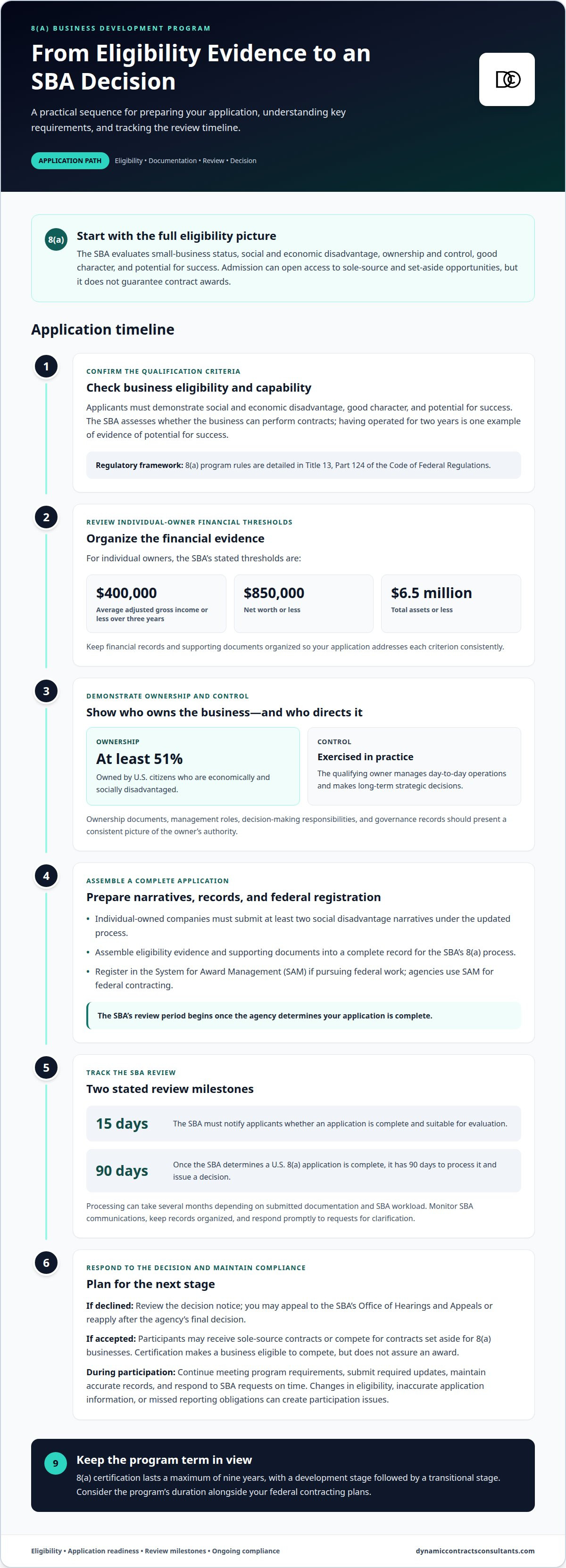
Application preparation means assembling eligibility evidence and submitting a complete record through the SBA’s 8(a) process. We recommend understanding each requirement before organizing your materials, because the SBA’s review period begins once the agency determines your application is complete. If you plan to pursue federal work, your business must also register in the System for Award Management (SAM), which agencies use for federal contracting.
For individual owners, the U.S. Small Business Administration requires average adjusted gross income of $400,000 or less over three years. An owner must also have net worth of $850 thousand or less and total assets of $6.5 million or less. We encourage you to organize financial records and supporting documents so your application addresses each criterion consistently.
Applicants must demonstrate social and economic disadvantage, good character, and potential for success. Individual-owned companies must submit at least two social disadvantage narratives under the updated process. The SBA also assesses whether a business can perform contracts; having operated for two years is one example of evidence of potential for success.
The SBA’s 8(a) program rules are detailed in Title 13, Part 124 of the Code of Federal Regulations, according to the Office of the Federal Register, National Archives and Records Administration. We use this regulatory framework to explain how the SBA evaluates eligibility and what evidence your application needs to address.
Approval and Application Status
Approval is the SBA’s decision that your application meets program requirements; status updates indicate where your submission stands in review. The SBA must notify applicants within 15 days whether an application is complete and suitable for evaluation. Once the SBA determines a U.S. 8(a) application is complete, it has 90 days to process it and issue a decision, according to the U.S. Small Business Administration.
Monitor your application through SBA communications and respond promptly to requests for additional information or clarification. Processing can take several months, depending on the documentation submitted and the SBA’s workload. Keep submitted records and correspondence organized, since clarification requests can affect the expected decision timeline.
If the SBA declines your application, you may appeal to the SBA’s Office of Hearings and Appeals or reapply after the agency’s final decision. Review the decision notice to understand the determination, then consider which response best addresses your circumstances. Dynamic Contracts Consultants can help you connect the application process to your broader federal contracting plans.
Suspension, termination, or early graduation can disrupt planned participation and access to program opportunities. To reduce compliance risks, continue meeting program requirements and submitting required updates. Changes in eligibility, inaccurate application information, or missed reporting obligations can create participation issues. Maintain accurate records and respond to SBA requests on time.
Ownership and control requirements
Ownership and control are separate parts of 8(a) eligibility. The U.S. Small Business Administration requires an applicant to be at least 51% owned and controlled by U.S. citizens who are economically and socially disadvantaged. The ownership test concerns who holds the business interest; the control test concerns who directs the company. Both must align for an applicant to meet this requirement.
Control must be exercised in practice, not merely reflected in corporate records. The qualifying owner must manage day-to-day operations and make long-term strategic decisions. An owner who holds the required ownership share but cannot direct operating decisions may not demonstrate the required control. Management authority, decision-making responsibilities, and governance documents should present a consistent picture.
This distinction matters in federal contracting because the agency evaluates the business described in the application. Reviewing ownership documents alongside operational roles can reveal whether another person has authority that limits the disadvantaged owner’s control. Delegated responsibilities can support normal operations, but they should not displace the owner’s actual authority over the company.
Once accepted, an 8(a) participant may receive sole-source contracts or compete for contracts set aside for 8(a) businesses. A sole-source award is made without competition among multiple offerors, while a competitive set-aside allows eligible businesses to compete for the opportunity. These are distinct procurement paths, and the contracting approach depends on the acquisition and the agency’s requirements.
For a competitive set-aside, certification makes a business eligible to compete within the 8(a) program, but the company still needs to respond to the solicitation and demonstrate its ability to perform. A sole-source opportunity follows a different route, with the agency considering a direct award under the program. In either case, ownership and control status remain relevant to eligibility when the SBA determines a participant’s eligibility for a contract.
These rules connect a company’s governance structure with its federal contracting strategy. Before pursuing opportunities, owners should understand how operational authority, strategic decisions, and procurement plans fit together. Changes in ownership or management can affect that alignment, so clear records support consistent program participation and contract planning.
After an award, execution introduces a separate set of administration and compliance responsibilities. If you need support coordinating post-award requirements, discuss post-award contract administration.
What is the 8(a) Business Development Program?
The 8(a) Business Development Program is a federal initiative for qualifying small businesses owned by socially and economically disadvantaged individuals. It combines contracting opportunities with business development support intended to help participants strengthen their capacity in the federal marketplace. For firms navigating the 8(a) business development program, it is useful to view certification as one part of a wider business-development framework.
Mentor-Protégé Agreements and Joint Ventures
The SBA Mentor-Protégé Program pairs eligible 8(a) participants with experienced businesses that can provide technical and management assistance, financial assistance, and subcontracting support. This relationship can help a participant identify capability gaps and develop a more deliberate approach to pursuing federal work.
A mentor-protégé agreement describes the assistance businesses intend to provide and receive. A joint venture, by contrast, is a collaboration through which businesses pursue or perform contract work together. The arrangements can complement each other, but serve different purposes: mentorship supports business development, while a joint venture can support a specific contracting effort.
For example, an 8(a) participant pursuing work that requires capabilities it is still developing can use mentor guidance to assess readiness and potential partners. A joint venture may then offer a structure for combining complementary capabilities on an opportunity. Navigating the 8(a) business development program also means considering how the participant’s role, responsibilities, and business-development objectives fit the proposed arrangement.
SBA Workshops and Mentorship
SBA guidance and mentor support can help participants understand program expectations and strengthen their contracting capabilities. The SBA provides detailed guidelines and support for the 8(a) application, while the Mentor-Protégé Program offers eligible participants technical and management assistance, financial assistance, and subcontracting support.
Training and development are most useful when tied to a defined business need. For example, a participant preparing to pursue federal opportunities can use mentor discussions to identify operational or management capabilities to strengthen. SBA application guidance can also help applicants understand eligibility criteria and documentation requirements before submitting materials.
The program’s statutory foundation is Sections 7(j)(10) and 8(a) of the Small Business Act. Its purpose extends beyond certification: participants can use available support to build business capacity while pursuing contracting opportunities. Mentorship can provide practical perspective, but the participant remains responsible for its business decisions and contract performance.
Participation does not guarantee federal awards. Businesses still need to identify suitable opportunities, assess their ability to perform, and prepare responsive proposals. For businesses navigating the 8(a) business development program, mentor support, SBA guidance, and joint venture planning can connect development priorities with a realistic federal contracting strategy.
Certification duration and program stages
The SBA 8(a) certification has a defined term, divided into development and transition stages. We help you understand how those stages unfold so you can connect program participation with your federal marketplace plans and ongoing compliance responsibilities.
According to the U.S. Small Business Administration, 8(a) certification lasts a maximum of nine years. The program’s first four years form the development stage, while its last five years form the transitional stage. We view these stages as a framework for building your capacity and preparing for the end of participation, rather than treating certification as permanent approval.
During the development stage, you can use the program period to strengthen your business operations and pursue federal contracting opportunities. We recommend submitting a comprehensive business plan to the SBA servicing office as soon as possible after admission to establish your priorities. Each program year, you must also forecast contract-award needs for the next program year, covering expected 8(a) and non-8(a) contracts.
The transitional stage covers the final five years of the certification term. It gives you a period to continue business development while preparing for participation to end. We recommend accounting for the remaining program period in your contracting strategy, including how your pipeline, capabilities, and customer relationships can support work beyond 8(a).
Annual compliance continues throughout your participation. You must certify annually that you meet statutory and regulatory requirements. You must also submit a modified business plan and updated information to your Business Opportunity Specialist within 30 days after each program year closes. We help you treat these recurring steps as part of an active compliance period, not simply a certification date range.
SBA 8(a) certification and System for Award Management registration serve different purposes in federal procurement. Certification establishes your acceptance into the 8(a) program; SAM registration is required for businesses seeking to do business with the federal government. We help you account for both in your application process and contracting readiness, because one does not replace the other.
SDB self-certification should also be distinguished from SBA 8(a) certification. Your representation as a small disadvantaged business does not itself establish acceptance into the 8(a) program. The SBA reviews your 8(a) application against program eligibility criteria, and participation depends on the agency’s decision. We help you understand this distinction as you plan which federal opportunities your company can pursue.
As the term progresses, program-year reporting and contract planning help you manage the transition. We recommend tracking your current stage, business plan updates, annual certification, and future opportunity needs to give your leadership a clearer basis for decisions throughout the program’s maximum nine-year period.
8(A) program duration and business development support
We help you approach 8(a) program development as ongoing business administration, not certification alone. You must maintain program records, submit annual financial information, and plan for contracting needs. These responsibilities help demonstrate your continued compliance and give you a structured way to assess your ability to perform federal work.
You must submit Form 1450-8(a), the Annual Update Review, each year. This recurring submission gives the SBA information to review your continuing program participation. We recommend treating the update as part of your regular reporting cycle so you can organize ownership, financial, and operational information before submission deadlines.
Your financial reporting requirements depend on revenue. If your 8(a) business has more than $10 million in revenue, you must submit annual audited financial statements within 120 days of your fiscal year. If your revenue is between $2 million and $10 million, you must submit annual reviewed statements within 90 days of your fiscal year.
- If your revenue is less than $2 million, you must provide an annual in-house or compiled financial statement within 90 days after your fiscal year closes.
- If your revenue is between $2 million and $10 million, you must prepare for the review process and its 90-day submission deadline.
- If your revenue is more than $10 million, you must plan for an audit and the 120-day deadline.
These reporting categories shape how you organize business administration. For example, if your company is approaching a different revenue tier, account for the corresponding financial statement requirement in your records and reporting calendar. We recommend coordinating finance and program administration to keep your documents aligned with the applicable criteria.
Program support also connects your business planning with contract execution. Use your annual planning process to assess upcoming opportunities, identify capability needs, and determine whether your operations can support the work. We recommend coordinating contract delivery leads with finance and management so performance obligations and reporting requirements are visible across your business.
Winning an award is only one part of federal contracting. After award, you must manage your obligations and maintain organized records. We can support your post-award contract administration; align contract execution with your internal compliance processes.
Use your program’s reporting cycle as a management tool: coordinate financial statements, annual updates, and contract planning rather than treating each as an isolated filing. To discuss support for your post-award requirements, contact us about your contract administration needs.
Dynamic Contracts Consultants
Dynamic Contracts Consultants LLC helps businesses connect federal contracting goals with practical proposal, capture, and compliance support. If you are assessing how 8(a) participation fits your growth strategy, proposal writing and capture management can support opportunity planning, while DCAA Compliance Consulting can address accounting-system compliance needs. Grant writing is also available when grant opportunities align with your organization’s objectives.
Our role is to support your broader government contracting readiness, not to determine 8(a) eligibility or guarantee awards. As you translate program participation into a contracting strategy, we can help align pursuit priorities with your capabilities and proposal requirements. For a discussion of how our support may fit your objectives, contact Dynamic Contracts Consultants LLC.
Turn Program Participation Into a Durable Growth Strategy
Use your next step to connect 8(a) participation with a broader federal contracting plan. A clear view of your target agencies, contract priorities, and internal capacity can help translate program access into deliberate business development. Navigating the 8(a) business development program is not only about pursuing eligible opportunities; it also means preparing your organization to compete and perform effectively over time.
Dynamic Contracts Consultants supports this work through Proposal Writing, Grant Writing, and DCAA Compliance Consulting. These services can align opportunity development, funding proposals, and compliance considerations with your organization’s objectives. The right focus depends on your procurement stage and the capabilities that need attention.
Contact Dynamic Contracts Consultants LLC to discuss how our support can fit your federal contracting priorities. With a disciplined strategy, your next step can move your business toward stronger, sustainable growth.
Frequently Asked Questions
How To Apply for SBA Certification?
Apply through the SBA’s 8(a) process by completing the required questionnaire and assembling evidence for the eligibility criteria. Individual applicants can prepare a social disadvantage narrative, and applicants must authorize the SBA to obtain relevant tax return information directly from the IRS. Federal contractors also need SAM registration. Organizing ownership, financial, and business records together can help ensure the application presents a consistent account of the company.
Can I reapply if my application is denied?
Yes. An applicant whose 8(a) application is declined may appeal to the SBA’s Office of Hearings and Appeals or reapply after the agency’s final decision. Review the denial decision to understand which eligibility or documentation issues affected the outcome, then address those points in an appeal or later application. The appropriate path depends on the grounds for the decision and the applicant’s circumstances.
How long does the certification last?
SBA 8(a) certification lasts a maximum of nine years. The program divides that term into a development stage and a transitional stage, so participants should plan business priorities across both periods. For example, a company can align its contract pipeline and capacity-building objectives with its remaining participation term. Annual compliance and business planning continue during participation, making the certification period an active management commitment.
What Are the SBA Annual Reporting and Compliance Requirements?
Participants must certify annually that they continue to meet statutory and regulatory requirements and submit the Form 1450-8(a) Annual Update Review each year. They also provide updated information and a modified business plan to their Business Opportunity Specialist within 30 days after each program year closes. Financial statement requirements vary by revenue tier, so companies should coordinate annual reporting with their fiscal-year close and accounting processes.
What are the SBA 8(a) and HUBZone Programs?
The SBA 8(a) Program supports qualifying small businesses owned by socially and economically disadvantaged individuals, while HUBZone is a separate small-business contracting program. The federal government’s annual contracting-dollar award goals differ: 5% for small disadvantaged businesses and 3% for HUBZone businesses. These goals do not make the programs interchangeable. A company should assess each program’s eligibility criteria and the opportunities relevant to its business.
What does "socially and economically disadvantaged" mean?
For 8(a) eligibility, applicants must demonstrate both social and economic disadvantage under the program’s criteria. Individuals of any race or ethnicity may qualify by establishing disadvantage; race alone does not determine eligibility. The application process includes a questionnaire about social disadvantage, and applicants may provide a narrative explaining their circumstances. Economic eligibility is assessed separately using the applicable financial standards and supporting documentation.
What is SAM registration, and why is it important for 8(a) applicants?
SAM is the System for Award Management, where businesses register to pursue work with the U.S. federal government. Registration is a separate requirement from SBA 8(a) certification: one records the business for federal contracting, while the other concerns program admission. For example, a certified 8(a) participant still needs SAM registration to do business with the federal government.
What is the SBA 8(a) Business Development Program and what benefits does it provide?
The SBA 8(a) Business Development Program is a federal program for qualifying small businesses owned by socially and economically disadvantaged individuals. Participants may pursue 8(a) sole-source contracts and compete for set-aside contracts. Eligible participants may also receive technical, management, financial, and subcontracting support through the SBA Mentor-Protégé Program. Certification creates access to program opportunities and support, but it does not guarantee contract awards.


