

In 2026, a single missing semicolon in your compliance matrix is more likely to disqualify your bid than a weak technical solution. We understand that the government proposal review process often feels like an impenetrable system where transparency is minimal and the stakes are unforgivingly high. You've likely felt the pressure of aligning complex technical responses with Section M criteria, fearing that a minor oversight will lead to immediate disqualification. This concern is valid. Federal agencies are adopting more rigorous, data-driven evaluation methods that leave no room for error.
We've designed this guide to demystify the federal evaluation landscape and provide you with a definitive roadmap to success. You'll learn how to engineer compliance through every stage of the review, ensuring your submission survives the government's scrutiny and secures the award. We'll explore the transition from administrative screening to technical realism reviews. We also highlight how our AI-driven precision and strategic compliance models help you achieve higher technical scores while reducing the risk of non-compliance. By the end of this article, you'll have the insights needed to navigate the procurement lifecycle with confidence and scalable intelligence.
Key Takeaways
- Understand the core stages of the government proposal review process to align your submission with the specific technical and price reasonableness criteria agencies use today.
- Learn how to mitigate performance risk by identifying "optimism bias" in your technical responses before evaluators flag it as a potential cost growth concern.
- Gain clarity on adjectival scoring models and the Source Selection Decision Document to anticipate how the government justifies its final award choice.
- Discover how to integrate AI-driven automation with expert oversight to build a robust compliance matrix that eliminates technical disqualification risks.
- Leverage strategic acquisition planning and FARIFY's precision to ensure your proposal isn't just compliant, but specifically engineered for a best-value win.
What is the Government Proposal Review Process?
The government proposal review process is the formal mechanism through which federal agencies evaluate an offeror's capacity to execute a contract successfully. It's not merely a check of your technical capabilities. It's a comprehensive assessment of requirements alignment, performance risk, and price reasonableness. In 2026, the Revolutionary FAR Overhaul (RFO) has fundamentally altered this landscape. The RFO has streamlined evaluation timelines by removing redundant provisions and encouraging commercial-style buying practices. This means we're seeing faster award decisions, but it also means the margin for error has vanished. We must view the review process as a hurdle where the government is looking for reasons to eliminate you as much as they're looking for reasons to select you.
We distinguish between competitive source selections, where multiple firms vie for an award, and sole-source negotiations. In a competitive environment, your proposal is measured against both the solicitation and your peers. In sole-source scenarios, the focus shifts toward justifying price reasonableness and cost realism in a non-competitive vacuum. Regardless of the path, the government's primary objective remains the same: identifying the partner that offers the highest probability of mission success at a fair price.
The Role of the Request for Proposal (RFP)
The RFP acts as the definitive rulebook for your submission. Specifically, Section L dictates the structure and format we must follow. If you exceed page counts or ignore font requirements, you risk immediate rejection. Section M is even more critical; it outlines the explicit criteria evaluators use to score your response. We see many contractors fail because they focus on what they think is important rather than addressing the specific scoring weights found in Section M. Any deviation from these instructions is viewed as a material weakness. This often leads to disqualification before the technical review even begins. Our focus on strategic compliance ensures that every response maps directly to these requirements, leaving no room for administrative rejection.
Competitive vs. Non-Competitive Evaluations
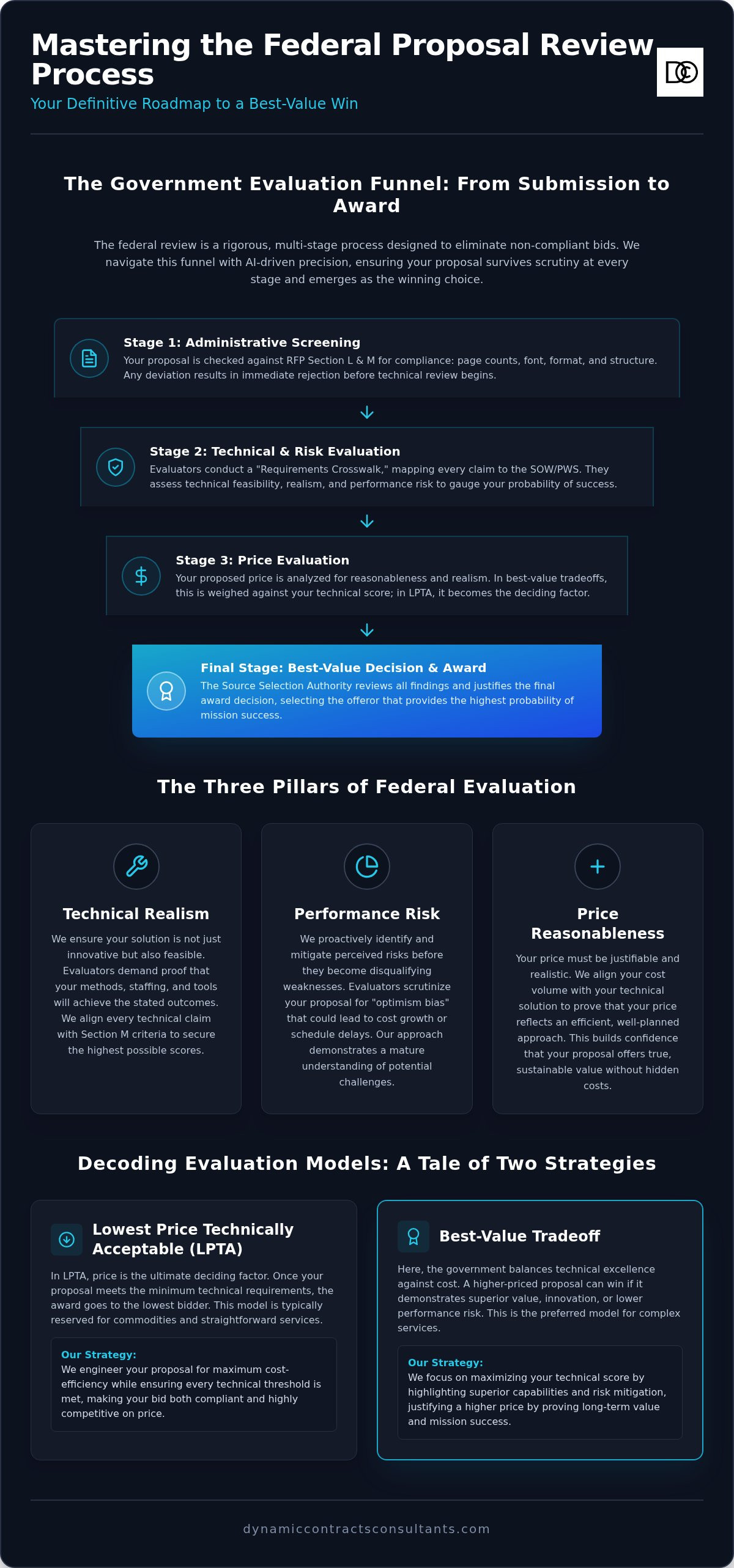
Your strategy depends heavily on the chosen evaluation method. In the Tradeoff process, the government balances technical excellence against cost. Here, we can win even with a higher price if we prove our solution offers superior value and lower risk. Conversely, Lowest Price Technically Acceptable (LPTA) models make price the deciding factor once you meet a baseline technical threshold. Since 2026, we've observed a shift toward best-value tradeoffs for complex services, while LPTA remains reserved for commodities. Understanding this distinction allows us to tailor your proposal writing efforts to either maximize technical lift or optimize for cost-efficiency. We don't just write to comply; we write to win based on the specific framework the government has declared.
The Three Pillars of Federal Evaluation: Technical, Risk, and Price
The government proposal review process relies on a triad of evaluation factors that determine your eligibility for an award. Evaluators don't just read your narrative; they perform a "Requirements Crosswalk." This involves mapping every sentence in your response to the specific line items in the Statement of Work (SOW) or Performance Work Statement (PWS). If a requirement is left unaddressed, the crosswalk fails, and your proposal is deemed non-compliant. We've seen that even the most innovative solutions fail when they aren't explicitly tied to the government's stated needs.
Technical Realism and Feasibility Review
Technical acceptability goes beyond simply stating you can do the work. Evaluators judge the feasibility of your proposed methods, staffing levels, and schedule. They look for evidence that your tools and processes will realistically achieve the stated outcomes within the performance period. Past performance plays a vital role here; it serves as the government's primary indicator of future success. We leverage AI-driven proposal development to ensure your technical response aligns perfectly with Section M scoring criteria, providing the empirical proof evaluators demand for every technical claim.
Documenting Performance Risk
Risk assessment is where many promising bids fail. Evaluators are trained to spot "optimism bias," which is the tendency to understate timelines or costs to appear more attractive. In 2026, federal reviews place a heavy emphasis on identifying supply chain vulnerabilities, cybersecurity posture, and safety risks. Ambiguous commitments, such as "we intend to" or "we will try," are immediate red flags that trigger a high-risk rating. We help you lower your overall risk profile by documenting specific, verifiable mitigations for every potential bottleneck. By showing that you've anticipated challenges, you build the confidence necessary for the government to trust your execution.
Price analysis and reasonableness form the final pillar. The government ensures the cost is fair, reasonable, and realistic. If your price is significantly lower than the Independent Government Cost Estimate (IGCE), evaluators may conclude you don't understand the scope. This creates a direct link between price and technical realism; an unrealistically low bid often triggers a "High Risk" rating in the technical volume. Balancing these three pillars requires a surgical approach to strategic compliance. If you're struggling to align these factors, you can consult with our strategic partners to refine your evaluation strategy before submission.
Scoring Models and the Best-Value Decision Framework
The government proposal review process reaches its critical climax during the scoring and selection phase. Evaluators don't simply assign numerical values; they utilize a standardized adjectival rating system to categorize the quality of your submission. These ratings typically include Excellent, Good, Satisfactory, Marginal, and Unsatisfactory. An "Excellent" rating indicates that we've presented a solution with numerous strengths that significantly exceed requirements, while a "Marginal" rating suggests a high risk of unsuccessful performance. We focus on engineering specific "strengths" because these are the value-added features that provide the government with a clear benefit beyond the baseline Statement of Work.
The final choice is documented in the Source Selection Decision Document (SSDD). This serves as the government's legally defensible justification for the award. It's not just a tally of scores; it's a comparative analysis where your proposal is measured directly against your competitors. In 2026, the RFO has placed a higher burden on the Source Selection Authority to justify price-technical tradeoffs with empirical data. This means that if we're more expensive, the SSDD must clearly explain why your technical superiority justifies the additional cost. We ensure your narrative provides the exact "discriminators" the government needs to write this justification in your favor.
LPTA vs. Tradeoff: Choosing Your Strategy
Your capture strategy must shift based on whether the government prioritizes cost or technical innovation. In a Lowest Price Technically Acceptable (LPTA) environment, the review process stops the moment you meet the minimum technical threshold. Here, operational efficiency and cost-cutting are your primary weapons. However, in a Best-Value Tradeoff environment, the government is willing to pay a premium for superior performance and reduced risk. We recommend using a sophisticated bid/no-bid analysis to determine if your unique value proposition aligns with the stated evaluation method. Positioning yourself for a tradeoff win requires a visionary approach that highlights scalable intelligence and long-term mission success.
The Discussion Process and Clarifications
If your proposal survives the initial scoring, you may enter the competitive range. This is where the government decides which offerors are still "in the fight." The government might issue "clarifications" for minor clerical errors, but "formal discussions" are more intensive. Discussions allow us to address weaknesses or deficiencies identified during the review. This phase culminates in the Final Proposal Revision (FPR). The FPR is your last chance to optimize your score and adjust your pricing. We treat this as a surgical opportunity to refine your strategic compliance and eliminate any remaining doubts the evaluators might have about your technical realism.
Strategic Preparation: Ensuring Compliance Before the Review
We don't leave success to chance. Survival in the government proposal review process requires a rigorous internal simulation of federal scrutiny. We develop a robust compliance matrix to track every requirement, ensuring that no instruction is overlooked. This preparation includes conducting internal reviews that replicate the government's own scoring environment:
- Red Team: Evaluates the technical draft against Section M scoring criteria to identify weaknesses and gaps.
- Gold Team: Performs the final management review to ensure the bid aligns with corporate strategy and pricing goals.
- White Team: Conducts a final production check for formatting, page counts, and administrative compliance.
Ensuring audit-readiness from day one is essential. It doesn't just help you win the award; it facilitates seamless post-award contract administration once you begin performance. We utilize a "Human-in-the-Loop" approach, combining the speed of AI with the seasoned oversight of our consultants. This ensures that every claim is backed by verifiable data and that your operational efficiency is clear to evaluators.
Leveraging AI for Requirement Extraction
Manual reviews often miss "hidden" requirements buried in the fine print of Section L and M. We use FARIFY to accelerate compliance matrix generation, extracting every obligation from complex RFPs in minutes. This scalable intelligence reduces the procurement lifecycle and eliminates the risk of technical disqualification due to administrative oversight. By automating the extraction of clauses, we allow our human experts to focus on high-level strategy rather than clerical tracking. You gain a competitive edge by responding to requirements your competitors might have overlooked.
Gap Analysis and Technical Editing
Before submission, we perform a detailed gap analysis to identify missing elements in your technical volume. This ensures your narrative aligns with your strategic capture management goals. Technical gap analysis serves as a pre-emptive strike against government risk flags by resolving inconsistencies before evaluators see them. We refine your language to be direct and impact-oriented, removing the fluff that evaluators find distracting. This process transforms a standard response into a visionary solution that inspires confidence. If you want to ensure your next submission is audit-ready and compliant, contact our expert team today.
Optimizing Evaluation Outcomes with Dynamic Contracts Consultants LLC
Winning the contract requires more than just a compliant response; it demands a strategy that anticipates the final selection decision. Dynamic Contracts Consultants LLC acts as your strategic partner to bridge the gap between submission and the eventual award. By integrating the technical precision of FARIFY.ai with our seasoned acquisition planning, we ensure your solution is positioned as the most advantageous choice within the government proposal review process. We don't just help you participate. We help you dominate the field through operational efficiency and scalable intelligence.
Our approach prioritizes audit-readiness from the earliest stages of capture. We ensure your proposal is DCAA compliant, which removes significant barriers during the price realism phase. Dynamic Contracts Consultants LLC delivers direct solutions to the most complex federal requirements, allowing your technical expertise to shine without being hindered by administrative gaps. It's about providing the "human-in-the-loop" assurance that evaluators demand in a tech-forward procurement environment. We provide the clarity needed to turn complex regulations into competitive advantages.
From Acquisition Planning to Post-Award Success
Our support extends throughout the entire procurement lifecycle. We help you manage flow-down clauses and develop high-impact CPARS narratives that secure your reputation for future bids. Business leaders rely on Dynamic Contracts Consultants LLC to maintain strategic compliance long after the initial award is made. This long-term partnership ensures that your growth is sustainable and your contract administration remains flawless. By focusing on the practical outcomes of our expert services, we ensure you're prepared for the rigors of performance as thoroughly as you were for the initial evaluation.
The FARIFY Advantage in 2026
In the wake of the 2026 Revolutionary FAR Overhaul (RFO), speed has become a critical discriminator. FARIFY.ai enables rapid document generation that meets the most stringent FAR and DFARS standards. This AI-driven automation provides a level of precision that manual processes can't replicate, allowing us to deliver audit-ready compliance matrices in record time. It's time to leverage our expert insights and cutting-edge technology for your next submission. Contact us to begin your optimization.
Securing Your Competitive Advantage in the 2026 Procurement Landscape
Success in the 2026 federal market is no longer a matter of chance; it's the result of methodical alignment with a shifting regulatory landscape. As we've discussed, the government proposal review process has evolved into a highly automated and data-centric evaluation where technical realism and risk mitigation carry as much weight as price. By integrating the strategic frameworks of Section M with the speed of AI-driven tools, your firm can move beyond basic compliance toward a position of visionary leadership. Mastering these nuances ensures that your technical superiority is clearly visible to every evaluator.
Our commitment is to provide the scalable intelligence and full-lifecycle support necessary to navigate these complexities. From initial capture to post-award administration, we ensure your operations are audit-ready and resilient. Partner with Dynamic Contracts Consultants LLC for your next federal proposal to leverage our expert insights and the FARIFY platform. Together, we can transform the challenges of the RFO era into a sustainable engine for your business growth and long-term success. Let's build your future in federal contracting with precision and confidence.
Frequently Asked Questions
What are the most common reasons proposals are disqualified during the review process?
Proposals are most frequently disqualified for non-compliance with the administrative instructions found in Section L. This includes exceeding page limits, using incorrect font sizes, or failing to submit required certifications. In the modern government proposal review process, even a single missing requirement in your compliance matrix can trigger an immediate rejection. We ensure every administrative and technical requirement is mapped precisely to avoid these preventable errors before the government's formal evaluation begins.
How has the Revolutionary FAR Overhaul (RFO) changed the proposal evaluation timeline in 2026?
The 2026 Revolutionary FAR Overhaul (RFO) has significantly compressed evaluation timelines by removing redundant regulatory provisions and encouraging commercial-style buying practices. Agencies now prioritize rapid document screening and automated compliance checks to reduce the procurement lifecycle. This shift means you have less time to respond to clarifications but receive award decisions much faster. We help you adapt to this accelerated pace by using scalable intelligence to ensure your submissions are audit-ready from day one.
What is the difference between a technical deficiency and a technical weakness?
A technical deficiency is a failure of a proposal to meet a government requirement or a combination of significant weaknesses that increases the risk of unsuccessful performance to an unacceptable level. In contrast, a weakness is a flaw that increases the risk of unsuccessful performance but doesn't necessarily disqualify you. While a weakness lowers your adjectival rating, a deficiency can lead to immediate exclusion from the competitive range. We perform gap analyses to eliminate both.
Can a higher-priced proposal win in a best-value tradeoff evaluation?
Yes, a higher-priced proposal can certainly win in a best-value tradeoff evaluation if the government determines that the technical superiority or reduced risk justifies the additional cost. The Source Selection Authority performs a comparative analysis to see if your unique discriminators provide enough value to offset the price premium. We help you articulate these strengths so the government can legally justify selecting your higher-quality solution over a lower-priced competitor.
How do federal evaluators score past performance if my company is new to government contracting?
If your company is new to federal contracting, the government cannot penalize you for a lack of corporate past performance. Per FAR 15.305, you'll typically receive a neutral rating, which is neither positive nor negative. However, we often help clients strengthen this area by highlighting the relevant experience of key personnel or the past performance of strategic subcontractors. This approach demonstrates a lower performance risk even without a long history of prime contract awards.
What happens during the 'competitive range' decision phase?
During the competitive range decision phase, the contracting officer evaluates all proposals against the solicitation criteria and excludes those that don't have a reasonable chance of being selected for award. Only the most highly rated firms proceed to the discussion phase. This decision is based on technical scores, risk assessments, and price reasonableness. Being excluded at this stage means your journey in the government proposal review process for that specific procurement has ended.
How can AI-driven tools like FARIFY improve my proposal's compliance score?
FARIFY improves your compliance score by using AI-driven automation to extract every requirement from Section L and M with perfect accuracy. It generates a comprehensive compliance matrix in minutes, identifying hidden obligations that manual reviews often overlook. By ensuring that every technical and administrative requirement is addressed in your narrative, FARIFY eliminates the risk of scoring penalties. This scalable intelligence allows us to focus on high-level win themes rather than clerical tracking.
What is a Source Selection Decision Document (SSDD) and why is it important for debriefings?
The Source Selection Decision Document (SSDD) is the government's final justification for its award choice. It's critical for debriefings because it contains the comparative analysis between your proposal and the winner's. Reviewing the SSDD logic helps you understand exactly where your technical solution or price was viewed as inferior. We use these insights to refine your future capture management strategies and improve your technical realism for subsequent federal submissions. This ensures long-term success in complex environments.


