

A government contract modification isn't just an administrative update; it's a high-stakes pivot that can either safeguard your firm's margins or trigger a devastating fiscal leak. We recognize the inherent anxiety that follows a change order, particularly when the lines of Contracting Officer authority blur or the specter of a DCAA audit looms over every price adjustment. You've likely experienced the mounting pressure of "scope creep" where additional requirements are added without a guaranteed path to equitable compensation.
By mastering the formal government contract modification procedures outlined in FAR Part 43, you can transform these changes into strategic opportunities. This guide provides the technical precision needed to navigate the latest regulatory shifts, such as the FY2026 NDAA's increase of the TINA threshold to $10 million and the $35 million CAS applicability trigger for new contracts. We'll show you how to protect your profitability while maintaining seamless compliance through every shift in project scope.
We'll examine the critical distinctions between unilateral and bilateral modifications, the nuances of Request for Equitable Adjustment (REA) submissions, and the strategic use of AI-enhanced documentation to ensure your firm remains audit-ready at every stage of the procurement lifecycle.
Key Takeaways
- Master the FAR Part 43 framework to ensure every contract change aligns with regulatory standards and your firm's strategic goals.
- Understand the critical functional differences between unilateral and bilateral modifications to maintain control over your procurement lifecycle.
- We'll guide you through the technical requirements of government contract modification procedures to ensure your Requests for Equitable Adjustment (REA) remain DCAA-compliant.
- Discover how AI-driven automation via FARIFY generates audit-ready modification analysis and SOW updates in minutes to reduce administrative overhead.
- Gain the insights needed to mitigate scope creep and protect your margins by integrating human expertise with scalable intelligence.
Understanding the FAR Part 43 Framework for Modifications
A contract modification represents any written change in the terms of an existing agreement. We view these actions as vital instruments for strategic compliance rather than mere administrative hurdles. The federal environment is inherently fluid. Mission requirements evolve, funding shifts occur, and technology advances at a pace that often outstrips original contract specifications. To maintain operational efficiency, you must treat the modification process as a core component of your procurement lifecycle.
The Contracting Officer (CO) serves as the sole authority capable of binding the Government in these matters. We've seen contractors face significant financial risk by following the direction of technical personnel who lack formal signing authority. Establishing rigorous government contract modification procedures ensures that every change to your contract is authorized, documented, and compensable. Without a formal signature from the CO, any additional work performed remains outside the legal protection of the contract.
Key Definitions in Federal Contract Administration
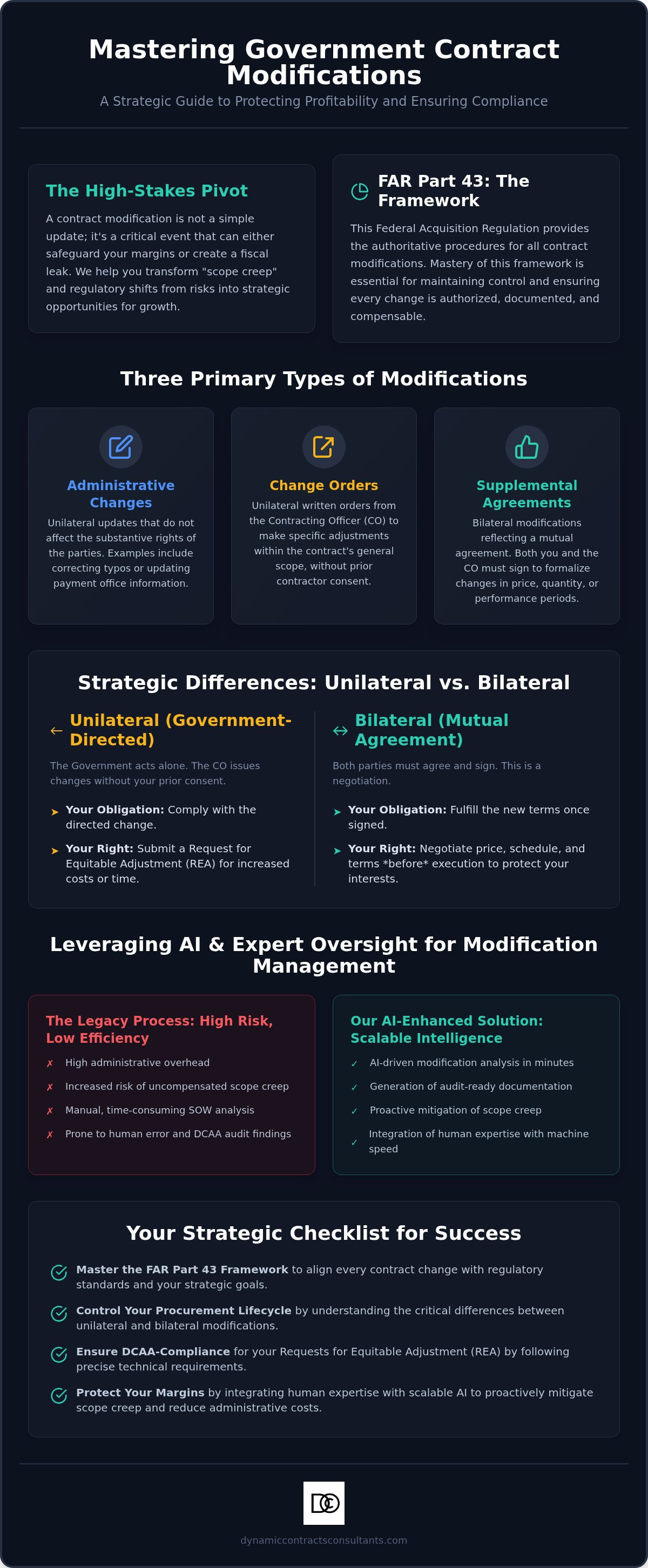
Effective management requires a precise understanding of how the FAR categorizes changes. These distinctions dictate whether you have a voice in the terms or must respond to a directive. We categorize these modifications into three primary types:
- Administrative changes: These are unilateral updates that do not affect the substantive rights of either party. Examples include correcting a typo in a zip code or updating the designated payment office.
- Change orders: These are unilateral written orders issued by the CO. They are authorized by the Changes Clause and allow the Government to make specific adjustments within the general scope of the contract without your prior consent.
- Supplemental agreements: These are bilateral modifications. Because they reflect a mutual agreement, both you and the CO must sign them. These are typically used to negotiate changes in price, quantity, or performance periods.
The Policy of FAR Part 43.102
The policy outlined in FAR 43.102 mandates that modifications must be in writing to be considered effective. This requirement serves as your primary defense against "scope creep" and uncompensated labor. Our approach at Dynamic Contracts Consultants LLC to post-award compliance emphasizes that oral agreements hold no weight in a federal audit. We help you ensure that all modifications are priced fairly before execution, or as soon as possible thereafter, to protect your firm's profitability. By adhering to these strict government contract modification procedures, you create an audit-ready trail that supports your performance record and ensures long-term success.
The Mechanics of the Changes Clause (FAR 52.243)
The Changes Clause (FAR 52.243) serves as the primary mechanism that empowers the Government to direct modifications unilaterally. It allows the CO to alter specifications, delivery methods, or performance locations without your prior consent, provided the changes remain within the general scope of the contract. This authority is a cornerstone of federal procurement; however, it carries specific obligations for the Government to provide equitable adjustments. Understanding these government contract modification procedures is essential to prevent uncompensated performance. You must recognize that while the CO has the power to order changes, you have the right to seek financial and schedule relief for the resulting impacts.
Constructive changes often pose the greatest risk to your firm's profitability. These occur when the Government's actions or inactions effectively change the contract requirements without a formal modification. For instance, an informal directive from a technical representative might force your team to exceed the original Statement of Work. To protect your interests, we recommend documenting these occurrences immediately and cross-referencing them with the Department of Energy Acquisition Guide, which provides a framework for identifying and processing such changes. If you encounter these complexities, our team can help you manage the documentation process to ensure your rights are preserved.
Step-by-Step Response to a Change Order
A disciplined response to a formal change order is non-negotiable. First, we analyze the order to verify it falls within the contract's general scope; changes outside this scope may constitute an illegal "sole source" procurement. Second, you must assess the impact on your cost structure and delivery schedule. Third, you must assert your right to an adjustment in writing within the standard 30-day window. Failure to meet this deadline can result in a waiver of your claim. Finally, we assist you in negotiating the adjustment by preparing a robust Request for Equitable Adjustment (REA) that meets all regulatory requirements.
Commercial vs. Non-Commercial Modifications
The rules shift significantly when dealing with commercial items under FAR Part 12. Unlike non-commercial contracts, FAR 52.212-4 requires mutual agreement for any modification. The Government cannot unilaterally change the terms of a commercial contract. For firms operating under GSA Schedules or MAS, this provides a layer of protection against unexpected directives. We help you leverage these government contract modification procedures to maintain control over your performance obligations and ensure that any changes are the result of a bilateral negotiation rather than a unilateral mandate.
Unilateral vs. Bilateral Modifications: Strategic Differences
Choosing the right modification path is a strategic decision that directly impacts your firm's risk profile and financial health. While the Contracting Officer (CO) may issue a unilateral modification for administrative tasks, substantive changes often require the collaborative framework of a bilateral agreement. Within the legal structure of FAR Part 43, the distinction lies in whether one or both parties must sign the document. We emphasize that understanding these government contract modification procedures allows you to identify when your consent is legally mandatory and when you must simply comply with a directive.
A unilateral modification is signed only by the CO. These are typically reserved for administrative updates, such as changing a paying office, or for issuing change orders under the Changes Clause. Conversely, bilateral modifications are supplemental agreements that require the signature of both the CO and the contractor. This "Signature of Contractor" serves as your primary leverage point. It confirms that you agree to the price, schedule, and scope adjustments proposed. You shouldn't view a bilateral mod as a mere formality; it's a legally binding confirmation that protects your firm from future disputes regarding the negotiated terms.
Strategic Use of Bilateral Agreements
We recommend pushing for bilateral agreements when dealing with complex scope changes or when definitive pricing is required. This approach ensures that all parties have a clear, documented understanding of the new requirements before work reaches a critical stage. Bilateral mods are the standard method for settling a Request for Equitable Adjustment (REA) once negotiations conclude. During this phase, you must ensure that all updated terms and flow-down clauses are properly integrated into your subcontractor agreements. This maintains strategic compliance across your entire supply chain and prevents gaps in performance obligations that could lead to uncompensated costs.
Handling Unilateral Directives Safely
When you receive a unilateral change order, you're often bound by the "duty to proceed" clause. This means you must continue performance even if you haven't yet agreed on the final price adjustment. To manage this risk, establish rigorous documentation protocols immediately. Track every labor hour and material cost associated with the change from day one. This proactive data collection prevents uncompensated scope creep and ensures you're audit-ready when it's time to definitize the modification. Distinguishing between a truly administrative unilateral action and one that substantively alters your government contract modification procedures is a critical skill for maintaining operational efficiency.
Procedures for Requesting Equitable Adjustments (REA)
A Request for Equitable Adjustment (REA) is your primary tool for restoring financial balance when a change order disrupts your performance baseline. While a formal claim under the Contract Disputes Act signals a legal impasse, an REA functions as a collaborative negotiation mechanism. We treat the REA as a strategic proposal designed to reach a bilateral agreement. It's a critical phase of government contract modification procedures that requires technical precision and exhaustive documentation to succeed. You must demonstrate exactly how the Government's directive increased your costs or extended your timeline.
The distinction between an REA and a formal claim is significant. A claim for money exceeding $100,000 must be certified as accurate and complete to be valid under the Contract Disputes Act. An REA doesn't carry this immediate legal weight, yet it requires the same granular level of detail to survive DCAA scrutiny. We've seen contractors lose thousands in potential adjustments because they failed to provide a clear nexus between the change order and the resulting cost increase. A well-structured REA package also protects your CPARS narrative. It ensures that any schedule delays are documented as Government-caused rather than contractor performance failures.
Essential Components of an REA Package
Your REA must be more than a simple invoice for extra work. We recommend building a package that includes a side-by-side Statement of Work (SOW) comparison. This demonstrates the "before and after" of your requirements. You must provide certified cost or pricing data if the modification exceeds the updated $100 million threshold for CAS-covered contracts awarded after June 30, 2026. Every package should include:
- Cost breakdown: Detailed labor hours, material receipts, and indirect rate adjustments.
- Schedule analysis: A revised project schedule showing how the change impacted specific milestones.
- Technical justification: A narrative explaining why the original contract didn't cover the new requirements.
Maintaining Audit-Ready Records
DCAA compliance is won or lost in the daily accounting logs. You must segregate costs for the changed work from your base contract activities immediately upon receiving a change order. Mixing these funds makes it nearly impossible to prove the exact financial impact during an audit. We prioritize Post-Award Compliance and Audit Preparedness to ensure your firm is never caught off guard by a retrospective review. Our team can help you develop a robust REA strategy that maximizes your recovery while maintaining strategic compliance with federal accounting standards.
Leveraging AI and Expert Oversight for Modification Management
Managing the procurement lifecycle in a modern federal environment requires more than just a deep understanding of regulations; it demands the integration of scalable intelligence. We've seen how traditional, manual government contract modification procedures often lead to administrative bottlenecks and increased audit risk. To solve this, we utilize AI-driven automation to simplify the analysis of complex FAR and DFARS modifications. This technology allows us to identify critical changes in real time, ensuring that your firm remains agile and compliant without sacrificing precision.
Our proprietary platform, FARIFY, is at the forefront of this digital transformation. It generates audit-ready modification analysis and PWS/SOW updates in minutes, a task that previously required days of manual labor. This isn't just about speed; it's about accuracy. By automating the tracking of deliverables and milestones, we help you achieve a level of operational efficiency that protects your margins during high-volume modification cycles. You don't have to choose between compliance and profitability when you have the right tools in place.
Accelerating the Procurement Lifecycle
We leverage AI to reduce the turnaround time for compliance matrix generation during complex modifications. This allows your team to visualize the impact of new requirements instantly. Our systems are specifically designed to identify conflicting flow-down clauses that often hide within new modification language. By catching these discrepancies early, we prevent downstream disputes with subcontractors. We invite you to Explore our Post-Award Compliance Services to see how we integrate these tools into your daily operations.
Strategic Partnership for Scalable Growth
While technology provides speed, our "Human-in-the-Loop" approach provides the necessary assurance for high-stakes decisions. We combine Dynamic Contracts Consultants LLC expert insight with AI speed to help you navigate specialized regulatory changes, including ITAR and EAR requirements. Our history as a prime contractor with the DoD, State Department, and EPA gives us a unique perspective on how to handle mission-critical modifications successfully. We don't just provide software; we act as a strategic partner that understands the nuance of every directive. If you're ready to modernize your approach, Contact us for specialized contract administration support to leverage our collective expertise for your business growth.
Securing Your Firm's Future Through Strategic Compliance
Mastering government contract modification procedures is no longer just a regulatory requirement; it's a strategic advantage that ensures your firm's long-term profitability and operational efficiency. By navigating the complexities of FAR Part 43 with precision, you protect your business from uncompensated scope creep and maintain a pristine performance record. We provide the technical depth and scalable intelligence needed to handle everything from simple administrative updates to complex Requests for Equitable Adjustment.
Our approach combines expert DCAA compliance consulting with the cutting-edge speed of AI-driven document generation via FARIFY. With our proven prime contractor experience across major federal agencies, we transform regulatory hurdles into seamless transitions. You don't have to manage these high-stakes pivots alone. Streamline your contract administration with our expert compliance services and ensure every modification serves your strategic goals. We look forward to helping you achieve audit-ready success and sustainable growth in the federal marketplace.
Frequently Asked Questions
What is the difference between a change order and a contract modification?
A change order is a specific type of modification. It's a unilateral written order issued by the Contracting Officer under the Changes clause. A contract modification is a broader term encompassing any written change to contract terms. This includes bilateral supplemental agreements, administrative changes, and change orders. We ensure your team distinguishes between these to protect your substantive rights during performance.
Can a Contracting Officer unilaterally change the price of my contract?
No, the CO cannot unilaterally dictate the final price adjustment. While they have the authority to issue a change order that impacts your costs, the final price must be negotiated through a bilateral modification. If an agreement isn't reached, the matter may transition into a formal claim. You have the right to an equitable adjustment whenever a directive increases your performance costs.
How long do I have to respond to a government-issued change order?
You generally have 30 days from the receipt of a written change order to assert your right to an equitable adjustment. This timeline is critical under FAR 52.243. While the CO has the authority to extend this period in writing, failing to notify the government within this window can jeopardize your recovery. We help you establish protocols to meet these strict deadlines every time.
What is a Request for Equitable Adjustment (REA) in federal contracting?
An REA is a formal proposal seeking a change to the contract price or schedule due to government-directed changes. It's a strategic negotiation tool used within government contract modification procedures to reach a mutual agreement. Unlike a formal claim, it's not a dispute but a request for the government to make you whole. We provide the technical data needed to make these requests successful.
Do I have to keep working if the Government issues a unilateral modification I disagree with?
Yes, you typically have a duty to proceed under the Disputes clause. Even if you disagree with the terms of a unilateral modification, you must continue performance as directed by the CO. We suggest documenting all costs and schedule impacts immediately. This data supports a future REA while you fulfill your contractual obligations, ensuring you don't lose out on rightful compensation later.
How does DCAA compliance affect the modification process?
DCAA compliance ensures that the cost data supporting your modification request meets federal accounting standards. If your modification exceeds certain thresholds, such as the $10 million TINA threshold for contracts awarded after June 30, 2026, the DCAA may audit your proposal. Maintaining audit-ready records is essential for successful negotiations. We provide expert consulting to ensure your financial data survives this rigorous federal scrutiny.
What are the common forms used for government contract modifications?
The Standard Form 30 (SF 30) is the primary document used for all federal contract modifications. It records administrative changes, change orders, and supplemental agreements. It's vital to review every SF 30 carefully before signing to ensure it accurately reflects the negotiated scope. We help you verify that these forms protect your firm's interests and don't inadvertently waive your right to future adjustments.
Can AI tools like FARIFY help with contract closeout and modification analysis?
Yes, FARIFY uses AI-driven automation to accelerate modification analysis by identifying scope changes and conflicting clauses in minutes. This technology simplifies government contract modification procedures by generating audit-ready documentation and tracking milestones. It's a vital tool for maintaining operational efficiency during complex closeout procedures. We combine this speed with expert oversight to ensure your firm remains compliant and profitable through every change.


