

We recommend making your company’s relevance clear at a glance. To write a capability statement for government contracting, we suggest starting with a focused, one-page business résumé that presents your core competencies, relevant experience, differentiators, NAICS codes, and contact information in an easy-to-scan format. Your buyers should quickly find your contact details and NAICS codes, then see how your capabilities fit the agency or opportunity.
We advise treating a capability statement as more than a general company brochure. Focus its content on the work you want to pursue, selecting experience and strengths for their relevance to your intended audience.
In this article, we explain how to organize your document, present agency-specific strengths, and make essential business details easy to find. We also cover the information to gather, including accurate company data, NAICS codes, past-performance examples, and details about your target opportunities. With those inputs, your statement can communicate fit clearly and support a coherent government contracting strategy.
Key Takeaways
- We help you present your contact details and most relevant NAICS codes so agency buyers can locate them quickly.
- We connect your core competencies to concrete outcomes and experience that align with the work you want to pursue.
- We create a clear, scannable layout that helps readers understand your capabilities without searching through dense text.
- We tailor your statement to the agency or opportunity, emphasizing relevant strengths and omitting unrelated experience.
- We help you provide accurate company information, past-performance examples, and opportunity details to support a precise, useful statement.
Contact information and NAICS codes
We organize your contact details, NAICS codes, UEI, and CAGE code so buyers can find key information quickly. We can also present your SAM.gov registration and relevant certifications based on the information you provide.
These details serve different purposes. A professional writer distinguishes identifiers and registration information from certifications, then arranges them for buyers to review easily.
- Provide the contact details you want buyers to use. We place your business name, designated contact, email address, phone number, and company website together in a consistent header or footer. This makes it easier for buyers to identify whom to contact and how. We use the business name shown in your registration records. If your company has multiple locations, specify which one is relevant to the opportunity.
-
Have a Professional Identify Relevant NAICS Codes
Share your service descriptions and target opportunities so we can identify relevant NAICS codes for the statement. We focus on codes that reflect the work you perform and want to pursue, rather than listing every possible business activity. We can prioritize the top 3-5 NAICS codes and place 1-3 primary codes in the header. For an agency-specific opportunity, we highlight codes aligned with that work and avoid an unfocused list.
-
Add Your UEI and CAGE Identifiers with Expert Support
Provide your UEI and CAGE code as they appear in your business records. We place these identifiers alongside your company information and can hyperlink them to your official DSBS profile. The UEI replaced DUNS in April 2022, so we use your current identifier. A CAGE code may be relevant to your government contracting records, so check what your situation requires. We label each identifier distinctly from NAICS codes.
-
Include Relevant Registrations with Expert Support
Share your SAM.gov registration details and certifications relevant to your company and target opportunity. We present registration information based on what you provide, clearly separating it from UEI, CAGE, and NAICS identifiers. Certifications are included when they apply to your business. For example, a relevant small-business certification may support agency-specific positioning. Clear labels help buyers distinguish registration status, business classifications, and contact information.
What is a Capability Statement?
A capability statement is a concise business résumé for government buyers and prime contractors. We shape it around your competencies, evidence, differentiators, and target work.
Federal, state, and local statements differ mainly in audience and opportunity focus. We tailor the emphasis to the buyer’s mission and the work you are pursuing, rather than assuming one version suits every public-sector audience.
- Define the intended buyer and opportunity. We start by identifying the contracting organization and the work you want to pursue. That context determines which capabilities and examples to emphasize. For a federal agency, for instance, the statement should foreground relevant strengths rather than give equal weight to every company activity. The same principle applies to state and local buyers.
-
Describe Your Company and Services with Expert Support
We use your company overview, service descriptions, and target opportunities to create a buyer-focused narrative. The overview should take 2-3 sentences, followed by specific capabilities that explain what your company does. We avoid generic claims such as “full-service provider” unless the services and evidence clarify what that means. This gives buyers a precise account of your work and intended market.
-
Present Core Competencies and Differentiators with Expert Support
We organize the strengths and evidence you share into 4-6 competencies aligned with your target work. A specialized process or technical capability can demonstrate how your company differs. We distinguish substantiated differentiators from routine service descriptions, and avoid unsupported claims of superior performance. This keeps the statement grounded in your actual qualifications.
- Connect competencies to documented outcomes. We link each capability to evidence buyers can assess, such as what the work enabled, delivered, or improved. A strong example names the service, explains the customer or project context, and describes a supported outcome. We do not imply that one project guarantees the same result elsewhere. Relevant, specific evidence helps buyers understand how your competencies apply to real work.
For example, we can describe a defined process, its role in a project, and the documented result. We keep the explanation concise so readers can assess its relevance without relying on unsupported claims. A capability statement is most effective when it clearly connects your work to its value.
- Review claims for accuracy and relevance. We remove common weaknesses, such as unrelated competencies, outdated information, unsupported performance statements, and incorrectly presented certifications. These can leave buyers uncertain about your qualifications. We ensure each claim reflects your company’s actual experience and distinguish demonstrated results from proposed capabilities.
We also check that the overview, services, differentiators, and project evidence present a consistent position. For example, an overview focused on one capability should not be followed by unrelated examples. When contract execution raises compliance or administration needs, we can discuss post-award support as a separate next step.
Capability statement layout and readability
We structure the statement as a one-page document with a clear hierarchy, restrained graphics, and readable typography. This makes it practical for government buyers to scan and find supporting details without navigating dense sections.
- We keep the statement to one page and prioritize its content. We place your company name and central capability prominently, followed by core competencies, relevant past performance, differentiators, and corporate details. This sequence gives vendors and buyers a predictable path through the information. Federal buyers may give a statement about 6 seconds to make an initial impression, so we lead with the strongest message for the target opportunity. The remaining page supports that message rather than repeating it.
We design for a rapid scan. A statement should stand out within about 30 seconds, so we use section labels that distinguish capabilities from evidence. Instead of shrinking every section to fit, we remove content that does not support the opportunity. The one-page format encourages a concise hierarchy and keeps essential information visible together.
- We apply consistent typography and spacing. We use 10-12 point body text, 14 pt for the About section, and 12 pt for the footer. These sizes establish a clear hierarchy while preserving legibility. We set margins between 0.5-0.75 inches and line spacing between 1.15-1.5, then apply consistent alignment across sections.
We reserve 40-60% of the page for white space, reducing competition between text and key details. Because statements may be scanned into agency databases, we use minimal graphics and crisp fonts. A logo or simple visual can establish identity, but decorative elements should not interrupt the text or obscure codes and contact details.
- We arrange sections for a natural visual scan. A Z-pattern layout can guide the eye from the company identity in the upper left to a prominent capability message, then toward evidence and contact information. Treat this as a design option, not a rigid formula. For example, we might put the company name at the top left, a concise value statement across the top, and relevant performance details lower on the page.
We align section headings and use simple tables or bullets when they clarify relationships. We avoid complex charts that need explanation. The reading order should also work from top to bottom, since buyers may review the document on screen, in print, or as a database copy.
- We test readability in the final file. We review the page at its intended display size and as a printed sheet. We confirm that headings, body text, and the footer remain distinct and that the content fits on one page. For agency databases, simple formatting, selectable text, and legible contrast also make the information easier to access.
We assess whether a buyer can locate the central capability, evidence, and contact area during a 20-second scan. If a graphic draws attention away from those sections, we reduce it or remove it. Our final review preserves a clear reading order without relying on color alone to explain the document’s structure.
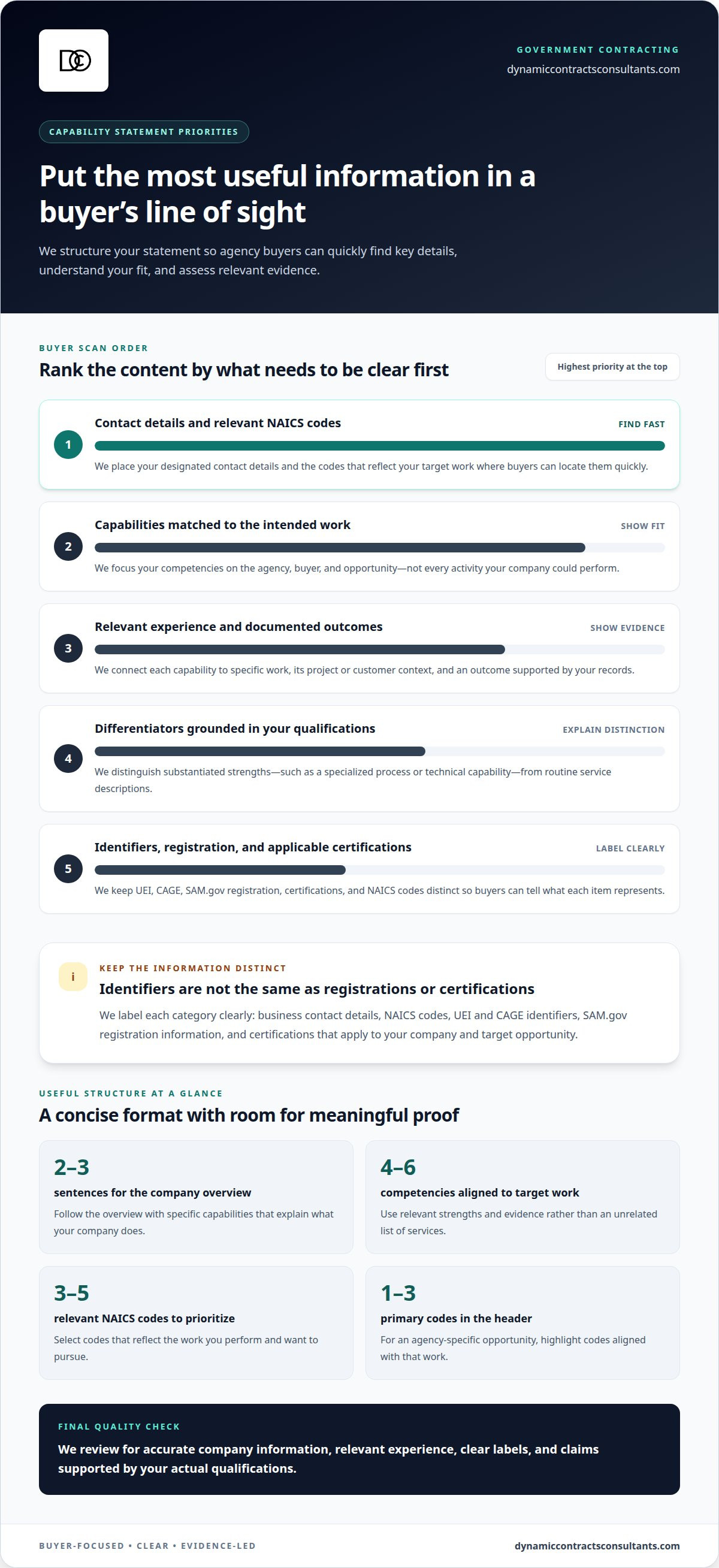
Readable formatting and agency-specific tailoring
We tailor your capability statement to the target federal agency or solicitation by aligning its emphasis with the agency’s needs. Keep the master content consistent, then we adapt relevant sections, examples, and presentation for each opportunity.
-
Align Your Statement with Agency Needs
Share your target agency, its mission, and your priority opportunities with us. We use that context to shape the content and highlight capabilities that fit the agency’s needs. For example, we emphasize relevant services and past performance instead of giving equal space to every company activity. Generic language that could apply to any government agency gives buyers little context for assessing your fit.
-
Tailor Content to Opportunities with Expert Support
Provide us with the solicitation or opportunity details so we can adapt your statement’s emphasis. We keep relevant competencies and evidence prominent, and omit experience that does not support the opportunity. For a significant RFP, tailor about 20% of a master capability statement while keeping about 80% consistent. This approach preserves a stable company profile while focusing the document on the specific work under consideration.
- Match the format to the information buyers need. HHS recommends presenting information concisely and making the statement visually appealing. We use bullets, simple tables, and highlighted sections to distinguish capabilities, evidence, and company details. A table can make a small set of service areas easier to compare, while bullets can bring relevant strengths forward. We avoid complex layouts that obscure the connection between your capabilities and the agency’s mission.
We keep a consistent visual system across tailored versions. For example, we use the same positions for section labels and the company overview while adjusting selected examples and opportunity-specific language. This helps distinguish intentional tailoring from inconsistent information across copies. We keep each version focused so the edits clarify how your work relates to the agency’s priorities.
- Review each tailored version for accuracy and relevance. HHS recommends checking a capability statement for spelling and grammar, then asking someone outside your company to review it and provide feedback before sharing it with customers or potential customers. We can provide that fresh perspective, spotting unclear agency references, misplaced emphasis, or wording that does not explain your relevance to the solicitation.
We compare the final draft with the target opportunity. We remove unrelated experience, confirm that each highlighted strength supports the agency-specific message, and ensure the company overview accurately describes your business. Tailoring should show buyers how your capabilities relate to the work, not suggest experience or results your company cannot substantiate.
What information should a government contracting capability statement include?
We guide you in organizing the document around your company identity, capabilities, evidence, and details relevant to the buyer. Each section should help an agency assess your business and its fit for the opportunity.
- Write a concise company overview. We help you use 2-3 sentences to identify your business, principal work, and intended government market. Avoid broad descriptions that could fit any vendor. For example, state the type of technical support your company delivers and the customers or missions it serves. We recommend using the overview to establish context, while the remaining sections supply evidence and detail.
- Present core competencies as specific services. We help you choose 4-6 competencies aligned with the work you want to pursue. List 4-6 bullet points describing your primary services, using clear terms rather than internal jargon. For example, distinguish data analysis from general consulting, or facilities maintenance from broad construction support. We guide you in focusing the list so buyers can connect your capabilities to their requirements without interpreting vague labels.
- Support your claims with relevant past performance. We guide you in including 3-5 contracts or projects, with client names and brief outcomes. Select examples that demonstrate the competencies already listed, rather than unrelated work that takes space from stronger evidence. Federal and state customers are useful examples; commercial projects can add context when needed. We help you describe your role accurately, identify the work performed, and state outcomes only when your records support them.
We can help you use a separate customer list to show experience across 4-6 federal and state customers. Keep client names and project examples consistent, and distinguish the organization served from a prime contractor or teaming partner. This precision helps readers understand your role and assess whether the experience relates to their requirement.
- Explain differentiators and relevant qualifications. We help you identify evidence that distinguishes your company, such as specialized equipment, technical certifications, cleared staff, or a repeatable process that reduces risk. Include only details that apply to your business and target work. Add applicable small-business certifications or contract vehicles when relevant. We recommend describing each differentiator in practical terms and connecting it to the work, rather than relying on unsupported claims that you are “best” or “unique.”
- Complete the corporate data and contact section. We guide you in including your company name, contact details, NAICS codes, UEI, and CAGE code. Add facilities or locations, relevant licenses, and other applicable compliance information when they support the opportunity. Use clear labels to distinguish identifiers from certifications and contract vehicles. We recommend delivering the final statement as a PDF, over Microsoft Word or PowerPoint files.
Before sharing, we recommend having someone outside your company review the statement for clarity, spelling, and grammar. For support after an award, discuss post-award contract administration with us.
Our Post-Award Contract Administration
We support your transition from winning work to managing contract responsibilities through Post-Award Contract Administration. A capability statement communicates your strengths before award; post-award administration addresses the coordination and documentation demands that follow. Turn to us when an awarded contract enters performance and your team needs structured contract administration.
For businesses developing their government contracting position, we offer Proposal Writing to help present an opportunity-specific response. Our DCAA Compliance Consulting is relevant when accounting-system and cost-compliance considerations affect your federal contracting operations. Each service addresses a distinct stage or need, so the right support depends on where your business is in the procurement lifecycle.
To discuss your contract administration needs, contact us.
Turn a Clear Statement into Your Next Strategic Move
We help you connect your company’s strengths to the opportunities you pursue as part of a broader growth strategy. Knowing how to write a capability statement for government contracting is one part of that work. We align your positioning with proposal development, compliance needs, and future contract performance to keep your strategy connected across the procurement lifecycle.
We offer Proposal Writing, Grant Writing, and DCAA Compliance Consulting for distinct business needs. Our Proposal Writing helps translate an opportunity into a focused submission, while our DCAA Compliance Consulting addresses compliance considerations relevant to your operations. Our Grant Writing supports organizations pursuing grant opportunities.
We recommend starting by identifying the business objective that needs attention, whether you are preparing a proposal, pursuing grant funding, or strengthening compliance practices. We can help clarify which support aligns with your priorities through a focused conversation.
Contact us to discuss your next step and move forward with a clear plan.
Frequently Asked Questions
What is a capability statement for government contracting?
We describe a capability statement as a concise business profile that introduces your company to government buyers and potential prime contractors. Unlike a proposal, it presents your qualifications broadly rather than responding to every requirement in a specific solicitation. We recommend using it as an introductory document for industry events, outreach, or teaming discussions. Its purpose is to help readers decide whether your capabilities warrant a closer conversation.
How does a professional write a government contracting capability statement, and what information should you provide?
We develop the document using your company records and target opportunities. When determining how to write a capability statement for government contracting, we draw on your current company profile, service descriptions, project summaries, customer names, substantiated outcomes, and relevant identifiers. Share agency or solicitation details with us for a tailored version. Notes about your role on each project help us distinguish your contribution from that of a prime contractor or teaming partner.
How do you present past performance when your business has no government contracts?
If you are considering how to write a capability statement for government contracting without federal past performance, we recommend using relevant commercial projects and labeling them accurately. Explain the scope, your company’s role, deliverables, and documented outcome. We can help you show how a commercial project involving similar technical work demonstrates relevant methods without implying government-contract experience. If employees bring public-sector experience, distinguish their individual backgrounds from the company’s contract history so buyers can assess both clearly.
What design, length, and formatting make a capability statement effective?
We recommend a concise, one-page PDF with clear headings and a logical reading order to give buyers an accessible overview. Use consistent contrast, readable text, and straightforward bullets or tables; avoid decorative graphics that compete with essential information. We advise checking that the document is legible on screen and in print, and that copied text keeps its intended order. A final proofread can catch layout shifts, broken links, or details that became difficult to scan after export.
What are examples of effective government contractor capability statements?
We define an effective capability statement as a one-page, agency-focused business résumé highlighting relevant competencies, documented project outcomes, differentiators, NAICS codes, and contact information. For example, it can describe a defined process, its role in a project, and the documented result.


