

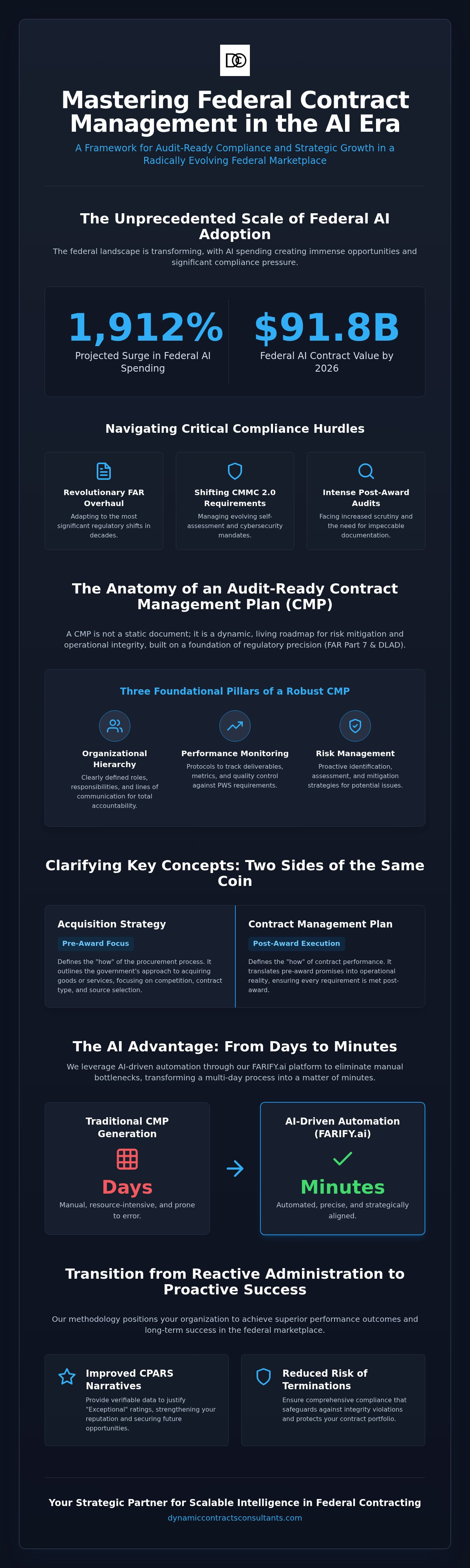
Could your current administrative framework survive a 1,912% surge in federal AI spending? With federal AI contract values hitting $91.8 billion in 2026, the margin for error in regulatory compliance has never been thinner. We recognize that navigating the "Revolutionary FAR Overhaul" while managing shifting CMMC 2.0 self-assessment requirements feels like a moving target. You're likely balancing the pressure of post-award audits against the manual bottlenecks of document generation and complex flow-down clauses for subcontractors.
We're here to help you master the complexities of a robust federal contract management plan to ensure seamless compliance, mitigate risk, and optimize your procurement lifecycle. By integrating sophisticated acquisition planning with "human-in-the-loop" AI precision, you can transform administrative burdens into strategic assets. This guide outlines a framework for building audit-ready plans that streamline document generation and improve your CPARS narratives through better tracking. We'll explore how to align your operations with the latest $350,000 SAT and $10 million TINA thresholds while maintaining the high-impact precision required for long-term success in the 2026 federal marketplace.
Key Takeaways
- Learn how to align your administrative oversight with FAR Part 7 and DLAD requirements to ensure your management plan serves as a living document for total lifecycle visibility.
- Discover the essential components of a robust federal contract management plan, including performance monitoring protocols and compliance matrices that safeguard against procurement integrity violations.
- Master our five-step framework for developing audit-ready plans that map resources and extract complex requirements with surgical precision during the proposal phase.
- Explore how we leverage AI-driven automation through FARIFY.ai to accelerate document generation, reducing the production time of a comprehensive CMP from days to mere minutes.
- Position your organization for improved CPARS narratives and reduced risk of contract terminations by shifting from reactive administration to proactive plan execution.
Understanding the Federal Contract Management Plan (CMP)
A federal contract management plan is far more than a static administrative requirement. It's a dynamic, living document that defines the specific methodologies, roles, and responsibilities necessary for comprehensive contract oversight. We view this plan as a fundamental risk-mitigation roadmap that secures the operational integrity of both the government and the contractor throughout the performance period. By establishing a clear framework, it ensures every deliverable meets the rigorous standards set by the agency. For those seeking a broader Contract Management Overview, it's clear that the federal sector requires a higher degree of precision due to the strict regulatory environment.
The foundation of any robust federal contract management plan rests on established regulations, specifically FAR Part 7 and the Defense Logistics Acquisition Directive (DLAD). In particular, DLAD 7.102-90 provides the framework for these plans in high-value or complex technical acquisitions. Adhering to these standards isn't just about checking a box. It's about maintaining strategic compliance across the entire procurement lifecycle. This document translates complex legal mandates into actionable daily workflows for your project teams, ensuring that no requirement is overlooked during execution.
The Regulatory Necessity of a CMP
A formal federal contract management plan becomes mandatory when an acquisition involves high-dollar thresholds, significant technical risks, or critical mission requirements. The Contracting Officer (CO) plays a pivotal role here. They must review and approve the management plan to ensure it aligns with the agency's oversight goals. We've observed that contractors who prioritize a detailed CMP consistently achieve superior CPARS narratives. A well-executed plan provides the verifiable data needed to justify "Exceptional" ratings during annual performance evaluations, as it demonstrates a disciplined approach to contract fulfillment.
CMP vs. Acquisition Strategy
It's vital to differentiate between the pre-award acquisition strategy and the post-award management plan. While the acquisition strategy focuses on the "how" of the procurement, the CMP focuses on the "how" of the performance. It effectively translates pre-award promises into operational reality. Your plan must be tightly aligned with the Performance Work Statement (PWS) to ensure that technical performance metrics are tracked in real-time. This alignment prevents scope creep and ensures every resource is utilized according to the contract's specific requirements, protecting your profit margins and reputation.
Essential Components of a Robust Federal CMP
A robust federal contract management plan isn't a generic administrative checklist; it's a structural blueprint for your organization’s operational integrity. We design these plans around three foundational pillars: organizational hierarchy, performance monitoring, and risk management. A central element of this framework is a detailed compliance matrix. This matrix acts as your internal compass, mapping every specific RFP requirement to a verifiable oversight activity. This level of detail aligns with official Federal Contract Management Plan Requirements, which mandate clear accountability and lifecycle-wide visibility to protect the government's interests and your company's reputation.
Managing partners and vendors is often where compliance gaps emerge. Your plan must explicitly detail flow-down clause requirements to ensure every subcontractor adheres to the same FAR/DFARS standards as the prime contractor. We also prioritize rigorous financial oversight within the CMP. This includes establishing standardized billing protocols and cost-control measures that prevent overruns. If you're looking to strengthen your current oversight framework, you might consider how consulting with our strategic experts can help refine these internal controls for 2026's complex regulatory environment.
Performance Monitoring and Quality Control
Effective performance monitoring requires more than just tracking deadlines. We implement methods for real-time deliverable tracking to ensure every milestone is met with precision. A critical component here is the integration of the Quality Assurance Surveillance Plan (QASP) directly into your management plan. This integration allows your team to identify and correct performance deficiencies long before they impact your annual CPARS evaluation. By maintaining a proactive stance on quality control, you ensure that technical execution consistently matches the promises made in your initial proposal.
Financial Administration and DCAA Alignment
For contracts involving cost-reimbursement or complex indirect rates, financial administration within the CMP is paramount. Your plan should document the specific controls used to manage these rates, providing a clear trail for future audits. This structured approach directly supports DCAA compliance consulting efforts by ensuring all records are audit-ready from day one. We focus on creating a framework where financial data is transparent and easily accessible, reducing the administrative burden during post-award reviews and ensuring your billing remains accurate and compliant.
Strategic Risk Mitigation through Proactive Plan Administration
A common misconception is that a federal contract management plan is merely a paperwork exercise required for compliance. In reality, we view it as a critical instrument for preventing costly legal disputes and contract terminations. By establishing clear protocols before performance begins, you eliminate the ambiguity that often leads to cure notices or show-cause letters. Our solution-driven approach simplifies the complex regulatory environment, ensuring that your team remains focused on technical delivery while we safeguard the administrative foundation. This proactive stance is essential for maintaining post-award compliance throughout the performance period.
The impact of the Procurement Integrity Act on management plan protocols cannot be overstated. We integrate strict communication firewalls and ethical guidelines directly into the CMP to prevent violations that could jeopardize your entire business. Additionally, the plan serves as the authoritative framework for managing contract modifications and requests for equitable adjustments. When changes occur, your CMP provides the roadmap for documenting impacts and securing fair compensation. This turns potential friction points into structured business processes, allowing you to manage scope creep with surgical precision.
Navigating Legal and Regulatory Pitfalls
Identifying common FAR compliance pitfalls early is a hallmark of disciplined administration. We help you navigate specific risks associated with ITAR, EAR, and FCPA regulations by embedding oversight triggers within your management workflows. This ensures you maintain an audit-ready status at all times. Instead of scrambling during a post-award review, your team operates within a system designed to capture and validate compliance data in real-time. We've found that this level of rigor significantly reduces the risk of procurement integrity violations.
Subcontractor Oversight and Compliance
Managing subcontractor performance is often where primary contractors face the greatest compliance risk. Our methodology utilizes teaming agreements as the structural foundation for the plan's organizational chart, clearly defining lines of authority. We facilitate the mandatory 'flow-down' process for clauses, ensuring every tier of your supply chain adheres to the prime contract's requirements. By establishing these rigorous oversight protocols, we mitigate the risk of non-compliance stemming from third-party actions. This protects your CPARS narrative and secures your long-term eligibility for future federal awards.
Step-by-Step Framework for Developing an Audit-Ready CMP
Developing a rigorous federal contract management plan requires a disciplined approach that begins long before the period of performance starts. We've established a 5-step framework designed to secure your operational integrity: Requirements Extraction, Resource Mapping, Protocol Development, Stakeholder Alignment, and Final Review. You shouldn't wait until the post-award kickoff to begin this process. We recommend utilizing customized federal proposal templates to jumpstart your CMP during the initial bidding phase. This proactive strategy ensures that your technical volume and management methodology are perfectly synchronized. An audit-ready federal contract management plan is built on the foundation of RFP requirement extraction and technical volume alignment.
Phase 1: Requirements Extraction and Gap Analysis
The success of your plan depends on your ability to distill complex Section L and M requirements into actionable management tasks. We begin by performing a comprehensive gap analysis to identify exactly where your current operational capacity might fall short of specific contract demands. This isn't a surface-level review; it's a deep dive into the technical and administrative obligations found in the solicitation. A detailed compliance matrix is essential in this initial phase. It serves as your master index, linking every regulatory obligation to a specific oversight activity. This level of precision ensures that no requirement is left to chance and that your team has the infrastructure necessary to succeed from day one.
Phase 2: Protocol Development and Implementation
Once your requirements are mapped, we focus on creating contract-specific standard operating procedures (SOPs). These protocols define exactly how your team will execute tasks, manage deliverables, and report progress to the agency. Establishing clear communication channels between your project leadership and the Contracting Officer (CO) or Contracting Officer’s Representative (COR) is a critical component of this phase. To ensure the highest level of accuracy, we employ a "human-in-the-loop" review process. This methodology ensures that even AI-generated drafts are refined by subject matter experts to meet exact agency standards. The final review process confirms that the plan is both compliant and operationally feasible, providing a realistic roadmap that your team can actually follow without compromising quality or safety.
If you're ready to transition from a reactive posture to a strategic, audit-ready framework, contact our acquisition specialists today to discuss your specific program requirements and secure your contract's success.
Enhancing Contract Performance with AI-Driven Management Solutions
The acceleration of the federal marketplace in 2026 requires a departure from traditional, manual administrative processes. We identify FARIFY.ai as the primary catalyst for rapid, compliant document generation within the modern federal contracting landscape. While manual drafting of a comprehensive federal contract management plan often consumes days of high-level labor, our AI-driven automation reduces this timeline to mere minutes. This shift allows your team to focus on technical execution and mission success rather than being tethered to repetitive document preparation. By adopting scalable intelligence, you gain the ability to manage a diverse portfolio of complex contracts with a level of oversight that was previously unattainable for many mid-sized firms.
Dynamic Contracts Consultants LLC stands as your strategic partner for digital transformation throughout the procurement lifecycle. We don't just provide a tool; we provide a framework where technology and human expertise converge to ensure your operational efficiency. This integration is critical for maintaining the high-impact precision required to survive post-award audits and deliver the results that federal agencies demand. As federal AI spending continues to grow, the organizations that leverage automated compliance will be those that secure the most significant growth opportunities.
The FARIFY Advantage: Speed Meets Precision
The core strength of the FARIFY.ai platform lies in its specialized training. Unlike generic large language models, our AI model is trained specifically on acquisition regulations, including the FAR, DFARS, and agency-specific supplements like the DLAD. This focus ensures that every output, from solicitation drafts and Independent Government Cost Estimates (IGCEs) to complex CPARS narratives, is technically accurate and contextually relevant. The platform generates audit-ready documents that reflect the current regulatory environment, including the latest inflation-adjusted thresholds and cybersecurity mandates. This precision eliminates the inaccuracies common in generic AI, providing you with a reliable foundation for your contract administration protocols.
Partnering for Long-Term Success
We remain committed to delivering excellence through a disciplined blend of human expertise and cutting-edge AI technology. Our "human-in-the-loop" approach ensures that every automated draft undergoes a rigorous review by seasoned acquisition professionals before implementation. This synergy provides you with a competitive edge that manual-only competitors simply cannot match. We invite you to leverage our expert insights to transform your administrative burden into a strategic advantage for your next high-value government opportunity. Contact our team to optimize your federal contract management strategy.
Securing Operational Excellence in the 2026 Federal Marketplace
Mastering the federal contract management plan is no longer a matter of manual compliance; it's a strategic necessity for organizations aiming to scale in a high-stakes environment. We've explored how a robust framework integrates AI-driven automation with "human-in-the-loop" expertise to ensure your operations remain audit-ready and resilient against regulatory shifts. By prioritizing requirements extraction and proactive risk mitigation, you position your organization to secure superior CPARS ratings and long-term profitability.
Our team brings extensive prime contractor experience with the DoD, State Department, and EPA to every partnership. We leverage the power of FARIFY to deliver rapid, AI-powered FAR/DFARS compliance while providing expert-led capture and post-award services nationwide. You don't have to navigate these complexities alone. We're ready to serve as your strategic partner in digital transformation and procurement success. Optimize your federal acquisition strategy with Dynamic Contracts Consultants LLC today. Your path to sustainable growth in federal contracting is built on precision, and we're here to help you achieve it.
Frequently Asked Questions
Is a Federal Contract Management Plan (CMP) mandatory for all contracts?
A federal contract management plan is not mandatory for every purchase, but it is required for high-value or complex acquisitions as defined by agency-specific supplements like DLAD 7.102-90. We typically see these requirements in contracts involving significant technical risk or high-dollar thresholds. Even when not strictly mandated, we recommend maintaining a plan to ensure operational integrity and to safeguard your organization against the risks of non-compliance during post-award audits.
What is the difference between a CMP and a Quality Assurance Surveillance Plan (QASP)?
The primary difference lies in the perspective and purpose of oversight. A CMP is your internal roadmap for executing and managing the contract, while a Quality Assurance Surveillance Plan (QASP) is the government's document used to monitor your performance against the contract's standards. While your management plan focuses on your administrative workflows and subcontractor oversight, the QASP outlines how the government will verify that you've met the technical requirements of the PWS.
How often should a federal contract management plan be updated?
You should treat your management plan as a living document that requires updates whenever significant changes occur in the contract's environment. We advise reviewing the plan during contract modifications, key personnel transitions, or shifts in subcontractor arrangements. Regular updates ensure that your administrative protocols remain aligned with the current operational reality. This disciplined approach keeps your records audit-ready and prevents the document from becoming obsolete during long-term performance periods.
Can AI truly generate audit-ready federal contracting documents?
Yes, AI can generate audit-ready documents when the model is trained specifically on specialized datasets like the FAR and DFARS. Our affiliate, FARIFY.ai, produces technical drafts in minutes by focusing on acquisition regulations rather than generic information. However, we always maintain a "human-in-the-loop" review process. This ensures that every document meets the exact technical standards of the agency and reflects the strategic nuances of your specific project, providing precision that generic AI cannot achieve.
Who is responsible for drafting the CMP—the government or the contractor?
The contractor is responsible for drafting the management plan, which the government then reviews and approves. In high-value or complex technical acquisitions, the Contracting Officer (CO) often requires the submission of a CMP as part of the post-award kickoff process. We help our clients jumpstart this process by using customized templates during the proposal phase. This ensures that the government's expectations for oversight are met with a structured, professional methodology from the very beginning.
What are the consequences of failing to follow the approved management plan?
Failing to adhere to an approved management plan can lead to severe administrative and financial penalties. You might face cure notices, show-cause letters, or even a termination for default if the government determines that your oversight is inadequate. Beyond immediate contract actions, non-compliance often results in poor CPARS ratings, which can disqualify your organization from future high-value opportunities. We emphasize disciplined administration to prevent these friction points and secure your organization’s long-term reputation.
How does a CMP impact my CPARS rating at the end of the contract?
A CMP serves as the primary source of data for your annual CPARS evaluations. It allows you to document technical successes, milestone completions, and proactive risk mitigation with surgical precision. By tracking performance metrics within the framework of your federal contract management plan, you provide the Contracting Officer with the verifiable evidence needed to justify "Exceptional" ratings. This structured approach transforms administrative data into a strategic asset that supports your future growth and capture management efforts.
What is the role of the Contracting Officer's Representative (COR) in the CMP?
The Contracting Officer's Representative (COR) acts as the government's primary point of contact for technical oversight and daily performance monitoring. While the CO handles the legal and financial aspects of the contract, the COR ensures that your work aligns with the technical requirements of the PWS. Your management plan must define clear communication channels with the COR to facilitate milestone reviews and deliverable acceptance. We design these protocols to ensure that technical performance is transparent.


