

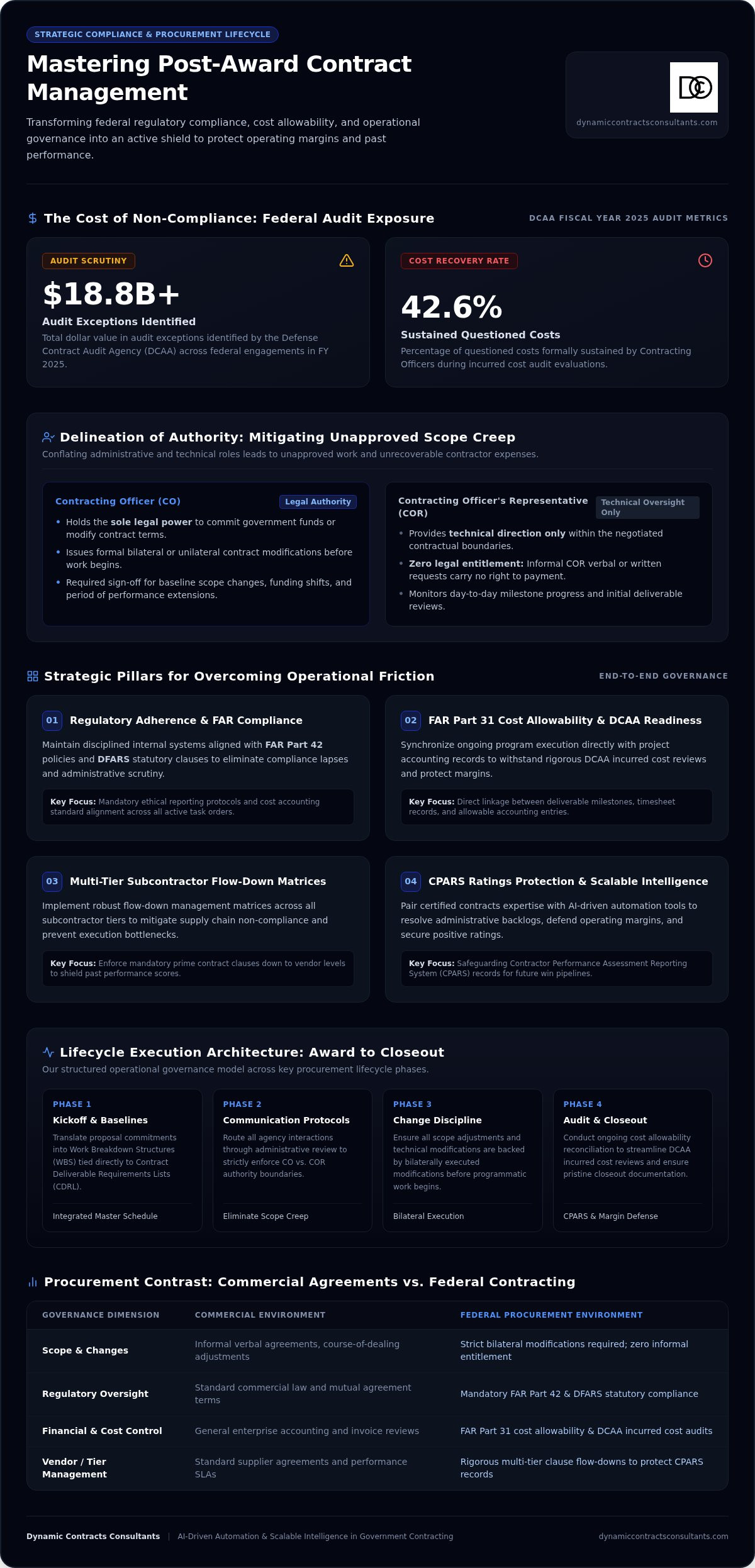
In FY 2025, the Defense Contract Audit Agency identified over $18.8 billion in audit exceptions, with contracting officers sustaining 42.6% of questioned costs on incurred cost audits. Winning a federal award is a substantial achievement, but the operational challenges of post-award contract management determine whether that win yields dependable profit or catastrophic regulatory exposure. You likely feel this administrative strain daily. Unchecked scope creep from informal agency requests, tedious FAR and DFARS flow-downs across lower tiers, and the constant fear of adverse CPARS ratings can quickly compromise your execution team and future capture pipeline.
Post-award administration must function as an active operational shield rather than an administrative drain. In this guide, you'll discover how to overcome complex post-award contract management challenges, maintain strict regulatory compliance, and protect project profitability. We will examine the mandatory compliance thresholds, change order disciplines, and scalable intelligence workflows our team uses to keep federal engagements fully audit-ready and commercially secure.
Key Takeaways
- Establish systematic contract governance immediately upon award to monitor baseline commitments, critical milestones, and formal closeout requirements across the procurement lifecycle.
- Address the operational challenges of post-award contract management by eliminating informal scope creep and enforcing structured change control for every technical modification.
- Synchronize ongoing program execution directly with project accounting records to maintain strict FAR Part 31 cost allowability and simplify DCAA incurred cost reviews.
- Implement robust flow-down management matrices across all subcontractor tiers to mitigate supply chain non-compliance and protect past performance ratings in CPARS.
- Leverage certified contracts expertise paired with AI-driven automation tools to resolve administrative backlog, enhance audit readiness, and defend operating margins.
Defining Post-Award Contract Management in Complex Procurement Environments
Post-award contract management represents the structured governance of contractual obligations, deliverables, and regulatory requirements following contract signing. While pre-award activities focus on proposal strategies and source selection, the post-award stage governs everything from initial award notification through final performance closeout. This disciplined oversight serves as the bridge between your initial proposal promises and operational reality. Without rigorous administration, even the most lucrative contracts face financial degradation, administrative friction, and severe compliance penalties.
In highly regulated markets, contract administration is not passive file keeping. It is active risk mitigation. Effective administration safeguards contractor margins, preserves positive Contractor Performance Assessment Reporting System (CPARS) records, and maintains statutory alignment across the broader contract management lifecycle. Addressing the operational challenges of post-award contract management requires clear visibility across multi-tiered deliverables, billing systems, and formal reporting channels to protect your enterprise from costly audit scrutiny.
The Operational Transition from Award to Performance Execution
Execution begins with translating negotiated proposal volumes into actionable operational baselines. During kickoff, your team must define boundaries of authority. A Contracting Officer (CO) holds the sole legal power to alter terms or commit funds, whereas a Contracting Officer's Representative (COR) provides technical direction only. Conflating these roles causes unapproved work and unrecoverable expenses. At this stage, our team establishes:
- Work breakdown structures tied directly to contract deliverable requirements lists.
- Formal communication protocols routing all technical directives through administrative review.
- Integrated master schedules linking deliverable milestones to financial accounting entries.
Why High-Stakes Procurement Contracts Differ from Commercial Agreements
Commercial relationships frequently rely on course-of-dealing adjustments, informal verbal agreements, or flexible scopes. Public sector procurement functions under strict legal doctrines where informal direction carries zero entitlement to additional payment. Managing the challenges of post-award contract management in this sector requires adhering strictly to mandatory Federal Acquisition Regulation (FAR) and Defense FAR Supplement (DFARS) clauses. Our certified specialists lead clients through dedicated post-award compliance workflows, ensuring that every scope adjustment is backed by a bilaterally executed modification before programmatic work proceeds.
The Critical Challenges of Post-Award Contract Management Today
Commercial contract software platforms often frame post-award governance as simple document archiving or automated renewal alerts. In federal contracting, however, the most demanding challenges of post-award contract management stem from strict statutory accountability. When program teams execute complex work without unified data records or strict administrative boundaries, operational friction rapidly transforms into deliverable rejection, financial withholdings, and CPARS penalties.
Navigating these demands requires managing compliance, communications, and vendor partnerships with absolute precision. Left unaddressed, systemic breakdowns across these operational areas erode margins and compromise your corporate reputation.
Regulatory Adherence: Navigating FAR, DFARS, and Evolving Mandates
Managing statutory clauses across federal task orders requires unrelenting oversight. Contractors must maintain compliant internal systems that align directly with FAR Part 42 contract administration policies, covering everything from cost accounting standards to mandatory ethical reporting protocols. When compliance mandates shift, internal oversights can quickly trigger contract terminations or severe administrative scrutiny. We help program teams establish disciplined post-award compliance frameworks that proactively map mandatory regulations to operational controls.
Scope Creep, Constructive Changes, and Unauthorized Commitments
Technical scope creep in government programs rarely begins with an intentional disregard for baseline requirements. Instead, agency technical leads routinely offer informal technical suggestions, small tweaks, or urgent verbal requests during project syncs. If your delivery team acts on these instructions without formal Contracting Officer approval, your firm absorbs constructive changes as unallowable, non-reimbursable expenses. To protect project margins, you must institute structured change control protocols that capture, document, and price scope adjustments before technical personnel proceed.
Subcontractor Oversight and Flow-Down Clause Enforcement
Prime contractors shoulder direct legal liability for supply chain compliance across lower tiers. Mandatory clauses covering prevailing wage determinations, ethical disclosures, and supply chain cybersecurity must flow down into every subcontract. Tracking compliance manually across multi-tiered vendor ecosystems invites administrative failure, leaving your organization vulnerable to False Claims Act scrutiny if a tier-two vendor defaults on basic standards. If you want to eliminate administrative bottlenecks and overcome the persistent challenges of post-award contract management, you can consult with our contracts advisory team to evaluate your current governance systems.
Financial Scrutiny, DCAA Incurred Costs, and Performance Milestone Tracking
General enterprise software platforms often reduce financial management to basic invoice processing and spend tracking. Within public procurement, however, one of the most critical challenges of post-award contract management is maintaining synchronicity between operational performance and statutory accounting frameworks. Delivering technical milestones on schedule is insufficient if your underlying financial records fail to satisfy federal cost principles. In FY 2025 alone, DCAA reviewed $788 billion in contract costs and secured $5.3 billion in net government savings, illustrating the intense financial oversight applied across defense and civilian acquisitions.
Cost-reimbursement and time-and-materials vehicles demand continuous adherence to FAR Part 31 cost principles. If your team cannot clearly demonstrate cost allowability, allocability, and reasonableness, government auditors can question direct and indirect pool charges months or years after deliverable acceptance. Contractors must institute proactive accounting alignments that mirror their master schedules. For deeper insights into operational execution models, review our companion analysis on comprehensive post-award administration.
Maintaining Audit-Ready Accounting and DCAA Billing Compliance
Under FAR 52.216-7(d)(2), contractors operating under cost-reimbursement terms must submit an adequate final indirect cost rate proposal within six months following the end of their fiscal year. Managing this requirement demands the standard DCAA Incurred Cost Electronically (ICE) model, supported by fully reconciled general ledgers, labor distribution records, and compliant timekeeping data. During FY 2025, contractor-led internal audits resulted in the voluntary self-removal of over $3.8 billion in unallowable costs prior to DCAA review, underscoring why proactive data scrubs are essential to avoiding statutory penalties under FAR 42.709.
Safeguarding Past Performance and CPARS Evaluation Narratives
Milestone slippage does more than trigger financial payment withholdings; it directly damages your Contractor Performance Assessment Reporting System (CPARS) record. Evaluations are mandatory for general contracts exceeding the $350,000 threshold and remain visible to source selection officials across the federal procurement lifecycle for three years. Overcoming the financial and reputational challenges of post-award contract management requires maintaining real-time documentation. When you encounter unexpected government-caused delays or scope clarifications, our experts advise building detailed evidentiary logs, enabling your organization to submit authoritative rebuttals during the mandatory 14-day review window.
A Strategic Framework for Overcoming Post-Award Operational Friction
Resolving operational friction requires replacing reactive tracking with a systematic execution model. Autonomous workflow platforms often attempt to manage federal obligations through unassisted algorithms, yet regulatory procurement demands both technological speed and experienced human interpretation. To conquer the recurring challenges of post-award contract management, we deploy a four-phase operational framework designed to secure contract baselines, enforce communication boundaries, automate tedious administrative workflows, and accelerate closeouts. Contractors can explore our structured consulting services to establish robust, audit-ready governance across every phase of execution.
Step 1 & 2: Establishing Contract Baselines and Formal Change Control
Operational stability begins by decomposing the signed contract into an unambiguous baseline matrix during phase one. This matrix assigns every regulatory clause, reporting deadline, and CDRL deliverable to an accountable internal owner. Phase two institutes rigorous change control to stop scope leakage before it compromises execution margins:
- Establish mandatory communication channels requiring written CO authorization before any baseline revision starts.
- Issue immediate requests for equitable adjustment (REA) or bilateral modifications when agency technical directions alter labor commitments.
- Log all customer inquiries, technical directives, and formal meeting minutes within a centralized compliance record.
Step 3 & 4: Deploying AI Document Automation and Closeout Protocols
Phase three introduces scalable intelligence to eliminate administrative backlogs. By integrating AI-driven document automation through platforms like FARIFY, our engagements accelerate the synthesis of complex modifications, compliance matrices, and subcontractor flow-down packages. We combine this technical speed with human-in-the-loop oversight led by Certified Professional Contracts Managers (CPCM), ensuring every automated output satisfies exacting regulatory standards.
Phase four focuses on structured closeout procedures under FAR 4.804-1. Prolonged closeouts tie up corporate capital and prolong audit liabilities. Depending on contract type, required timeframes vary significantly:
- Firm-Fixed-Price contracts: Must be administratively closed within six months following physical completion.
- Labor-Hour and Time-and-Materials agreements: Require formal settlement within 20 months.
- Cost-Reimbursement contracts: Demand final settlement within 36 months, pending indirect cost rate determinations.
Executing systematic closeout audits ensures final overhead rates reconcile, subcontracts de-obligate properly, and retained funds release quickly. If manual compliance burdens are slowing your delivery teams, contact our contract administration advisors to modernize your post-award governance today.
Mitigating Execution Risk with Strategic Contract Management Solutions
Internal delivery teams are built to engineer solutions, manage field operations, and deliver mission-critical technical results. Forcing program managers to interpret dense regulatory clauses or manage flow-down tracking diverts vital bandwidth away from core contract milestones. Commercial software vendors often claim their applications solve these hurdles autonomously. In reality, software alone cannot reconcile a contentious scope dispute with an Administrative Contracting Officer or assemble a defensible incurred cost package. Overcoming the persistent challenges of post-award contract management requires hands-on advisory led by credentialed specialists.
Dynamic Contracts Consultants LLC bridges this operational gap by delivering comprehensive contract administration across the acquisition lifecycle. From pre-award alignment and targeted proposal writing to complete post-award execution, we provide defense and civilian contractors nationwide with structured oversight that protects project margins and builds lasting past performance equity.
Augmenting Internal Teams with Certified Contracts Managers
Engaging our team grants your enterprise immediate access to Certified Professional Contracts Managers (CPCM) and Certified Federal Contracts Managers (CFCM) without overhead burdens. Our advisors integrate seamlessly into your program management office, providing authoritative regulatory oversight across high-risk post-award functions:
- Subcontract flow-down clause administration across all supply chain tiers.
- Evaluation and formal negotiation of baseline scope adjustments and equitable modifications.
- Independent compliance reviews that insulate your business from audit exceptions and civil penalties.
Accelerating Audit-Ready Documentation Through Scalable Intelligence
Together with our affiliate platform FARIFY, we combine deep subject-matter expertise with cutting-edge AI automation. FARIFY accelerates the generation of contract modification matrices, compliance tracking deliverables, and initial CPARS rebuttal drafts in minutes rather than weeks. Every output undergoes rigorous human-in-the-loop review by our certified consultants, ensuring absolute alignment with FAR, DFARS, and agency supplements before submission.
This hybrid approach removes the administrative backlog that causes deliverable slippage and non-compliance. By pairing scalable intelligence with verified federal procurement expertise, we help contractors master the challenges of post-award contract management while protecting their operational profitability across every federal engagement.
Transforming Contract Execution into a Strategic Advantage
Securing a federal award is only the opening chapter of procurement success. Sustained profitability relies on disciplined change order governance, proactive FAR Part 31 accounting alignment, and flawless flow-down execution across all vendor tiers. When you confront the complex challenges of post-award contract management with structured oversight, you shield your organization from costly DCAA audit exceptions and build invaluable past performance credibility in CPARS.
Dynamic Contracts Consultants stands ready to elevate your operational capacity. Led by certified NCMA professionals holding CPCM, CFCM, and CCCM credentials, we deliver proven prime contractor support for defense and civilian programs nationwide. By uniting experienced regulatory assurance with AI-driven FARIFY integration, our team produces audit-ready compliance documentation in minutes while eliminating administrative backlog.
You don't have to navigate strict federal surveillance alone. Partner with our certified experts to streamline post-award contract administration and protect your operating margins. With a disciplined governance framework in place, your team can execute every contract with complete regulatory confidence.
Frequently Asked Questions
What is the most significant challenge of post-award contract management in federal procurement?
The most severe hurdle is maintaining strict alignment between operational field work and statutory procurement regulations. Disconnects between technical delivery, accounting allocations, and formal contract terms lead to constructive changes and unallowable costs. Addressing the challenges of post-award contract management demands continuous surveillance over baseline modifications, flow-down compliance, and accounting systems to prevent substantial financial withholdings or adverse administrative findings.
How do unauthorized commitments occur, and how can contractors prevent them?
Unauthorized commitments occur when contractor personnel perform technical revisions based on verbal guidance or informal requests from government representatives lacking contracting authority, such as CORs. Contractors prevent this vulnerability by enforcing strict internal governance protocols. Program staff must understand that only an Administrative Contracting Officer holds legal authority to alter contract scope, and all technical directives must receive formal contractual review before work starts.
What are mandatory flow-down clauses, and why are they critical in subcontractor administration?
Mandatory flow-down clauses are statutory FAR and DFARS requirements that prime contractors must legally incorporate into lower-tier agreements. These provisions govern essential areas like prevailing wage standards, cybersecurity, and mandatory ethics disclosures. Failure to enforce these clauses down your vendor supply tiers creates prime liability, exposing your company to False Claims Act investigations, financial penalties, and default terminations.
How does post-award administration impact CPARS evaluations and future contract wins?
Post-award administration establishes the factual, transparent operational narrative that determines your Contractor Performance Assessment Reporting System scores. Prompt milestone delivery, audit-ready financial tracking, and collaborative change management generate positive evaluations across quality and schedule metrics. Because CPARS records stay visible to source selection officials across the procurement lifecycle for three years, clean post-award documentation directly impacts future contract awards.
Can AI software replace human contract managers in post-award federal administration?
AI software cannot replace human contracts managers in complex government procurement. While platforms like FARIFY rapidly automate deliverable tracking matrices, modification analyses, and initial compliance drafts, regulatory accountability requires experienced human interpretation. Certified contracts professionals provide the necessary human-in-the-loop assurance to negotiate equitable adjustments, manage complex disputes, and interpret nuanced statutory requirements that algorithms cannot evaluate reliably.
What happens if a contractor fails to properly document out-of-scope technical work?
Failing to document out-of-scope tasks results in unrecoverable costs and significant margin erosion. Government contracting operates under strict bilateral modification rules where informal performance confers no legal right to payment. Without contemporaneous timecards, detailed cost records, and prompt written notices of constructive changes submitted to the Contracting Officer, the contractor must absorb all associated expenses internally as unallowable costs.
How can organizations prepare their post-award records for an unexpected DCAA audit?
Organizations must maintain tight daily synchronization between technical deliverables, timekeeping records, and general ledgers. Preparing for DCAA scrutiny requires segregating unallowable expenses under FAR Part 31, documenting approved indirect cost rates, and maintaining audit-ready incurred cost models throughout the fiscal year. Routine internal scrubs prevent administrative backlogs and allow your team to address the challenges of post-award contract management before auditors initiate formal reviews.


