

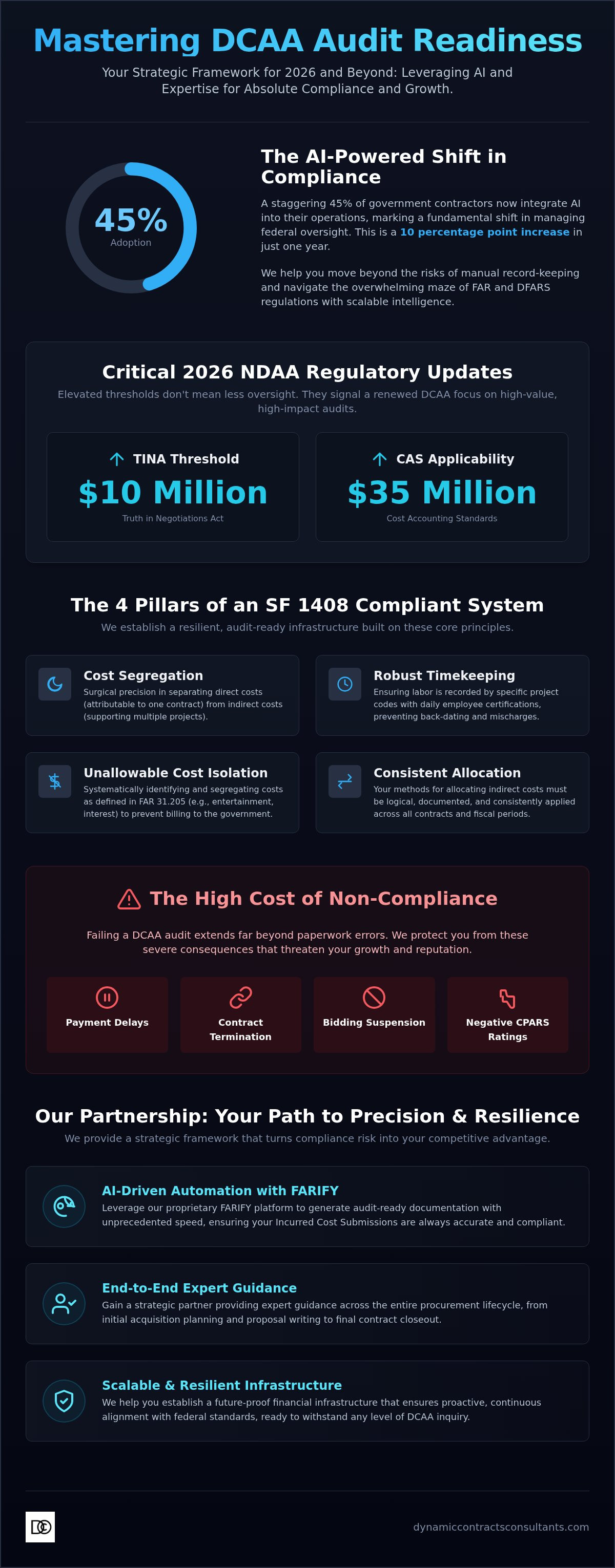
Forty-five percent of government contractors have now integrated AI into their operations to stay ahead of shifting regulatory demands. This ten percentage point increase in just one year signals a fundamental shift in how we approach dcaa audit readiness and federal oversight. You likely feel the mounting pressure of maintaining a compliant accounting system while managing the fear of contract termination or the inherent risks of manual record-keeping. We understand that the maze of FAR and DFARS regulations feels overwhelming, especially with the 2026 NDAA raising TINA thresholds to $10 million and CAS applicability to $35 million.
Our goal is to help you master these rigorous expectations and establish a resilient, audit-ready infrastructure for your contracts. By the end of this guide, you'll possess a strategic framework for compliance that leverages both human expertise and scalable intelligence. We will preview the critical updates to the SF 1408 survey, the transition to the ICE Model Version 1.04, and how to automate indirect rate calculations for long-term success. This is your roadmap to navigating the procurement lifecycle with absolute precision and confidence.
Key Takeaways
- Understand how to align your financial systems with 2026 federal standards to ensure proactive dcaa audit readiness across your entire contract portfolio.
- Learn the essential criteria for a successful SF 1408 survey, focusing on the rigorous segregation of direct and indirect costs.
- Discover how to leverage AI-driven automation and our FARIFY platform to generate audit-ready documentation with unprecedented speed and precision.
- Gain mastery over indirect cost pools and internal controls to ensure your Incurred Cost Submissions remain accurate and compliant with evolving regulations.
- Establish a resilient infrastructure through a strategic partnership that provides expert guidance from initial acquisition planning to final contract closeout.
The Strategic Importance of DCAA Audit Readiness in 2026
In the current federal marketplace, we define dcaa audit readiness as the proactive, continuous alignment of a contractor’s financial infrastructure with the stringent expectations of the Department of Defense. It's a fundamental shift from reactive accounting to a state of permanent compliance. The regulatory environment has evolved significantly following the Fiscal Year 2026 National Defense Authorization Act (NDAA), which adjusted the Truth in Negotiations Act (TINA) threshold to $10 million and the Cost Accounting Standards (CAS) threshold to $35 million. These elevated thresholds don't imply less oversight. Instead, they signal that the DCAA is focusing its resources on high-value, high-impact audits with greater intensity. We view Strategic Compliance as a primary growth driver that unlocks access to the most lucrative federal opportunities by demonstrating institutional reliability and operational maturity.
Pre-Award vs. Post-Award Audit Scrutiny
The Defense Contract Audit Agency (DCAA) applies different lenses depending on the contract phase. Pre-award scrutiny typically involves an accounting system survey, often centered on the SF 1408, to determine if your system is adequate for a cost-reimbursement contract. Post-award audits, such as incurred cost audits, examine the actual costs you've charged to the government. Your government proposal writing must reflect audit-ready cost structures from the very first page. If your bid isn't built on a foundation of reasonableness and verifiable data, you risk failing the audit before the performance phase begins. We ensure your proposal and execution phases remain perfectly synchronized to withstand any level of federal inquiry, protecting your profit margins from the start.
The High Cost of Non-Compliance
The consequences of failing to maintain dcaa audit readiness extend far beyond simple paperwork errors. Non-compliance leads to immediate payment delays, contract termination, or even suspension from future bidding. Perhaps more damaging is the long-term impact on your Contractor Performance Assessment Reporting System (CPARS) ratings. A negative rating here is a permanent red flag that significantly lowers your future win rates across all federal agencies. Beyond the business risk, rigorous internal oversight fulfills our collective duty to protect the American taxpayer. By ensuring every dollar is spent efficiently and transparently, you build a reputation as a trusted partner in the national interest. We provide the framework to turn these risks into a competitive advantage, ensuring you're prepared for the DCAA's renewed focus on government-furnished property and financial improvement.
Navigating the SF 1408: Criteria for a Compliant Accounting System
Standard Form 1408 serves as the definitive benchmark for your accounting system's adequacy. Achieving dcaa audit readiness requires you to move beyond basic bookkeeping into a structured environment where every transaction is categorized with surgical precision. We help you establish a system that segregates direct costs, which are solely attributable to one contract, from indirect costs that support multiple projects. Your allocation methods must be logical and consistently applied. If you change your method mid-stream without justification, auditors will flag it as a risk. This consistency is a core expectation for any contractor seeking to scale within the federal sector.
A robust timekeeping system is perhaps the most critical component of the SF 1408 criteria. It's not enough to track total hours; you must record labor by specific project codes. This ensures that labor costs are charged accurately to the correct funding source. We recommend implementing automated solutions that prevent back-dating and require daily employee certifications. If you're unsure about your current system's capabilities, you can consult with our experts to identify potential vulnerabilities before the DCAA arrives.
The Core Requirements of DCAA Accounting
The DCAA Contract Audit Manual (CAM) provides the blueprint for what auditors expect during a survey. A primary focus is the segregation of unallowable costs as defined in FAR 31.205. These include expenses like interest, entertainment, and certain legal fees that cannot be billed to the government. We ensure your general ledger is configured to automatically filter these costs into non-billable accounts. Additionally, every cost must be allocable, meaning it provides a clear benefit to the contract it's charged against. Your general ledger must reconcile perfectly with your job cost reports to provide a transparent audit trail. This level of detail is essential for effective post-award compliance and long-term contract health.
Steps to Pass the Pre-Award Survey
Success begins with a comprehensive gap analysis of your current accounting software. We evaluate whether your platform can handle the multi-dimensional reporting required by the DCAA. Once the software is validated, you must formalize written policies for labor, travel, and procurement. These documents serve as the law of the land for your organization. Finally, we emphasize the human element. You must train your staff on DCAA-compliant timekeeping protocols. Even the best software fails if employees don't understand the importance of project-based labor tracking. By following these steps, you transform compliance from a hurdle into a standard operating procedure.
Modernizing Compliance: The Intersection of AI and DCAA Readiness
The traditional reliance on manual spreadsheet reconciliation is increasingly insufficient. With 45% of contractors now adopting AI, the standard for dcaa audit readiness has shifted toward automated speed and precision. We utilize scalable intelligence to eliminate the inherent human errors that often compromise complex compliance matrices. Our FARIFY.ai platform enables the generation of audit-ready documentation in minutes. This transition isn't merely about operational speed. It's about establishing a digital infrastructure that withstands the most rigorous DCAA inquiries.
AI-Driven Document Generation
Generating Statement of Work (SOW) and Performance Work Statement (PWS) documents that align with DCAA compliance consulting standards requires deep regulatory knowledge. We automate this process by mapping RFP requirements directly to FAR and DFARS standards. Our AI tools rapidly create compliance matrices for complex proposals, ensuring no requirement is overlooked. We also streamline the extraction of FAR/DFARS flow-down clauses for your subcontractors. This automation ensures that your entire supply chain remains compliant without the need for exhaustive manual reviews.
Data Integrity and Audit Trails
Maintaining a searchable, digital audit trail is no longer optional in a high-stakes environment. We leverage AI to flag anomalies in labor charging or expense reporting before they become red flags for auditors. This proactive approach strengthens your dcaa audit readiness by catching inconsistencies in real-time. Scalable intelligence allows us to manage multi-agency contract data with absolute consistency. You gain the ability to search through years of contract data instantly, providing auditors with the exact information they need without delay.
While AI provides the processing power for this transformation, we maintain a human-in-the-loop requirement for all critical outputs. Technology facilitates rapid data synthesis, but our certified experts provide the necessary regulatory oversight. This synergy between AI-driven automation and human expertise ensures that your documentation is both rapid and accurate. We position your organization as a sophisticated partner that prioritizes both technical innovation and strict regulatory adherence.
Critical Pillars of Readiness: Indirect Rates and Internal Controls
Establishing a sophisticated indirect cost structure is the bedrock of fiscal transparency. We categorize these costs into three primary pools: Fringe, Overhead, and General and Administrative (G&A). This organization ensures that every expense is logically allocated to its benefiting base. Meeting the Incurred Cost Submission (ICS) deadline is a non-negotiable requirement. For contractors with a calendar fiscal year, the deadline to submit the Incurred Cost Electronically (ICE) is June 30, 2026. Missing this date risks your payment reliability and triggers immediate DCAA scrutiny. We also implement rigorous internal controls to prevent the billing of unallowable costs. For contracts exceeding $800,000, the government applies strict penalties for including expressly unallowable items in indirect pools.
Calculating and Defending Indirect Rates
Your provisional billing rates must align closely with your actual costs throughout the year. If a significant variance occurs, you risk either under-billing or owing the government substantial refunds. We help you optimize these rates to remain competitive during the procurement lifecycle while protecting your profitability. A key part of dcaa audit readiness involves defending executive compensation. The estimated maximum allowable compensation for senior executives in 2026 is $695,000. We ensure your compensation structures are reasonable and supported by market data to withstand the DCAA "reasonableness" test. This level of precision prevents year-end adjustments that could disrupt your cash flow.
Internal Control Systems for Labor and Procurement
Modern compliance requires more than just paper policies. We implement automated floor checks and labor audits to verify that employees are working on the projects they're charging. This real-time visibility prevents the common pitfalls of manual record-keeping. In the procurement phase, you must document procurement integrity and counterfeit avoidance acceptances. Managing contract flow-down requirements is equally vital. You're responsible for ensuring your subcontractors adhere to the same DCAA standards you follow. Our approach provides the operational efficiency needed to monitor these complex variables through a single pane of glass. This holistic oversight is what separates successful contractors from those who struggle during the audit phase.
If you need to refine your indirect rate structure or strengthen your internal controls, contact our strategic consultants today for a comprehensive system evaluation.
Partnering for Precision: How We Secure Your Federal Future
Achieving sustainable dcaa audit readiness isn't a one-time project; it's a commitment to operational excellence that spans the entire procurement lifecycle. We don't just provide surface-level advice. We act as your strategic compliance arm, integrating directly into your workflows to ensure your financial infrastructure remains resilient. Our team consists of CPCM and CFCM certified consultants who possess the specialized knowledge required to navigate the most complex federal regulations. By bridging the gap between technical proposal excellence and financial audit success, we provide a unified strategy that protects your margins and your reputation.
Our approach is built on the principle of continuous oversight. We understand that a successful audit begins long before an auditor contacts your firm. It starts during acquisition planning and continues through the rigorous demands of contract performance. We provide the expert-led guidance necessary to transform compliance from a perceived burden into a scalable growth driver. This partnership allows you to focus on mission delivery while we ensure your administrative foundation is impenetrable.
Scalable Solutions for Government Contractors
We provide a suite of customized templates and AI-driven workflows designed to meet the specific needs of agencies like the DoD and EPA. These tools are tailored to your unique operational requirements, ensuring that your documentation is always precise and professional. Managing the complexities of post-award contract administration requires constant vigilance. We help you maintain this focus, ensuring your firm remains audit-ready 365 days a year. Our scalable intelligence platforms, including FARIFY.ai, allow you to adapt quickly as your contract volume increases, maintaining the same level of precision at every stage of growth.
Next Steps: Your Roadmap to Compliance
Securing your federal future requires immediate, decisive action. We follow a structured roadmap to ensure your systems meet the highest standards of federal oversight. You can begin this process by engaging with our team for a preliminary readiness assessment to identify potential gaps in your current accounting or timekeeping systems. From there, we implement a customized strategy that includes:
- Utilizing the FARIFY platform for rapid, AI-driven document generation and compliance matrix creation.
- Formalizing internal controls and policies that reflect 2026 regulatory standards.
- Establishing a continuous monitoring schedule to ensure ongoing adherence to FAR and DFARS requirements.
Don't leave your contract's success to chance. Contact us today to develop a comprehensive dcaa audit readiness strategy that positions your business for long-term success in the federal marketplace.
Advancing Your Federal Strategy with Precision Compliance
Establishing a resilient infrastructure for dcaa audit readiness is no longer a defensive measure; it's a strategic necessity for any contractor aiming to lead in 2026. We've demonstrated that successful compliance requires a proactive alignment of financial systems, from the initial proposal through post-award administration. By leveraging our AI-powered FARIFY platform and the expertise of our Certified Professional Contracts Managers (CPCM), you can navigate the 2026 regulatory landscape with absolute confidence.
Our proven track record with the DoD, State Department, and EPA ensures that your indirect rates and internal controls withstand the most rigorous scrutiny. We provide the scalable intelligence needed to transform administrative hurdles into competitive advantages. Don't let the complexity of new TINA thresholds or ICE deadlines stall your organizational growth when precision is within reach.
Secure Your Federal Contracts with DCAA-Ready Compliance - Contact Our Experts Today
We're ready to help you master the complexities of federal contracting and achieve a future of sustainable, audit-ready success.
Frequently Asked Questions
What is the most common reason contractors fail a DCAA audit?
The most common failure point is an inadequate timekeeping system that doesn't track labor by specific project codes. Auditors look for real-time entries and daily employee certifications. If your labor distribution doesn't reconcile perfectly with your general ledger, the DCAA will likely deem your accounting system inadequate. We've seen many firms struggle because they lack documented policies for labor segregation, which is a fundamental pillar of dcaa audit readiness.
Does DCAA require me to use a specific accounting software?
No, the DCAA doesn't mandate any specific software brand. However, your chosen platform must be capable of meeting all Standard Form 1408 criteria. This includes the ability to segregate direct and indirect costs and identify unallowable expenses automatically. While QuickBooks is popular, it often requires specialized configurations or third-party add-ons to reach full compliance. We help you evaluate if your current software can support your strategic growth.
How far back can a DCAA auditor look into my financial records?
Auditors typically review records for the past three to six years, depending on the contract type and its current status. Under FAR 4.703, contractors must generally retain financial records for three years after final payment. However, if an audit is ongoing or a dispute exists, that period extends. Maintaining a digital, searchable audit trail is essential for long-term protection, especially during the post-award contract administration phase.
What is the difference between a DCAA audit and a DCMA review?
The DCAA focuses on financial oversight, ensuring that costs are allowable, allocable, and reasonable. In contrast, the DCMA handles contract administration and performance, including property management and quality assurance. While the DCAA audits your books, the DCMA ensures you're delivering what you promised in the contract. Both agencies interact frequently, so maintaining dcaa audit readiness often simplifies your interactions with DCMA officials and ensures smoother contract closeouts.
Can small businesses use AI to manage DCAA compliance requirements?
Yes, small businesses can use AI-driven automation to level the playing field against larger competitors. Platforms like FARIFY.ai allow you to generate audit-ready documentation and compliance matrices in minutes. This technology reduces the need for large internal compliance teams by flagging anomalies in labor or expenses automatically. It's a scalable solution that ensures your internal controls remain robust without the high overhead of manual record-keeping.
How long does it typically take to become DCAA compliant?
It typically takes six to twelve months to establish a fully compliant accounting system from scratch. This timeline includes software implementation, policy documentation, and staff training. The process isn't just about technical setup; it's about shifting your organizational culture toward rigorous financial discipline. We recommend starting this transition well before bidding on cost-reimbursement contracts to avoid delays during the pre-award survey phase.
Are my indirect rates set in stone once a contract is awarded?
No, indirect rates are usually provisional and subject to year-end adjustments. You use provisional billing rates for invoices, but you must reconcile these with actual costs through your annual Incurred Cost Submission. If your actual rates are lower than your billing rates, you'll owe the government a refund. Conversely, if they're higher, you may be under-recovering costs. We help you monitor these rates in real-time to ensure stability.
What happens if DCAA finds "unallowable costs" in my submission?
If the DCAA identifies unallowable costs, they'll remove them from your billable pools and potentially assess penalties. For contracts over $800,000, you might face interest charges on the overpaid amounts. Frequent findings of unallowable costs can trigger a broader audit of your entire accounting system. We emphasize the importance of automated filters and human oversight to catch these items before they ever reach a federal voucher.


