

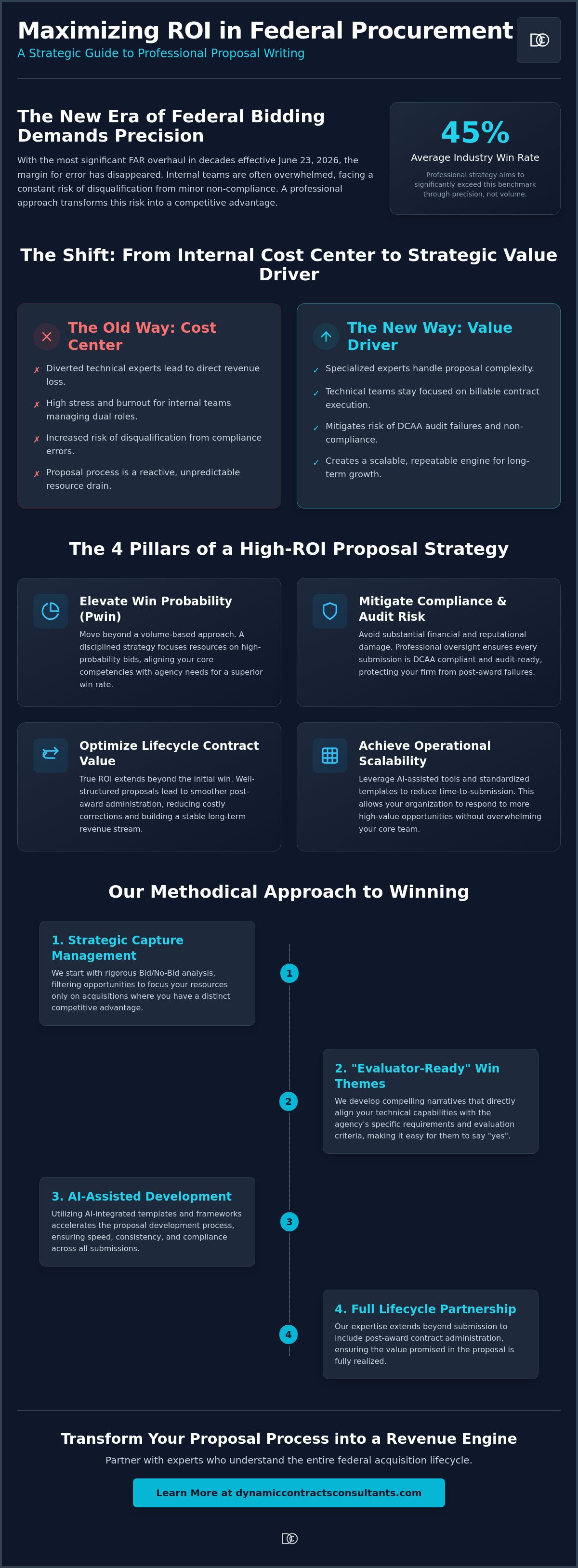
With the June 23, 2026, announcement of the most significant FAR overhaul in four decades, the margin for error in federal procurement has effectively vanished. Many organizations find that their internal teams are overwhelmed by the labor burden of bid season, leading to a persistent fear of disqualification due to minor non-compliance. While the average win rate has climbed to 45%, the true ROI of professional proposal writing isn't found in volume alone. It's found in the strategic precision that protects your firm from technicalities and ensures that every submission aligns with the government's new preference for fixed-price contracts.
We agree that the pressure to scale operations while maintaining DCAA compliance is a daunting administrative challenge. This article offers a methodical analysis of how professional proposal development maximizes your probability of win and optimizes lifecycle contract value. You'll learn how to leverage professional capture management and AI-integrated templates to reduce the risk of audit failures. We'll also examine the specific ways that expert oversight transforms the proposal process from a frantic internal cost center into a scalable engine for long-term revenue stability.
Key Takeaways
- Understand the fundamental economic transition from viewing proposal development as an internal cost-center to a strategic value-driver that optimizes long-term contract lifecycle value.
- Learn how integrated capture management and the development of "evaluator-ready" win themes significantly elevate your Probability of Win (Pwin) by aligning technical capabilities with agency requirements.
- Analyze the risk-adjusted ROI of professional proposal writing by mitigating the substantial financial and reputational hazards associated with post-award DCAA audit failures and non-compliance.
- Discover how to achieve operational scalability and reduced time-to-submission through the methodical implementation of AI-assisted proposal development and customized organizational templates.
- Identify the critical selection criteria for a proposal partner whose expertise encompasses the entire federal acquisition lifecycle, including complex post-award contract administration.
The Economic Framework of Professional Proposal Development
The evaluation of the ROI of professional proposal writing requires a fundamental shift in perspective from viewing the bid process as an isolated administrative hurdle to recognizing it as a critical financial lever. This calculation is defined by the delta between the significant opportunity costs of internal resource diversion and the superior, risk-adjusted results achieved through external expertise. Within the complex federal procurement process, firms that treat acquisition planning as a value-driver rather than a cost-center gain a distinct competitive advantage. They transform a reactive, high-stress cycle into a methodical investment in institutional knowledge and repeatable strategic frameworks that serve the organization across multiple fiscal years.
Beyond the Bid: Defining Lifecycle ROI
The financial return on professional proposal development encompasses more than the immediate probability of win. It includes the long-term ease of post-award contract administration. Professional proposal development ensures that technical promises are grounded in regulatory reality, which reduces the necessity for costly post-award corrections. By integrating professional capture management into the pre-solicitation phase, contractors can influence their market positioning and ensure that their technical capabilities are articulated as evaluator-ready win themes. This precision minimizes the risk of disqualification and protects the firm's reputation across the federal marketplace, ensuring that every submission contributes to a stable, long-term revenue stream.
The Opportunity Cost of In-House Development
Calculating the true cost of in-house development requires a granular analysis of the fully burdened labor rate of internal subject matter experts. This rate includes base salary, fringe benefits, and the overhead costs associated with each employee. When technical staff are diverted from billable performance to proposal writing, the organization suffers a direct loss of revenue that often exceeds the cost of specialized external support. This revenue loss is compounded by the hidden costs of burnout and increased turnover in high-stress internal teams who are forced to manage complex solicitations alongside their primary duties.
A professional approach mitigates these risks by allowing technical personnel to focus on execution while specialists handle the complex administrative and compliance requirements of the solicitation. This strategy preserves the firm's billable capacity and ensures that the final submission is a product of focused expertise rather than exhausted internal resources. By treating proposal development as a specialized function, leadership can protect their most valuable human capital while simultaneously improving the quality and compliance of their federal bids. It's a strategic move that maximizes the ROI of professional proposal writing by transforming the proposal department from a drain on resources into a scalable engine for growth.
Quantifying the Impact on Win Probability (Pwin)
Increasing your Probability of Win (Pwin) isn't a matter of chance; it's the result of a disciplined, strategic approach to the acquisition lifecycle. While technical competence is mandatory, the ability to communicate that competence within the rigid structures of federal evaluation is what separates successful contractors from the rest of the field. The ROI of professional proposal writing becomes evident when organizations move away from a volume-based strategy toward a focused, high-probability pipeline. This transition relies on the synergy between strategic capture management and the precise articulation of technical value.
Strategic Capture Management and Bid/No-Bid Analysis
The foundation of a high-ROI proposal operation is the ability to say "no" to the wrong opportunities. Professional proposal development involves a rigorous analysis that filters solicitations based on corporate core competencies and past performance alignment. This methodology identifies opportunities that align with the firm's strategic goals, effectively reducing wasted spend on non-competitive solicitations. By focusing on acquisitions where the firm possesses a clear competitive edge, leadership can ensure that their internal labor and external consulting budgets are utilized only where the Pwin is statistically significant. Organizations seeking to refine their selection process often benefit from a formal bid - no-bid analysis to ensure their capture efforts align with high-probability opportunities. Key factors in this analysis include:
- Identification of gaps in technical or past performance requirements.
- Evaluation of the competitive landscape and incumbent advantages.
- Assessment of internal resource capacity to meet rigid submission deadlines.
Translating Technical Excellence into Evaluator Scores
Internal technical experts are often too close to their own solutions to write effectively for a government audience. They may focus on features that they find interesting rather than the specific benefits the agency requires. Professional writers solve this problem by translating technical capabilities into "evaluator-ready" win themes that directly address the agency's pain points. This process requires meticulous compliance mapping to ensure that every requirement in the Statement of Work is met with an explicit, high-scoring response.
The statistical correlation between professional editing and higher technical scores is well-documented. Understanding the mechanics of proposal scoring allows a writing team to structure responses so that evaluators can easily find the information they need to award maximum points. A professionally developed proposal doesn't just present data; it projects a consistent voice of authority and reliability. This consistency builds trust with the source selection board, signaling that the contractor is as capable of managing the contract as they are of writing about it. The ROI of professional proposal writing is ultimately realized when these higher technical scores translate into a consistent stream of contract awards and a more robust corporate bottom line.
The Risk-Adjusted ROI: Compliance as a Value Driver
The true ROI of professional proposal writing is often measured by the liabilities it prevents rather than just the revenue it secures. Winning a federal contract is a significant milestone, but an award based on non-compliant technical or cost data creates a "Negative ROI" scenario. This occurs when post-award audit failures lead to disallowed costs, heavy fines, or contract termination for default. With the June 2026 overhaul of the FAR introducing the most significant regulatory changes in forty years, professional services ensure that every submission is built upon a foundation of FAR and DFARS compliance. These experts treat regulatory adherence as a primary value driver from the initial acquisition planning phase.
During the evaluation process, agencies employ rigorous Federal Acquisition Regulation proposal analysis techniques to determine cost realism and price reasonableness. If a contractor's cost proposal isn't aligned with DCAA-compliant accounting principles, it risks immediate disqualification or a post-award financial crisis. Professional oversight mitigates these risks by conducting internal compliance audits before the final submission. This protects the organization from the reputational and financial damage of bid protests or intense regulatory scrutiny that follows poorly documented bids.
DCAA Compliance and Acquisition Planning
Integrating DCAA compliance consulting into the proposal phase is essential for long-term profitability. This involves establishing indirect rate structures that are both competitive and defensible during a future audit. Pre-award monitoring ensures that your accounting systems meet federal standards before the first invoice is even generated. By addressing these requirements early, contractors prevent future revenue clawbacks. They ensure that their profit margins remain intact throughout the contract lifecycle, transforming compliance from a burden into a competitive advantage.
Managing Flow-Down Clauses and Regulatory Risk
Complex solicitations often contain extensive flow-down clauses that must be managed across a network of subcontractors. Professional proposal writing identifies these requirements during the bid phase to prevent "compliance surprises" during execution. This proactive approach includes:
- Mapping mandatory DFARS clauses to all relevant subcontractor agreements.
- Verifying that all partners meet specific cybersecurity and reporting standards.
- Establishing post-award contract administration frameworks to track ongoing adherence.
Protecting your organization from the repercussions of a subcontractor's non-compliance is a critical component of the ROI of professional proposal writing. It ensures that the contract remains a scalable source of growth rather than a legal or financial burden.
Operational Efficiency: The ROI of AI and Standardized Frameworks
As of April 2026, 68% of proposal teams have integrated generative AI into their core workflows, marking a 100% increase since 2023. This rapid maturation isn't just a technological trend; it's a fundamental shift in how the ROI of professional proposal writing is calculated. By automating routine structural tasks, organizations can focus their high-value human capital on strategic positioning rather than administrative formatting. This integration significantly lowers the per-bid cost while maintaining the rigorous quality standards required by federal agencies. It allows a firm to remain competitive in an environment where the government's preference for fixed-price contracts demands maximum internal efficiency.
AI-Driven Proposal Development in 2026
The current procurement environment demands a transition from manual drafting to AI-augmented strategic refinement. Modern proposal operations utilize AI for automated RFP shredding and compliance cross-referencing, which ensures that no requirement is overlooked during the initial analysis phase. These tools save an average of 40-60% of response time; in practice, teams using AI can reduce a typical 25-hour response process to under 5 hours. For firms handling sensitive federal bids, the use of sovereign AI and secure data environments is paramount to maintaining information security while leveraging these efficiencies. AI-driven proposal ROI is the intersection of reduced man-hours and increased compliance accuracy.
The Value of Customized Proposal Templates
Standardization through customized proposal templates eliminates the inefficient practice of re-inventing the wheel for every new solicitation. These frameworks ensure that every submission maintains a consistent brand aesthetic and projects a professional image of reliability to federal evaluators. Beyond visual appeal, templates accelerate the internal review and approval cycle by providing a predictable structure that senior leadership can evaluate quickly. Implementing these standardized systems allows for a scalable operation that can respond to a higher volume of RFPs without a proportional increase in headcount. To optimize your firm's submission speed and accuracy, you should implement customized proposal templates and AI proposal writing solutions designed specifically for the federal regulatory environment.
- Automated compliance matrices reduce the risk of administrative disqualification.
- Standardized past performance libraries allow for rapid response to short-turnaround task orders.
- Centralized win-theme repositories ensure strategic consistency across multiple business units.
The methodical application of these technologies doesn't replace professional expertise; it amplifies it. By stripping away the manual labor associated with document assembly, professional writers can dedicate more time to refining the competitive positioning that ultimately drives a higher Pwin. This synergy between human strategy and technological speed is what defines the modern ROI of professional proposal writing.
Selecting a High-ROI Proposal Partner
The procurement of advisory services for federal contracting must be treated with the same level of scrutiny as the contracts themselves. Organizations that prioritize low-cost writing services often experience a negative ROI of professional proposal writing due to critical compliance gaps and a lack of strategic depth. A partner whose expertise is limited to prose, rather than the nuances of the federal acquisition lifecycle, cannot adequately protect a firm from the complexities of modern procurement. The selection process should focus on identifying a methodical strategist capable of integrating DCAA compliance and contract administration into every submission.
Criteria for Evaluating Federal Consulting Firms
A high-ROI partner must demonstrate a profound understanding of the Federal Acquisition Regulation (FAR) and the specific requirements of the Defense Contract Audit Agency (DCAA). This expertise shouldn't be an afterthought; it must be the foundation of the proposal development process. You should evaluate potential partners based on their ability to manage the full lifecycle of a contract, from the initial capture phase to post-award contract administration. Specialized knowledge of flow-down clauses is a critical differentiator, as these requirements dictate the legal and financial obligations you'll pass to your subcontractors. A partner who overlooks these details exposes your firm to significant regulatory risk.
- Evidence of successful DCAA audit support and cost proposal defensibility.
- Proven methodologies for translating technical capabilities into evaluator-ready win themes.
- A track record of managing complex acquisitions within the June 2026 FAR regulatory framework.
- Capability to provide post-award support, ensuring that technical promises are compliant with actual performance.
Next Steps: Maximizing Your Acquisition Strategy
Implementing a phased approach to professional proposal integration allows your organization to scale its operations without overwhelming internal resources. This begins with a rigorous assessment of your current win-rate and compliance metrics to establish a baseline for performance. By measuring the ROI of professional proposal writing through both contract award volume and the reduction of administrative corrections, leadership can justify the transition to a value-driver model.
To ensure your pipeline is populated with high-probability opportunities for the 2026 fiscal year, you must align your capture efforts with your long-term corporate objectives. We recommend engaging with specialized Capture Management Services to begin the strategic filtering process. This alignment ensures that your professional writing team is focused only on solicitations where your technical excellence and regulatory readiness provide a clear path to award. Success in the federal marketplace is not the result of volume; it's the result of a disciplined, risk-adjusted strategy that prioritizes lifecycle contract value over simple submission counts.
Strategic Alignment for the Modern Procurement Landscape
The transition toward fixed-price defaults and the comprehensive regulatory overhauls discussed throughout this analysis have fundamentally altered the federal contracting environment. Success now demands a shift from reactive bidding to a methodical, risk-adjusted strategy that prioritizes compliance as a primary value driver. By integrating expert DCAA compliance consulting and AI-driven proposal development methodologies, your firm can effectively reduce internal labor burdens while significantly elevating its technical scores. It's no longer sufficient to simply submit; you must submit with the precision that ensures long-term contract stability and audit readiness.
The ROI of professional proposal writing is ultimately measured by the delta between a disqualified effort and a scalable, award-winning operation. This lifecycle approach protects your revenue from the initial capture phase through comprehensive post-award administration support. To ensure your organization is prepared for the rigorous demands of the upcoming fiscal cycle, Consult with Dynamic Contracts Consultants LLC to Optimize Your Federal Acquisition Strategy. Our team provides the specialized oversight necessary to navigate the system's many obstacles. Your firm possesses the technical excellence required by federal agencies; we provide the strategic framework to ensure that excellence is recognized and rewarded.
Frequently Asked Questions
How do you calculate the specific ROI of a professional proposal writer?
ROI is calculated by measuring the net gain from increased contract awards and the reduction in internal labor diversion against the cost of the service. The ROI of professional proposal writing is also realized through the prevention of disallowed costs and post-award financial penalties. By analyzing the fully burdened labor rate of technical staff, firms often find that external expertise costs significantly less than diverting billable personnel to non-billable administrative tasks.
Is AI-driven proposal writing compliant with federal security standards?
Compliance depends on the deployment of technology within secure, sovereign environments that meet federal data protection requirements. AI-driven proposal development in 2026 requires strict adherence to these standards to protect sensitive solicitation data during the drafting process. When utilized correctly, these tools enhance accuracy in compliance cross-referencing while maintaining the integrity of the firm's information security posture and protecting proprietary technical data.
Can professional proposal services help with DCAA audit preparation?
Professional services integrate DCAA compliance consulting directly into the proposal development lifecycle to ensure long-term profitability. This includes establishing defensible indirect rate structures and verifying that accounting systems meet federal standards before the contract is awarded. Addressing these requirements during the bid phase prevents future revenue clawbacks and ensures that the firm remains compliant throughout the entire contract lifecycle.
What is the difference between capture management and simple proposal writing?
Capture management is a pre-solicitation strategic process focused on opportunity filtering and competitive positioning. Proposal writing is the tactical execution of the resulting strategy within the final document. While writing focuses on meeting RFP requirements, capture management utilizes bid/no-bid analysis to ensure resources are only dedicated to high-probability acquisitions that align with the organization's core competencies.
How does professional proposal writing impact my win probability (Pwin)?
Professional writing elevates Pwin by aligning technical responses with the specific scoring criteria used by federal source selection boards. This involves meticulous compliance mapping and the development of evaluator-ready win themes that address the agency's specific pain points. Higher technical scores are statistically correlated with professional editing and the methodical application of strategic frameworks that project authority and reliability.
What are the risks of using a generic writing service for federal contracts?
Generic services lack the specialized knowledge of FAR and DFARS requirements, which often leads to administrative disqualification or technical non-compliance. Using a partner without federal expertise creates the risk of winning a contract that the firm cannot legally or financially execute. This leads to a negative ROI of professional proposal writing due to potential DCAA audit failures and the legal repercussions of non-compliance.
Does professional proposal writing include post-award contract administration?
High-ROI proposal partners offer post-award contract administration to ensure that technical promises made during the bid are translated into compliant performance. This includes managing complex flow-down clauses for subcontractors and maintaining the documentation required for federal reporting. Such lifecycle support protects the organization from financial penalties and ensures that the contract remains a scalable source of revenue for the firm.
How can customized templates improve my proposal ROI?
Customized templates reduce the time-to-submission by providing a standardized, compliant framework for every federal solicitation. This eliminates the need to re-invent structural elements for each bid, allowing the team to focus on strategic refinement and competitive positioning. Templates also ensure brand consistency and professional aesthetics, which signals a high level of organizational maturity to federal evaluators during the scoring process.


