

The increase of the Simplified Acquisition Threshold to $350,000 is projected to bring an additional 5,000 awards per year into simplified procedures, yet this expansion of opportunity often masks a tightening of evaluation standards. Many qualified contractors continue to struggle with opaque disqualification reasons that result in a significant drain on resources without a corresponding increase in revenue. Identifying the common government proposal mistakes to avoid is no longer just a best practice; it's a requirement for survival in a landscape defined by the "Revolutionary FAR Overhaul" and heightened security expectations.
We recognize that the complexity of federal regulations can turn a technically superior bid into a rejected submission. This article provides the necessary clarity to navigate these challenges, offering a roadmap to ensure compliance certainty and a streamlined submission process. You'll receive a detailed 2026 checklist designed to eliminate critical errors and elevate your win-probability through rigorous strategic capture and regulatory foresight.
Key Takeaways
- Learn why strict adherence to the compliance matrix is mandatory and how a single administrative oversight like a missing signature results in immediate disqualification.
- Discover how to eliminate "blind bidding" by utilizing capture management strategies that specifically address the incumbent's existing performance gaps.
- Master benefit-driven writing techniques to bypass common government proposal mistakes to avoid, such as using recycled content that fails to resonate with evaluators.
- Understand the dangers of the "low price, high risk" trap and why integrating DCAA compliance is essential for a credible cost proposal.
- Establish a fail-safe development lifecycle by implementing structured Color Team reviews to ensure every submission is polished and strategically aligned.
The Fatal Flaw of Non-Compliance: Why "Good Enough" Leads to Disqualification
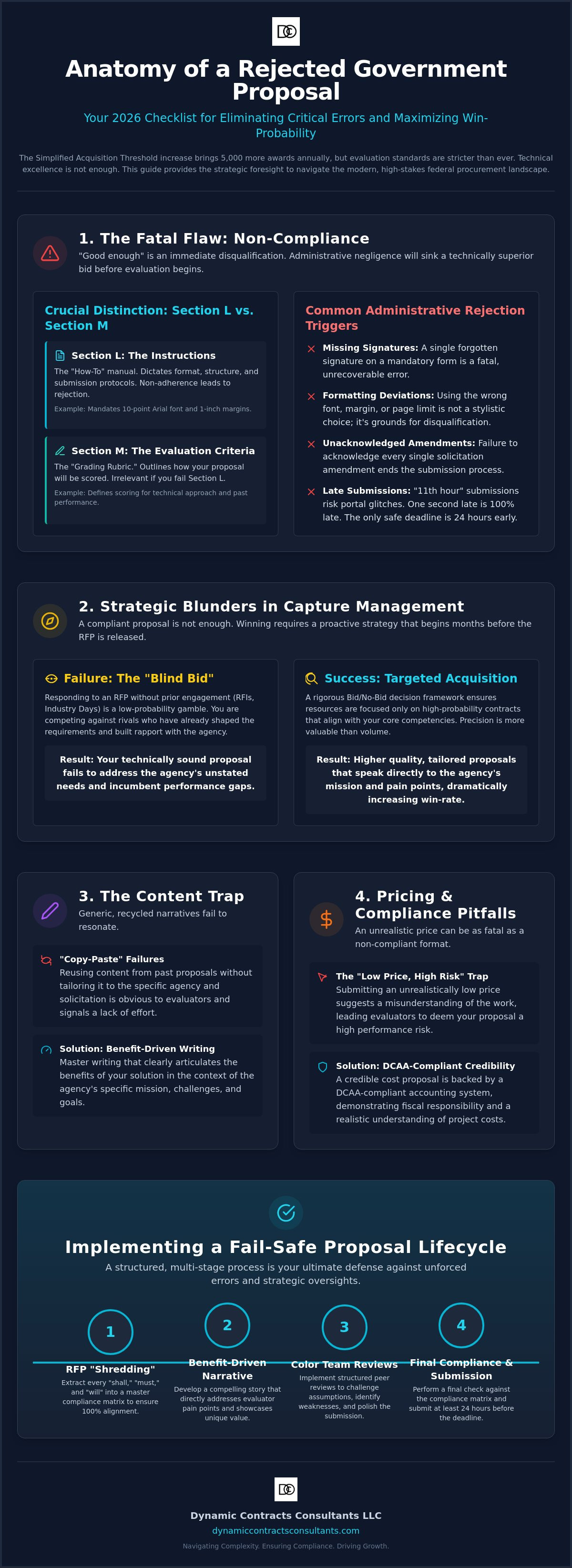
Federal procurement is an environment where technical excellence cannot compensate for administrative negligence. Government evaluators don't just look for the best solution; they actively seek reasons to eliminate bids to manage their workload. One of the most common government proposal mistakes to avoid is assuming that a "good enough" approach to compliance will pass the initial screening. It won't. A single missing signature on a mandatory form or a failure to acknowledge an amendment ends your journey before the technical evaluation even begins.
Understanding the distinction between Section L and Section M of a Request for Proposal (RFP) is vital for survival. Section L provides the specific instructions for how you must structure and submit your response, while Section M outlines the criteria the agency will use to grade you. Contractors often make the mistake of focusing entirely on the evaluation criteria while ignoring the submission instructions. If Section L mandates a 10-point Arial font and 1-inch margins, submitting a 12-point Times New Roman document isn't just a stylistic choice; it's a grounds for immediate rejection.
The Compliance Matrix: Your Shield Against Rejection
To ensure total alignment with agency requirements, you must employ a rigorous process known as "shredding" the solicitation. This involves extracting every "shall," "must," and "will" from the RFP and placing them into a compliance matrix. This document acts as a master checklist, mapping every requirement to a specific paragraph in your response. By 2026, automated compliance checks have become the industry standard, replacing manual reviews to identify hidden mandatory requirements that human eyes might miss. If your response doesn't mirror the agency’s requirements exactly, you're inviting a non-responsive rating. We utilize these structured methodologies to ensure that no detail, regardless of how minute, is overlooked during the proposal development phase.
Administrative Rigor and Submission Protocols
The submission phase is often where the most avoidable errors occur. Relying on an "11th hour" submission is a gamble you'll eventually lose. Portal glitches, slow upload speeds, and server timeouts at SAM.gov or other agency portals are common. In the current regulatory climate, 24 hours early is the only safe deadline. You must also verify your SAM.gov status and ensure all representations and certifications are current before hitting submit. A "clarification" request from a contracting officer isn't an opportunity to fix a mistake; it's a narrow window to explain an existing part of your bid. If you've missed a core requirement, that clarification won't save you from being deemed non-responsive.
Strategic Blunders in Capture and Competitor Analysis
Winning a federal contract requires more than just a compliant response; it demands a proactive capture strategy that begins months before the solicitation is released. The "Blind Bid" represents one of the most frequent and costly failures in the industry. Responding to a solicitation without prior engagement means you're likely competing against firms that have already helped the agency shape the requirements during the Request for Information (RFI) phase or at Industry Days. If you wait until the RFP is public to begin your strategy, you've already missed the opportunity to influence the acquisition approach or build the necessary rapport with the program office.
A "Bid-Everything" strategy is another high-cost error that dilutes your team's focus and drains financial resources. In a 2026 procurement environment characterized by the "Revolutionary FAR Overhaul" and a shift toward fixed-price contracts, precision is more valuable than volume. Spreading your proposal team too thin across dozens of low-probability bids leads to the very five common mistakes government contractors should avoid, such as failing to address specific agency pain points or ignoring the incumbent's existing performance gaps. Success is found in targeted acquisition planning where you only pursue contracts that align perfectly with your core competencies.
The Bid/No-Bid Decision Framework
Implementing a rigorous Bid/No-Bid analysis is your primary defense against resource waste. This framework evaluates three critical pillars: capability, capacity, and customer relationship. You must honestly assess whether you have the technical expertise to perform and the administrative bandwidth to manage the contract's lifecycle. This process also helps identify "wired" solicitations, where the requirements are so specific to a competitor's solution that your probability of winning is effectively zero. Using a data-driven decision matrix ensures you're only investing in bids where you have a clear path to victory.
Competitor Ghosting and Differentiation
To displace an incumbent or beat a strong rival, your proposal must utilize "ghosting" techniques. This involves highlighting a competitor's known weaknesses, such as high personnel turnover or outdated technology, and contrasting them with your own strengths without explicitly naming the rival firm. Researching award history via the Federal Procurement Data System (FPDS) and SAM.gov allows you to predict competitor pricing and performance trends. This data is essential for developing a Unique Value Proposition (UVP) that resonates with evaluators. If your current win-rate suggests a need for a more disciplined approach, we recommend a strategic capture consultation to refine your targeting and differentiation tactics.
The Content Trap: Avoiding Generic Narratives and "Copy-Paste" Failures
Evaluators can detect a recycled narrative within the first few paragraphs of a submission. Relying heavily on a "proposal library" without significant modification is one of the most common government proposal mistakes to avoid. While templates provide a foundation, failing to tailor the content to the specific Statement of Work (SOW) signals a lack of genuine interest in the agency's mission. When your response sounds like a generic sales brochure, you force the evaluator to work harder to find the value, which often results in a lower technical rating.
A frequent error involves focusing on features rather than benefits. The agency doesn't necessarily care about your "state-of-the-art" technology; they care about how that technology reduces their operational risk or increases efficiency. We see many firms fail because they list technical specifications without explaining the resulting outcome for the government. This disconnect often stems from the most common mistakes vendors make, where the "Why" is buried under a mountain of "What." Your Executive Summary must sell your unique solution within the first two pages, or you risk losing the evaluator's attention before they reach your technical approach.
Tailoring the Technical Approach
Moving beyond generic "Management Plans" requires a deep understanding of agency-specific operational strategies. You must demonstrate that you understand the environment where the work will be performed. To maintain speed without sacrificing quality, we utilize AI-driven proposal development to customize templates. This ensures that the technical narrative remains precise and perfectly aligned with the cost volume. If your technical plan promises a high level of senior oversight but your cost volume only accounts for junior staff, the inconsistency will trigger a "weakness" or "deficiency" rating during the evaluation phase.
Evidencing Past Performance
Past performance is not merely a list of previous contracts; it's a narrative of success that proves your reliability. The "Relevant and Recent" rule is absolute. A success story from ten years ago is often ignored by evaluators who prioritize performance within the last three to five years. You must quantify your results using specific metrics, KPIs, and CPARS ratings to build trust. If you have "negative" past performance on record, don't attempt to hide it. Proactively addressing the issue and explaining the corrective actions you took demonstrates administrative maturity and reduces the risk perceived by the contracting officer.
Pricing and Post-Award Compliance Pitfalls: Beyond the Bottom Line
The cost volume is often treated as a secondary concern compared to the technical approach, but it's frequently where the most devastating errors occur. One of the most common government proposal mistakes to avoid is falling into the "Low Price, High Risk" trap. While a competitive price is necessary, an unrealistically low bid signals to evaluators that you don't fully grasp the project's scope or the technical requirements. Contracting officers perform price realism analyses to ensure your firm can actually perform the work at the proposed rate. If your pricing is deemed too low to sustain the required talent or resources, your bid will be flagged as a high-risk liability, regardless of your technical score.
Administrative errors in the price volume are equally fatal. Inconsistent math remains the primary reason for immediate price volume rejection. If the totals on your SF33 don't match your detailed cost breakdown or your labor rate tables, the agency may find your entire proposal non-responsive. These discrepancies suggest a lack of internal quality control and administrative rigor. You must ensure that every spreadsheet cell, total, and indirect calculation is audited multiple times before submission to prevent these preventable disqualifications.
DCAA and Indirect Rate Strategy
For many federal contracts, particularly cost-reimbursable types, having an approved accounting system is a non-negotiable requirement. DCAA compliance is a prerequisite for cost-plus contracts, ensuring that your firm can accurately track and allocate costs. Many contractors make the mistake of "plugging" numbers into their price volume without a defensible indirect rate structure. This lack of strategy becomes a disaster during pre-award audits. Your accounting system must be ready for scrutiny before the contract is awarded, not after. We provide comprehensive DCAA compliance consulting to help you establish indirect rates that are both competitive and audit-ready.
Post-Award Awareness in the Pre-Award Phase
Success in government contracting requires you to look beyond the award date and plan for long-term execution. Ignoring "flow-down" clauses during the proposal phase is a significant oversight that can quickly erode your profit margins. These clauses require you to pass certain federal requirements down to your subcontractors, which often increases their costs. If you haven't accounted for these obligations in your initial pricing, you'll be forced to absorb those expenses yourself. Identifying "killer clauses" in the solicitation, such as liquidated damages or onerous reporting requirements, allows you to negotiate or price accordingly. Effective post-award contract administration begins during the bid phase. If you're concerned about your price volume's accuracy or your indirect rate strategy, contact our experts for a price volume audit today.
Implementing a Fail-Safe Proposal Development Lifecycle
Transitioning from a reactive to a proactive proposal culture is the final step in securing a competitive advantage in federal contracting. Most firms operate in a state of perpetual crisis, responding to solicitations as they appear rather than following a disciplined acquisition strategy. This lack of structure is why many organizations fall victim to the common government proposal mistakes to avoid that we've outlined throughout this checklist. By implementing a repeatable, multi-stage development lifecycle, you ensure that every submission undergoes rigorous quality control before it reaches the contracting officer’s desk.
A proactive culture also requires establishing a "Lessons Learned" loop. Regardless of the outcome, every bid should conclude with a post-submission debrief. Analyzing why a proposal won or lost allows you to refine your capture strategies and technical narratives for future pursuits. This continuous improvement process transforms your proposal department from a cost center into a strategic asset that consistently delivers higher win-probabilities and compliance certainty.
The Color Team Review Protocol
The Color Team process is a specialized methodology designed to simulate the agency's evaluation environment. Each stage serves a distinct purpose in the proposal's evolution:
- Pink Team: This early-stage review focuses on the overarching strategy and storyboards. It ensures that the proposed solution aligns with the agency's mission and that the "win themes" are clearly defined before the heavy writing begins.
- Red Team: Acting as "Mock Evaluators," this team scores the near-complete draft against the specific criteria in Section M. Their goal is to identify weaknesses, deficiencies, and compliance gaps that would lead to a lower rating.
- Gold Team: The final executive review focuses on the finished product, including the price-to-win verification and final administrative approval. This is the last opportunity to ensure the proposal is a polished, professional representation of your firm.
Leveraging AI for Competitive Advantage
In 2026, the integration of advanced technology is no longer optional for high-performing contractors. Tools like FARIFY.ai have revolutionized acquisition planning by automating risk assessments and identifying regulatory hurdles in seconds. One of the most significant advancements is the ability to "shred" a Request for Proposal (RFP) using AI. This process extracts every mandatory requirement with 100% accuracy, creating a compliance matrix that serves as the foundation for your response. This level of precision effectively eliminates the common government proposal mistakes to avoid related to administrative oversight and non-compliance.
However, it's vital to maintain a human-in-the-loop approach. While AI excels at data extraction and template customization, it cannot replace the strategic foresight and nuanced storytelling provided by professional proposal writing experts. AI should be viewed as a tool to enhance efficiency and accuracy, allowing your team to focus on the high-level strategy that ultimately wins contracts. If your current process feels disorganized or lacks the necessary rigor, we invite you to partner with our consultants to implement a fail-safe development lifecycle.
Securing Your Competitive Advantage in the 2026 Federal Marketplace
Mastering the federal procurement landscape requires a shift from reactive bidding to a disciplined, lifecycle-based approach. By prioritizing administrative rigor and strategic capture management, you effectively eliminate the common government proposal mistakes to avoid that lead to costly disqualifications. Success in this environment isn't just about technical capability; it's about demonstrating regulatory maturity and a deep understanding of agency pain points through tailored, benefit-driven narratives that resonate with evaluators.
Our team of Certified Professional Contracts Managers (CPCM) and DCAA Audit Readiness Experts combines decades of institutional knowledge with AI-powered proposal precision to ensure your submissions are both compliant and compelling. We focus on the intricate details of FAR/DFARS compliance and price realism so your organization can focus on its core mission. Request a Strategic Consultation to Optimize Your Next Bid and transform your proposal process into a reliable engine for long-term growth. Your path to a higher win-probability begins with a commitment to meticulous preparation and strategic foresight.
Frequently Asked Questions
What are the most common reasons for government proposal disqualification?
Administrative non-compliance remains the most frequent cause for immediate disqualification in federal procurement. This includes missing signatures, failing to acknowledge solicitation amendments, or exceeding specified page counts. Evaluators use these objective criteria to filter out non-responsive bids before the technical review ever begins. Ensuring that every administrative requirement in Section L is met is the only way to protect your submission from being rejected on a simple technicality.
How can I ensure my proposal is 100% FAR compliant?
Ensuring total FAR compliance requires a systematic review of the solicitation’s specific clauses and the broader Federal Acquisition Regulation requirements. You must map each requirement to your response and verify that your internal policies align with the mandated standards. Utilizing expert oversight from Certified Professional Contracts Managers helps identify subtle regulatory obligations that are often overlooked by internal teams. This rigorous approach minimizes the risk of common government proposal mistakes to avoid.
Is it okay to reuse content from previous government proposals?
Reusing content is acceptable as a baseline, but failing to tailor that material to the specific Statement of Work is a significant error. Recycled narratives often lack the agency-specific context required to score highly in the technical evaluation. You should use a proposal library for foundational information while ensuring that the final narrative directly addresses the unique challenges and pain points outlined in the current solicitation.
What is a Compliance Matrix and why do I need one?
A Compliance Matrix is a cross-reference document that maps every RFP requirement to the corresponding section of your proposal. You need one to ensure that no mandatory instruction or evaluation factor is missed during the drafting phase. It serves as a master checklist for both your writing team and the government evaluators, facilitating a more streamlined and accurate review of your submission’s responsiveness.
How does the government evaluate my past performance?
The government evaluates past performance based on the relevance and recency of your previous work. Evaluators look for contracts of similar size, scope, and complexity performed within the last three to five years. They also review CPARS ratings and interview previous contracting officers to assess your reliability and quality of work. Providing a narrative of success rather than just a list of contracts is essential for building trust with the agency.
What happens if I submit my proposal five minutes late?
A late submission almost always results in immediate rejection, regardless of the reason for the delay. Federal regulations are extremely strict regarding deadlines; even a five-minute delay due to portal glitches or slow internet is usually not excused. You should aim to submit your proposal at least 24 hours before the deadline to account for technical issues and ensure your bid is officially received by the agency.
Can AI really help in writing a compliant government proposal?
AI tools like FARIFY.ai significantly enhance the precision of your response by automating the compliance shredding process and acquisition planning. These tools can identify hidden requirements and risks in seconds with higher accuracy than manual reviews. However, human expertise remains necessary to refine the strategic narrative and ensure the technical solution is viable. AI serves as a powerful force multiplier for professional proposal writing teams when used as a specialized tool.
How much does DCAA compliance matter during the proposal stage?
DCAA compliance is critical during the proposal stage for cost-reimbursable contracts because it verifies that your accounting system is audit-ready. If you can't demonstrate a defensible indirect rate structure, the government will likely deem your firm a high-risk candidate and disqualify your bid. Establishing these systems before the award date is a prerequisite for competing in the cost-plus marketplace and avoiding common government proposal mistakes to avoid during the evaluation phase.


