

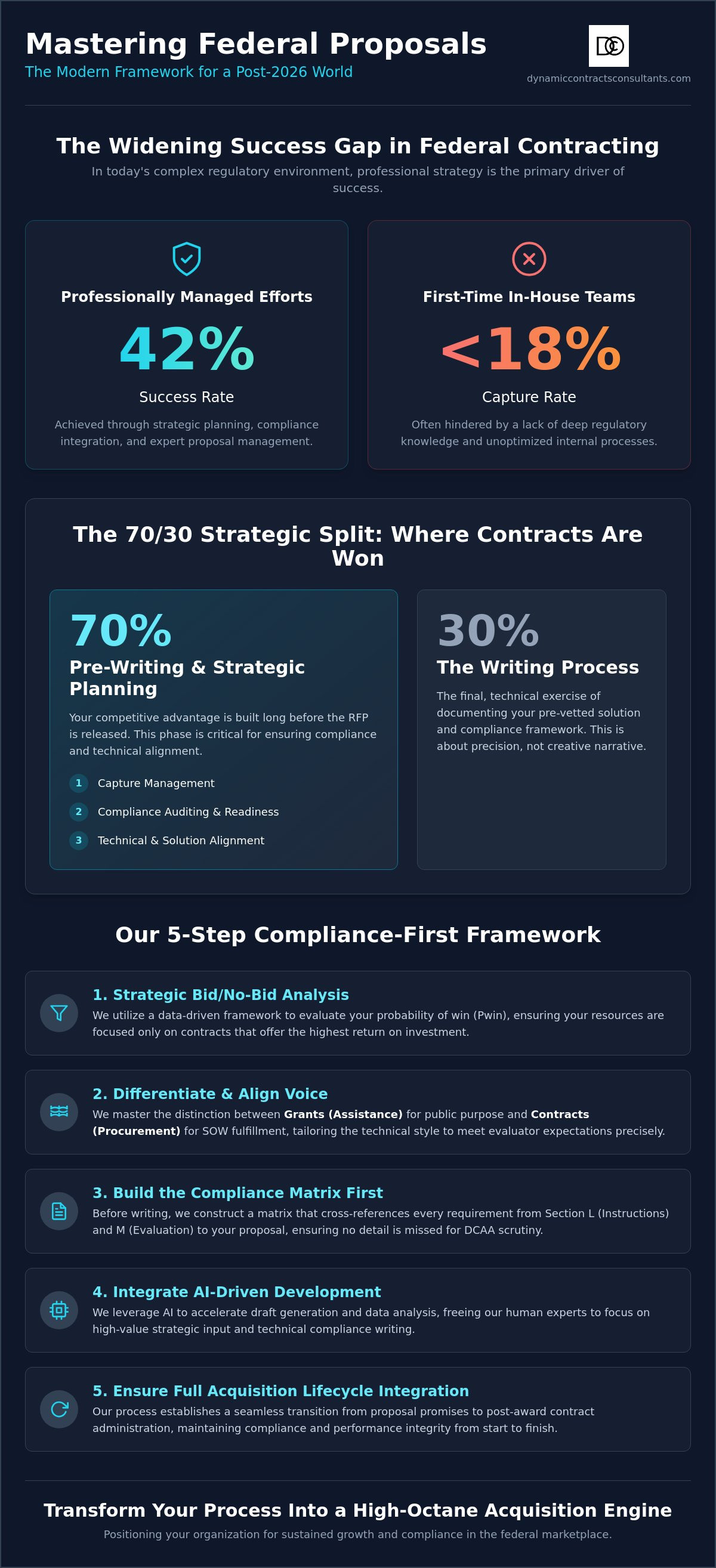
Did you know that professionally managed grant writing and proposal writing efforts achieve a 42% success rate, while first-time in-house teams often capture less than 18% of their targeted contracts? In the wake of the 2026 Revolutionary FAR Overhaul and the phased rollout of revised DFARS parts, the margin for professional error has vanished. You're likely feeling the pressure of increased cybersecurity validation and the strict demand for outcome-driven funding. We understand that managing these multi-layered regulatory shifts while maintaining technical precision feels like a moving target.
You don't have to sacrifice your team's efficiency to meet these rigorous standards. This guide provides a repeatable framework designed to maximize your organization's win-rates through the seamless integration of AI-driven development and human strategic expertise. We'll show you how to build a pre-award compliance structure that survives the most intense DCAA scrutiny. By the end of this article, you'll possess the tools to transform manual, inefficient processes into a high-octane acquisition engine that meets every 2026 federal requirement.
Key Takeaways
- Understand why modern federal solicitations require a hybrid strategy that synthesizes technical precision with administrative compliance.
- Learn how to leverage AI-driven development to accelerate draft generation while shifting focus from creative narratives to technical compliance writing.
- Master the use of Bid/No-Bid analysis within a Capture Management framework to optimize resource allocation before the RFP is released.
- Discover how to integrate FAR and DFARS standards directly into your grant writing and proposal writing processes to ensure readiness for DCAA scrutiny.
- Establish a seamless transition from proposal promises to post-award contract administration to maintain compliance throughout the entire acquisition lifecycle.
Strategic Frameworks: Navigating the Intersection of Grant and Proposal Writing
Federal acquisition in 2026 demands more than just clerical accuracy. It requires a deep understanding of the regulatory architecture that governs both assistance and procurement. While many organizations treat grant writing and proposal writing as separate silos, the modern federal landscape has blurred these lines. Success now depends on your ability to synthesize technical expertise with strict administrative compliance. Evaluation boards no longer look for persuasive prose alone; they search for evidence of risk mitigation and technical readiness that aligns with the 2026 Revolutionary FAR Overhaul.
We've observed that high-performing organizations treat every solicitation as a strategic acquisition project. This means moving beyond the "writing" phase and into a comprehensive framework that addresses the entire contract lifecycle. If your team focuses solely on the narrative without anchoring it in regulatory requirements, your win-rates will suffer regardless of your technical expertise. You must adopt a hybrid approach that satisfies both the program officers looking for innovation and the contracting officers demanding total FAR and DFARS compliance.
Defining the Federal Proposal Landscape
Differentiating between assistance and procurement is the first step in a mature acquisition strategy. Federal grants, or assistance, focus on public purpose and broad program descriptions. In contrast, competitive contracts, or procurement, are governed by a strict Statement of Work (SOW) designed to fulfill specific agency needs. It's a mistake to use a "grant voice" when responding to a procurement RFP. Procurement requires a technical, declarative style that mirrors the SOW's requirements exactly.
The Grant Writing Process and the contract proposal cycle share a critical commonality: the actual writing only accounts for approximately 30% of a successful submission. The remaining 70% is won through capture management, compliance auditing, and technical alignment. If you aren't spending the majority of your time on the pre-writing phases, you're essentially guessing what the evaluators want to see. Understanding the "Program Description" in a grant versus the "Statement of Work" in a contract is the difference between being "qualified" and being "selected."
The Shift Toward Strategic Acquisition Planning
Winning in today's environment requires you to align your organizational goals with agency-specific missions long before a solicitation is released. Effective market research allows us to understand an agency's pain points and historical spending patterns. This pre-solicitation phase is where your competitive advantage is built. By the time the RFP or NOFO is public, your strategy should already be solidified. You can explore our comprehensive proposal development services to see how we integrate these strategic layers into every submission.
Strategic planning also involves a rigorous Bid/No-Bid analysis. We don't recommend chasing every opportunity that appears on SAM.gov or Grants.gov. Instead, use a data-driven framework to evaluate your probability of win (Pwin) based on your technical capabilities, past performance, and current compliance status. This disciplined approach ensures that your resources are focused on the contracts and grants that offer the highest return on investment.
The Technical Architecture of a Winning Federal Proposal
In the federal sector, grant writing and proposal writing are not exercises in creative storytelling. They are technical exercises in rigorous compliance. Unlike academic or non-profit grants that might reward "imagination," federal evaluators score based on strict adherence to the Federal Acquisition Regulation (FAR). Every sentence must map back to a specific requirement in the solicitation. If you treat your proposal as a narrative rather than a technical specification, you risk immediate disqualification during the initial administrative review.
Before writing a single word, we prioritize the construction of a Compliance Matrix. This document cross-references every requirement from Section L (Instructions) and Section M (Evaluation Criteria) with its corresponding page and paragraph in your response. It serves as the foundational architecture, ensuring that no technical or administrative mandate is overlooked. This meticulous approach transforms the proposal from a persuasive document into a verifiable proof of capability that stands up to DCAA scrutiny.
AI-Enhanced Proposal Development
Modern acquisition demands speed without compromising accuracy. We leverage tools like FARIFY.ai for rapid acquisition planning and bid-ready drafting. This allows your team to bypass the "blank page" problem and move directly into the strategic refinement phase. However, we maintain a "Human-in-the-Loop" philosophy to ensure that every AI-generated draft is vetted for strategic nuance and technical precision. AI-driven proposal writing is a synthesis of algorithmic speed and expert oversight. It's about augmenting human intelligence, not replacing it, to ensure your organization stays ahead of tightening 2026 deadlines.
Customized Templates and Structural Integrity
Generic templates fail in the federal space because they don't account for the unique "Flow Down" requirements and agency-specific formatting rules. We build customized templates that incorporate your library of past performance and technical volumes, allowing for a rapid response to short-fuse RFPs. This structural integrity ensures that mandatory clauses, such as those related to cybersecurity validation or greenhouse gas disclosures, are baked into the document from the start. If you're struggling to modernize your submission pipeline, you can consult with our strategic team to evaluate your current processes and identify gaps in your technical architecture.
Capture Management: Enhancing Win-Rates through Strategic Bid Analysis
Winning in the federal marketplace isn't a reactive process that begins when an RFP is published. It's a proactive discipline known as Capture Management. This phase is where the most successful organizations differentiate themselves long before a solicitation enters the public domain. If you wait until an RFP is released to begin your strategy, you're already trailing competitors who have spent months shaping requirements and building relationships with agency stakeholders. High win-rates are built on the intelligence gathered during this pre-solicitation window.
Resource optimization is critical for maintaining a sustainable acquisition pipeline. Indiscriminate bidding dilutes your team's focus and drains your business development budget without a guaranteed return. We advocate for a rigorous Bid/No-Bid analysis to ensure you only pursue opportunities where you possess a clear technical and strategic advantage. This decision isn't just about your ability to perform the work; it's about whether you can win the work while meeting the strict compliance burdens of the 2026 regulatory environment.
The Bid/No-Bid Decision Matrix
- Step 1: Technical Alignment. Evaluate your core competencies against the anticipated solicitation requirements. If a gap exists, determine if it can be bridged through a strategic teaming agreement or a specialized subcontractor.
- Step 2: Compliance Risk Assessment. Analyze the specific FAR and DFARS clauses expected in the contract. You must verify if your current infrastructure can survive a DCAA audit or meet the new 2026 cybersecurity validation standards.
- Step 3: Competitive Landscape. Identify the incumbent and their historical performance. We look for specific weaknesses in their delivery that your organization is uniquely positioned to correct.
- Step 4: Price to Win (PTW). Calculate the optimal price point by analyzing historical agency spending and competitor pricing models to ensure your bid is both competitive and profitable.
Developing Win Themes and Differentiators
Effective grant writing and proposal writing requires you to write specifically for the evaluator's score sheet. You aren't just describing features; you're highlighting agency-specific benefits. Win themes should be woven throughout every volume of your response, reinforcing why your organization represents the lowest risk and highest value to the government. This involves translating complex technical specifications into clear, value-driven statements that address the agency's primary pain points directly. You can review our strategic capture management solutions to see how we help clients navigate these complex pre-bid arrangements and identify their strongest differentiators.
Strategic partnerships often serve as the catalyst for unlocking larger prime contracts. Teaming agreements allow you to leverage the past performance of subcontractors to bolster your technical volume. However, these agreements must be managed with legal and administrative precision to ensure all flow-down clauses are met by every party involved. By formalizing these relationships early in the capture phase, you present a unified and low-risk front to the evaluation board.
Compliance-First Development: Integrating FAR, DFARS, and DCAA Standards
The common misconception that compliance is a post-award administrative burden often leads to proposal rejection. In the current 2026 regulatory climate, compliance must be the primary driver of your grant writing and proposal writing efforts from the initial draft. Federal evaluators use Section L and M instructions to gauge your organization's maturity; a lack of regulatory alignment in the proposal signals a high risk of project failure. Integrating Federal Acquisition Regulation (FAR) and Defense Federal Acquisition Regulation Supplement (DFARS) requirements into your narrative demonstrates that your firm is already prepared for the rigors of federal oversight. This preparation is especially critical given the Revolutionary FAR Overhaul (RFO) updates that took effect on February 1, 2026.
Preparing for a Contractor Purchasing System Review (CPSR) begins during acquisition planning, not after the contract is signed. You must ensure that your writing reflects a compliant procurement process, especially when managing subcontractors or teaming partners. Every commitment made in the technical volume must be verifiable and audit-ready to survive the scrutiny of agency officials who are increasingly focused on government-led validation of contractor claims. You can learn more about our post-award contract administration to see how we maintain this compliance framework throughout the entire contract lifecycle.
Cost Proposal Accuracy and Audit Readiness
A winning cost proposal is more than a collection of spreadsheets. It requires a detailed Basis of Estimate (BOE) that provides a clear, logical link between the technical requirements and the proposed price. We ensure that your BOEs are written to withstand Defense Contract Audit Agency (DCAA) scrutiny by utilizing verifiable historical data and clear labor category mapping. Integrating indirect rate consulting into your financial volume is essential for justifying your competitive position while maintaining profitability. Price analysis must be rigorous, demonstrating that your bid represents the best value through a transparent and compliant methodology that aligns with 2026 audit standards.
Navigating Specialized Regulatory Frameworks
Your technical volumes must also address specialized frameworks such as International Traffic in Arms Regulations (ITAR) and Export Administration Regulations (EAR) where applicable. Managing the Procurement Integrity Act during the writing process is mandatory to avoid ethics violations that can lead to permanent debarment. Compliance is the primary lens through which federal evaluators mitigate project risk. Whether you're navigating Foreign Corrupt Practices Act (FCPA) requirements or the latest cybersecurity mandates, your proposal must prove that your internal controls are robust. If your current financial systems aren't prepared for these requirements, you should contact our compliance consultants to ensure your cost proposal meets all DCAA standards before submission.
Optimizing the Acquisition Lifecycle with Professional Writing Services
Winning a contract is often celebrated as the ultimate success; however, in the federal sector, the award is merely the transition from strategy to performance. Professional grant writing and proposal writing must be viewed as a lifecycle service rather than an isolated event. The narratives and cost structures you commit to during the solicitation phase become the legal benchmarks for your post-award contract administration. If those promises aren't anchored in operational reality, the resulting compliance gaps can lead to cure notices or even contract termination. We treat every submission as a binding blueprint for execution. This ensures that your technical promises remain sustainable over the long term.
Managing the acquisition lifecycle also involves the complex task of flow-down clause management. Prime contractors must ensure every subcontractor meets the same FAR and DFARS standards outlined in the original bid. This requires constant pre- and post-award compliance monitoring to maintain contract health and protect your organization's reputation. We provide the strategic oversight necessary to ensure your partners don't become a liability during agency audits or performance reviews. By establishing these controls early, you create a disciplined environment where technical delivery and administrative compliance work in tandem.
Post-Award Administration and Closeout
Seamless contract administration depends on the quality of your initial documentation and your ability to maintain it. We help you manage records reviews and build comprehensive documentation trails that stand up to rigorous agency scrutiny. This proactive approach prevents the common audit panic that occurs when a contract enters the closeout phase or faces a surprise DCAA inspection. You can ensure long-term success with post-award compliance support by integrating these practices into your standard operational workflow. Proper closeout procedures are essential for protecting your past performance ratings, which directly impacts your future win-rates.
The Dynamic Advantage in Federal Contracting
Choosing a strategic partner means gaining access to a methodical framework that balances efficiency with absolute precision. Our AI-integrated systems allow us to move faster while our deep DCAA-compliant expertise ensures every detail is correct. We don't just help you win; we help you perform and grow within the federal ecosystem. Our solution-driven approach focuses on long-term stability and meticulous adherence to the 2026 regulatory environment. We position your firm as a reliable, low-risk partner for any federal agency. Ready to modernize your acquisition strategy? Contact Dynamic Contracts Consultants LLC for a professional consultation today.
Advancing Your Acquisition Strategy in the 2026 Federal Market
Federal success in 2026 demands a disciplined synthesis of technical precision and regulatory compliance. We've explored how integrating AI-driven development with a robust capture management framework allows organizations to move from reactive bidding to proactive acquisition. By prioritizing DCAA-compliant cost structures and FAR-aligned narratives from the outset, you establish a foundation that survives the most rigorous agency audits. This strategic alignment is no longer optional; it's the baseline for maintaining a competitive advantage in an environment defined by the Revolutionary FAR Overhaul.
As a Minority Owned Small Business with extensive prime contract experience for the DoD, State Department, and EPA, we bring the disciplined approach necessary for high-stakes environments. Our team's Certified Professional Contracts Manager (CPCM) expertise ensures that every aspect of your grant writing and proposal writing process is optimized for long-term contract health and audit readiness. We're ready to help you navigate these complexities and transform your acquisition pipeline into a repeatable engine for growth. Secure your next federal award with expert proposal and grant writing support. Your organization's potential for expansion is within reach when backed by meticulous strategic oversight from Dynamic Contracts Consultants LLC.
Frequently Asked Questions
What is the primary difference between grant writing and proposal writing in the federal sector?
Grants represent assistance for public benefit, whereas proposals address specific government procurement needs. While grant writing and proposal writing both require technical precision, proposals are governed by the strict Statement of Work (SOW) and the Federal Acquisition Regulation (FAR). Grants typically follow broader program descriptions rather than the rigid procurement requirements found in competitive contracts.
How does AI improve the win-rate of federal proposals without sacrificing compliance?
AI improves win-rates by accelerating the acquisition planning and drafting phases through specialized tools that cross-reference current regulations. It allows teams to generate bid-ready drafts that are technically compliant with the latest 2026 federal updates. Expert human oversight remains essential to refine strategic nuance and ensure that the final submission reflects the organization's unique value proposition.
Why is DCAA compliance critical during the proposal writing phase?
DCAA compliance is critical because it establishes the audit readiness of your cost proposal from the initial submission. If your Basis of Estimate (BOE) doesn't meet Defense Contract Audit Agency standards, you risk being eliminated for financial unreliability. Integrating these standards early ensures that your indirect rates and price analysis are defensible during both the evaluation and post-award reviews.
What is a Bid/No-Bid analysis, and why is it essential for small businesses?
A Bid/No-Bid analysis is a formal framework used to evaluate the probability of winning a specific contract against the resources required to pursue it. Small businesses use this methodical decision-making process to avoid wasting limited capital on solicitations where they lack a technical or competitive advantage. It focuses your team's efforts on opportunities with the highest potential return on investment.
Can professional writing services help with post-award contract administration?
Professional services extend beyond the submission phase to include comprehensive post-award contract administration and compliance monitoring. This support includes managing subcontractor flow-down clauses, conducting records reviews, and preparing for formal contract closeout. Maintaining this level of oversight is essential for protecting your past performance ratings and ensuring the long-term health of your federal portfolio.
What are the most common FAR compliance pitfalls in federal proposals?
Common pitfalls include failing to follow Section L and M instructions precisely and neglecting mandatory 2026 updates like cybersecurity validation. Many organizations also overlook the requirements of the Procurement Integrity Act or fail to document their price analysis methodology properly. These errors often lead to immediate disqualification during the government's initial administrative review process.
How do customized templates improve the efficiency of acquisition planning?
Customized templates improve efficiency by incorporating agency-specific formatting and mandatory FAR/DFARS clauses into every response. They allow your team to respond rapidly to short-fuse solicitations without sacrificing structural integrity or technical accuracy. By utilizing a pre-vetted library of past performance narratives, you ensure consistent compliance and professional branding across all submissions.
What role does capture management play in securing long-term federal contracts?
Capture management is the proactive strategic phase where you identify win themes and shape requirements before an RFP is officially issued. It's essential for securing long-term contracts because it allows you to build relationships with agency stakeholders and understand their specific pain points. Successful capture management ensures that your eventual proposal is positioned as the lowest-risk and highest-value solution.


