

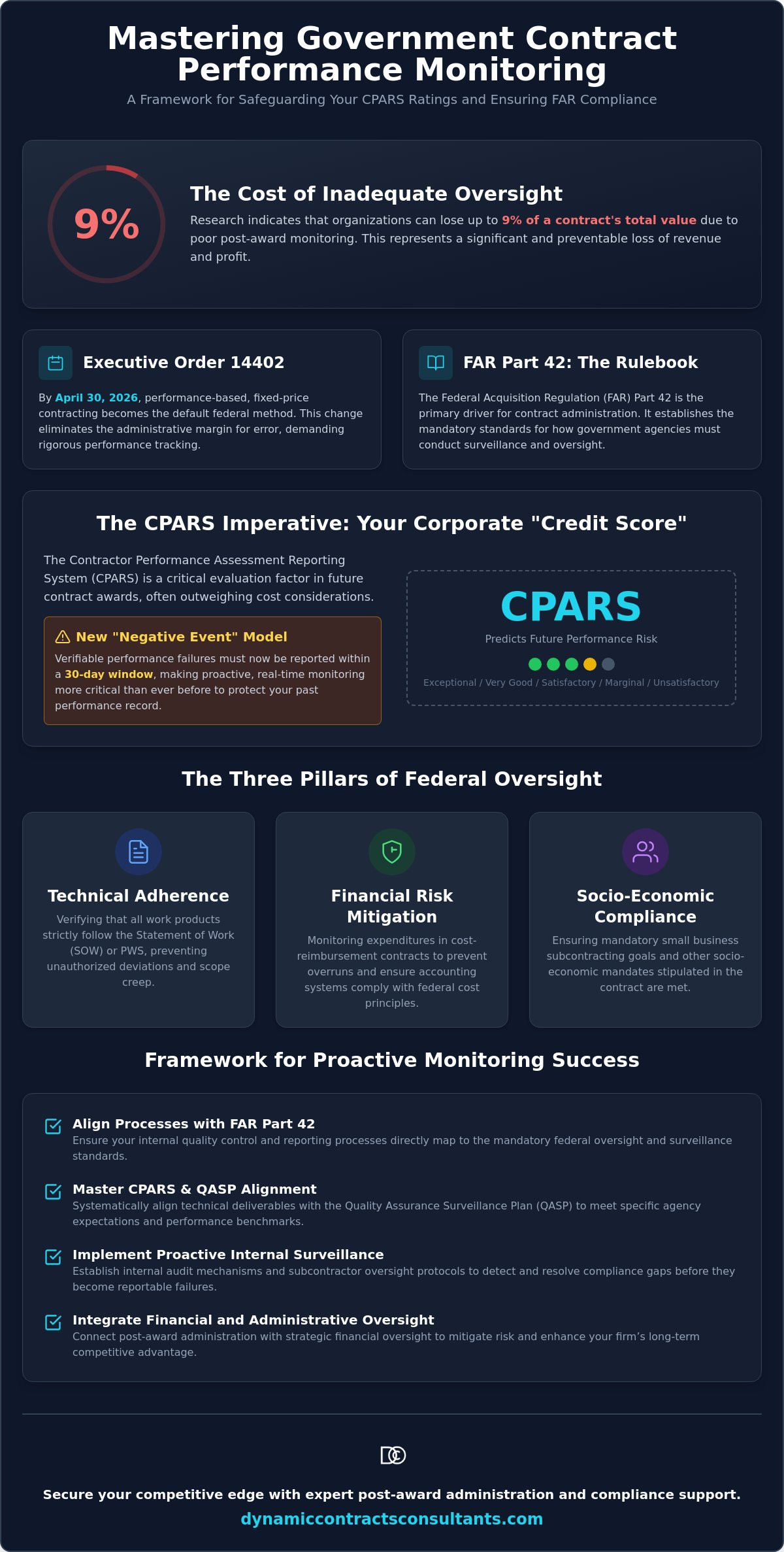
Research indicates that organizations can lose up to 9% of a contract's value due to inadequate post-award oversight. This significant loss is often a direct consequence of failing to implement a rigorous government contract performance monitoring strategy. With Executive Order 14402 establishing performance-based, fixed-price contracting as the default federal procurement method as of April 30, 2026, the administrative margin for error has effectively been eliminated.
It's understandable to feel apprehensive about the CPARS transition to a "negative event" model, especially when verifiable failures must now be reported within a 30 day window. You're likely managing disparate reporting requirements while trying to meet the evolving expectations of your Contracting Officer's Representative. This guide will help you master these complexities and safeguard your CPARS ratings with a methodical approach to federal oversight. We'll provide a clear framework for internal performance auditing and a detailed analysis of FAR Part 42 requirements to ensure your firm maintains a dominant competitive position.
Key Takeaways
- Identify the regulatory imperatives of FAR Part 42 to ensure your internal processes align with mandatory federal oversight and surveillance standards.
- Establish a robust government contract performance monitoring framework to navigate the updated CPARS reporting model and maintain a superior past performance record.
- Master the alignment of technical deliverables with the Quality Assurance Surveillance Plan (QASP) to meet specific agency expectations and performance benchmarks.
- Implement proactive internal surveillance mechanisms and subcontractor oversight protocols to detect compliance gaps before they escalate into significant performance failures.
- Understand how integrating post-award administration with strategic financial oversight can enhance your firm’s long-term competitive advantage in the federal marketplace.
Defining Government Contract Performance Monitoring and Its Regulatory Basis
Government contract performance monitoring represents the systematic observation and evaluation of a contractor's fulfillment of contractual obligations throughout the acquisition lifecycle. It isn't merely a clerical function but a critical administrative discipline designed to ensure the government receives the exact value it's paying for. This process is deeply rooted in a broader Contract Management Overview, where oversight acts as the primary mechanism for accountability between the public sector and private industry.
The Federal Acquisition Regulation (FAR) Part 42 serves as the primary regulatory driver for this activity. It outlines the rigorous standards for contract administration and audit services, establishing the legal framework for how agencies must conduct surveillance. While FAR Part 42 provides the general federal standard, contractors must also account for agency-specific supplements. For instance, the Defense Federal Acquisition Regulation Supplement (DFARS) or the USAID Acquisition Regulation (AIDAR) often impose more granular reporting requirements that exceed basic federal guidelines. These supplements reflect the unique risk profiles and mission requirements of their respective departments.
Success in this environment depends on understanding the distinct roles of the oversight team. The Contracting Officer (CO) maintains the sole legal authority to modify the contract or bind the government. The Contracting Officer’s Representative (COR) functions as the technical liaison. They're responsible for the day-to-day government contract performance monitoring, ensuring that every deliverable aligns with technical specifications. They don't have the power to change the contract terms, but their reports directly influence the CO's decisions regarding payments and performance ratings.
The Core Objectives of Federal Oversight
The government's surveillance efforts focus on three primary pillars of compliance to ensure mission success:
- Technical Adherence: Verifying that all work products strictly follow the Statement of Work (SOW) or Performance Work Statement (PWS) without unauthorized deviations or scope creep.
- Financial Risk Mitigation: In cost-reimbursement environments, agencies monitor expenditures to prevent cost overruns and ensure the contractor's accounting systems remain compliant with federal cost principles.
- Socio-Economic Compliance: Ensuring the contractor meets mandatory small business subcontracting goals and other socio-economic mandates stipulated in the award document.
The Evolution of Monitoring in 2026
By mid-2026, the federal procurement landscape has shifted toward data-driven, real-time performance tracking. Agencies now utilize integrated dashboards to monitor milestones as they occur, rather than relying solely on retrospective monthly status reports. This increased transparency places higher administrative burdens on mid-tier and large-scale contractors who must provide granular data access to their internal systems. Performance monitoring is a proactive risk-mitigation strategy rather than a reactive audit response. It's a continuous process that safeguards the integrity of the mission and the contractor's standing in the marketplace.
The Strategic Impact of CPARS and Performance Evaluations
A contractor's historical reliability is codified within the federal ecosystem through a centralized record that functions as a corporate credit score. Federal agencies utilize the Contractor Performance Assessment Reporting System (CPARS) to predict future performance risk during the source selection process. This data isn't merely a retrospective summary; it's a primary evaluation factor that can outweigh technical or cost considerations in "Best Value" procurements. Effective government contract performance monitoring ensures that the narrative recorded in this system accurately reflects the firm's capabilities. As of 2026, the shift toward a "negative event" model means that verifiable failures are reported within 30 days, making real-time accuracy more critical than ever before.
The lifecycle of a performance report begins with an initial evaluation by the Assessing Official, which then triggers a contractor's rebuttal period. This window is the only opportunity to provide a counter-narrative or objective evidence to dispute a lower rating. While a "Satisfactory" rating meets the basic requirements of the contract, it rarely provides a competitive advantage in a crowded marketplace. "Exceptional" ratings, conversely, serve as a strategic differentiator that lowers the government's perceived risk and justifies higher profit margins on future bids.
Navigating the Evaluation Process
Evaluations are structured around four primary pillars: Quality, Schedule, Cost Control, and Management. Each area requires specific documentation to support the assigned rating. For contractors operating under subcontracting plans, the government places a heavy emphasis on small business participation goals. Failing to meet these socio-economic targets can lead to a "Marginal" rating in the management category, even if technical performance was flawless. If an assessment is inaccurate, contractors must follow formal procedures to dispute the findings. Engaging in professional post-award contract administration provides the rigorous documentation needed to safeguard these ratings throughout the contract lifecycle.
Past Performance as a Capture Management Asset
Strategic contractors treat their CPARS record as a capture management asset rather than a passive administrative requirement. By integrating past performance data into a bid/no-bid analysis framework, firms can identify solicitations where their historical excellence provides a clear path to victory. High ratings should be explicitly cited in technical proposals to demonstrate a proven track record of mitigating agency-specific challenges. This proactive use of performance data allows a firm to position itself as a low-risk partner, which is essential for maintaining a competitive edge in the 2026 federal market.
Critical Metrics and KPIs for Federal Contract Oversight
Effective government contract performance monitoring requires a transition from qualitative assessment to quantitative precision. Agencies don't just look for general satisfaction; they require empirical evidence that deliverables meet the specific thresholds defined in the Quality Assurance Surveillance Plan (QASP). This technical oversight is complemented by rigorous tracking of schedule variance through the Integrated Master Schedule (IMS) and cost variance metrics. By monitoring the Actual Cost of Work Performed (ACWP) against the Budgeted Cost of Work Performed (BCWP), contractors can identify financial deviations before they jeopardize the entire program. These metrics provide the objective data needed to support the high CPARS ratings discussed in previous sections.
Beyond technical and financial data, compliance metrics regarding labor standards and security protocols are non-negotiable. Adherence to the Davis-Bacon Act and specific agency security clearances must be tracked with the same rigor as project milestones. Failing to maintain these compliance KPIs often results in immediate administrative flags, regardless of the quality of the technical work. Systematic tracking ensures that the firm remains eligible for future solicitations and avoids the verifiable failures that now trigger rapid reporting within the federal system.
Technical Excellence and Quality Control
Contractors should develop an internal Quality Control Plan (QCP) that acts as a mirror image of the government's QASP. This alignment ensures that the internal team evaluates work using the same criteria as the agency's surveillance team. Central to this process is the definition of Acceptable Quality Levels (AQLs). These metrics establish the minimum performance standard allowed for any given task. Conducting regular internal audits identifies technical drift, which is a gradual departure from contract specifications, allowing for correction before an official agency inspection occurs. This proactive approach prevents performance deficiencies from reaching the Contracting Officer's desk.
Financial and Schedule Integrity
For complex, high-value federal programs, Earned Value Management (EVM) is the standard for maintaining financial and schedule integrity. It provides a unified view of performance by integrating scope, time, and cost into a single reporting framework. Contractors must remain vigilant regarding the Limitation of Funds and Limitation of Cost clauses. These typically require formal notification to the Contracting Officer when expenditures reach 75% of the total obligated amount. Identifying early warning signs of schedule slippage is vital for maintaining a "Green" status on agency dashboards. It's this level of detail that separates high-performing contractors from those who struggle with administrative compliance.
Establishing an Internal Performance Monitoring Framework
The government's surveillance activities are exhaustive, yet many firms fail because they treat government contract performance monitoring as an external event rather than an internal discipline. A robust framework requires a proactive surveillance plan that identifies compliance gaps before the Contracting Officer's Representative (COR) issues a deficiency report. This involves implementing automated tracking systems for deliverable management to ensure every reporting deadline is met with precision. By conducting "Mock Evaluations" semi-annually, firms can simulate the annual CPARS assessment, allowing the team to address weaknesses in quality or schedule adherence while there's still time to influence the final record.
A systematic internal framework doesn't just track progress; it mirrors the agency's own Quality Assurance Surveillance Plan. This alignment allows the contractor to speak the same technical language as the evaluators during progress meetings. It also ensures that the data collected internally is directly applicable to the metrics the government uses for its formal assessments. Maintaining this level of detail requires specialized expertise in pre and post-award compliance services to ensure no administrative requirement is overlooked throughout the contract lifecycle.
Subcontractor Oversight and Risk Management
Prime contractors bear the ultimate responsibility for the entire project's success. This necessitates rigorous subcontractor monitoring and the meticulous management of flow-down clauses. These clauses must ensure that every partner adheres to the same DCAA compliance and labor reporting standards required of the prime. Effective risk management involves identifying early signs of subcontractor non-performance. Firms must have a clear mitigation strategy in place to prevent these issues from impacting the prime's past performance rating. Liability for a subcontractor's failure often rests with the prime, making diligent oversight a mandatory administrative function.
Communication Protocols with Agency Oversight
Building a transparent and professional relationship with the COR and CO is essential for long-term success. The "early and often" communication principle is a critical component of this strategy. If a performance issue arises, the contractor should be the one to bring it to the agency's attention, along with a concrete proposed solution. This transparency builds trust and demonstrates a commitment to mission success. Equally critical is the practice of documenting all informal guidance. Verbal instructions from a COR can lead to future contractual disputes if they aren't confirmed in writing and integrated into the official project record.
Professional Post-Award Administration and Compliance Support
The administrative rigor required to maintain compliance in the 2026 federal landscape often exceeds the internal capacity of even well-established contractors. Outsourcing contract administration to specialized consultants provides a distinct advantage by decoupling technical execution from regulatory reporting. This strategic separation ensures that technical teams remain focused on mission-critical milestones while administrative experts manage the complex documentation required for government contract performance monitoring. Professional oversight acts as a continuous internal audit, identifying potential discrepancies in labor reporting or deliverable tracking before they escalate into verifiable failures that could damage a firm's past performance record.
Effective performance management must be integrated with broader financial oversight, particularly regarding DCAA compliance and indirect rate consulting. Performance data and financial reporting are not siloed functions; they are interdependent metrics that define a contractor's reliability. Discrepancies between the work performed and the costs billed can trigger intensive audits and negatively impact CPARS ratings. By synchronizing these disciplines, firms ensure that their financial systems accurately reflect the technical progress reported to the agency. This holistic approach to oversight guarantees audit preparedness throughout the entire contract lifecycle, from the initial award through the final closeout procedures.
Optimizing the Contract Lifecycle
Professional expertise is essential for managing the multifaceted reporting obligations that characterize modern federal awards. By utilizing specialized support, contractors can significantly reduce the administrative burden on their technical leads, allowing for a more efficient allocation of resources. This sustained level of performance excellence positions a firm for long-term growth, as the resulting high CPARS scores become a primary asset in future procurements. A disciplined approach to administration ensures that every contractual requirement is met with the precision the government expects.
Strategic Compliance Integration
Successful post-award administration begins with alignment during the pre-award capture management and acquisition planning phases. Establishing a foundation for successful monitoring requires a deep understanding of how specific contract clauses will be evaluated during execution. Dynamic Contracts Consultants LLC facilitates this seamless performance management by providing the specialized knowledge necessary to navigate these administrative complexities. Their methodical approach ensures that your firm's internal systems are fully prepared for the scrutiny of federal oversight. You should contact Dynamic Contracts Consultants LLC for a comprehensive performance monitoring audit to safeguard your firm's competitive standing and ensure total regulatory adherence.
Securing Long-Term Viability through Performance Excellence
The transition toward a "negative event" CPARS model and the federal preference for performance-based contracting have fundamentally altered the administrative landscape. Organizations must now prioritize a rigorous government contract performance monitoring strategy that anticipates agency expectations rather than merely reacting to deficiency reports. It's essential to align internal quality control plans with the specific technical and financial metrics mandated by FAR Part 42. This methodical approach ensures that your firm's performance data remains an asset during the source selection process for future solicitations.
Maintaining this level of precision demands a holistic integration of expert DCAA compliance consulting and strategic capture management specialists. Precision is mandatory. By treating past performance as a strategic asset, your firm can transform administrative compliance into a significant competitive advantage. Secure Your Federal Contract Performance with Professional Administration Services through comprehensive post-award administration support that ensures audit preparedness from award to closeout. A commitment to these professional standards will safeguard your corporate reputation and ensure your firm remains a preferred partner in the 2026 federal marketplace.
Frequently Asked Questions
What is the difference between contract administration and contract monitoring?
Contract administration encompasses the broad management of the legal and financial lifecycle of an award, while monitoring is the tactical observation of performance against specific technical standards. Administration involves handling modifications, payments, and final closeout procedures. Monitoring focuses on the execution of the Quality Assurance Surveillance Plan (QASP) to ensure that day-to-day deliverables meet the required technical specifications.
How often does the government conduct performance evaluations?
Formal performance evaluations are typically conducted annually and upon the completion of the contract, though interim assessments may occur for high-risk projects. The 2026 implementation of the "negative event" model requires contracting officers to report significant, verified failures within 30 days. This shift necessitates constant internal vigilance to ensure that any performance deviations are corrected before they trigger a rapid reporting event.
Can a contractor appeal a negative CPARS rating?
Contractors have a mandatory 14-day window to review and provide a formal written rebuttal to any performance evaluation. If the Assessing Official doesn't adjust the rating after reviewing your evidence, the dispute is elevated to a Reviewing Official for a final determination. This process requires a methodical presentation of objective data to successfully challenge an inaccurate or unfair assessment of your firm's performance.
What are the most common reasons for poor performance ratings in federal contracts?
Performance deficiencies usually stem from consistent schedule slippage, technical non-compliance with the Statement of Work, or inadequate oversight of subcontractors. Agencies also frequently issue lower ratings for failures to meet mandatory small business subcontracting goals. In cost-reimbursement environments, poor ratings often result from a contractor's inability to manage costs or maintain a compliant accounting system, leading to significant budget variances.
How does performance monitoring differ for fixed-price vs. cost-reimbursement contracts?
Monitoring for fixed-price contracts focuses primarily on deliverable acceptance and schedule adherence, whereas cost-reimbursement contracts require intensive financial surveillance. Under a cost-reimbursement model, the government scrutinizes the Actual Cost of Work Performed (ACWP) and indirect rate applications. This ensures that the contractor is following federal cost principles and isn't exceeding the obligated funding limits stipulated in the award document.
What is a Quality Assurance Surveillance Plan (QASP) and why does it matter?
A QASP is a government-authored document that defines the specific methods, metrics, and frequency the agency will use to evaluate your performance. It's the primary benchmark for government contract performance monitoring and dictates how your work is inspected. Understanding the QASP allows you to align your internal Quality Control Plan (QCP) with the agency's objective standards, ensuring your team meets the defined Acceptable Quality Levels (AQLs).
How do flow-down clauses affect subcontractor performance monitoring?
Flow-down clauses mandate that subcontractors adhere to the same technical, labor, and financial standards required of the prime contractor. This requires the prime to implement a secondary level of government contract performance monitoring to ensure total partner compliance. Since the prime contractor remains legally liable for subcontractor failures, diligent oversight of these clauses is a critical risk-management function during post-award administration.
What role does the COR play in the day-to-day monitoring of my contract?
The Contracting Officer’s Representative (COR) serves as the technical liaison who observes daily operations and verifies that all work meets the contract's technical specifications. They function as the primary eyes and ears for the Contracting Officer but lack the legal authority to modify contract terms. Their daily surveillance reports and documentation of your progress serve as the foundational evidence for your final performance evaluations.


