

While many firms believe a compelling narrative wins the day, true government contract award success is actually forged in the intersection of pre-proposal capture management and rigorous post-award compliance. We understand that navigating the federal marketplace often feels like a high-stakes gamble where the cost of bid development offers no guaranteed ROI. It's a significant burden to face the mounting complexity of FAR and DCAA regulations, especially when the fear of a post-award audit failure looms over your operations.
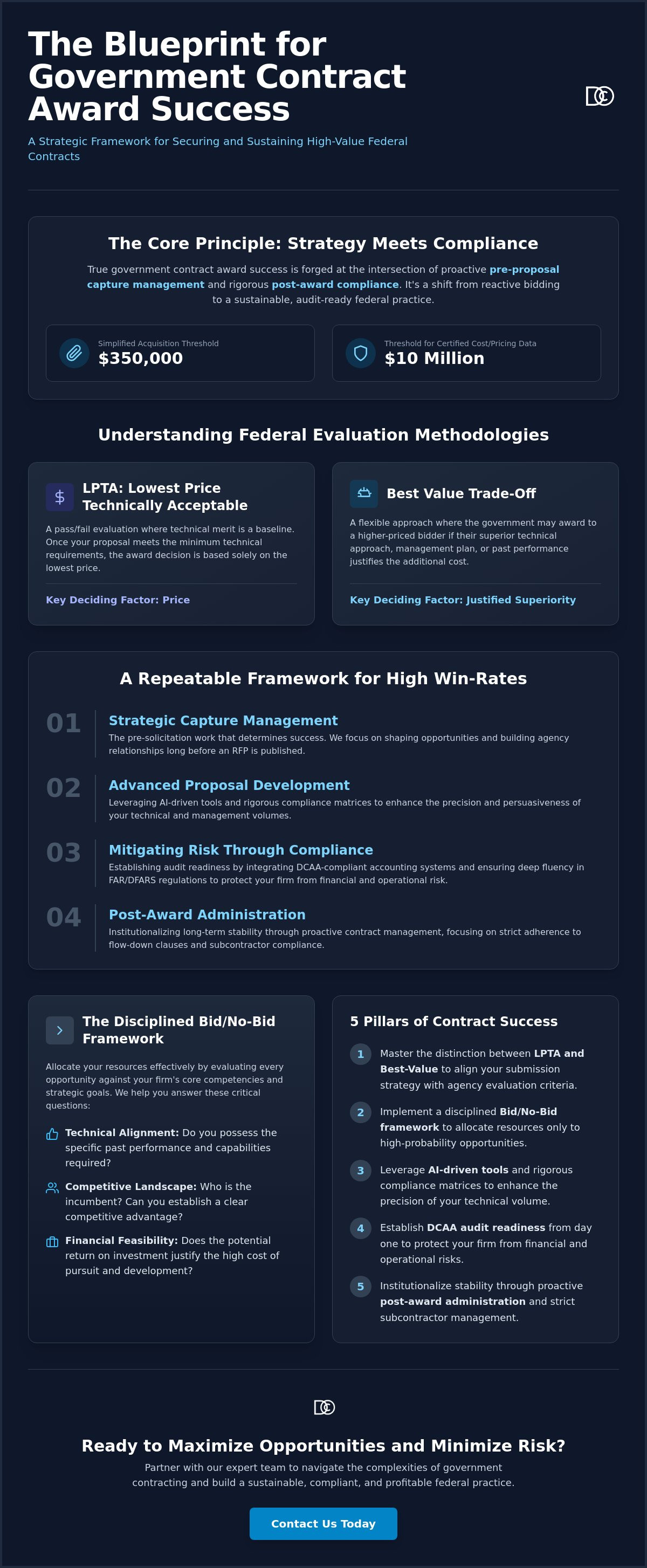
You're looking for more than just a win; you're seeking a sustainable path through a landscape where the Simplified Acquisition Threshold has risen to $350,000 and the threshold for certified cost or pricing data is now $10 million. This article provides a comprehensive analysis of the methodologies and compliance standards required to secure and maintain high-value federal contract awards in 2026. We'll examine a repeatable framework for high win-rates, ensuring your firm achieves full regulatory compliance and long-term stability. Our guide leads you through the lifecycle of contract management, from initial strategy to final execution, so you can maximize opportunities while minimizing risk.
Key Takeaways
- Master the distinction between Lowest Price Technically Acceptable (LPTA) and best-value trade-off selections to align your submission strategy with specific agency evaluation criteria.
- Implement a disciplined Bid/No-Bid framework to ensure your resources are allocated only to high-probability capture opportunities where you maintain a clear competitive advantage.
- Leverage AI-driven tools and rigorous compliance matrices to enhance the precision of your technical volume, a critical step for achieving government contract award success in 2026.
- Establish audit readiness by integrating DCAA-compliant accounting systems that protect your firm from financial and operational risks during cost-reimbursement contract performance.
- Institutionalize long-term stability through proactive post-award administration, focusing on the strict management of flow-down clauses and subcontractor compliance.
The Anatomy of Government Contract Award Success
In the framework of the Federal Acquisition Regulation (FAR), a contract award is the formal notification that the government has accepted your firm’s offer, creating a legally binding obligation. This milestone is the culmination of complex government procurement processes that demand more than just a persuasive proposal. To achieve government contract award success in 2026, you must recognize that the award represents a strategic alignment between your capabilities and the government’s mission requirements. The Contracting Officer (CO) acts as the ultimate arbiter, ensuring that every selection is justifiable, compliant, and provides the best value to the taxpayer. We see 2026 procurement trends shifting away from reactive bidding. Agencies now prioritize contractors who demonstrate proactive strategy and deep regulatory fluency before the RFP even hits the street.
Understanding the Federal Selection Criteria
The government typically employs two distinct evaluation methodologies to determine which firm receives the award:
- LPTA (Lowest Price Technically Acceptable): This is a pass/fail system where technical merit is treated as a baseline. Once a firm meets the minimum technical requirements, price becomes the sole deciding factor.
- Best Value Trade-Off: This flexible approach allows the government to award a contract to a higher-priced bidder if their technical approach, management plan, or past performance justifies the additional cost.
Evaluation boards meticulously score technical and management volumes, looking for specific "strengths" that exceed baseline requirements. Your past performance isn't just a reference check; it's a heavily weighted metric that serves as a primary indicator of your firm’s ability to mitigate risk and deliver results under pressure. In 2026, scoring high in these areas requires a clear demonstration of how your internal processes align with federal standards.
The Economic Impact of Strategic Awards
A single award often serves as an entry point into a much larger ecosystem of federal opportunities. The lifecycle value of a federal contract frequently extends far beyond the initial dollar amount through the exercise of option years and the issuance of task orders. Strategic positioning on IDIQ (Indefinite Delivery Indefinite Quantity) vehicles or GSA Schedules is essential for long-term growth. These vehicles provide a streamlined path for agencies to reach your services, effectively reducing future competition. Contract Award Success is the alignment of technical merit and regulatory compliance. By viewing each bid as a component of a broader capture management strategy, you ensure that your firm isn't just winning work, but building a sustainable, compliant, and profitable federal practice.
Strategic Capture Management: Maximizing Win-Probability
Winning a federal contract isn't an accident of good writing; it's the result of a disciplined capture process that begins long before the Request for Proposal (RFP) is published. We believe that government contract award success is determined by the work you perform during the pre-solicitation phase. This is especially true for firms leveraging small business certifications like 8(a), SDVOSB, or WOSB, where early engagement can help shape set-aside requirements. If you're waiting for the RFP to hit SAM.gov to start your strategy, you're already behind competitors who've spent months mapping the procurement environment and building relationships with agency stakeholders.
The Bid/No-Bid Decision Matrix
A disciplined framework for resource allocation is essential because the cost of pursuit is high. We utilize a Bid/No-Bid matrix to evaluate every opportunity against your firm's core competencies and strategic growth goals. This analysis includes several critical layers:
- Technical Alignment: Does your firm possess the specific past performance and technical capability required by the likely evaluation criteria?
- Competitive Landscape: Who is the incumbent, and what are their documented weaknesses? For firms with 8(a) or SDVOSB status, we analyze if the agency is likely to move the procurement from a full-and-open competition to a targeted small business set-aside.
- Financial Feasibility: You must calculate the cost of bid development against the potential lifecycle value of the contract. We ensure that your pursuit costs don't compromise your firm's overall profitability.
Intelligence Gathering and Relationship Building
Effective capture requires moving beyond public data. While official guidance on how to win government contracts emphasizes market research, we take this further by utilizing Freedom of Information Act (FOIA) requests to obtain previous pricing and performance data. This competitive intelligence allows us to establish pricing benchmarks that are both aggressive and profitable. Attending industry days and pre-solicitation conferences isn't just about gathering information; it's about building rapport with the Contracting Officer and Program Managers who will eventually review your submission.
By understanding the specific frustrations an agency faces with its current solutions, you can develop a "Win Theme" that resonates throughout your technical volume. This proactive approach ensures your proposal isn't just compliant, but compelling. Our team's capture management expertise helps you navigate these early stages to ensure you're only chasing contracts where you have a high probability of success.
Advanced Proposal Development and AI Integration
We've moved past the era of manual requirement tracking. In 2026, achieving government contract award success requires a sophisticated blend of artificial intelligence and senior-level strategic insight. As 55.7% of government organizations now utilize AI, with 42.9% having formal policies in place, your firm must adapt to this technological shift to remain competitive. We use AI-driven tools to automate the technical heavy lifting, allowing our strategists to focus on the "Win Themes" established during the capture phase. This transition ensures your response isn't just a document, but a precision-engineered solution that speaks directly to agency evaluators.
Leveraging AI in Federal Proposals
Our approach to AI proposal writing focuses on rapid requirement shredding and automated compliance cross-referencing. Tools like ChatGPT and Microsoft Copilot, used by 64.8% and 61.1% of government-adjacent organizations respectively, can analyze thousands of pages of solicitation text in seconds. This ensures no "shall" or "must" requirement is overlooked during the initial drafting phase. AI-driven templates reduce submission errors by over 40% by automatically flagging inconsistencies in technical specifications and formatting. We maintain a strict "human-in-the-loop" philosophy. AI can't replace the strategic nuance needed to address an agency's unique mission culture; it simply provides the foundation for our experts to build upon.
Technical and Management Volume Optimization
The foundation of a winning technical volume is the Compliance Matrix. We build this document first to ensure every RFP requirement is mapped to a specific page and paragraph in your response. If an evaluator can't find your answer, it doesn't exist. Your executive summary shouldn't just summarize; it should highlight immediate value and address the "Revolutionary FAR Overhaul" proposed rules published on June 23, 2026. Evaluators are looking for contractors who understand these regulatory shifts and have already integrated them into their management plans.
The management approach must be equally rigorous. We integrate specific flow-down clauses and subcontracting plans into this volume to demonstrate your readiness for post-award execution. Before any submission, we conduct a "Red Team" review. This process simulates an actual agency evaluation board, identifying weaknesses and ensuring your narrative is airtight. By utilizing our customized proposal templates, you maintain brand consistency while ensuring your technical response is audit-ready from day one. This disciplined process streamlines the RFP response management cycle, allowing your team to submit high-quality bids without the typical last-minute chaos.
Mitigating Risk Through DCAA and FAR Compliance
Technical excellence is a prerequisite for bidding, but it's rarely enough to secure a long-term partnership with the federal government. We've seen numerous firms achieve technical pass scores only to have their government contract award success derailed by a failed pre-award accounting system audit. The government doesn't just buy a solution; it buys into your firm's operational and financial integrity. If your back-office systems can't withstand the scrutiny of the Defense Contract Audit Agency (DCAA), you're effectively disqualified from cost-reimbursement opportunities. Audit readiness isn't a state you achieve once; it's a constant operational standard that protects your firm from post-award failures and potential debarment.
The Fundamentals of DCAA Compliance
A DCAA-compliant accounting system must accurately segregate direct and indirect costs while maintaining a transparent labor distribution process. Indirect rate structures are particularly critical because they directly impact your contract profitability. You must account for the 2026 contractor compensation cap, which limits allowable costs for employee compensation to $695,000 for the calendar year. Costs exceeding this limit aren't recoverable, and failing to exclude them from your indirect pools can trigger audit findings. We focus on establishing rigorous timekeeping policies that ensure every hour is charged to the correct final cost objective. This level of precision is the only way to mitigate the risk of "floor checks" and labor mischarging allegations.
Regulatory Risk Assessment
The regulatory landscape in 2026 has shifted significantly, particularly with the "Revolutionary FAR Overhaul" and updated thresholds from the 2026 NDAA. As of June 30, 2026, the threshold for requiring certified cost or pricing data has been raised to $10 million. Additionally, the Cost Accounting Standards (CAS) applicability threshold now stands at $35 million. While these increases reduce the compliance burden for some, they don't exempt you from the fundamental ethics and business system requirements found in FAR Part 15. We also monitor the January 7, 2026, executive order that links incentive pay to delivery performance rather than financial metrics. Navigating these complexities requires a partner who understands the intersection of policy and execution. You can strengthen your firm's position by engaging our specialized DCAA compliance consulting to ensure your systems are ready for the next audit cycle.
Institutionalizing Success: Post-Award Administration
The formal acceptance of your proposal is a significant milestone, but it's only the start of the contract lifecycle. True government contract award success is sustained through meticulous post-award administration and a formal commitment to operational excellence. We've seen firms win high-value awards only to struggle during performance because their internal systems weren't prepared for the rigors of federal oversight. It's vital that your actual delivery matches the technical and management promises made in your winning submission. Discrepancies between your proposal and your performance can lead to negative evaluations, financial penalties, or even contract termination.
Effective Contract Administration Protocols
Maintaining a centralized repository for all contract modifications and official correspondence is a fundamental requirement. This documentation serves as your primary defense during audits and performance reviews. We emphasize the proactive monitoring of entries in the Contractor Performance Assessment Reporting System (CPARS). These ratings are the lifeblood of your firm's future growth. A single "Marginal" or "Unsatisfactory" rating can disqualify you from future best-value trade-off selections, regardless of your technical capability. Post-award compliance is the bridge between a single win and a repeatable framework for success.
Managing flow-down clauses is another critical area where firms often face risk. You're legally responsible for ensuring that your subcontractors adhere to the same FAR and DFARS standards that apply to your prime contract. We help you implement robust subcontractor monitoring processes to protect your firm from compliance gaps. Performance monitoring and reporting should be automated where possible to ensure accuracy and timeliness. This disciplined approach ensures that your contract closeout process is seamless, paving the way for exceptional past performance ratings that strengthen your competitive position.
Long-Term Strategic Growth
Success on one contract should be the catalyst for your next ten. We help you leverage current awards to secure follow-on contracts and task orders through strategic acquisition planning. For firms holding 8(a), SDVOSB, or WOSB certifications, post-award excellence is particularly critical, as it often leads to sole-source opportunities or set-aside task orders within existing IDIQ vehicles. By demonstrating consistent value and regulatory fluency, you position your firm as a low-risk partner for new agencies. If you're ready to move beyond reactive bidding and build a sustainable federal practice, contact Dynamic Contracts Consultants LLC for professional proposal and compliance support.
Mastering the 2026 Federal Procurement Landscape
Achieving government contract award success in 2026 requires a shift from reactive bidding to a holistic, compliance-driven strategy. We've explored how the integration of AI-driven proposal frameworks and disciplined capture management creates a decisive advantage in a marketplace where the Simplified Acquisition Threshold has reached $350,000. It's clear that technical merit alone isn't enough; your firm's financial integrity and audit readiness must be beyond reproach to survive the scrutiny of the DCAA and evolving FAR standards.
Our goal is to help you navigate these complexities while institutionalizing the processes that lead to long-term contract stability. By mastering post-award administration and maintaining exceptional CPARS ratings, you ensure that every win serves as a foundation for future growth. We provide the specialized DCAA compliance expertise and comprehensive support needed to minimize risk in high-stakes environments. Secure your next federal award with expert proposal and compliance consulting. Your firm has the capability to lead; we have the strategic framework to ensure you get there.
Frequently Asked Questions
What is the primary difference between a contract award notice and a standstill period?
A contract award notice is the formal public announcement of the selected supplier, while the standstill period is a mandatory pause between the notification of the award and the final contract signature. During this interval, unsuccessful offerors have the opportunity to request debriefings or challenge the decision. This period is designed to ensure transparency and allow for the resolution of potential protests before the government legally executes the agreement.
How can AI-driven proposal writing improve my firm's win-rate in 2026?
AI-driven proposal writing improves win-rates by automating the labor-intensive process of requirement shredding and compliance cross-referencing. These tools allow your team to identify every "shall" and "must" requirement in seconds, reducing the risk of administrative disqualification. By streamlining the drafting of technical volumes, your strategists can spend more time refining win themes and addressing agency-specific pain points that differentiate your bid from the competition.
Why is DCAA compliance necessary before a government contract is even awarded?
DCAA compliance is a prerequisite for cost-reimbursement contracts because the government must verify that your accounting system can accurately track and segregate costs. Achieving government contract award success often depends on passing a pre-award accounting system survey, such as the SF 1408. If your firm isn't audit-ready, the Contracting Officer will be unable to award you the contract, even if your technical proposal received the highest score.
What are the most common reasons for a federal proposal to be disqualified?
Disqualification usually stems from a failure to follow the strict instructions found in Sections L and M of the solicitation. Common errors include exceeding page counts, missing mandatory compliance documents, or failing to address a specific technical requirement. Additionally, submitting a proposal that is deemed "technically unacceptable" during the pass/fail phase of an LPTA evaluation will lead to immediate removal from further consideration by the evaluation board.
How does capture management differ from standard business development?
Capture management is a tactical, opportunity-specific strategy, whereas business development focuses on the broader identification of market leads and relationship building. The capture process involves deep-dive intelligence gathering on a single upcoming RFP, mapping key procurement influencers, and analyzing incumbent performance. It's a disciplined pursuit designed to shape the solicitation requirements and maximize your firm's probability of winning that specific contract.
What is a 'bid/no-bid' analysis and why is it critical for resource management?
A bid/no-bid analysis is a formal decision-making framework used to evaluate if an opportunity is worth the high cost of proposal development. It's critical for resource management because it forces your firm to assess technical alignment, competitive advantages, and financial ROI before committing assets. By declining low-probability opportunities, you ensure that your capture and proposal teams are focused only on the contracts that offer the highest strategic value.
Can a contract award be challenged after the standstill period has ended?
A contract award can be challenged after the standstill or debriefing period, but the process becomes significantly more complex and time-sensitive. Protests are typically filed with the Government Accountability Office (GAO) or the U.S. Court of Federal Claims. However, to trigger an automatic stay of performance, most protests must be filed within 10 days of the debriefing. Waiting until after the contract is executed often makes it harder to stop performance.
What role do flow-down clauses play in post-award contract administration?
Flow-down clauses extend the prime contractor's legal and regulatory requirements to all subcontractors involved in the project. They're essential for maintaining compliance across the entire contract lifecycle, covering everything from DCAA timekeeping standards to cybersecurity protocols. As the prime contractor, you're responsible for ensuring your subcontractors adhere to these clauses. Failure to manage this flow-down process can result in performance failures and financial liability for your firm.


