

We treat a government RFI as an opportunity to help agencies understand the market before shaping an acquisition. Responding to a request for information (RFI) lets you present relevant capabilities, experience, and market insight. A federal RFI supports market research, not a bid or procurement action, and FAR Part 10 covers market research, according to the Federal Acquisition Regulatory Council.
That distinction matters to your strategy: an RFI response isn’t a proposal, and responding doesn’t guarantee that a solicitation will follow. We make your information clear and useful to agency decision-making while showing how your organization relates to the requirement.
This guide explains how to plan a response around agency questions, present evidence without unnecessary proprietary detail, organize and review content, and follow up appropriately. It also shows how a disciplined RFI process can support capture planning, compliance, and readiness for the next stage of the procurement lifecycle.
Key Takeaways
- We frame your RFI response as market-research input that helps an agency assess capabilities and acquisition options, not as a bid.
- We align your response with the agency’s questions, decision needs, and submission instructions.
- We centralize reusable response content and audit it for accuracy, consistency, and appropriate handling of proprietary information.
- We establish a structured follow-up process to track agency updates and maintain a professional channel for further discussion.
- We format your response for clarity, with direct answers and relevant evidence that makes your capabilities easy to assess.
Positioning a professionally developed RFI response as a marketing opportunity
- We begin by identifying the agency’s market-research objective. Federal Acquisition Regulation (FAR) Part 10 covers market research, according to the Federal Acquisition Regulatory Council. An RFI helps an agency understand available companies, capabilities, commercial approaches, and potential acquisition needs before deciding how to proceed. We treat your response as decision support, not a sales brochure or substitute for a later proposal. That focus helps your team provide relevant, specific information the agency can assess.
- We translate the request into decision criteria before drafting. Our process maps each agency question to supporting evidence, identifies gaps, and connects claims to verifiable company experience. If an agency asks about implementation capacity, for example, we describe your delivery model, key dependencies, and comparable work. If it asks about market availability, we explain your capability and its practical limits. This approach keeps the main point clear and prevents unsupported claims from obscuring useful information.
- We distinguish an RFI from later procurement documents so you can plan appropriately. An RFI gathers market information; an RFP requests proposals for a potential award, while an RFQ requests quotations against stated requirements. An RFI response is not a bid, and it does not guarantee a later solicitation. We position your response as input to agency planning, not as a promise of an award or a substitute for a future proposal.
- We handle legal effect and confidentiality carefully. An RFI response supports market research, but that alone does not establish a blanket rule about every statement’s legal effect. We review the RFI’s instructions with you, identify proprietary material, and avoid presenting estimates, capabilities, or schedules as commitments unless intended. Don’t assume the agency will keep the entire response confidential. If the RFI does not specify how to mark proprietary information, we can help you choose an appropriate approach.
- We use the agency’s RFI as the primary template for your response. Its questions, requested attachments, and submission directions provide the working structure; an unrelated sample may not fit. We can adapt previously approved responses to comparable requirements, update outdated details, and tailor each answer to the current request. Customized proposal templates can help maintain consistency, but we adapt them to the agency’s inquiry rather than reuse proposal language wholesale. This keeps the content relevant and focused.
Planning appropriate post-submission follow-up with expert support
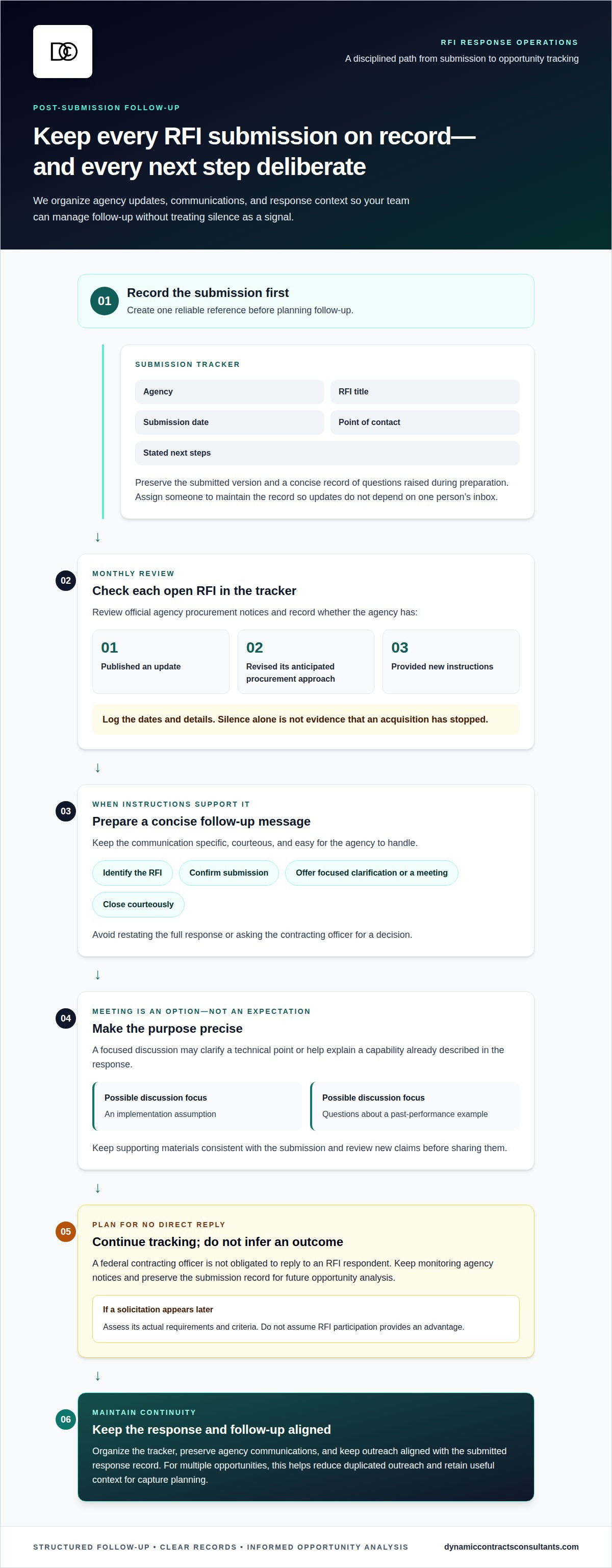
- We record your submission before planning follow-up. Our tracker captures the agency, RFI title, submission date, point of contact, and stated next steps. We also preserve the submitted version and a concise record of questions raised during preparation. This gives your team a reliable reference if the agency requests clarification or capture staff revisit the opportunity. We assign responsibility for maintaining the record, so important updates don’t depend on one person’s inbox.
- We schedule a monthly review for each open RFI in your tracker. During each review, we record whether the agency has published an update, revised its anticipated procurement approach, or provided new instructions. We use official agency procurement notices to identify changes and log their dates and details. This cadence helps your team stay informed without treating silence as evidence that an acquisition has stopped.
- We prepare a concise follow-up message when the submission process or agency instructions support one. A useful email can identify the RFI, confirm submission, offer a focused clarification or meeting, and close courteously. We keep the message specific to your response and avoid restating the full proposal or asking the contracting officer for a decision. This makes the next interaction easier to handle without pressing for an immediate reply.
- We frame a meeting as an option, not an expectation. A focused discussion may clarify a technical point or help the agency understand a capability described in your response. We state the proposed purpose clearly, such as explaining an implementation assumption or answering questions about a past-performance example. We also keep supporting materials consistent with your submission and review new claims before sharing them.
- We plan for the possibility that you receive no direct response. A federal contracting officer is not obligated to reply to an RFI respondent, so your follow-up plan shouldn’t depend on confirmation or feedback. We continue tracking agency notices and preserve the submission record for future opportunity analysis. If a solicitation appears later, we help your team assess its actual requirements and criteria rather than assume RFI participation provides an advantage.
- We help maintain continuity between your submission and follow-up. A proposal professional can organize the tracker, prepare a concise message, and keep agency communications aligned with the response record. If your team manages several opportunities, this process can reduce duplicated outreach and preserve useful context for capture planning. To discuss a structured follow-up approach, connect with our team.
Centralizing and auditing RFI response content with professional support
- We work with your team to establish a controlled repository for approved response content. We organize capability statements, past-performance examples, technical descriptions, and contract references by topic. Together, we assign each asset an owner and record its approval date, source, and intended use. Our team can maintain this structure so you can draw on current material instead of scattered files. Centralization also helps us identify duplicate claims before they enter an agency response.
- We help your team separate reusable facts from opportunity-specific answers. Your company’s staffing model may remain stable, while its proposed approach depends on the agency’s requirement. We label these content types clearly. For example, we mark a past-performance narrative as reusable, then tailor the relevance statement to the RFI’s scope. This distinction helps us prevent older proposal language from being presented as a precise answer to a different market-research question.
- We track versions and approval status for every shared asset with your team. We record who revised a capability claim, what evidence supports it, and whether the change has been approved. A version history helps us trace a statement to its source when a contract example or performance metric changes. It also reduces conflicting descriptions across response drafts, capability materials, and internal capture documents.
- We audit content for accuracy with your team before adapting it to a new RFI. We review dates, customer names, contract descriptions, performance results, and references to competitors. We remove claims that cannot be substantiated and update language that no longer reflects current capabilities. Proposal managers report that 18% audit their responses once per year, while 25% never audit their proposal content. We make a defined review cycle part of response operations, not an occasional cleanup.
- We work with your team to assign distinct review responsibilities. A technical lead can validate solution descriptions, while a contracts specialist checks contract references and a proposal editor checks consistency and readability. We route exceptions, such as an outdated metric or an unclear customer reference, to the responsible owner. This review path records decisions and prevents unresolved edits from moving silently into a submitted version.
- We help your team control sensitive and proprietary material at the content level. We store approved public descriptions separately from restricted details, such as internal methods or commercial information. During RFI development, we use only the detail needed to answer the agency’s question. We check the RFI’s instructions for marking requirements and apply the selected treatment consistently across the response and its attachments.
- We turn review findings into process improvements with your team. If reviewers repeatedly find stale contract examples or inconsistent capability claims, we revise the repository and assign an owner for future updates. We save the approved final response alongside its source materials so later teams can distinguish reusable evidence from opportunity-specific language. This keeps each submission grounded in your own verified record and separates it from unsupported claims about competitors.
Planning a professional RFI response process
We connect the agency’s requirements, your evidence, and the response deadline through a structured process.
Assessing your RFI response
We assess the RFI, attachments, submission deadline, and your relevant capability materials. We also review examples of comparable work, known delivery constraints, and the internal owners who can validate technical claims. This helps us determine whether the request aligns with your capabilities and whether your evidence supports a credible response. We evaluate the agency’s questions and your ability to answer them, not just a potential contract’s visibility.
Before we begin, we explain how we evaluate fit, coordinate subject-matter experts, control revisions, and handle proprietary information. We clarify who reviews each response area and how we surface open issues. Together, we establish the work plan and decision points before drafting begins.
Planning your RFI response timeline
We start with the agency’s deadline and your internal approval constraints. We build the schedule backward from the deadline, allowing time for content development, technical review, leadership approval, and final document checks. The effort depends on the RFI’s scope, attachment requirements, access to accurate source material, and the number of reviewers involved. There is no standard response period for every organization; the agency’s deadline determines the available time.
We identify dependencies early. For example, if your response requires input from a technical lead or contract-performance documentation, we schedule those contributors before final review. A clear review calendar also shows when unresolved claims or missing evidence could affect the response’s completeness.
Structuring and formatting your RFI response
We map each RFI question to a response section and supporting evidence. Your response should follow the agency’s requested structure, answer each direct question first, and add context only when it improves understanding. We format the response to make requirements, assumptions, and capability statements easy to distinguish. We also review the solicitation’s file, page, and submission instructions so document design supports compliance rather than distracting from the content.
Before approval, we conduct a traceability review that connects each agency question to its answer. Our final pass catches unanswered subparts, inconsistent terminology, unsupported claims, and attachment references that don’t match the submitted files. This shows reviewers clearly how your response addresses the requirement.
- We confirm the agency’s objective and your response’s strategic value before drafting.
- We assign technical, contracts, and leadership reviewers based on the evidence each section requires.
- We reserve final review time for traceability, document consistency, and submission instructions.
How does a proposal professional structure and format an RFI response?
- We organize your response around the agency’s requested sequence. We map each question to a corresponding answer, preserving the RFI’s headings and numbering. This makes omissions easier to spot and helps agency reviewers locate requested information. We place the direct answer first, followed by supporting context, examples, or assumptions. We ensure unrequested sections do not displace the information the agency asked companies to provide.
- We draft a concise executive summary only when it supports the requested format. Our suggested outline allocates two to four sentences and one-quarter of a page to this summary. We use that space to identify your capability, its relevance, and any central assumption. The summary introduces the response’s substance rather than repeating marketing claims or promising results you cannot substantiate.
- We present your organizational information and relevant experience in separate, scannable sections. Our suggested outline assigns one page to the cover and one to two pages to relevant experience. We include two or three similar efforts when useful, explaining their scope and connection to the agency’s stated need. We keep each example specific and distinguish documented past performance from capabilities proposed for future work.
- We place requested pricing information and recommendations where reviewers expect them. Our suggested outline allows one page for rough-order-of-magnitude pricing and assumptions when requested, plus half a page for recommendations. We state the basis and assumptions accompanying any estimate and avoid implying a binding price where the RFI seeks preliminary market input. If recommendations are not requested, we keep them out of the main response or clearly separate them.
- We prepare attachments to be legible and self-explanatory. For example, we ensure aerial and GIS imagery includes north arrows, scale bars, titles, and legends. We check that each exhibit has a clear reference in the body and directly supports an answer. We use file names that identify each attachment’s subject, while keeping labels and captions consistent with the response terminology.
- We run a final format and traceability review before submission. We match every RFI question to an answer, confirm the page sequence, and check that tables, figures, and attachment references remain readable. We review the agency’s submission instructions for file types, naming conventions, and delivery method. These checks help prevent a missing section or unreadable exhibit from weakening your technical response.
- We provide professional proposal-writing support when your response requires coordinated drafting, formatting, and review. Our structured process aligns technical content with the agency’s requested presentation while preserving a clear record of revisions. Request support for your RFI response when you need a polished, submission-ready document.
Dynamic Contracts Consultants LLC
Dynamic Contracts Consultants LLC helps government contractors turn RFI insights into a disciplined proposal and capture strategy. When you need support assessing an opportunity, organizing your response, or connecting market research to future bids, our Proposal Writing and Capture Management services can help align your capabilities with agency requirements. We focus on clear, evidence-based content that supports decision-making without treating an RFI as a guaranteed path to a contract award. If your team is preparing a response or planning its next procurement move, contact Dynamic Contracts Consultants LLC to discuss your needs.
Turn RFI insight into your next strategic move
A completed RFI response can inform more than one procurement decision. We recommend treating the agency’s questions and market signals as inputs to broader business planning. Consider whether they reveal capability gaps, affect investment priorities, or point toward partnerships worth exploring. Our disciplined approach to responding to a request for information (RFI) can support decisions across your opportunity pipeline, not just the immediate submission.
We offer Proposal & Grant Writing, DCAA & Cost Support, and Capture & Proposal Development. Our services can support your organization as you develop proposals, pursue grants, assess opportunities, or address cost and compliance needs. The right support depends on your objectives and the work ahead.
Bring your next opportunity into focus with a deliberate plan. Contact us to discuss how we can support your goals. Your next strategic step can begin with a clear conversation.
Frequently Asked Questions
What is a government RFI for?
A government RFI helps an agency gather information about the market before shaping an acquisition. We help you clarify whether your company offers relevant capabilities, what approaches are available, and how a requirement might be framed. For example, agency feedback may inform whether an acquisition should consider a small-business set-aside. We guide you in providing input for planning, while making clear that responding to a request for information (RFI) does not guarantee a later solicitation or contract award.
What is an RFI process?
An RFI process begins when an agency releases questions or information requests to learn about available capabilities and market conditions. We help you respond according to the agency’s instructions, so your input can support acquisition planning. Our guidance includes assessing fit, gathering evidence, preparing a compliant response, and tracking later agency notices. This is distinct from competing for an award through a solicitation.
What is an RFI?
An RFI, or request for information, is an agency document used to ask companies for information relevant to a potential need. We help you address requests about technical approaches, organizational capabilities, market availability, or implementation considerations. For instance, your company might explain how its existing capability addresses a stated need and identify dependencies that affect delivery. The agency uses responses to understand the market, not as a substitute for a solicitation.
What should a proposal professional leave out of an RFI response?
We advise proposal professionals to omit unsupported performance claims, unrelated company history, and technical details that don’t answer the agency’s questions. For example, a response about implementation capacity need not include an extensive description of unrelated product features. We also help you avoid disclosing proprietary methods beyond what the request requires, criticizing competitors, or presenting preliminary assumptions as firm commitments. Keep useful evidence and remove material that distracts from the agency’s inquiry.
What is a request for information (RFI), and what is it used for?
A request for information is a structured way for an agency to obtain market input before finalizing an acquisition approach. We help you use your response to identify available solutions, inform the description of a requirement, and surface considerations that affect procurement planning. For example, agency feedback may indicate that a stated need could be met through different technical approaches. An RFI is a research instrument, not a request for a binding offer.
What information should a proposal professional include in an RFI response?
We help you include information that directly addresses the agency’s questions, such as relevant capabilities, delivery considerations, supporting experience, and material assumptions. When describing a past project, explain its connection to the agency’s need rather than relying on a customer name alone. We recommend including limitations that affect feasibility and distinguishing current capabilities from potential approaches that depend on agency decisions or additional requirements.
What are the steps a proposal professional follows to prepare and submit an RFI response?
We guide you through reviewing the RFI and identifying its questions, instructions, and required attachments. Next, we help gather input from relevant technical and business contributors, map evidence to each question, and prepare a draft. We support reviews to resolve gaps, confirm accuracy, and check the format against the agency’s submission directions. After submission, we help you record the final version and track related agency updates.
How can a proposal professional write a clear and persuasive RFI response?
We help you make a response persuasive by answering each question directly and supporting important claims with relevant evidence. Use precise descriptions instead of broad statements such as “industry-leading,” and explain how a capability applies to the agency’s stated need. For example, describe a comparable effort’s scope and outcome without implying it guarantees future performance. We also recommend consistent terminology, readable formatting, and clear assumptions to help agency reviewers assess the information.


