

What if information can be unclassified and still carry strict cybersecurity obligations? Controlled Unclassified Information (CUI) requires safeguarding or dissemination controls under applicable law, regulation, or government-wide policy. We explain how your contract and the information you handle shape the cybersecurity requirements for government contractors, including when NIST SP 800-171, DFARS, and CMMC may apply.
These obligations vary by contract and can extend throughout your supply chain. Identify the data in scope, the standards that apply to your systems, and the contract terms for incident reporting and subcontractor flow-downs.
This guide explains how CUI is defined, how NIST frameworks, DFARS, and CMMC fit together, and what incident reporting and flow-down clauses mean for you and your subcontractors. Use it to assess your contract obligations and align compliance planning with the work you perform.
Key Takeaways
- Determine whether your contract information is FCI or CUI, since the data type helps shape the cybersecurity safeguards that apply.
- Use contract clauses to identify whether NIST SP 800-171, DFARS, CMMC, or other requirements govern the systems handling the information.
- Understand how CMMC level requirements relate to the information your organization handles and the terms of your contract.
- Plan for cyber incident reporting by clarifying applicable obligations, responsible parties, and response procedures.
- Address subcontractor flow-downs by tracing covered information through your supply chain and aligning contract terms with safeguarding responsibilities.
Which frameworks meet your government contractor cybersecurity requirements?
For your U.S. contracting work involving CUI, cybersecurity requirements center on NIST SP 800-171 and applicable contract clauses. Your other systems may face different requirements, depending on the information you handle and the terms of your award. Unmet clauses or assessment obligations can create contract risk, including difficulty demonstrating compliance for covered work. We help you understand these obligations and align your compliance approach with the work you perform.
NIST SP 800-171 Requirements for CUI
NIST SP 800-171 provides security requirements for nonfederal organizations handling controlled unclassified information for federal agencies. We use it to guide CUI protection in your contractor systems, while contract clauses establish when requirements apply. Federal contractors have been required to comply with NIST SP 800-171 standards since 2016.
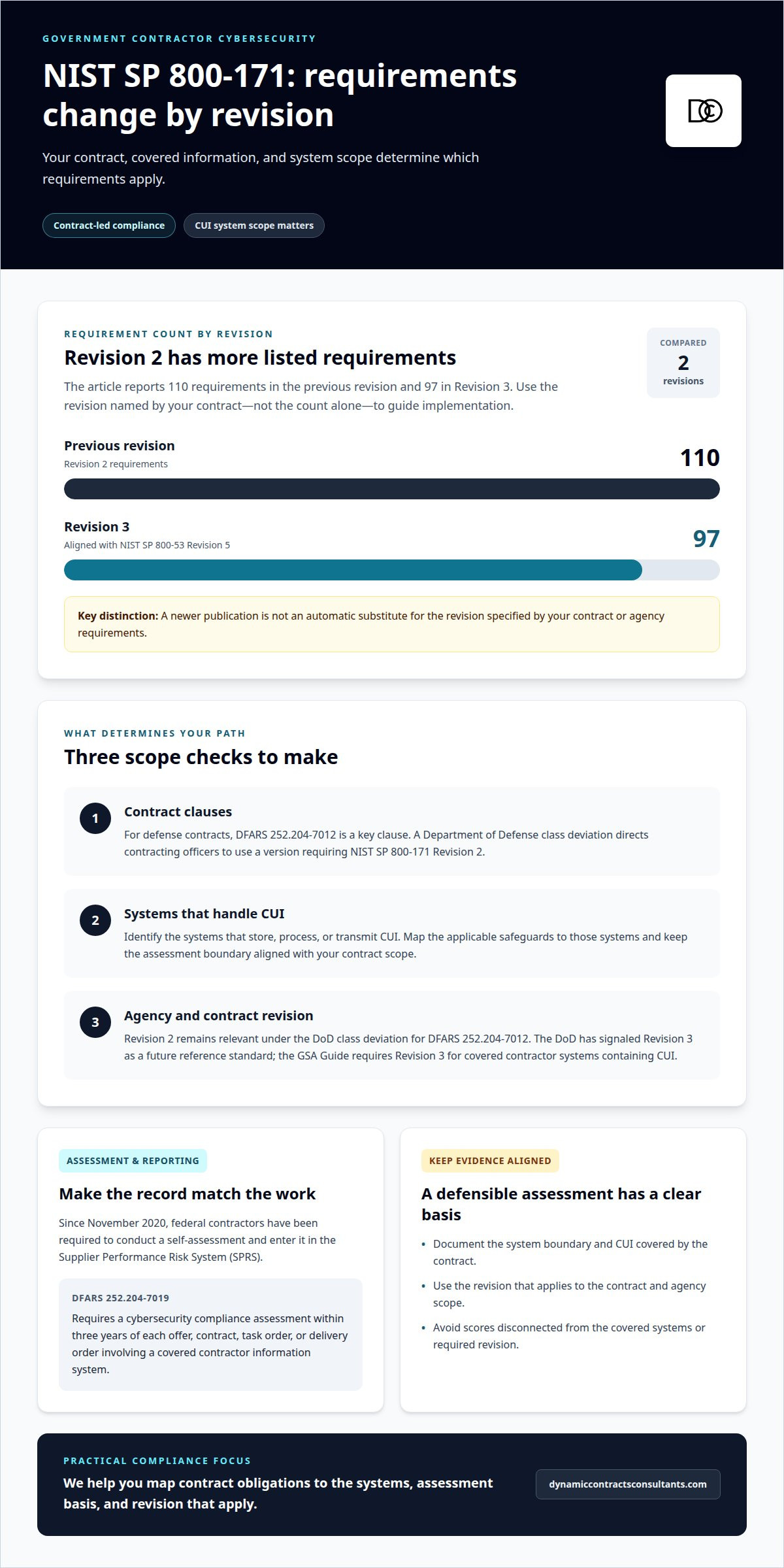
Start by identifying which of your systems store, process, or transmit CUI, then map applicable safeguards to those systems. For your work involving CUI, the specific cybersecurity requirements depend on your contract terms and system scope. For defense contracts, DFARS 252.204-7012 is a key clause; a Department of Defense class deviation directs contracting officers to use a version requiring NIST SP 800-171 Revision 2. We can help you map these obligations to your procurement lifecycle and document your approach.
Assessment and SPRS Score Reporting
Assessment and reporting make your implementation measurable. Since November 2020, federal contractors have been required to conduct a self-assessment and enter it in the Supplier Performance Risk System (SPRS). Your assessment should reflect the systems and CUI covered by your applicable contract, rather than an organization-wide score disconnected from contract scope.
Keep your assessment basis aligned with your documented system boundary and the selected NIST revision. DFARS 252.204-7019 requires contractors to undergo a cybersecurity compliance assessment within three years of each offer, contract, task order, or delivery order involving a covered contractor information system, according to the Department of Defense. A score that does not match your relevant system or required revision can weaken your compliance record. We help you maintain precise, defensible assessment documentation.
Revision 3 Requirements
NIST SP 800-171 Revision 3 contains 97 requirements, compared with 110 in the previous revision, and aligns with NIST SP 800-53 Revision 5. The changed requirement count does not remove your need to assess safeguards against the version named by your contract. We recommend tracking your applicable revision and avoiding treating a newer publication as an automatic substitute.
Revision 2 remains relevant under the Department of Defense class deviation for DFARS 252.204-7012, while the Department of Defense has signaled Revision 3 as a future reference standard. The GSA Guide requires covered contractors to implement NIST SP 800-171 Revision 3 for contractor systems containing CUI. These distinctions make your contract and agency scope essential when planning updates, documenting implementation, and reporting assessment results. We partner with you to support strategic compliance and scalable operational efficiency.
CMMC certification requirements for your contracts and subcontracts
We help you understand how CMMC applies to Department of Defense contracting, with requirements tied to contract scope and the information you handle. State and local contractors do not automatically face the same federal CMMC requirements. Your obligations depend on your contracts and applicable agency terms.
Self-Assessments and Third-Party Certification
We guide you through CMMC requirements by level and assessment pathway. Level 1 generally applies when you handle Federal Contract Information only, while Level 2 applies when you handle CUI and aligns with NIST SP 800-171. Level 3 is reserved for select, higher-risk contracts.
Under the announced CMMC 2.0 model, Level 1 uses an annual self-assessment and affirmation. Levels 2 and 3 require third-party certification in the described model, although some Level 2 contracts may use self-certification. Your solicitation and contract determine the applicable assessment route. DFARS 252.204-7021 addresses your compliance with CMMC level requirements, according to the Department of Defense.
Defense Industrial Base Requirements
We help you navigate CMMC, developed for the Defense Industrial Base and built on NIST SP 800-171 to verify cybersecurity practices. For a Level 2 contract involving CUI, the applicable requirements include 110 security controls in NIST SP 800-171 Revision 2, with Revision 3 compliance forthcoming. Your required level depends on your contract’s information and stated CMMC terms.
As a prime contractor, you should account for subcontractors that handle covered information, because CMMC obligations can extend through defense contracts and subcontracts. A subcontractor’s role, access to CUI, and contract flow-downs help determine the relevant assessment requirements. The Department of Defense estimates that more than 220,000 Defense Industrial Base companies will be affected by CMMC, while more than 76,000 will eventually need third-party certification.
Cross-Agency Compliance Differences
CMMC is a Department of Defense program, so it does not replace requirements imposed by other federal agencies. For example, GSA’s IT Security Procedural Guide applies to covered GSA systems containing CUI, including systems that meet CMMC Level 2 requirements. If you work across agencies, distinguish CMMC obligations from agency-specific controls and contract clauses.
That distinction matters for your state and local awards: the federal CMMC schedule does not, by itself, set their requirements. Review your applicable solicitation and contract terms to identify required standards, assessment evidence, and reporting duties.
The final CMMC regulation was released on September 10, 2025. Beginning November 10, 2025, Department of War solicitations must include Level 1 and Level 2 self-assessment requirements. The Department of War announced the immediate suspension of CMMC Phase II requirements on July 13th, 2026, while the broader rollout is expected to continue through 2028. We recommend tracking the phase and assessment terms stated in each solicitation rather than assuming a uniform implementation date.
For support aligning your contract clauses and post-award obligations, connect with Dynamic Contracts Consultants LLC about the requirements affecting your awards and subcontract relationships.
DFARS cyber incident reporting and subcontract flow-down
DFARS 252.204-7012 requires you and your subcontractors to report cyber incidents affecting covered contractor information systems or covered defense information. We recommend connecting your incident response procedures to the clause and the reporting instructions in your contracts.
Incident Reporting and Government Notifications
How do you report cyber incidents to the federal government? We help you follow the reporting process and notifications required by your applicable contract, including DFARS 252.204-7012 when it applies. The clause covers incidents affecting covered systems or covered defense information, so your response teams need to identify affected assets and information promptly.
A practical response plan assigns responsibility for recognizing, escalating, documenting, and reporting incidents. For example, you can specify how your security team alerts contract administration when an affected system supports a defense award. This coordination helps ensure you consider government notifications alongside technical containment and evidence preservation.
The one-hour reporting rule applies in a specific context. A cited Department of Defense directive requires personally identifiable information breaches to be reported to US-CERT within one hour of discovery. This is not a general DFARS deadline for every cyber incident. We recommend distinguishing the PII breach requirement from the reporting terms in your applicable contract.
During crisis management, keep a clear record of the incident, its known impact, and notifications made. We recommend using response plans and tabletop exercises to help your teams rehearse roles before a critical event. Your contract terms, agency-specific information security controls, and the information affected determine which notifications and follow-up steps apply.
Subcontractor Flow-Downs
We recommend addressing incident reporting in your subcontracts involving covered information or systems. DFARS 252.204-7012 applies to contractors and subcontractors handling covered defense information, making your subcontract terms an important part of the compliance chain. Align your flow-down language with your prime contract’s obligations.
Define how your subcontractor escalates a suspected incident to you, who coordinates government notifications, and how relevant records are preserved. For example, your subcontractor supporting a defense system should know which of your contacts receives incident details. Clear procedures reduce gaps between your supplier’s detection and your response.
Tie each flow-down clause to your subcontractor’s role and information access. A supplier handling covered defense information may need different response coordination from one that does not. Documenting these distinctions supports consistent supply-chain reporting without assuming every supplier has identical duties.
Review your prime contract and each relevant subcontract together when requirements change or a new supplier gains access. This process helps you identify mismatched reporting language, unclear escalation paths, or responsibilities that have not been assigned. For ongoing awards, post-award contract administration can help you organize flow-down clauses and compliance responsibilities across the contract lifecycle.
What is Controlled Unclassified Information (CUI)?
CUI is unclassified information that requires safeguarding or dissemination controls under applicable laws, regulations, or government-wide policies. Federal Contract Information (FCI) and CUI are related categories, but their contract safeguards differ. We help you distinguish between them to support strategic compliance.
Federal Contract Information and CUI
The federal CUI regulation defines controlled unclassified information at 32 CFR § 2002.4. CUI is not classified information, but its designated category can require specific protections. Executive Order 13556, issued on November 4, 2010, created an executive branch-wide program for managing sensitive unclassified government information.
FCI has a separate contract-security framework. FAR § 52.204-21 establishes cybersecurity requirements for federal contract information, including 15 basic security controls for covered contractor information systems. The practical distinction is the applicable contract clause and information category, not simply whether information appears sensitive. You should trace the data to your contract and identify any CUI designation or FCI safeguards.
CUI Safeguarding
Federal CUI requirements connect the information’s category to its required safeguarding and dissemination controls. Under 32 CFR 2002.14(c), the applicability of the CUI Guide depends in part on established safeguarding requirements. You should identify the CUI involved, the systems handling it, and the contract terms that govern access and protection.
For CUI you handle as a nonfederal organization, NIST SP 800-171 provides the relevant security requirements when applicable contract terms invoke them. The CMMC framework also draws on NIST SP 800-171 for defense contractors. These frameworks support your protection of CUI, but they do not make every unclassified record CUI or replace the clauses that establish your obligations.
Federal contracts can also contain cybersecurity representations tied to specific clauses and covered systems. FAR 52.204-21 is relevant to FCI; defense contracts may impose distinct requirements for covered defense information. You should align your statements about safeguards with the systems, data, and controls actually covered by your contract. A representation that describes a broader environment than your assessed scope can create avoidable compliance exposure.
FISMA adds another layer when you operate a system on behalf of a federal agency. The Federal Information Security Modernization Act of 2014 applies to federal agencies and contractors operating federal systems. In that context, the agency’s system security requirements matter alongside your contract-specific CUI or FCI clauses. Distinguish an agency-operated federal system from your system handling contract information, then map each system to its applicable standards and technology controls.
For practical scoping, we recommend documenting which systems receive federal information, which category applies, and which contract clauses govern each system. This helps you distinguish FCI protections from CUI requirements and connect required actions to the correct contract, system, and cybersecurity maturity model.
Supply-chain cybersecurity and subcontractor flow-downs
We help you account for information shared beyond your internal network as you build your federal cybersecurity program. Federal contract information security standards apply to contractors and subcontractors and include 15 basic security practices. We assess where covered information travels, which vendors can access it, and how contract terms assign safeguarding responsibilities across your supply chain.
We map information flows from your prime contractor operations to each supplier, vendor, and subcontractor. For each relationship, we identify the information shared, the systems involved, and the work performed. For example, a vendor accessing a system containing contract information creates a different data path from a supplier that receives no government information.
- We identify systems and data shared with your suppliers, including relevant cross-border data flows.
- We connect each subcontractor’s role to applicable contract requirements and flow-down clauses.
- We define how you receive compliance information and escalate identified gaps.
- We record changes when your vendors, systems, or information access change.
These cybersecurity requirements for government contractors call for documented responsibilities across your supplier relationships. The National Institute of Standards and Technology’s NIST SP 800-171 framework can inform safeguards where CUI requirements apply. For your defense awards, CMMC requirements may also shape how your contractors and subcontractors demonstrate cybersecurity maturity. We assess applicable clauses and information to determine which standards govern each relationship.
We help you address both technical controls and contractual visibility through vendor risk management. As a prime contractor, you need enough information to assess whether suppliers handling covered data can meet relevant requirements. We build that visibility into your subcontract terms, reporting paths, and system-access records. This also helps you identify when a vendor’s role changes the information or controls in scope.
Agency requirements may go beyond a baseline framework, so we help you trace each supply-chain review requirement to its source contract. We compare your prime award, subcontract language, and supplier’s actual access. Applying cybersecurity requirements for government contractors consistently helps us reveal unclear flow-downs and implementation gaps. We document the review to support aligned internal policies across your procurement and contract administration.
We help you keep the information map current as your contract lifecycle changes. New subcontractors, revised deliverables, or system migrations can alter data flows and access. An updated flow-down review clarifies who safeguards information, provides compliance evidence, and escalates concerns to you as the prime. This supports practical supply-chain coordination without assuming every vendor has identical responsibilities.
For help aligning your subcontract terms and post-award responsibilities, contact Dynamic Contracts Consultants LLC about flow-down compliance.
Dynamic Contracts Consultants: Post-Award Contract Administration
Dynamic Contracts Consultants LLC provides Post-Award Contract Administration to help manage contract obligations after award, including cybersecurity-related clauses and subcontractor flow-downs. Use this support when requirements need coordination across contract documents, compliance responsibilities, and supplier relationships.
We help organize post-award compliance so responsibilities and contract terms stay aligned during performance. For broader federal contracting needs, our Proposal Writing, Grant Writing, and DCAA Compliance Consulting services address distinct stages of business development and compliance work.
Contact Dynamic Contracts Consultants LLC to discuss post-award contract administration for your government contracts.
Build Compliance Into Your Next Contract Decision
We treat cybersecurity governance as part of contract performance. We help you make it an operating discipline that informs bid decisions, award planning, supplier coordination, and how your team documents execution. As requirements vary across awards, we use an integrated approach to align compliance decisions with your delivery priorities and business growth.
We support government contractors with Post-Award Contract Administration, as well as Proposal Writing, Grant Writing, and DCAA Compliance Consulting. Whether you’re preparing for a new opportunity or strengthening processes across active awards, we help you connect cybersecurity requirements for government contractors to your contract lifecycle and the responsibilities your organization can manage.
We help you assign clear internal ownership of contract obligations, keeping compliance decisions connected to daily operations. That coordination also gives your leadership a practical basis for evaluating opportunities and planning sustainable growth.
Discuss your government contracting priorities with us and identify a practical path forward. We can help you build a disciplined compliance strategy to support confident, sustainable progress.
Frequently Asked Questions
What is NIST 800-171, and how can we help you get started?
NIST SP 800-171 is a security framework for nonfederal organizations handling CUI for federal agencies. We recommend starting by identifying the contract data involved and the systems that store, process, or transmit it. Then determine which revision and contract clauses apply, assess relevant safeguards, and document gaps and implementation evidence. For defense work, confirm how your contract ties NIST requirements to the required assessment and reporting process.
What is the difference between CUI and FCI?
FCI and CUI are distinct information categories, and their protections depend on your applicable contract requirements. FAR § 52.204-21 addresses federal contract information, while CUI has category-based safeguarding and dissemination controls. For example, you may handle FCI under a covered system without that information being designated CUI. Classifying your information correctly helps us determine which security framework, contract clauses, and assessment scope apply.
What are the FAR cybersecurity clauses for federal contractors?
FAR § 52.204-21 is a key clause for federal contract information. It requires covered contractor information systems to meet 15 basic security controls. The clause’s applicability depends on your contract and the system handling the information. We help you distinguish this baseline from CUI-related terms or agency-specific requirements, then map each clause to the systems and contract work it covers.
What is DFARS 252.204-7012, and who must comply?
DFARS 252.204-7012 establishes safeguarding and cyber incident reporting obligations for covered defense information and covered contractor information systems. It applies to you as a contractor or subcontractor when the clause is included in your relevant defense contract terms. We recommend mapping the information and systems supporting your award, then aligning your security procedures and subcontract terms with the clause’s requirements.
What are the CMMC 2.0 levels, requirements, and rollout timeline?
CMMC Level 1 generally applies when you handle only FCI, Level 2 applies when you handle CUI, and Level 3 is limited to select higher-risk contracts. The model uses self-assessment for Level 1; Levels 2 and 3 involve third-party certification, with some Level 2 contracts eligible for self-certification. CMMC requirements are being phased in, and the Department of War announced a suspension of Phase II requirements in July 2026.
What NIST SP 800-171 controls must you implement as a DoD contractor?
Your applicable contract and required NIST revision determine which controls you must implement as a DoD contractor. For CMMC Level 2 contracts involving CUI, the stated requirement is 110 security controls under NIST SP 800-171 Revision 2, with Revision 3 compliance forthcoming. We help you turn the control count into an implementation plan by linking each applicable requirement to system boundaries, evidence, and your contract’s assessment path.
What cybersecurity requirements apply when you handle FCI versus CUI?
For FCI, FAR § 52.204-21 establishes 15 basic security controls for covered contractor information systems. CUI can trigger additional safeguarding requirements, including NIST SP 800-171 and, on applicable defense contracts, CMMC provisions. If you handle both categories, we recommend mapping each information type to its contract clause and system boundary. This helps you avoid applying one baseline indiscriminately across systems with different obligations.
How can you assess compliance and prepare for a CMMC assessment?
Start by defining your system boundary, inventorying covered information, and identifying the assessment route specified in your solicitation or contract. Compare implemented safeguards with the applicable NIST revision, record supporting evidence, and document gaps alongside corrective actions. You must enter a self-assessment in SPRS under the applicable process. We help you align assessment records, system scope, and required affirmation or certification with your contract’s level.


