

We build defensible project estimates by documenting the reasoning behind them. A basis of estimate (BOE) records how we developed an estimate, including the scope, assumptions, methods, and data behind its figures. It helps you trace the connection between planned work, resources, and costs.
That traceability matters because changes to scope, schedule, or estimating assumptions can alter a project’s cost basis. We create a clear BOE so your team and reviewers share an explanation of how the estimate was built, rather than seeing a total without context.
In this article, we explain what a BOE includes, how scope and estimating methods shape project costs, and when we recommend revising the document as work changes. We also cover how a supported estimate can inform your proposal development, project planning, and cost management.
Key Takeaways
- We connect each cost and resource estimate to the work it supports so reviewers can follow the estimate’s logic.
- We document assumptions, data sources, and estimating methods to make the cost basis clear and reviewable.
- We choose estimating methods that fit the available scope definition and explain how each method supports its cost elements.
- We revisit the estimate when scope, schedule, pricing bases, or execution plans change, and preserve a clear revision history.
- We use the estimate to support budgeting and project control while distinguishing contingency for defined-scope uncertainty from management reserve for potential scope changes.
What Is a Basis of Estimate (BOE)?
A Basis of Estimate (BOE) records how a project’s cost, resource, schedule, and risk estimates were developed. We use the term for the documented reasoning behind an estimate, giving you a way to understand how planned work connects to projected resources and costs. In the United States, AACE International Recommended Practice 34R-05 provides guidance for preparing a BOE.
Estimate Assumptions and Data Sources
A BOE explains the assumptions, estimating methods, and data used to develop an estimate. Documenting these inputs lets you and a reviewer assess how each figure relates to the planned work, rather than relying on an unsupported total.
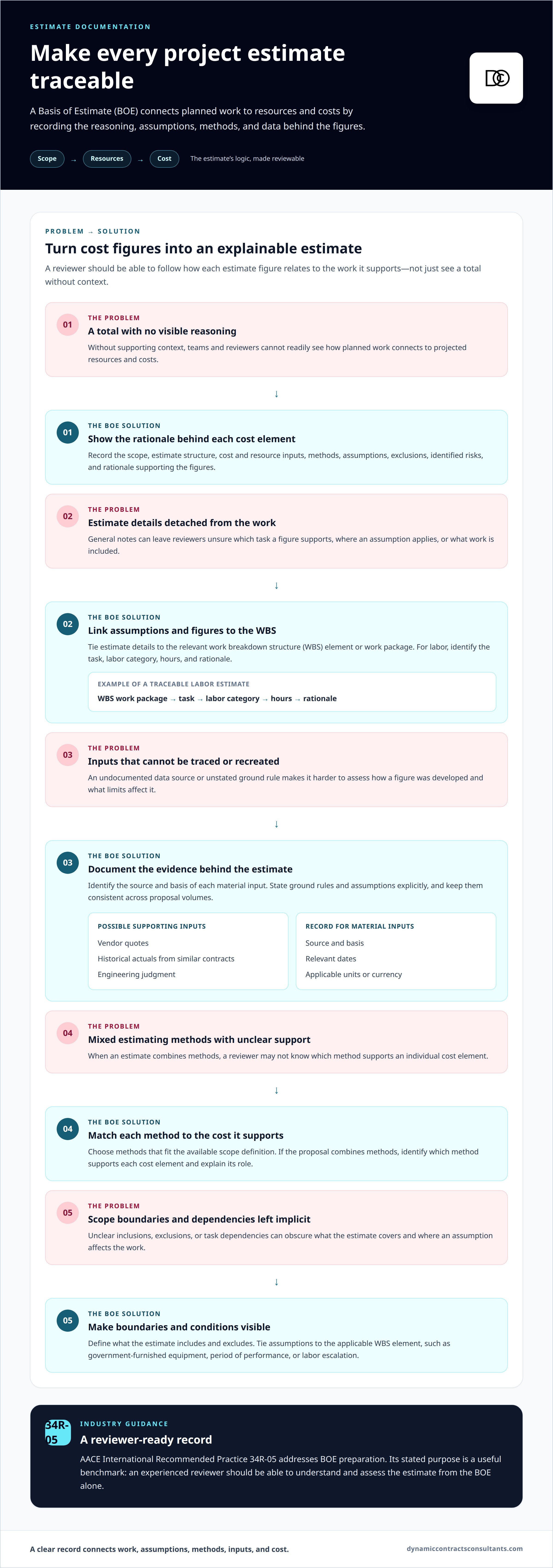
For example, a labor estimate can identify task hours, labor categories, and the rationale behind each cost element. Supporting inputs may include vendor quotes, historical actuals from similar contracts, or engineering judgment. If a proposal combines methods, identify which method supports each cost element.
Document the source and basis of each material input, including relevant dates and applicable units or currency. State ground rules and assumptions explicitly, then keep them consistent across proposal volumes. Assumptions do not need dollar values, but a knowledgeable reviewer should be able to follow and recreate the estimate. Clear records also show where exclusions, risks, or limits affect it.
Assumptions Linked to the WBS
A BOE links assumptions and estimate details to the work breakdown structure (WBS), connecting cost elements to defined work. Make these links visible so you and reviewers can trace a figure from the estimate to its supporting task or work package.
For example, a labor-hours estimate should identify its task, labor category, hours, and rationale under the relevant WBS element. If the estimate assumes government-furnished equipment, document which work depends on it and where the assumption applies. This also helps distinguish included scope from excluded work.
Ground rules can address the period of performance, labor escalation, and other conditions used to develop the estimate. Tie each assumption to the relevant WBS element or work package instead of leaving it as a general note. If an assumption affects several tasks, identify those links so reviewers understand its reach and you have a clearer basis for project decisions.
Industry Guidance for BOE Documents
Industry guidance provides a framework for preparing and reviewing BOEs, while each project’s scope and estimating approach determine the specific contents. AACE International Recommended Practice 34R-05 addresses BOE preparation. We use its stated purpose as a benchmark: an experienced reviewer should be able to understand and assess the estimate from the BOE alone.
A BOE commonly records scope, assumptions, estimating methods, cost and resource inputs, risks, exclusions, and estimate rationale. Organize these details to show how the estimate relates to the work and information used. In government contracting, this record also supports scrutiny of proposed cost elements.
Separate BOE documentation from broader contractor business-system requirements. Under U.S. defense contractor business-system rules, a significant deficiency in one system requires the Administrative Contracting Officer to reduce payments on covered contracts by 5%, according to the U.S. Department of Defense. That consequence concerns a significant system deficiency, not a standalone BOE calculation. We treat a well-organized BOE as a traceable record for estimate review.
BOE definition and purpose
We use a BOE to explain the rationale behind an estimate and show how its cost elements derive from planned work. In federal proposals, this structure helps you connect proposed figures with scope, analysis, and a traceable record.
BOE Definition and Core Elements
We define a BOE as the supporting record that connects estimate figures to their scope, assumptions, methods, inputs, and rationale. We prepare it so someone who did not build the estimate can understand the reasoning behind it.
We include core elements such as the statement of work, estimate structure, cost and resource inputs, exclusions, and identified risks. For example, we explain the task being priced in a labor estimate and the reasoning behind its hours and labor category. These details help you and reviewers assess whether proposed cost elements correspond to the work.
We treat a BOE as more than a list of assumptions attached to a total. Its audit trail preserves how source data and estimating choices support individual cost elements. We also define clear boundaries to show what the estimate includes and excludes, helping you explain its credibility without treating a proposed figure as self-explanatory.
Purpose in Federal Proposals
We use a BOE in a federal proposal to explain how proposed costs align with the statement of work and support evaluation of the offer. Federal Acquisition Regulations Part 15 establishes requirements for transparent written justification of every cost element in a government contracting BOE submission, according to the U.S. General Services Administration.
We connect proposal scope with the estimate’s structure through this written rationale. If your proposal includes labor for a defined task, we explain the task, applicable labor category, and how we developed the proposed hours. That connection gives reviewers a basis for examining costs rather than relying on an unsupported total.
For federal submissions, we can incorporate cost rationale into a coherent proposal. We align your technical approach, scope, and cost explanation so they tell a consistent story. Discuss proposal support when you need help aligning those components.
BOEs, Cost Estimates, and Estimate Reports
We distinguish a cost estimate, which presents calculated figures, from a BOE, which documents the reasoning and inputs that produced them. An estimate report may present results or analysis; we use the BOE to provide the underlying rationale and traceability.
For example, a table may show labor hours and a total for a work package. We use the accompanying BOE to explain which task those hours support, which estimating method produced them, and what assumptions shaped the calculation. Without that explanation, you can see the result but may not be able to reconstruct its basis.
We use these documents for related but distinct purposes. The estimate communicates the projected amount; the BOE makes its assumptions and derivation reviewable. Together, they help you assess scope, cost elements, and rationale during proposal analysis and subsequent review.
Documenting project scope and estimation methods
We prepare a BOE by defining the work, selecting estimating methods, and tracing quantities to documented sources. We start with your statement of work and work breakdown structure (WBS), then explain how we developed each estimate element.
Estimating Methods and Data Sources
We use an estimating method to develop a cost or resource figure, supported by identifiable data. By naming the method and its sources, we help reviewers assess whether each estimate fits its task and available scope definition.
For example, we use analogy estimating to scale a figure from a comparable past effort, while a bottoms-up estimate builds a total from task and labor details. We use parametric estimating to apply a rate or formula, such as cost per square foot or per line of code. We may combine methods in a proposal, but we identify the method supporting each cost element in the BOE.
We can use inputs such as historical actuals from similar contracts, vendor quotes, and engineering judgment. For major commodity and labor bases, we document base dates, quote validity windows, and intended escalation index families. Our dated quote log connects a quantity and price basis to its source. If a similar task supports an analogy, we describe the comparison and identify its relevant charge numbers where applicable.
We use benchmarking against historical data or comparable projects as a cross-check, rather than as a replacement for task-specific analysis. We can also include sensitivity analysis or alternate scenarios in a BOE to show how assumptions affect results. We explain the rationale for efficiency factors and show the calculations leading to the final hour total. These details help reviewers distinguish measured inputs from judgment and understand how we developed the estimate.
Preparing a BOE Step by Step
We prepare a BOE through a structured process that moves from defined scope to supported estimate elements. Following this sequence makes quantity traceability visible and keeps your estimate aligned with the work breakdown.
- We start with your statement of work, then map deliverables and tasks to the relevant WBS elements. We record scope boundaries, exclusions, and the definition status used for the estimate.
- We identify the quantities and resource inputs for each task. We connect labor hours, labor categories, material quantities, and other cost elements to their WBS locations and supporting sources.
- We select a suitable method for each element. We use analogy for comparable prior work, bottoms-up analysis for detailed task inputs, or parametric estimating when a meaningful rate or formula applies.
- We document assumptions, base dates, quote validity, and calculation logic. We include benchmarks or a cross-check, and explain any efficiency factor that affects the result.
- We review the completed estimate for traceability. AACE International Recommended Practice 34R-05 provides guidance for preparing a BOE, while we ensure the document lets an independent reviewer follow its rationale.
For your government proposal, this record makes the link between defined work and estimated resources inspectable. We apply the same discipline to defense work, so reviewers can trace a figure through its WBS task, source, method, and calculation without treating the total as self-explanatory.
Revising a BOE when the statement of work changes
A revised statement of work can change the tasks, schedule, resources, or risks behind your estimate. We reconcile affected estimate elements with the new scope and preserve a version history explaining each change.
We re-estimate when a scope, schedule, or risk change alters the basis of the prior estimate. For example, adding a deliverable may require new labor tasks, while moving a milestone may change the period of performance or resource timing. In the revised BOE, we explain which assumptions still apply, which have changed, and how those changes affect your cost estimate.
We connect each revision to its source and rationale through change control. Our records can identify the changed statement-of-work language, affected work breakdown structure elements, revised quantities, and resulting estimate adjustments. We also document who made the change, when it occurred, and why. This detail helps you and other reviewers distinguish approved scope changes from estimating corrections or updated assumptions.
- Identify the trigger: We record the contract modification, updated schedule, changed risk assessment, or other decision that affects your estimate.
- Trace the impact: We map the changed work to affected tasks, labor, materials, schedule assumptions, and risk responses.
- Reconcile the estimate: We compare prior and revised estimate elements, explaining the basis for each adjustment.
- Preserve the record: We retain the previous version alongside the revision, including its change rationale and approval history.
We also treat risk changes carefully. If new information alters a defined project risk, we update the relevant assumptions and mitigation approach, then show how your estimate reflects that assessment. We keep risks tied to the work they affect rather than applying an unexplained adjustment across the project. This makes the connection between risk analysis and estimate revisions more transparent for you and your reviewers.
Our consistent version history supports estimate reconciliation during project reviews and contracting discussions. For a change order, we can show the original basis, the changed scope, and the reasoning behind the revised estimate. Historical versions also help your team understand how decisions shaped the current baseline, instead of relying on memory or isolated cost files.
We update the BOE when decisions change scope, quantities, pricing bases, or execution plans. During delivery, actual cost, schedule, and risk information can also inform replanning and a new estimate. By recording changes in sequence, we give your reviewers a clear account of how the project’s cost basis developed and which assumptions informed each version.
Project budgeting and cost management
We use a BOE to connect your project scope to the budget used for planning and control. Its cost breakdown can include labor, materials, and administrative expenses, with calculations tied to the work they support.
Using the BOE Across the Project Lifecycle
During planning, we use the BOE to translate proposal assumptions into resource, schedule, and procurement plans. During execution, its documented basis gives your project team a reference for comparing planned work with actual cost and progress. The estimate can also provide a baseline for measuring your project performance.
We make that baseline more useful by aligning its cost and schedule structure with your project’s performance measurement system. This alignment supports variance analysis by connecting a difference in actual results to the relevant work or schedule element, rather than treating your project budget as one undifferentiated total.
For projects using Earned Value Management, we can transfer proposal data into the system to support progress tracking. The BOE’s work breakdown and assumptions provide context for interpreting that data. During delivery, actual cost, schedule, and risk information can inform your replanning and a new estimate.
Updating the BOE at Project Gates
We use project gates as decision points to reassess whether your estimate still reflects approved scope and execution plans. Update the BOE when decisions change scope, quantities, pricing bases, or how work will be performed. We recommend recording the rationale so your current estimate remains connected to those decisions.
- At a scope decision: Reconcile changed deliverables with the affected tasks and budget elements.
- At a pricing-basis change: Update the inputs and calculations that depend on the revised basis.
- During execution: Use actual cost, schedule, and risk data to support re-planning.
- At closeout: Compare estimates with actual results to capture lessons for future planning.
We also recommend separating contingency from management reserve in your budget controls. Contingency addresses variability within defined scope; management reserve stays outside the estimate for potential scope changes. Keeping these purposes distinct helps your decision-makers understand what the project baseline covers and what remains reserved for a changed requirement.
For government contract pursuits, we use cost planning to inform strategic decisions about which opportunities align with your capabilities and priorities. If you need to align pursuit planning with a defensible project budget, discuss capture management support.
Dynamic Contracts Consultants
We help organizations align government contracting strategy, proposal development, and compliance priorities. When a BOE informs a federal proposal, connecting scope, technical approach, and cost rationale supports a coherent submission. Our Capture & Proposal Development services can support the broader pursuit, while our DCAA & Cost Support addresses relevant cost and compliance needs.
Consider engaging our team when you need to strengthen proposal alignment, evaluate a contracting opportunity, or address compliance alongside cost planning. These services complement the estimating work described above; they do not replace your project team’s responsibility for maintaining estimate assumptions and records.
Contact us to discuss your proposal, capture, or compliance needs.
Put Your Estimate to Work
Understanding what a basis of estimate (BOE) is provides a starting point; its ongoing value comes from how it informs decisions across your contracting work. We help you treat the estimate as an active management resource, not a static attachment. As your priorities evolve, we connect cost planning with proposal strategy, funding opportunities, and the compliance demands that shape execution.
We offer Proposal & Grant Writing and DCAA & Cost Support to support you at different points in that process. Our services can help align your proposal materials, funding pursuits, and cost and compliance planning with your broader business objectives.
If you are assessing how your estimating process fits into an upcoming opportunity or operational priority, contact us to discuss your needs. We can help you put stronger planning into motion.
Frequently Asked Questions
How Do You Document a BOE in a Government Proposal?
We recommend organizing the BOE so you can match each proposed cost element to its supporting work and documentation. Use the estimate’s code of accounts, define its units and currency, and cross-reference relevant proposal sections. For example, a labor element can point to the associated task, labor category, calculation, and supporting source. Consistent references help evaluators review the cost narrative alongside the technical proposal.
Is a BOE only created at the start of a project?
No. You can develop a BOE again when replanning produces a new estimate or project decisions change its basis. For example, a quote’s validity window may expire, requiring revised pricing inputs even if the task remains unchanged. We recommend retaining prior versions alongside updates to help distinguish a new estimate from the original and preserve the reasoning behind changes across the project lifecycle.
What level of the Work Breakdown Structure (WBS) needs a BOE?
A BOE can support WBS elements, control accounts, work packages, and planning packages. We recommend selecting the appropriate level based on how your estimate is organized and the detail needed to trace its costs. For example, a control account may summarize related work, while a work package can provide task-level support. Keep the structure consistent with the estimate so reviewers can trace costs through each applicable level.
What is a basis of estimate (BOE) in project estimating?
In project estimating, a BOE is the record that explains how an estimate was constructed and what reasoning supports it. It helps an independent reviewer assess the estimate without relying on the estimator’s undocumented knowledge. For example, if two tasks use different labor assumptions, the record can show which assumption applies to each task and how that choice shaped the estimate.
What information is included in a basis of estimate?
A BOE commonly includes scope, assumptions, methods, data inputs, calculations, exclusions, risks, and estimate rationale. It can also identify the estimate’s units, currency, and code of accounts. We recommend checking whether a reader can connect each figure to its work element and reproduce the calculation from the recorded inputs. The level of detail should match your estimate’s structure and intended review.
What is the purpose of a BOE?
A BOE gives project teams and reviewers an auditable explanation of how proposed figures were developed. In negotiated procurements, that record can support discussion of price by showing the reasoning behind individual cost elements. It can also preserve the rationale if an award is later challenged. We value its role in connecting your estimate to documented decisions, rather than asking reviewers to accept totals without context.
What assumptions and exclusions should a BOE document?
Record assumptions that materially affect scope, resources, timing, or pricing, and identify work excluded from the estimate. Examples include the period of performance, labor escalation, and reliance on government-furnished equipment. Explain which tasks depend on each condition and what work remains outside the estimate. We recommend making this distinction clear so readers understand your estimate’s boundaries and do not treat an assumption as included work.
What estimating methods and data sources are documented in a BOE?
Document the method and supporting evidence for each estimate element. Methods may include analogy, bottoms-up task analysis, or parametric estimating; sources may include historical actuals, vendor quotes, or engineering judgment. A dated quote log can preserve the basis for a material input, while a comparable-project benchmark can provide a separate cross-check. We recommend explaining why the selected method fits your available scope and data.


