

The hardest part of compliance for federal subcontractors is often determining which prime-contract terms flow down to your subcontract and the work you perform. A clause in the prime contract does not automatically apply to every subcontractor. Applicability depends on the clause, the subcontract’s terms, and the work assigned. That assessment can be difficult when contract, operational, financial, and employment responsibilities sit with different teams.
You need a clear view of which requirements apply and whether your records can support a request or review from the prime contractor. This guide explains how to assess relevant obligations, assign ownership, and maintain evidence of performance. It also shows how contract clauses, employment-related requirements, and ongoing documentation fit into post-award oversight.
Drawing on experience as both a prime contractor and a subcontractor, we connect clause analysis with practical controls, deliverable tracking, and audit-ready record preparation. Dynamic Contracts Consultants provides strategic compliance and post-award contract administration support, with FARIFY’s AI-powered capabilities complemented by human review. The result is a traceable approach to managing the requirements tied to your specific subcontract.
Key Takeaways
- Define the compliance scope around your subcontract, assigned work, and organization, including relevant contract-performance and employment obligations.
- Review flow-down terms against the subcontract’s actual scope before translating applicable clauses into controls.
- Build evidence around completed obligations, deliverables, and assigned responsibilities. Policies alone do not show that an action was completed.
- Make compliance for federal subcontractors an ongoing process by documenting how contract modifications affect requirements and controls.
- Use clause analysis and post-award administration to align subcontract controls with organized, review-ready records.
What Compliance for Federal Subcontractors Covers, and Why Scope Matters
Compliance for federal subcontractors means meeting the contract, work-related, and organizational obligations that apply to a particular subcontract. We treat compliance as a scope question, not a generic checklist exercise. Relevant requirements depend on the subcontract’s terms, the work performed, and the organization’s circumstances. This broader view also distinguishes subcontract compliance from guidance focused only on employment requirements.
Contract-performance requirements and employment-related obligations are separate areas, though both may warrant attention. Employment coverage depends on current requirements and relevant organizational or contract-specific facts, so a general summary cannot establish whether a particular obligation applies. The Office of Federal Contract Compliance Programs (OFCCP) provides context on employment-related oversight, but that topic alone does not describe the full range of subcontract commitments.
For a brief overview of subcontractor compliance, watch:
Which federal requirements may affect a subcontractor?
The Federal Acquisition Regulation (FAR) and Defense Federal Acquisition Regulation Supplement (DFARS) provide frameworks that may inform clauses in federal contract documents. Their presence does not mean every provision applies to every subcontract. We compare the subcontract language with the assigned work and organizational context to identify commitments that may require operational controls or records. Employment-related matters call for a distinct review against current authoritative guidance.
Why prime-contractor status does not settle every obligation
A prime contract establishes requirements for the prime’s overall work, while a subcontract defines the terms and scope agreed with a subcontractor. Some prime-contract provisions may be incorporated or otherwise relevant; others may not apply to the subcontractor’s assigned work. We distinguish your organization’s commitments from the prime’s broader obligations so the analysis reflects the agreement, not assumptions based on subcontractor status.
A useful scope record identifies each requirement, its basis in the subcontract, the work or function it affects, and the responsible owner. This gives your team a practical starting point for administration and keeps contractual commitments distinct from general regulatory context. Our post-award compliance support connects contract terms with practical administration and evidence management across the award lifecycle.
How Flow-Down Clauses Translate Federal Contract Duties into Subcontract Work
We approach flow-down analysis as a translation task: identify the language incorporated into your subcontract, assess what it requires for the assigned work, and connect each applicable commitment to a responsible function. The Federal Acquisition Regulation (FAR) Part 44 - Subcontracting Policies and Procedures offers federal context for subcontracting. We use the applicable contract documents to determine what the subcontract assigns rather than assuming every prime-level requirement transfers unchanged.
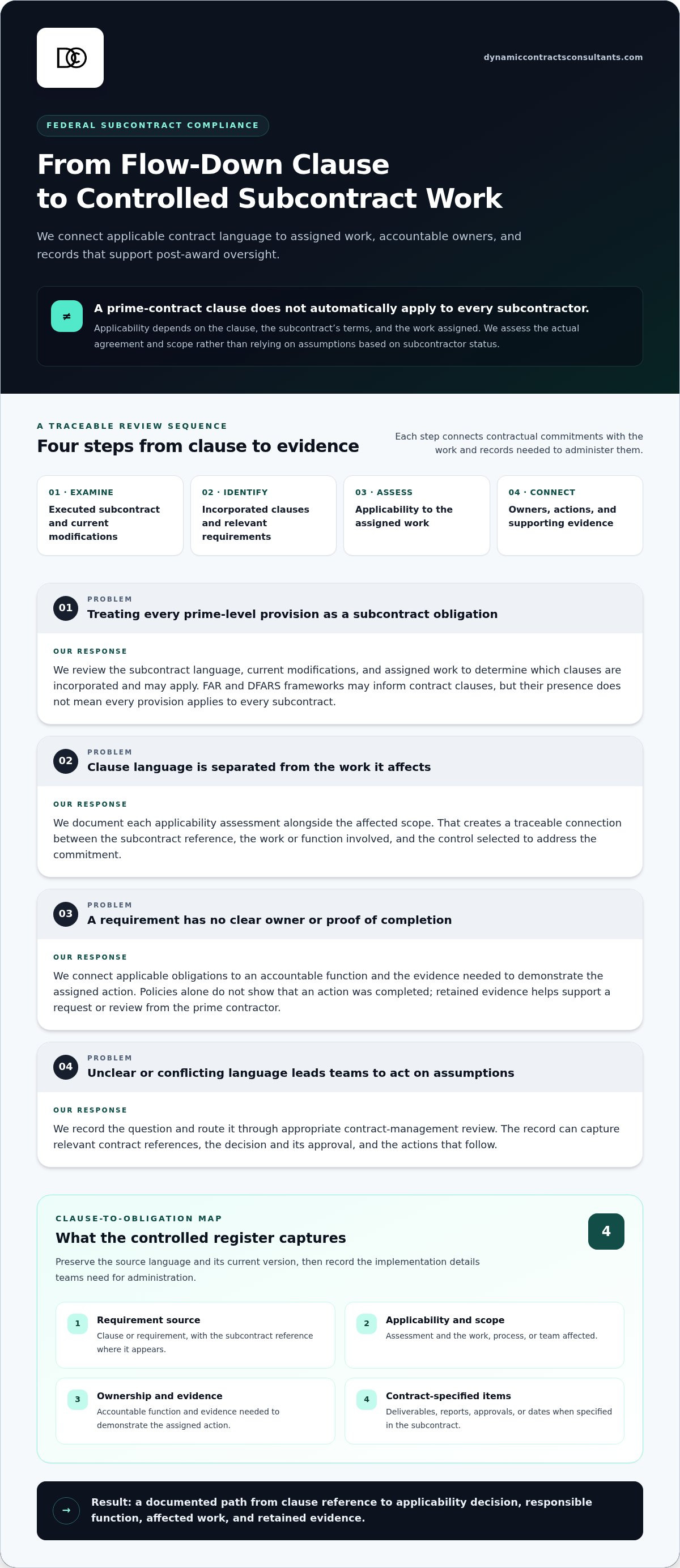
Our review sequence is straightforward: examine the executed subcontract and current modifications, identify incorporated clauses, assess applicability, assign owners, and retain supporting evidence. This creates a traceable path from a clause reference to the work it affects. A clause’s presence in the prime contract alone does not establish that it applies to every subcontractor or task. The clause, governing requirements, and subcontract terms inform the assessment.
We document clause applicability alongside the affected scope so your team can see the contractual basis for a control and the work it governs. This connection separates clause language from the operational steps selected to address it and preserves the reasoning behind decisions for future contract administration.
Build a clause-to-obligation map
We recommend maintaining a controlled register that points to current subcontract language and captures the implementation details your teams need. For each applicable entry, record:
- The clause or requirement and the subcontract reference where it appears.
- The applicability assessment and the work, process, or team affected.
- The accountable function and the evidence needed to demonstrate the assigned action.
- Deliverables, reports, approvals, or dates when the subcontract specifies them.
For example, if a subcontract requires a report, connect that commitment to the person preparing it, any required review, and the retained submission record. Preserve the source language and its current version in a controlled document, and distinguish contractual requirements from internal process choices. This lets your teams trace an interpretation to its source instead of relying on a copied checklist or outdated summary.
Resolve clause questions through documented contract administration
If language is unclear, conflicting, or incomplete, record the question and route it through appropriate contract-management review before teams act on an assumption. The record can identify relevant contract references, the decision and its approval, and resulting actions. When an amendment or documented communication changes the baseline, update the affected map entries and preserve the prior record to maintain a clear change history.
Our flow-down clause analysis and management connects subcontract language with obligation tracking and post-award administration. We help teams maintain a consistent record of interpretations, assigned controls, and contract updates as work proceeds.
Operational Controls and Records That Support Subcontract Compliance
We structure operational controls around the obligations assigned by the subcontract, the functions responsible for carrying them out, and the records that show what occurred. For compliance for federal subcontractors, a written policy can set expectations, but it does not demonstrate by itself that a required action was completed. We help teams distinguish policy documentation from performance evidence, then organize records so each item has a clear purpose and connection to the work.
For an obligation involving a deliverable, for example, supporting records may include the relevant requirement, the completed item, evidence of submission, and related correspondence. For an internal process control, a completed review or approval may provide relevant evidence, depending on the commitment. We focus on records that accurately reflect execution, not paperwork without a defined link to an obligation.
Assign owners and maintain evidence by obligation
We recommend assigning each applicable obligation to a named organizational owner and setting an internal review cadence suited to the work. A controlled record set should preserve the versions of subcontract terms, modifications, approvals, submissions, and supporting materials needed to understand which requirement was in effect. When responsibilities cross functions, we help coordinate contracts, operations, finance, and HR so ownership and handoffs are explicit.
- Contracts: We organize the current subcontract, amendments, clause references, and documented interpretations.
- Operations: We connect work records and deliverable evidence to assigned performance responsibilities.
- Finance: We identify and organize relevant financial support and approvals when required by the subcontract or applicable controls.
- HR: We keep employment-related records in a distinct category, with handling appropriate to their purpose.
Separate files can remain discoverable through a shared index for authorized staff. Consistent naming and version control help teams trace a requirement to its owner and supporting record. During an internal review, test whether the owner can identify the applicable commitment, locate the evidence, and explain what it demonstrates. This can expose missing records or unclear handoffs while there is time to address them through routine administration.
Keep employment-related compliance in its proper scope
OFCCP-related matters, Section 503, and VEVRAA may be relevant employment-compliance topics, depending on current requirements and the organization’s circumstances. We treat these as a distinct review area and recommend using authoritative, up-to-date sources when assessing whether a specific obligation applies. Employment records may support that analysis, but they do not replace evidence of contract performance, such as completed work products or required submissions.
Through post-award compliance administration, we connect subcontract management, deliverable oversight, and organized records. This gives your team a clearer basis for showing which evidence supports each responsibility, while keeping documentation aligned with its purpose.
A Practical Review Process for Monitoring Compliance and Readiness
Compliance monitoring should be a recurring contract-management activity, not a one-time review that begins only when a request arrives. For compliance for federal subcontractors, a practical review connects the current subcontract baseline with active deliverables, accountable owners, and evidence of performance. Set a review cadence suited to the subcontract’s requirements, and reassess whenever a modification, revised instruction, or other contract change may affect an obligation.
Review changes before they become missed obligations
When contract documents change, compare the revised language with the current clause and obligation map. Assess whether the change affects scope, specified deadlines, deliverables, reporting, approvals, or the internal functions responsible for performance. For example, a revised work package may affect which team owns a deliverable and whether existing evidence practices still fit the commitment.
Record the assessment in the contract file. Capture the document reviewed, affected obligations, impact decision, person or function responsible for the decision, and any follow-up actions. If the change requires an internal control update, record who will implement it and how completion will be documented. If the interpretation remains unresolved, track the question and its disposition rather than letting an informal assumption become the operating baseline.
A recurring review can follow a consistent sequence:
- Confirm the current subcontract version and identify changes since the prior review.
- Check upcoming or completed deliverables against assigned owners and contract requirements.
- Verify that supporting evidence is retained, accessible, and tied to the relevant obligation.
- Document gaps, decisions, and follow-up actions, then track them through resolution.
Prepare a coherent response record
A well-organized file lets an authorized reviewer trace each applicable obligation to its owner and supporting evidence without reconstructing the history from disconnected emails. Check for missing approvals or submissions, unresolved interpretations, overdue deliverables, and records that refer to outdated contract language. Record the status and corrective follow-up. A review log that identifies a gap but does not track its disposition leaves the control process incomplete.
Routine internal monitoring supports management oversight, but it is not the same as a formal government audit and does not establish a legal determination. Use it to identify record weaknesses and manage contract commitments. If an audit or formal inquiry occurs, preserve the relevant records and follow the applicable response process.
Regulatory requirements and thresholds can change. For any 2026 development that may affect your subcontract, verify the current text and applicability against authoritative government sources before changing controls or assuming a new duty. Broader post-award compliance and contract administration practices can connect change management, deliverable monitoring, and record readiness across the contract lifecycle.
We help organizations strengthen this review process through post-award compliance and contract-administration support. Discuss your subcontract compliance needs with our team.
How Dynamic Supports Federal Subcontract Compliance Across the Contract Lifecycle
Managing subcontract obligations requires a working connection between contract language, operational ownership, and retrievable evidence. Dynamic Contracts Consultants supports that connection through flow-down clause analysis, subcontract management, and post-award compliance. Our experience as both a prime contractor and a subcontractor informs a practical view of how requirements move from contract terms into day-to-day administration.
Connect clause review with post-award administration
Clause analysis provides a structured starting point: identify terms relevant to the subcontract, assess them against the assigned work, and translate applicable commitments into tracked responsibilities. Post-award administration maintains that record as deliverables progress and contract documents change. For example, a reporting commitment can be connected to its owner, submission record, and follow-up correspondence, keeping the obligation and its evidence together.
Our post-award compliance services support obligation tracking, subcontract administration, compliance monitoring, and audit-ready record preparation. This approach helps your team organize evidence around the specific commitments it supports, rather than assembling disconnected files only when a review is approaching. It also helps identify ownership gaps or missing records while there is still an opportunity to address them through normal contract management.
Apply technology with expert oversight
FARIFY is an affiliated AI-powered platform for government-contracting document generation. AI-driven workflows can assist with organizing and preparing documentation, while human-in-the-loop review supports audit-ready outputs. Technology should strengthen consistency and operational efficiency, not replace expert judgment about contract language, scope, or the evidence needed for a specific obligation. AI alone does not determine whether a subcontract requirement applies or guarantee compliance.
Across the procurement lifecycle, Dynamic’s federal contract administration and compliance support connects clause analysis with post-award controls and record practices. We help your organization structure oversight around its subcontract terms, assigned responsibilities, and documentation needs, tailored to the work and contract context. This partnership is intended to improve visibility and coordination, not to substitute for legal advice or guarantee an outcome.
For a focused review of your subcontract administration approach, discuss your subcontract compliance needs with our team.
Make Compliance a Durable Part of Contract Operations
Make compliance for federal subcontractors part of how your organization manages change, rather than a separate exercise that starts only when someone requests documentation. Build review steps into contract handoffs, modification intake, and routine management discussions. This keeps responsibility visible as teams, deliverables, and contract terms evolve, and gives leadership a clearer view of unresolved issues before they disrupt performance.
Start with one active subcontract. Confirm that the current contract record, assigned owners, and evidence trail align, then identify where a recurring review fits into existing workflows. A focused review can show whether responsibilities are understood across functions and whether the records tell a coherent story of performance. Refine the process and apply it consistently to other subcontracts.
Dynamic Contracts Consultants can help turn that operating need into structured contract-administration support tailored to your subcontract environment. Discuss your federal subcontract compliance needs with our team and take a deliberate next step toward stronger oversight. Clear ownership and disciplined follow-through help your organization manage federal subcontract work with greater confidence.
Frequently Asked Questions
Does every federal subcontractor have the same compliance obligations?
No. Obligations can differ between subcontractors, even when their work supports the same prime contract. Separate subcontracts may assign different deliverables or incorporate different terms, so one company’s compliance matrix may not fit another’s. Review the executed agreement and its modifications rather than relying on a generic checklist or assuming every prime-contract duty transfers. Use authoritative government sources to assess current legal applicability.
Do FAR clauses automatically flow down to every subcontract?
No. Do not assume every FAR clause automatically applies to every subcontract. Whether a clause flows down can depend on the clause, governing requirements, and the subcontract’s terms. Compare the contract documents and record which clauses were reviewed, the basis for each applicability decision, and any unresolved questions. This creates a traceable rationale for your team and helps prevent a checklist copied from another subcontract from being treated as controlling.
Are federal subcontractors subject to OFCCP requirements?
Some subcontractors may have employment-related obligations connected to OFCCP requirements, but applicability depends on current requirements and the organization’s circumstances. That employment-compliance analysis is distinct from administering contract deliverables, approvals, or other subcontract commitments. Before treating a particular obligation as applicable, consult current Department of Labor guidance and assess the relevant facts. Do not apply a requirement solely because it appears in another contractor’s materials.
What records should a federal subcontractor retain for compliance?
Retain records that support obligations actually assigned to your organization, such as the controlling agreement and modifications, documented clause assessments, approvals, required submissions, and evidence that assigned work was performed. A deliverable file, for example, can preserve the applicable requirement, final version, submission confirmation, and related acceptance or follow-up record. Employment documentation may belong in a separate record category where relevant. Retention periods depend on governing requirements, so verify them rather than adopting an assumed timeframe.
Can a subcontractor rely on the prime contractor to manage its compliance?
No. A prime contractor’s oversight does not replace your need to understand your own agreement and manage assigned responsibilities. Prime communications can clarify expectations or provide instructions, but your team should document who received a request, who owns the response, and what was submitted. Maintain coordination records alongside the applicable subcontract documents. Specific responsibilities depend on the contract and applicable rules, so a general statement about prime oversight does not determine liability.
What should a subcontractor do when a flow-down clause is unclear?
Preserve the relevant contract language, note the uncertainty, and identify the affected work or obligation before acting on an assumption. Route the question through appropriate contract-management review, recording who reviewed it and what decision or next step followed. If an amendment or documented agreement clarifies the requirement, retain it with the contract record and update affected internal processes. This is a contract-administration practice, not a legal determination. Seek qualified legal advice when legal interpretation is needed.
Can AI-generated documents ensure federal subcontract compliance?
No. AI-generated documents cannot independently ensure compliance or guarantee an audit outcome. AI may assist with drafting, organizing, or analyzing material, but a responsible reviewer must assess outputs against the governing subcontract and current requirements. FARIFY’s workflow includes human-in-the-loop review to support audit-ready outputs. Your organization should still verify source documents, resolve discrepancies, and assign accountability for approving and maintaining each record before relying on it operationally.


