

A strong federal market-entry strategy isn’t built by pursuing every available solicitation. It starts by matching each opportunity to your capabilities, capacity, and ability to deliver. Federal procurement consulting helps bring those decisions together, especially when your team is navigating acquisition requirements and documentation while managing capture, proposals, and compliance with limited internal resources.
An opportunity may look promising but still conflict with your operational readiness. Decisions made during pursuit can also shape performance after award. We connect market research, acquisition planning, bid/no-bid analysis, and proposal development so you can assess opportunities with greater discipline and prepare for the requirements that follow.
This guide explains how federal procurement consulting can support a coordinated approach across the procurement lifecycle, from identifying suitable opportunities to contract execution. You’ll learn how strategic compliance, proposal planning, AI-assisted tools with human review, and post-award administration can reinforce operational efficiency and support informed growth in the federal market.
Key Takeaways
- Use federal procurement consulting to connect market research, opportunity screening, and bid/no-bid decisions to your organization’s capabilities and capacity.
- Compare consulting approaches by how clearly they define deliverables, responsibilities, review points, and internal owners.
- Prepare for an engagement by clarifying your goals and constraints and organizing relevant opportunity and procurement materials.
- Coordinate acquisition planning, capture, proposal development, strategic compliance, and post-award administration across the procurement lifecycle.
- Use AI-assisted document generation to support efficiency, with human review guiding context and judgment.
What Federal Procurement Consulting Covers Across the Contract Lifecycle
We define federal procurement consulting as strategic and operational support that helps organizations assess federal acquisition opportunities, make informed pursuit decisions, and coordinate requirements through contract execution. It extends beyond proposal writing. We connect market research and acquisition planning with capture, compliance, contract administration, and closeout, shaping the work around your objectives, capabilities, and internal capacity.
We help you understand the public purchasing environment in which your organization operates. The overview of Government procurement in the United States provides broader context for federal acquisition. Our consulting support helps you plan and coordinate participation. It is separate from legal representation, direct government funding, and lobbying.
Which organizations use federal procurement consulting?
Organizations entering the federal market use consulting to assess potential opportunities and structure initial pursuit decisions. Established contractors can use it to evaluate new agencies, contract areas, or solicitations while managing current operations. For business leaders balancing acquisition activity with delivery, finance, and staffing, we help define work that reflects strategic priorities and available internal resources.
We tailor the work to your goals. If you’re developing a federal-market approach, we can focus on research and acquisition planning. If you’re considering a specific solicitation, we can coordinate the relevant capture and proposal activities. Our federal procurement services connect these activities to your objectives instead of treating each task as an isolated exercise.
Where consulting fits in the procurement lifecycle
We organize support around lifecycle stages that are connected but distinct. At each transition, we clarify the purpose of the work, the documents involved, and who owns the next step.
- Pre-award: We support market research and acquisition planning to help identify where your organization may fit. Capture management addresses how to pursue a specific opportunity, while proposal development turns a decision to compete into a submission.
- Award: We help your team shift from competing to understanding the awarded work and coordinating the transition into performance. Clear internal ownership connects pursuit commitments with execution planning.
- Post-award: We support contract administration and compliance monitoring to keep relevant obligations visible as work proceeds, including applicable flow-down clauses.
- Closeout: We support an orderly approach to completing remaining contract activity and handling associated documentation.
These activities remain distinct, but decisions at one stage can affect the next. Market research informs planning, capture defines pursuit strategy, proposal writing develops the submission, and post-award administration supports performance. By connecting each stage to your organization’s decisions and responsibilities, we help your team maintain a coherent view of the work across the procurement lifecycle.
How Procurement Consulting Connects Market Research to Opportunity Decisions
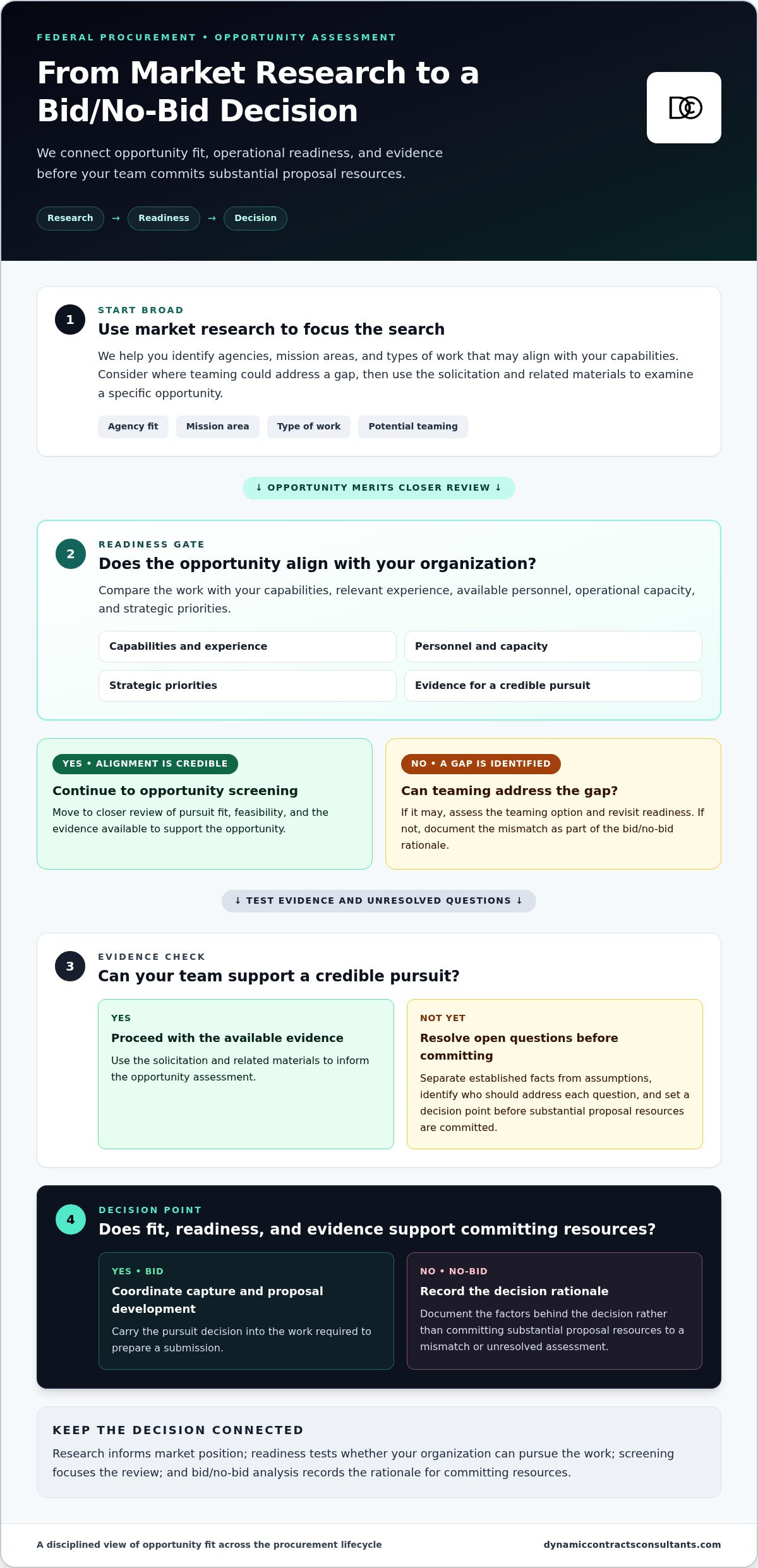
We use market research to help you move from a broad view of the federal market to a disciplined opportunity decision. Research can clarify which agencies, mission areas, and types of work align with your capabilities, where teaming may address a gap, and what acquisition planning should consider. Assess opportunity fit before investing in a proposal: a polished submission cannot resolve a mismatch with your capacity or strategic objectives.
Our federal procurement consulting approach links positioning, readiness assessment, opportunity screening, and bid/no-bid analysis in a practical sequence. Research informs your market position; a readiness review tests whether your organization can pursue the work; screening identifies opportunities for closer examination; and analysis records the rationale for committing resources. The Government Contracts Reference Book can provide useful context on federal contracting terms as you assess an opportunity.
Assessing readiness before pursuing federal opportunities
We help you compare an opportunity with your capabilities, relevant experience, available personnel, operational capacity, and strategic priorities. SAM.gov can serve as a reference point in your opportunity research, while the solicitation and related materials inform the specific assessment. The goal is to understand both your alignment with the work and the evidence available to support a credible pursuit.
We also help distinguish established facts from assumptions that need further research. Your team may have the technical capability to perform, for example, but still need to assess how the work fits alongside existing commitments. We help document open questions, identify who should address them, and set a decision point before substantial proposal resources are committed. Our procurement consulting connects this readiness review with acquisition planning and capture decisions.
Turning opportunity analysis into a bid/no-bid decision
Once an opportunity merits closer review, we help organize the factors that shape its strategic fit and pursuit feasibility. A consistent framework gives your leadership team a shared basis for weighing trade-offs and recording its rationale.
- Mission and strategic fit: Assess whether the work supports your objectives and builds on relevant capabilities.
- Requirements and readiness: Identify what the solicitation calls for, what evidence supports your ability to respond, and what information gaps remain.
- Competitive position and teaming: Consider how your experience and potential partners may address the opportunity’s needs, while keeping your organization’s own readiness in view.
- Capacity and pursuit effort: Weigh proposal demands against staff availability and existing operational responsibilities.
We document the decision rationale, key assumptions, unresolved information, and internal decision-makers. AI-assisted bid/no-bid analysis can help organize inputs, while human review brings context and judgment to the decision. This framework supports your assessment; it cannot predict an award or guarantee an outcome. If you’re evaluating how research and pursuit decisions fit your objectives, discuss your procurement priorities with our team.
How to Evaluate Federal Procurement Consulting Approaches
Consulting approaches differ in scope, coordination, and the level of support your team needs. Focused advisory work can suit a defined question when internal owners are ready to act. Coordinated lifecycle support can better fit organizations that need connected planning across opportunity assessment, capture, proposals, compliance, and contract administration. Neither approach guarantees a contract award. The objective is to make decisions and responsibilities more deliberate.
The comparison below is a starting point. The right model depends on your objectives, procurement lifecycle, and operational capacity. A useful federal procurement consulting overview can also provide context on common consulting activities. Your engagement should specify how the work applies to your situation.
| Consideration | Narrowly scoped advisory support | Coordinated lifecycle support |
|---|---|---|
| Primary focus | A defined issue, decision, or work product | Connected work across selected procurement stages |
| Typical coordination | Client team directs follow-through across other activities | Dependencies and transitions between activities are addressed together |
| Best suited to | Teams with internal capacity and clear ownership | Organizations seeking broader coordination within stated constraints |
| Key planning need | Define the advisory question and how recommendations will be used | Define stage-specific outputs, owners, and review points |
What makes a consulting engagement actionable?
An actionable engagement translates objectives into defined work. We align consulting activities with your project scope and business objectives, considering the procurement stages involved and your internal team’s capacity. Our federal procurement consulting services can focus on the support your situation requires rather than assuming every organization needs the same deliverables.
At the outset, define the intended work products, who provides inputs, who reviews them, and who makes each internal decision. Set review points so the team can resolve gaps before they affect downstream work. Recommendations should account for operating constraints such as staff availability and existing delivery commitments. Clear ownership makes it easier to move from analysis to implementation.
Balancing regulatory rigor with operational efficiency
FAR and DFARS are relevant regulatory frameworks in federal acquisition. Their applicability and the specific requirements for an opportunity must be assessed in context, not assumed from a generic checklist. Strong strategic compliance practices make review responsibilities visible and help teams organize their work without treating documentation as a substitute for sound judgment.
AI-driven automation can assist with document workflows by generating or organizing drafts, while qualified human review remains important for context, accuracy, and decisions. FARIFY, our technology-focused affiliate, offers AI-assisted contracting document generation with human-in-the-loop review. We also connect pursuit decisions to our guide on strategic government contract capture planning, so market positioning and execution considerations inform the work. To align support with your objectives, discuss your procurement priorities with our team.
How to Prepare for a Federal Procurement Consulting Engagement
Preparation turns an initial discussion into a focused work plan. Before federal procurement consulting begins, we work with you to define the decision or outcome you want to address, identify the opportunity or market context, and clarify the resources available. You don’t need to resolve every open question first. A record of known facts, assumptions, and information gaps gives us a practical starting point for shaping the work.
Information to organize before the initial discussion
Materials that show both your federal-market objectives and your readiness to pursue them help us focus the conversation. If you’re responding to a specific solicitation, gather the solicitation and related materials available to your team. For broader planning, summarize your target agencies, opportunity areas, and reasons for pursuing them. These inputs establish the context; they don’t need to form a complete package.
To help us organize the discussion, consider preparing the following:
- State your objectives. Describe the market-entry, growth, capture, proposal, or compliance issue you want to address, and the decisions our work should inform.
- Describe your capabilities. Gather capability materials, relevant experience, prior proposal work, and information about resources available for pursuit and performance.
- Gather procurement documents. Where applicable, share solicitation materials, existing contract documents, internal procurement records, and known compliance considerations relevant to the engagement.
- Identify constraints and owners. Note staff capacity, operational commitments, internal stakeholders, decision authority, and current decision timelines so we can account for them in the work plan.
We treat regulatory references with care. FAR and DFARS considerations depend on the specific context, so we use current authoritative sources for applicable details rather than relying on outdated summaries or assumptions. The materials and objectives you share help us focus the work and identify where further review is needed.
Defining useful deliverables and measures of progress
We work with you to define what the engagement will produce and how your team will use each work product. Depending on the scope, outputs may include documented analysis, recommendations, planning materials, or proposal-related work. Together, we clarify who provides information, who reviews materials, who resolves questions, and who has authority for internal decisions. Clear roles keep the engagement aligned with your team’s capacity.
We also establish review points and a communication cadence that fit your decision timeline. Progress measures can track agreed activities, such as completing an opportunity assessment, documenting open questions, or reviewing a defined work product. These measures support accountability without treating consulting progress as a promise of an award.
We tailor the engagement to your objectives and scope, with your operational realities in view. Discuss your federal procurement consulting priorities with our team to establish a focused starting point.
How Dynamic Supports Federal Procurement from Planning Through Compliance
Federal procurement consulting delivers more value when market decisions, pursuit activities, and contract responsibilities are coordinated around your organization’s objectives. At Dynamic Contracts Consultants LLC, we support work across pre-award, award, post-award, and closeout stages. We can address a defined need or connect multiple stages, based on your priorities and internal capacity.
We have served as a prime contractor on contracts for the Department of Defense, Department of State, EPA, and NOAA. That experience informs how we approach the relationship between acquisition planning, proposal commitments, and responsible contract execution. It doesn’t replace your organization’s judgment or guarantee an award; it helps keep planning and delivery considerations connected.
Connecting pre-award strategy with proposal execution
Pre-award support involves distinct activities, each with a different decision purpose. Acquisition planning establishes priorities and an approach to the federal market. Market research informs positioning and opportunity context. Opportunity analysis considers a specific pursuit, while bid/no-bid analysis supports a decision about whether to commit resources. Capture management supports pursuit planning, and proposal writing develops the submission using the selected opportunity and your organization’s inputs.
These activities inform one another, but they are not interchangeable. A decision to pursue should come before significant proposal investment, and the proposal should reflect a clear understanding of the opportunity and your capabilities. We tailor support to the engagement’s scope, whether you need a particular work product or coordination across several pre-award activities. Our federal procurement services provide a fuller view of the support available across the lifecycle.
FARIFY LLC, our technology-focused affiliate, offers AI-assisted contracting document generation with human-in-the-loop review. AI can support document workflows, while expert review helps assess context and maintain human judgment. Used this way, AI-driven automation is an efficiency tool, not a substitute for informed acquisition decisions or accountable review.
Maintaining compliance and administration after award
After award, attention shifts from pursuit to execution. Post-award contract administration supports organized management of contract activity, while compliance monitoring keeps relevant obligations in view. Flow-down clause support addresses clauses passed through to subcontracting relationships. We coordinate these activities with your organization’s processes and the applicable contract context; they don’t constitute legal representation or guarantee audit outcomes.
Closeout is a distinct part of the lifecycle, and planning for it supports orderly completion of remaining contract activity. Our post-award support complements acquisition and proposal work, helping your team carry relevant commitments into administration. For additional detail, see our post-award contract administration guidance.
Bring us your procurement objectives, opportunity context, and preferred engagement scope. We support coordinated planning, capture, proposal development, compliance, and administration to align with your priorities.
Set Your Next Federal Market Decision in Motion
Federal growth becomes more manageable when your next step is specific: clarify the decision ahead, the information needed to make it, and the people responsible for acting on it. That focus helps your leadership team direct time and resources toward pursuits that fit your priorities while keeping operational realities in view. Federal procurement consulting is most useful when it strengthens decision discipline and supports your organization’s own judgment.
As you plan what comes next, consider which issue would benefit most from focused attention: market positioning, pursuit readiness, proposal capacity, or post-award execution. A defined starting point makes it easier to shape an engagement around your objectives and internal resources.
Share your procurement objectives with our team to discuss a focused engagement scope. We’re ready to help you build a deliberate path toward federal market growth.
Frequently Asked Questions
Can a small business benefit from federal procurement consulting?
Yes. A small business can use federal procurement consulting to turn technical strengths into a focused market approach without assigning every procurement task to existing executives. For example, a specialist firm considering an agency opportunity can compare its documented experience with the work sought, identify gaps in evidence or its delivery model, and decide whether to pursue alone or explore a teaming path. This helps protect operating focus while building a deliberate entry strategy.
Does federal procurement consulting guarantee a contract award?
No. Federal procurement consulting cannot guarantee a contract award because the government makes the award decision through the applicable acquisition process. A consultant can help you assess an opportunity, organize your response effort, and address planning or compliance needs, but those activities don’t control the agency’s decision. Treat proposed outcomes as work products and decision support, not promises of selection, revenue, or a particular procurement result.
When should a contractor engage a federal procurement consultant?
Engage when an upcoming decision would benefit from additional structure or dedicated capacity. That may be while setting federal-market priorities, before committing a proposal team to a solicitation, or after award when administration and compliance work needs clearer ownership. Early support can help frame a pursuit; later support can address a defined workload or process gap. The best timing is before the decision or deliverable becomes urgent.
Can federal procurement consultants support subcontractors?
Yes. Subcontractors can use consulting support to assess prospective work, organize proposal inputs for a prime contractor, and manage relevant post-award administrative and compliance processes. For example, a firm asked to contribute a technical section can clarify its evidence, staffing assumptions, and delivery commitments before providing material to the prime. Support can also address applicable flow-down clauses, with responsibilities understood in the context of the subcontract.
Is federal procurement consulting the same as legal representation?
No. Federal procurement consulting provides business and acquisition support, not legal representation. It can help organize contract-related information, identify operational questions, and coordinate proposal, compliance, or administration work. It doesn’t provide legal advice or represent a company in legal matters. Keeping this distinction clear helps your team define the engagement’s purpose and assign procurement planning and execution tasks to the appropriate internal decision-makers.
Can AI prepare federal procurement documents without human review?
AI can assist with document generation, but it shouldn’t be treated as a substitute for human review. FARIFY, our technology-focused affiliate, provides AI-assisted contracting document generation with human-in-the-loop review. Reviewers assess source information and context and confirm that a draft accurately reflects its intended content before use. AI-driven automation can support efficiency while people remain responsible for reviewing and approving documents.
What should a contractor expect from an initial procurement consulting discussion?
Expect a focused conversation about the business issue prompting support, rather than an award prediction. You can describe the situation in plain terms, such as a new federal opportunity, uncertainty about internal readiness, or a post-award workflow that needs attention. A polished briefing isn’t necessary. The discussion can clarify whether you need a discrete advisory engagement or broader lifecycle support, and which internal decision would make the next step useful.


