

What if the main reporting risk isn’t completing a form, but overlooking an instruction outside the award document? Federal grant reporting requirements may be spread across award terms, agency guidance, and program-specific instructions. Start by identifying the rules that apply to your award before preparing a submission.
Financial data, performance results, and compliance records often sit with different teams. Without coordinated inputs, review, and documentation, gaps can complicate award management and oversight. For many federal awards, 2 CFR Part 200 provides a common framework, while award-specific terms and agency instructions determine the details that apply.
In this guide, we explain how to identify reporting obligations, organize supporting records, and coordinate preparation, approval, submission, and retention. We distinguish financial, performance, and compliance reporting, then outline a repeatable process for reducing avoidable omissions. The goal is practical: connect each award requirement to reliable evidence, financial information, and documented results.
Key Takeaways
- Use your signed award and incorporated terms as the starting point for identifying the federal grant reporting requirements that apply to your award.
- Build a reporting register that assigns an owner and records each report’s source, due date, and submission method.
- Separate financial expenditure support, performance evidence, and compliance documentation, then verify what your award requires.
- Set review milestones early so teams can reconcile figures and address gaps before submitting reports.
- Connect reporting workflows to post-award compliance and organized, audit-ready records.
What Federal Grant Reporting Requirements Cover, and Why Awards Differ
Federal grant reporting is not one form or a fixed calendar that applies to every award. It is the process of communicating required financial, performance, and compliance information to the awarding agency in the manner specified for a particular grant. In short, federal grant reporting is the award-specific communication of financial activity, project progress, and compliance evidence to the awarding agency. The applicable requirements depend on the award’s terms, incorporated documents, agency guidance, program instructions, and relevant rules.
Federal grantmaking involves different agencies and programs, as the overview of Federal Grants in the United States describes. Your reporting profile should therefore come from the documents and instructions governing your award, not from another recipient’s process.
Which information can federal grant reports cover?
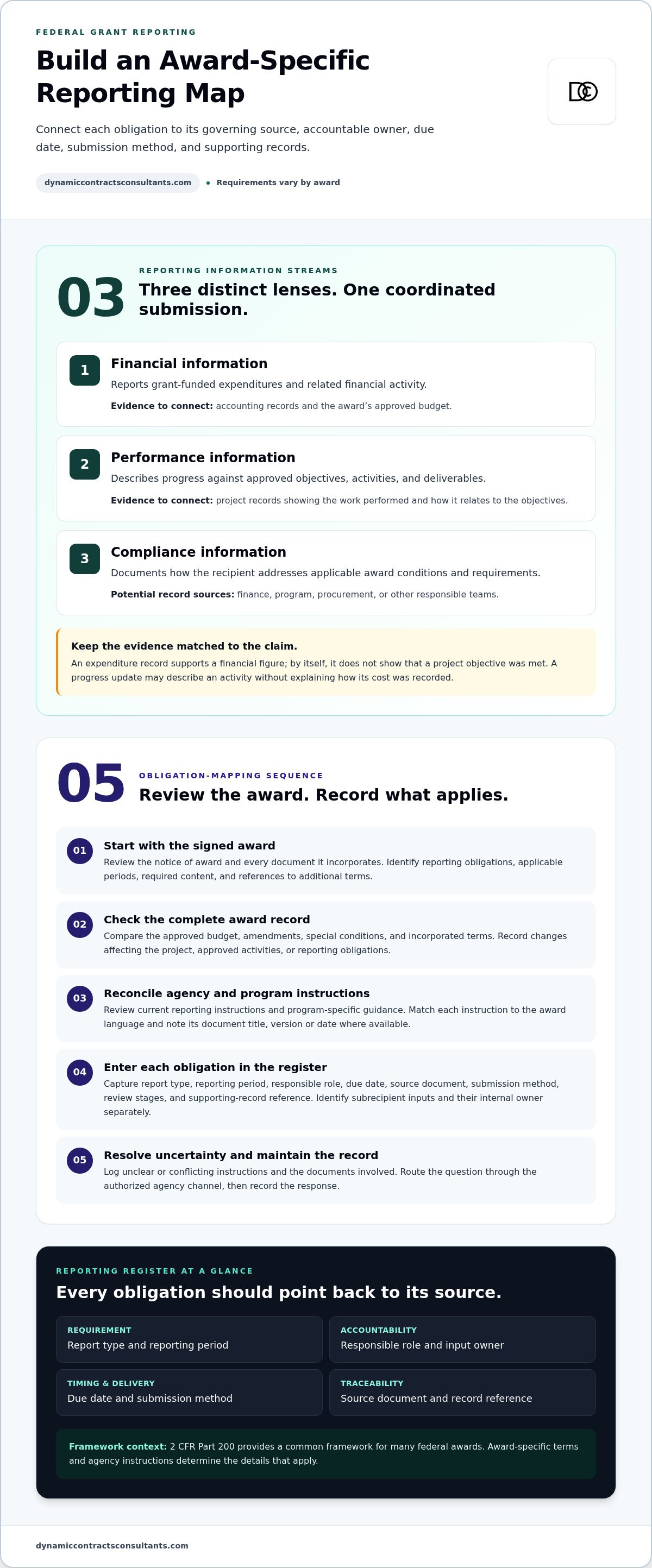
Reporting generally draws on three connected information categories. Each supports a different oversight question, so identify the evidence behind each rather than treating a report as a stand-alone narrative:
- Financial information records grant-funded expenditures and related financial activity. Supporting records show how reported amounts connect to your organization’s accounting records and the award’s approved budget.
- Performance information describes progress against approved objectives, activities, and deliverables. Project records can show what work took place and how it relates to those objectives.
- Compliance information documents how the recipient addresses applicable award conditions and requirements. Depending on the award, relevant records may come from finance, program, procurement, or other responsible teams.
These categories can overlap, but they are not interchangeable. An expenditure record supports a financial figure; it does not, by itself, show that a project objective was met. A progress update may describe an activity without explaining how its cost was recorded. Coordinate evidence across teams so each report claim is traceable to appropriate records.
Why does each grant have a different reporting profile?
Award conditions and agency or program instructions shape report content and timing. Some requirements recur during the award, while special conditions or program-specific instructions may call for additional information. Read the signed award and its incorporated terms alongside current agency guidance and applicable rules. Do not assume a schedule or form used for another award applies to yours.
Responsibilities also depend on the recipient structure. The recipient is accountable for submissions to the awarding agency, while a subrecipient may provide financial, performance, or compliance information needed to prepare those reports. Establish information flows from the award and relevant subaward terms. We provide post-award compliance support to help organizations coordinate documentation and maintain organized, audit-ready records, while keeping each award’s requirements at the center of the process.
How to Identify Every Reporting Obligation in Your Federal Grant Award
A complete reporting map starts with the documents that govern your specific award, not a generic calendar or checklist. As you review those documents, build a requirements register that traces each obligation to its source and assigns it to an accountable role. The Grants.gov Reporting Overview provides useful context on reporting categories, but your award documents and current agency instructions define what applies to your project.
An award-specific register is more reliable than a generic checklist because it connects each report to its governing source, owner, due date, and submission method. Follow a sequenced review to create that record:
- Start with the signed award. Review the notice of award and every document it incorporates. Identify reporting obligations, applicable periods, required content, and any instructions that point to additional terms.
- Check the complete award record. Compare the approved budget, amendments, special conditions, and incorporated terms. Record changes that affect the project, its approved activities, or reporting obligations instead of relying on an earlier version.
- Reconcile agency and program instructions. Review current reporting instructions and program-specific guidance. Match each instruction to the award language, noting the document title, version or date where available, and the requirement it addresses.
- Enter each obligation in the register. Record the report type, reporting period, responsible organizational role, due date, source document, submission method, review stages, and reference for supporting records. If a subrecipient supplies an input, identify that input and its internal owner separately.
- Resolve uncertainty and maintain the record. Log unclear or conflicting instructions, the documents involved, and the question to resolve. Route the issue through the authorized agency channel and record the response rather than choosing the easiest interpretation.
Which documents should inform the reporting register?
Start with the signed notice of award, then review the approved budget, amendments, special conditions, and all incorporated award terms. Compare these with the awarding agency’s current reporting instructions and program-specific guidance. Preserve a reference to the source behind each register entry so reviewers can distinguish an award condition from program guidance and trace later changes.
How should teams record deadlines and responsibilities?
Assign each report and supporting input to a named organizational role, such as the finance lead or program manager, rather than listing only a department. Capture the due date, source, submission channel, reviewer or approver, and supporting evidence reference. Revisit the register when an amendment, agency notice, or approved scope change may affect reporting. Document unresolved instructions and seek authorized clarification before changing the requirement in your register.
This process turns document review into a controlled post-award workflow. Our post-award compliance support strengthens coordinated documentation and record readiness as award obligations evolve.
How Financial, Performance, and Compliance Reporting Fit Together
Reporting inputs often come from different teams and record systems. The central coordination task is to make sure related information agrees without treating separate evidence as interchangeable. Compare reported figures and narratives with their supporting records, then check that each item addresses the award’s instructions. The table outlines handoffs and verification points your team can use.
Reporting category
Review focus
Likely contributor
Award-specific verification
Financial
Trace reported amounts to transaction records, accounting entries, and approved budget information.
Finance or accounting staff.
Check the required reporting format, period, and relevant budget presentation against the award instructions.
Performance
Connect reported progress to project records showing activities, deliverables, and relevant results.
Program or project staff.
Compare the narrative with approved objectives and the agency’s reporting prompts.
Compliance
Confirm that documentation addresses applicable award conditions and required procedures.
The staff responsible for the relevant process, with compliance review as appropriate.
Verify the condition, evidence, and any reporting or approval requirement in the governing documents.
These are coordination examples, not a universal list of required reports or records. Your award and current agency instructions determine which apply.
What belongs in financial reporting support?
Build a traceable path from each reported figure to its source. For example, a reconciliation can identify the accounting detail behind a summarized amount and show how it relates to the reporting period and budget information used to prepare the report. Keep explanatory notes with the relevant records when an adjustment or classification needs context. Review presentation requirements in the award and current guidance; do not infer cost treatment from an example or another recipient’s practice.
How do performance and compliance evidence differ?
For performance review, program staff can connect the narrative to dated project records, such as activity logs, completion documentation, or notes explaining a delay. Compliance review asks a different question: does the evidence address an applicable condition or procedure, and does it have the required approval? Include property or subaward documentation in the reporting file when the award requires it.
Consider a project activity involving approved training sessions. Finance can reconcile related reported amounts to accounting records, while program staff connect the activity narrative to attendance or completion documentation. A compliance reviewer can separately check whether applicable award conditions were followed and documented. Use a shared reference, such as the activity date or project identifier, to help reviewers connect these records. Keep each source in its proper role, resolve discrepancies with the responsible owner, and retain the rationale for material adjustments. This creates a coherent evidence trail without asking one record to substantiate claims it was not designed to support.
How to Build a Repeatable Grant Reporting and Review Process
A dependable reporting process turns award-specific obligations into coordinated work with clear ownership and documented review. Set internal milestones ahead of each submission date, leaving time to collect inputs, resolve discrepancies, and obtain required approvals. Set the schedule according to your award’s requirements and your organization’s review capacity, rather than relying on a universal template.
Use a consistent cycle for each report:
- Track the obligation. Maintain a reporting calendar and assign an accountable owner for every report and supporting input. Include the source requirement and applicable submission date.
- Collect and validate inputs. Finance gathers financial source records and performs reconciliations. Program staff prepare progress narratives and evidence of completed activities. Compliance reviewers check alignment with award terms, documentation, and required approvals.
- Resolve gaps before approval. Compare figures, reporting periods, and descriptions across inputs. If evidence is missing or information conflicts, return the item to its owner, record the issue, and document the resolution. Escalate late inputs or unresolved questions to the designated manager early enough for a decision.
- Approve, submit, and retain. Route the reconciled report through your organization’s authorized review and approval process. The designated submitter uses the method specified for the award, records submission evidence, and saves the final report with its supporting file.
Internal review validates and authorizes a report within your organization; agency submission is the separate act of transmitting the approved report through the required channel. Keeping these stages distinct clarifies who can approve content, who can submit it, and where proof of each action belongs.
How should recipients coordinate finance, program, and compliance teams?
Define responsibilities before the reporting cycle begins. Finance owns the financial source records and reconciliation; program staff own progress narratives and evidence that activities occurred; compliance review checks consistency with award terms, documentation, and required approvals. One coordinator can manage handoffs without taking over each team’s technical responsibility. Documenting who supplies, reviews, and approves each input helps prevent gaps from being mistaken for completed work.
Set internal milestones relative to the award’s actual due date, with time for review and correction. If a project change may affect reported activities or figures, route it to the relevant owners and assess its reporting implications against the award terms. For a potential correction to information already submitted, preserve the original record, document the issue and review, and follow applicable agency instructions for addressing it.
What should a defensible reporting file retain?
Maintain a file that lets an authorized reviewer trace reported information from submission back to its sources. Organize the submitted report, source records, approvals, relevant correspondence, and applicable award amendments together. Use consistent file names and version control to distinguish drafts from approved submissions and show which records support each reporting period. Apply retention practices under current award and organizational requirements, verifying the rules that govern the records.
We help organizations strengthen post-award documentation and coordinated compliance processes. Learn more about our post-award compliance support.
Strengthen Federal Grant Reporting with Post-Award Compliance Support
When reporting responsibilities span multiple teams, strategic compliance calls for clear decision paths as well as organized records. We work with you to connect award terms to day-to-day documentation and review practices, so your process reflects the needs of the award rather than a generic model. Our post-award compliance support includes compliance risk management and audit-ready record preparation. We help you organize your process around the award while preserving recipient accountability and alignment with agency instructions.
When can external post-award support add value?
Post-award support can help when ownership is fragmented, award terms are complex, or documentation gaps recur. We help assess where handoffs break down, clarify process responsibilities, and organize follow-up around identified risks. If your organization uses AI-driven automation in related administrative workflows, defined human review and documented decision ownership help keep those tools aligned with established controls. Our support complements your team’s responsibilities and current agency instructions.
How can reporting processes support the wider award lifecycle?
Reporting practices can strengthen consistent oversight beyond an individual submission. We help you connect documentation with continuing award administration and the broader procurement lifecycle, while keeping grant-specific obligations tied to their governing sources. Our approach can focus on the process and record-readiness challenges most relevant to your organization.
We provide post-award compliance support for reporting operations and documentation needs. Contact our team about grant reporting support to discuss a practical approach for your award environment.
Make Reporting Discipline Part of Award Management
Use your next reporting cycle to establish a durable operating rhythm that remains useful as staff, project activities, and award conditions evolve. Treat reporting as part of active award management: keep responsibilities visible, preserve the rationale behind decisions, and revisit internal controls when the work changes. This approach helps your organization manage federal grant reporting requirements as an ongoing responsibility, not a task isolated to submission dates.
Dynamic Contracts Consultants LLC provides post-award compliance and audit-ready record preparation, and has supported FEMA grant work as a subcontractor for municipal entities. We bring federal regulatory expertise and a solution-oriented perspective to complex award administration, working with your team to address process and documentation needs while preserving recipient accountability and alignment with agency instructions.
Start a focused conversation about the reporting challenges your organization wants to address. Discuss your federal grant reporting needs with our team and take a deliberate next step toward more coordinated award management.
Frequently Asked Questions
What are federal grant reporting requirements?
Federal grant reporting requirements specify the information an award recipient must provide to the awarding agency, including financial, performance, and compliance information. The phrase describes broad obligations, not a standard package: the documents for each award determine the reports, formats, dates, and submission methods. Compare your award terms with current agency instructions and record which source governs each reporting item.
Which reports are commonly required for federal grants?
Examples may include financial, progress or performance, property, and subaward-related reports. These are examples, not a checklist for every recipient. HRSA’s grant-management resources illustrate reports relevant to its programs, but they do not establish requirements for other agencies or awards. Build your applicable list from the documents governing your grant, and distinguish reports submitted to the agency from information your organization collects internally for oversight and decision-making.
When are federal grant reports due?
Use the due dates specified in your award terms and current agency instructions; no universal deadline applies to every report. Check that each date corresponds to the correct reporting period, since a period’s end date and the report’s due date are different milestones. If an amendment or agency notice changes the schedule, confirm which dates are affected and update the controlled record your team uses to monitor submissions.
What is a Federal Financial Report, and does every grant require one?
A Federal Financial Report is a federal form used to report an award’s financial information, and it appears in some agency guidance, including HRSA’s grant-management resources. Do not assume it applies to every grant. Before preparing a submission, verify the form named for your award, the applicable reporting period, and the required submission route. Retain the instructions used to make that determination with your reporting workpapers.
What happens if a federal grant report is late or incomplete?
The agency’s response depends on the circumstances and the award, so do not assume a specific consequence or remedy. Identify whether the issue is a missed submission, an incomplete field, or a discrepancy in supporting information. Document when it was found, who is addressing it, and what remains outstanding, then follow the applicable agency communication process. Keep the response with your records, and do not treat an extension or correction as approved without agency direction.
Do federal grant subrecipients have reporting responsibilities?
Subrecipients may need to provide information to the prime recipient under the governing award and subaward terms. Those terms can specify what the prime needs, when inputs are due internally, and how changes should be communicated. Prime recipients should also verify whether separate subaward disclosure obligations apply. Thresholds and reporting platforms can change, so confirm current requirements for the award rather than relying on an older example.
How long should federal grant reporting records be retained?
Retention duration depends on the rules and circumstances applicable to the award, so do not set one organization-wide period by assumption. Check whether different record categories or award events affect the schedule, and document the source used to determine the applicable period. Assign responsibility for applying the schedule and managing changes. If requirements are unclear, resolve the question using current authoritative guidance before disposing of records connected to the award.


