

AI can accelerate federal proposal production, but its output is useful only when requirements and supporting claims remain under control. Manual solicitation analysis and repetitive drafting consume valuable team capacity, while generic AI-generated language can miss solicitation-specific instructions or introduce unsupported assertions. Effective AI proposal development for contracts requires more than faster drafting: it requires a disciplined process for validating each output.
We’ll show you where AI can support the proposal workflow, from extracting RFP requirements to developing compliance matrices and identifying gaps, and where experienced human review remains essential. You’ll learn how to establish review and traceability controls so your team can improve operational efficiency without treating AI output as final or self-validating. We’ll also explain how FARIFY’s proposal support works alongside experienced proposal professionals in a controlled, human-in-the-loop process.
Key Takeaways
- Use AI proposal development for contracts to support repeatable analysis and drafting tasks, while keeping strategic decisions with experienced proposal leadership.
- Build a controlled workflow that connects solicitation requirements to evidence, response content, and submission-readiness review.
- Assess AI-generated content for requirement coverage, factual support, consistency, and unsupported claims before it enters a final proposal.
- Use Section L and Section M to guide response organization and evaluation alignment, with human review validating the resulting content.
- Combine AI capabilities with expert proposal development to improve operational efficiency without treating generated output as proof of compliance.
What AI proposal development for contracts means in a federal context
Federal proposal development is not simply a matter of turning a company overview into polished pages. We ground the work in the specific opportunity: a response must address the solicitation’s instructions, demonstrate capabilities with supportable evidence, and give evaluators a clear basis for assessing the offer. A government contract is formed within a defined procurement context, so we develop proposal content against the actual opportunity rather than a general business brief.
We define AI proposal development for contracts as using AI to analyze solicitation materials and assist with drafting inside a controlled workflow where people verify requirements, evidence, and final decisions. This differs from a general business proposal, which may be organized around broad goals or a client’s preferences, and from automated formatting, which changes document presentation without interpreting what the solicitation requires. We use AI as an assistant to the proposal process, not as an autonomous decision-maker that determines what to submit.
To see how AI is being discussed in government contracting, watch this video:
Which proposal tasks can AI support?
We use AI assistance to turn lengthy RFP materials into a structured working set that proposal teams can organize, assign, and track. Depending on the task, this support may include:
- Extracting requirements and organizing them for response planning.
- Creating or supporting a compliance matrix that connects requirements to response locations.
- Assisting with technical-volume drafting and identifying potential evidence gaps.
- Assessing submission readiness by surfacing items for team review.
We treat these outputs as starting points, not validated conclusions. Our review compares generated language with solicitation instructions and approved source material to confirm that claims are accurate, relevant, and supportable. Dynamic Contracts Consultants LLC proposal writing support can pair AI-assisted analysis with professional drafting and review.
Where AI fits in the procurement lifecycle
We place proposal development after opportunity selection: once a contractor decides to pursue an opportunity, the team analyzes the solicitation, plans its response, develops content, and prepares the submission. AI can assist with selected activities in this phase, while your team retains judgment over whether to pursue the opportunity and how to shape a competitive strategy.
We also distinguish proposal work from adjacent procurement lifecycle activities. Acquisition planning takes place on the procurement side before an offer is submitted, while post-award contract administration concerns work after an award decision. Keeping these phases distinct helps define the right scope and review responsibilities. Solicitation interpretation, requirement coverage, and final approval remain human responsibilities. Automated assistance may inform a reviewer, but it cannot approve your response or establish that it meets the solicitation.
How AI supports a contract proposal workflow from RFP extraction to review
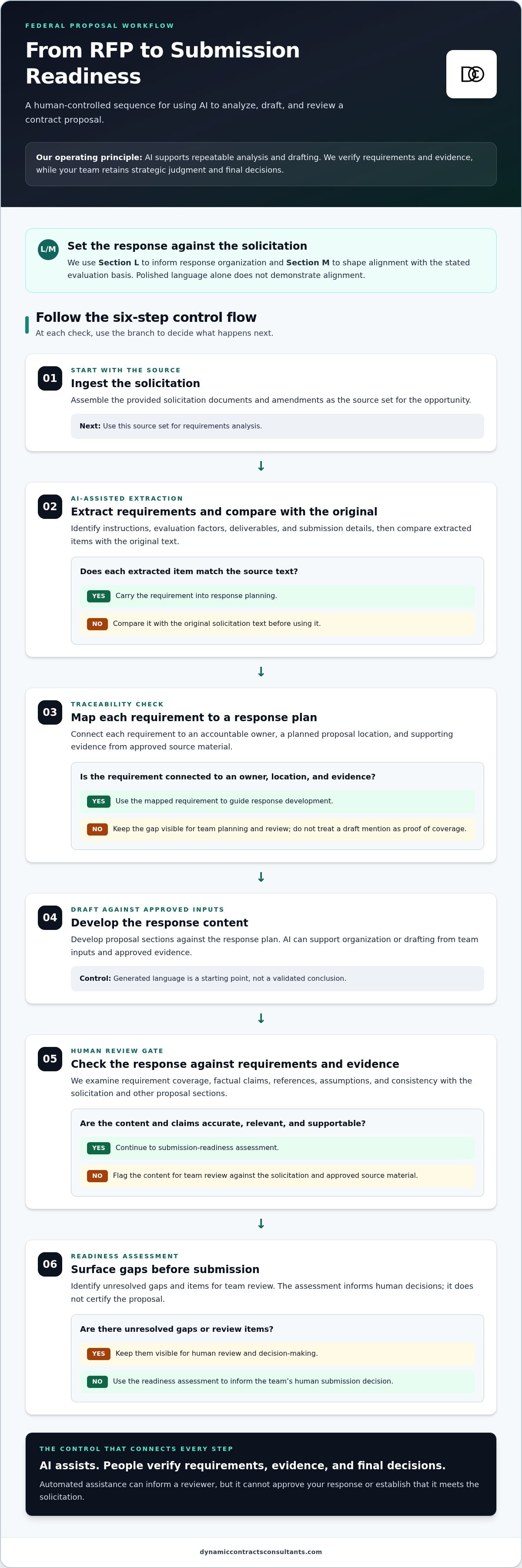
We structure AI support as a sequence that takes the team from solicitation materials to a response that can be traced, verified, and assessed before submission. AI can assist with analysis and drafting, while our workflow connects each output to the requirement and evidence it is meant to address. This gives your team a practical framework for applying AI proposal development for contracts to a specific opportunity.
We use Section L instructions to inform response organization and Section M evaluation factors to shape how the proposal addresses the stated evaluation basis. These sections guide the response plan. Polished language alone does not demonstrate alignment.
- Ingest the solicitation. We assemble the provided solicitation documents and amendments as the source set, so the team analyzes the materials relevant to the opportunity.
- Extract requirements. We use AI assistance to identify instructions, evaluation factors, deliverables, and submission details, then compare extracted items with the original text.
- Map evidence. We connect each requirement to an accountable owner, a planned response location, and supporting evidence from approved source material.
- Draft response content. We develop proposal sections against the response plan, using AI to support organization or drafting from team inputs and approved evidence.
- Review the response. We examine requirement coverage, factual claims, references, assumptions, and consistency with the solicitation and other proposal sections.
- Assess readiness. We identify unresolved gaps and review items before submission. A readiness assessment informs human decisions rather than certifying the proposal.
Turn solicitation requirements into a traceable response plan
We use a compliance matrix to make the response plan visible and reviewable. For each requirement, the matrix can record its source or identifier, assigned owner, planned proposal location, supporting evidence, and validation status. This helps us distinguish a requirement that has been addressed from one that merely appears in a draft. It also gives reviewers a practical way to track progress across the response.
Requirement traceability matters because it lets reviewers connect every response claim to the solicitation that prompted it and the evidence that supports it. We use gap analysis to identify requirements without an assigned response, claims without adequate support, and items that still need validation. Resolving these issues early gives the team time to revise the response plan before final review.
Use AI for drafting support without surrendering content control
We can use AI to help prepare technical-volume language from approved source material, such as capability descriptions and project inputs provided by the team. Our proposal leads direct the drafting against the solicitation’s requirements and the planned response structure. Generated text should not introduce experience, commitments, or performance details that the source material does not support.
Our reviewers verify factual claims and references against their sources, check assumptions with relevant subject-matter experts, and assess consistency across volumes. They also confirm that the response addresses the solicitation’s actual language rather than a generalized interpretation. Human approval remains the decision point for content and submission readiness.
We can help your team formalize this workflow and tailor it to your proposal needs. Discuss your proposal-development requirements with us.
How human review controls accuracy and compliance risk in AI proposals
Human oversight is most effective when it is built into the proposal process rather than left to an informal final read. We recommend assigning review roles, establishing decision points, and defining how unresolved issues move toward resolution. These controls help your team distinguish routine editing from decisions that affect the proposal’s position, commitments, and approval.
Tool-assisted checks can help organize review activity, but proposal leadership must make judgments about response strategy and quality. A reviewer may identify a concern; the designated lead determines whether to revise the approach, consult a subject-matter expert, or escalate the issue. An audit-ready output is a review objective, not an automatic result of using AI.
Review generated content against requirements and evidence
Use a defined review sequence so each contributor understands their responsibilities. For example, a technical reviewer can assess technical meaning, while a proposal lead considers how the material fits the response strategy. The process should also define who resolves disagreements and who has authority to approve final content.
- Assign review ownership: Name the person responsible for each proposal area and the lead accountable for coordinating decisions.
- Route exceptions: Establish how reviewers flag unresolved issues and identify the person responsible for disposition.
- Control revisions: Record material changes and approval status through the team’s established document-control process.
- Separate review from approval: Make clear which contributors provide input and who authorizes the final version.
These practices create a decision record rather than relying on informal comments or assumptions about who approved a change. They also help prevent late-stage edits from bypassing the team’s review sequence. The goal is not to add unnecessary process; it is to make responsibility clear when a proposal changes hands or an issue requires escalation.
Professional judgment remains distinct from mechanical review. A tool may assist with a defined check, but experienced proposal leadership evaluates strategic choices, the strength of the response, and whether the final narrative presents a coherent offer. Assigning that judgment explicitly helps your team use AI without transferring accountability to the tool.
Set governance for sensitive proposal information
Establish data-use rules before proposal contributors begin using AI tools. Your organization should determine which materials are approved for use, who may access them, and which internal owner can resolve questions about sensitive content. Apply the same governance across the proposal team rather than leaving each contributor to make separate assumptions.
- Review current platform documentation for privacy, retention, and model-use terms.
- Limit access and inputs in accordance with established organizational controls.
- Keep final sign-off with the authorized proposal decision-makers.
We treat these governance practices as part of a controlled proposal process. They help your organization define acceptable use, preserve clear accountability, and make informed decisions about where AI assistance fits.
How to evaluate and implement AI proposal development for your contract team
Selecting an AI workflow is not only a technology decision. Your team needs to determine whether its outputs fit the solicitation structure, support traceable review, and reduce friction without displacing proposal leadership. A practical evaluation focuses on the work your team performs and the controls required to use generated content responsibly.
Assess AI workflow fit against proposal-team needs
Use an internally reviewed test with representative solicitation materials and a defined task, such as organizing requirements or supporting a technical-volume draft. Compare the output with your team’s expected response format and review process. Do not treat fluent language as evidence of quality. Determine whether reviewers can trace the content to a requirement and approved evidence.
The following comparison framework can help identify where a tool fits and where human review remains necessary:
| Capability | Evaluation focus | Human control |
|---|---|---|
| Requirement extraction | Does it capture solicitation instructions and evaluation factors in a useful structure? | Compare extracted items with the source documents. |
| Matrix support | Can the team connect requirements to response locations, owners, and evidence? | Validate each mapping and track unresolved entries. |
| Gap analysis | Does it surface requirements without planned responses or supporting material? | Confirm identified gaps and determine how to resolve them. |
| Review controls | Can reviewers record corrections, decisions, and approval status? | Retain final approval with the designated proposal lead. |
| Workflow fit | Does the output support your solicitation format, technical volumes, and existing review sequence? | Assess usability against internal quality and workflow criteria. |
Measure operational usefulness with criteria your organization defines. For example, assess whether reviewers can locate source evidence, identify open issues, and move content through established approvals. Avoid relying on invented industry benchmarks. Repeatable administrative tasks, such as organizing extracted requirements, may suit AI assistance. Capture strategy, solution choices, and decisions about how to position strengths require experienced proposal leadership.
Establish repeatable implementation and review practices
Before expanding use, assign responsibility for source materials, AI-assisted drafting, technical review, and final approval. Document approved prompt patterns, how generated content is revised, and lessons from each test. These records help the team apply a consistent process and improve prompt and review practices as needs become clearer.
Expert proposal writing services can support drafting and alignment with solicitation requirements, while an independent review can offer another perspective on response quality. Keep both roles within a defined workflow, with clear ownership of decisions and sign-off.
We can help you evaluate a controlled approach that aligns AI support with your team’s proposal process. Discuss your AI proposal workflow with us.
Integrating FARIFY and expert proposal development into your contract strategy
AI-supported proposal work is most effective when technology and proposal expertise have distinct, coordinated roles. FARIFY supports solicitation requirement extraction, compliance matrices, technical-volume assistance, gap analysis, and submission-readiness assessment. Dynamic’s proposal professionals can apply that structured information to drafting, align responses with Section L instructions and Section M evaluation factors, and review the proposal in context. Together, these capabilities connect workflow acceleration to disciplined proposal development.
Combine AI-driven automation with proposal expertise
Structured requirements and matrices give proposal leads and reviewers a clearer view of how the response addresses the solicitation. They can help identify which requirements have an assigned response, where supporting material is expected, and what issues need attention. FARIFY can assist with organizing this work; experienced professionals assess whether the response is persuasive, supported, and aligned with the opportunity.
That division of work matters. AI can accelerate defined tasks, but your team retains responsibility for strategic decisions, factual claims, and approval. A human-in-the-loop process treats generated material as work to assess and refine, not as a determination that a proposal is compliant or likely to receive an award. The objective is a carefully reviewed, traceable proposal, with decisions remaining under human control.
Our proposal development and writing services complement AI assistance with tailored technical volumes, gap analysis, Section L and Section M alignment, and submission-readiness review. This integrated approach lets AI-driven automation support administrative tasks while proposal professionals focus on interpretation, solution logic, and response quality.
Move from assessment to a controlled proposal workflow
Start by defining the opportunity and the work your team needs to complete. A discussion of your proposal process can be grounded in practical inputs, including:
- The opportunity’s objectives and the team’s pursuit context.
- The solicitation documents, including instructions, evaluation factors, and requested volumes.
- The proposal timeline, internal review stages, and decision points.
- Existing response materials, approved evidence, and current drafting practices.
These inputs help establish where AI support may fit, what information requires human validation, and how work should move between contributors and reviewers. The resulting workflow can be tailored to the proposal rather than forcing your team into a generic drafting sequence. It should also define who owns source material, who reviews generated content, and who approves the final response.
For teams assessing AI proposal development for contracts, the strategic objective is not automation for its own sake. It is a controlled process that combines scalable intelligence with experienced judgment, while keeping proposal decisions and approval with your organization. Discuss AI-supported contract proposal development with our team.
Build a Repeatable Advantage for Future Pursuits
Treat AI adoption as a capability your team can refine across successive opportunities, not as a one-time technology decision. Begin with the proposal workflow you want to strengthen, then define what useful, reviewable work looks like for your organization. As your team gains experience, document effective practices and incorporate lessons into future pursuit planning. This creates a foundation for more consistent execution while leaving room to adapt to each solicitation’s priorities.
AI proposal development for contracts can support a broader operating model when technology, proposal expertise, and team decision-making align around your objectives. We can help you assess how that collaboration fits your proposal needs and move from an initial use case toward a controlled, scalable approach.
Discuss your AI-supported contract proposal requirements and identify a practical next step for your team. With a clear process and experienced support, you can pursue innovation with greater confidence.
Frequently Asked Questions
Can AI write a federal contract proposal?
AI can assist with drafting proposal content, but it should not be treated as the proposal owner. For example, a team might use it to shape an initial technical-volume draft from approved capability statements and project details. Proposal professionals then determine what belongs in the response, verify the content, and tailor it to the opportunity. AI proposal development for contracts works best when the team controls the source material and approves the final submission.
Can AI guarantee a compliant contract proposal?
No. AI cannot guarantee that a proposal satisfies every solicitation requirement. It may misinterpret an instruction, omit a detail, or produce a statement that does not match the supporting record. Treat its output as material for review, not as a compliance determination. For instance, a reviewer should compare a generated response with the exact requirement and verify that any stated capability is supported by approved company evidence.
How does AI help with an RFP response?
AI can help teams process solicitation information by summarizing sections, organizing requirements, and preparing draft material for review. A proposal lead might use it to group related instructions or turn approved technical notes into a working draft. The team still needs to check the output against the source document, especially where amendments, cross-references, or precise submission instructions may affect how the response should be prepared.
Is AI-generated proposal content allowed in government contracting?
Whether AI use is appropriate depends on the tool, solicitation, and procurement context. Contractors should review the solicitation’s instructions and applicable agency or organizational policies, then assess the AI platform’s terms before using it for proposal work. Keep a human accountable for the final content, and do not assume that AI use is automatically permitted or prohibited without reviewing the requirements that apply to the specific opportunity.
How much time can AI save in proposal development?
The time saved varies with the solicitation, source-material quality, workflow, and amount of review required, so a dependable figure cannot be assumed. Your team can assess the effect by recording time spent on selected tasks before and during a controlled trial, such as requirement organization or first-draft preparation. Include correction and validation time in the comparison. A faster draft is useful only if the reviewed work remains accurate and usable.
Can AI create a compliance matrix from an RFP?
Yes, AI can assist in creating a working matrix by identifying requirements and arranging them into a reviewable structure. The team should confirm each entry against the solicitation, since an omitted subparagraph or misread instruction can affect the response plan. Add fields for the assigned owner, planned response location, evidence reference, and review status so the matrix supports coordination rather than serving as an unchecked list.
How should contractors protect proposal information when using AI?
Start by applying your organization’s data-handling rules before entering proposal material into an AI tool. Review current platform documentation for privacy, retention, and model-use terms, and restrict access and inputs according to established controls. If a team member is unsure whether material is approved for use, pause before entering it until the appropriate internal owner resolves the question. Keep the final proposal and its approval within your organization’s controlled process.


